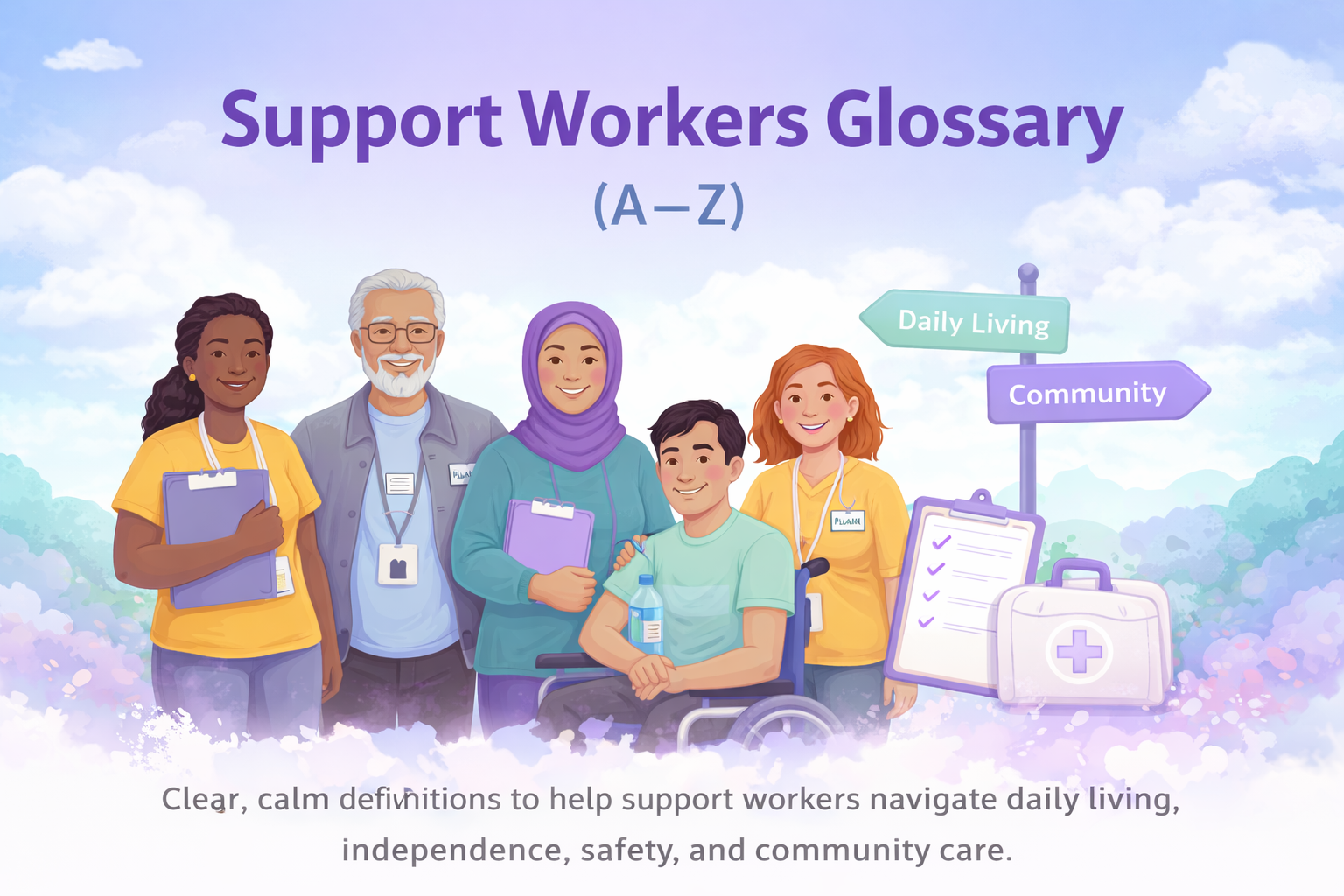
Support Workers Glossary (A–Z)
Plain-language definitions for support work terms — routines, goals, safety, boundaries, independence, community access, and communication — written to be calm and easy to use.
Quick overview
What support workers often help with
| Area | Examples of support |
|---|---|
| Daily living | Routines, meal prep, prompts, hygiene steps, household tasks. |
| Community access | Appointments, shopping, transport, social outings, planning. |
| Independence | Skill-building, confidence, gradual steps, choice-making. |
| Communication | Explaining options, writing notes, advocacy support, visuals. |
| Safety | De-escalation, risk awareness, incident response, boundaries. |
| Goals & planning | Support plans, SMART goals, progress notes, reviews. |
Boundaries & consent
Support should feel safe and respectful
Good support includes consent, choice, privacy, dignity, and clear boundaries. You can say:
- “Please explain that step-by-step.”
- “I need a break / quieter space.”
- “I don’t consent to that.”
- “Can we write a plan so we both understand the goal?”
A Letter A
Advocacy
Support to help someone’s voice be heard, understand options, and access services fairly.
Example: “My support worker helped me write what I wanted to say.”
Accessibility
Removing barriers so a person can participate (communication, sensory, physical, cognitive).
Example: “We planned a low-sensory option for the outing.”
ADLs (Activities of Daily Living)
Everyday tasks like showering, dressing, eating, medication routines, basic mobility.
Example: “We used a checklist for morning ADLs.”
B Letter B
Boundaries
Clear limits that protect safety, privacy, and respectful relationships in support.
Example: “We agreed on boundaries around personal space.”
Breaks / Pacing
Planned pauses to reduce overload, fatigue, or dysregulation.
Example: “We used a timer for short breaks.”
C Letter C
Consent
A clear “yes” to support tasks — with the option to change your mind.
Example: “I consent to help with forms, not phone calls today.”
Community Access
Support to participate outside the home (appointments, groups, errands, activities).
Example: “We planned the route and noise breaks.”
Co-regulation
Calming together using steady tone, predictable steps, and reassurance.
Example: “We slowed down and used breathing prompts.”
D Letter D
Dignity
Being treated with respect, privacy, and choice — even during hard moments.
Example: “We asked permission before entering the room.”
De-escalation
Steps to reduce distress (space, calm voice, fewer demands, safety planning).
Example: “We reduced talking and offered two simple choices.”
E Letter E
Executive Functioning
Brain skills for planning, starting tasks, remembering steps, and managing time.
Example: “We used prompts to start the first step.”
Enablement
Support that builds independence (not doing everything for someone).
Example: “We practised cooking with gradual support.”
F Letter F
Functional Goals
Practical goals that improve everyday life (home skills, routines, access).
Example: “Goal: manage shopping with a list and breaks.”
Fatigue
Body/brain exhaustion (can be sensory, social, mental, or medical).
Example: “We shortened the outing to prevent fatigue.”
G Letter G
Goals (SMART)
Specific, measurable goals with realistic steps and timeframes.
Example: “One appointment per week with recovery time.”
Grounding
Tools that bring attention back to the present (sensory, breath, movement).
Example: “We named 5 things we could see.”
H Letter H
Handover
Sharing important info between workers/shifts to keep support consistent.
Example: “Handover included sensory triggers and calming steps.”
Health & Safety
Steps that reduce harm (risk checks, safe lifting, incident procedures).
Example: “We followed safe lifting guidance.”
I Letter I
Incident Report
A written record when something unsafe or significant happens.
Example: “We documented what happened and what helped.”
Informed Choice
Choosing after you understand options, risks, and supports available.
Example: “We explained two transport options.”
J Letter J
Journaling / Notes
Writing down patterns, needs, wins, and support ideas for planning.
Example: “We noted what times of day felt hardest.”
K Letter K
Key Supports
The main people/services involved in someone’s support network.
Example: “We listed key supports for emergencies.”
L Letter L
Least Restrictive Support
Supporting safety while keeping autonomy and freedom as high as possible.
Example: “We used choices and structure instead of control.”
Life Skills
Practical skills for independent living (cooking, budgeting, planning).
Example: “We practised budgeting with a simple template.”
M Letter M
Manual Handling
Safe ways to assist movement or lifting to prevent injury.
Example: “We followed manual handling training.”
Medication Prompting
Reminding/supporting routines (without giving medical advice).
Example: “We used alarms and a pill organiser.”
N Letter N
Needs Assessment
Looking at what support is needed for daily life, safety, and wellbeing.
Example: “The assessment helped clarify weekly hours.”
O Letter O
Outcomes
What changes you want support to help create (not just tasks).
Example: “Outcome: attend community group with less overwhelm.”
P Letter P
Person-centred Support
Support based on the person’s goals, needs, preferences, and consent.
Example: “We planned the day around my energy levels.”
Positive Behaviour Support (PBS)
Understanding why behaviour happens and changing supports/environment.
Example: “We reduced triggers and increased predictability.”
Q Letter Q
Quality of Life
Overall wellbeing: safety, autonomy, relationships, meaning, comfort.
Example: “Support focused on my goals, not just chores.”
R Letter R
Routine
Predictable steps that reduce stress and support independence.
Example: “We used a visual morning routine.”
Risk Assessment
Identifying risks and planning supports to reduce harm.
Example: “We planned safety steps for community travel.”
S Letter S
Support Plan
A written plan for goals, routines, preferences, risks, and strategies.
Example: “My plan includes sensory supports and breaks.”
Safeguarding
Protecting people from harm, exploitation, and unsafe situations.
Example: “We followed safeguarding steps for a concern.”
Sensory Support
Strategies or tools to reduce overload (headphones, breaks, lighting).
Example: “We chose a quieter supermarket time.”
T Letter T
Trauma-informed Support
Support that prioritises safety, choice, trust, and “what happened” not “what’s wrong.”
Example: “We avoid sudden demands and explain each step.”
Transport Planning
Planning routes, timing, breaks, and backups for travel.
Example: “We planned a quiet route and exit options.”
U Letter U
Upskilling
Building skills over time through practice, not pressure.
Example: “We practised phone calls with scripts.”
V Letter V
Visual Supports
Pictures, schedules, prompts, checklists, or icons that reduce demand.
Example: “We used a visual shopping list.”
W Letter W
Wellbeing Plan
A personal plan for what helps, warning signs, and what to do next.
Example: “My plan lists triggers and calming tools.”
X Letter X
X-factor (Individual Needs)
A reminder that everyone’s needs differ — one size doesn’t fit all.
Example: “My sensory needs are different each day.”
Y Letter Y
Yes-set (Gentle Choices)
Offering choices that are easier to say yes to during overwhelm.
Example: “Do you want water or a quiet break first?”
Z Letter Z
Zones (Regulation Zones)
A framework for recognising energy/emotion states and what helps.
Example: “We used a ‘yellow zone’ plan for early stress.”