
Work & Employment • Workplace Rights & Employment Guidance • Australia
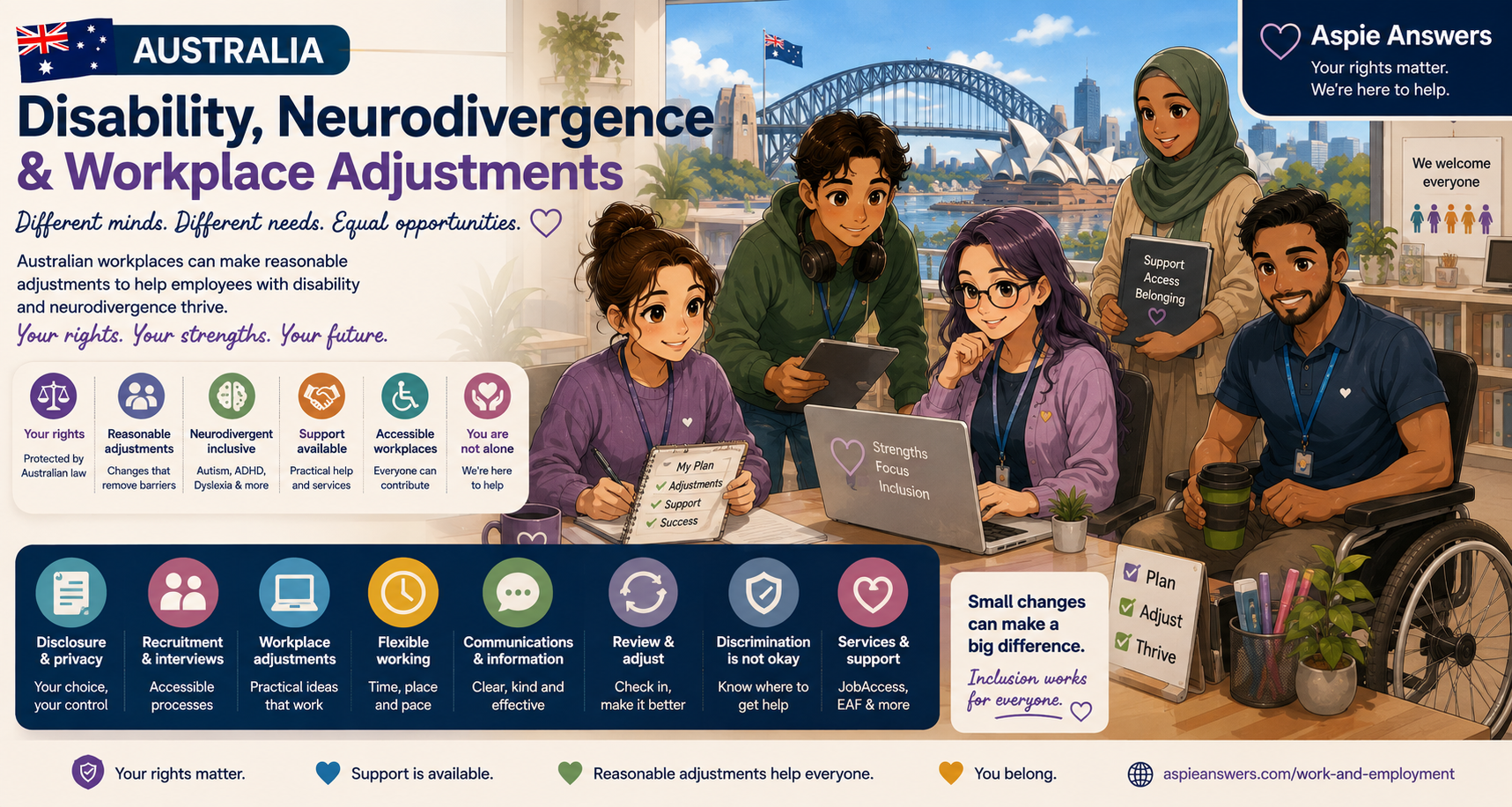
Australia — Disability, Neurodivergence & Workplace Adjustments
Accessible, neurodivergent-informed guidance for understanding workplace barriers, reasonable adjustments, disclosure, recruitment access, flexible ways of working and Australian disability-employment support.
🌱 Gentle Legal, Disability & Wellbeing Guidance
Aspie Answers provides general educational information and practical planning support. It does not replace individual legal, employment, disability, medical, mental-health, occupational-health or other professional advice.
Workplace adjustment needs are individual. A diagnosis or disability label does not tell an employer everything a person needs, and not every disabled or neurodivergent worker needs adjustments.
When exact legal duties, eligibility, funding or complaint processes matter, check current Australian official guidance for your circumstances.
🔎 Search Workplace Accessibility Guidance
Search Aspie Answers for workplace adjustments, disclosure, accessibility, flexible work, disability, neurodivergence and workplace support.
♿ What Is a Workplace Adjustment?
A workplace adjustment is a change that helps a person with disability participate in recruitment or work safely and effectively. In Australian disability law, you may also see the legal term reasonable adjustment.
Environmental
Changes to the physical or sensory environment, equipment, workstation or access.
Administrative
Changes to how information, schedules, instructions or communication are provided.
Procedural
Changes to work methods, recruitment processes, task organisation or other workplace procedures.
🧩 Start With the Workplace Barrier
Communication
Fast verbal instructions, ambiguous expectations, inaccessible meetings or difficulty processing information in real time.
Sensory Environment
Noise, lighting, smells, crowding, interruptions or an unpredictable workspace.
Executive Function
Prioritising, working memory, task switching, planning, time awareness or managing multiple instructions.
Physical Access
Entrances, desks, toilets, parking, equipment, mobility or other environmental barriers.
Energy & Health
Fatigue, pain, fluctuating capacity, appointments, recovery needs or pacing.
Recruitment & Assessment
Application formats, interviews, tests, group activities or inaccessible assessment methods.
🛠️ Examples of Workplace Adjustments
Information & Communication
- Written instructions
- Task lists, labels or reminders
- Clearer priorities and deadlines
- Written follow-up after meetings
- Alternative communication methods
Environment & Equipment
- Reduced noise or distraction
- Lighting changes
- Assistive technology
- Accessible workstation or equipment
- Physical access changes
Work Pattern & Tasks
- Adjusted start or finish times
- Flexible work where appropriate
- Rest breaks or pacing changes
- Changes to work methods
- Task modification or redistribution where reasonable
Small changes can matter.
An effective adjustment does not have to be complicated or expensive. The best option depends on the worker, the barrier, the role and the workplace.
🧠 Neurodivergence at Work
Autistic, ADHD, dyslexic and otherwise neurodivergent people are not one group with one set of needs. Support should be based on the individual rather than assumptions about a diagnosis.
Predictability & Clarity
Clear expectations, advance notice of changes, structured instructions, priorities and predictable routines may help some workers.
Sensory Access
Some workers may benefit from quieter locations, reduced interruptions, lighting changes, headphones where safe and appropriate, or alternative workspaces.
Executive-Function Support
Checklists, written steps, calendars, reminders, task-management tools, clearer deadlines or regular check-ins may reduce unnecessary cognitive load.
Communication
Direct language, written follow-up, processing time, agendas or alternatives to speaking spontaneously in large meetings may help.
Strengths-Based Work
Good adjustment planning can consider strengths and effective ways of working as well as barriers.
Individual Choice
Do not assume a worker wants the same adjustment as another person with the same diagnosis.
📝 Recruitment, Interviews & Starting Work
Adjustments can be relevant before someone becomes an employee. Accessible recruitment can include alternative formats, accessible venues, communication support, adjustments to interview or assessment processes, and other changes related to disability access.
Before an Interview
- Identify the barrier
- Ask what adjustment may help
- Clarify accessible format or venue needs
- Prepare how you want to communicate the request
Starting the Job
- Confirm agreed adjustments
- Clarify communication and supervision
- Check equipment or access
- Agree when to review what is working
🔐 Disclosure, Privacy & Personal Information
Disclosure and adjustment requests overlap, but they are not exactly the same question. Think about what workplace barrier you are trying to address, what information is relevant to that conversation and what you are comfortable sharing.
Questions to Consider
- What do I need the employer to understand?
- What adjustment am I asking for?
- What information is relevant?
- Who needs to know?
- How would I prefer this information to be handled?
Aspie Answers Disclosure Guide
Use our broader guide to think through disclosure, communication, privacy and workplace support.
Disclosure at Work💬 Preparing to Request an Adjustment
A Simple Structure
- Describe the workplace barrier
- Explain how it affects participation or work
- Suggest one or more possible changes
- Discuss practical implementation
- Agree on follow-up or review
You Can Prepare in Writing
If speaking spontaneously is difficult, prepare notes or a written request. Depending on the workplace process, you may also ask whether a support person can assist.
International Workplace Adjustments Guide🔄 Review & Adjust
Workplace adjustments are not necessarily a one-time decision. A worker's role, workplace, health, technology or support needs can change.
Is It Helping?
Check whether the adjustment is actually reducing the identified barrier.
Has Something Changed?
A new manager, role, location, schedule or health change may mean an adjustment needs updating.
Keep Useful Notes
Record what was agreed, when it began, what is working and what may need to change.
🇦🇺 JobAccess & the Employment Assistance Fund
JobAccess
JobAccess is an Australian Government service providing disability-employment information and advice for people with disability, employers and service providers, including workplace-adjustment guidance.
Visit JobAccess ↗Employment Assistance Fund (EAF)
For eligible people and workplaces, the EAF can help cover approved workplace modifications, equipment, assistive technology and some services. Check current eligibility and approval requirements before purchasing or relying on funding.
Explore EAF ↗🛡️ If an Adjustment Is Refused or There Is a Workplace Problem
First clarify what was requested, the response given and whether alternatives were discussed. Depending on the circumstances, support may involve the employer, HR, a union or representative, JobAccess, Fair Work, the Australian Human Rights Commission, a state/territory equality body or legal advice.
Workplace Issues & Problems
Start by organising what happened, what concerns you and what support or next step you may need.
Start HereBullying, Harassment & Discrimination
Use focused guidance if the concern involves bullying, harassment, discrimination or harmful workplace behaviour.
Focused GuidanceAustralia Support Directory
Use the Australian services page to identify the appropriate official or community pathway.
Directory availableFind Workplace Rights & Support →
📥 Resources & Downloads
Workplace Adjustment Planner
Barrier → impact → possible adjustment → conversation → review.
More resources are coming soon.Neurodivergent Workplace Needs Profile
Organise communication, sensory, executive-function, scheduling and environmental preferences.
More resources are coming soon.Adjustment Conversation Planner
Prepare key points and possible solutions before talking with an employer.
More resources are coming soon.Workplace Adjustment Review
Check what is working, what has changed and what may need updating.
More resources are coming soon.Recruitment Adjustment Checklist
Plan access needs for applications, interviews and assessments.
More resources are coming soon.Disclosure & Privacy Reflection
Think through goals, relevant information, boundaries and preferred communication.
More resources are coming soon.📚 Related Collections
♿ Accessibility & Workplace Adjustments
Adjustment planners, access profiles, review tools and workplace conversation supports.
More resources are coming soon.🧠 Neurodivergent Workplaces
Sensory, communication, executive-function, routine and sustainable-work resources.
More resources are coming soon.💬 Disclosure & Self-Advocacy
Disclosure reflection, meeting preparation, communication and self-advocacy tools.
More resources are coming soon.Different Minds • Different Needs • Accessible Workplaces
Good workplace adjustment planning starts with the individual, the barrier and the work. Clear communication, practical changes and regular review can help create more equitable and sustainable participation.
Aspie Answers gentle guidance: General educational and planning information only. Check current Australian official guidance whenever exact legal duties, funding, eligibility or formal processes matter.
↑ Return to the Beginning