
What is Autism?
Autism is a lifelong neurodevelopmental difference that can shape how someone processes information, communicates, experiences sensory input, responds to change, regulates energy and emotions, learns and interacts with the world around them.
Autism is not something that needs to be “fixed.” Understanding autism means recognising that different ways of communicating, thinking, processing and responding can be valid, while also recognising that autistic people may need meaningful support or adjustments in some areas of life.
No two autistic people are exactly alike. A person may experience strong differences in one area and fewer differences in another, and their support needs may change across environments, life stages, stress levels and circumstances.
Autism looks different for everyone
This page gives a broad, supportive introduction to autism. It cannot represent every autistic person's experience and should not be used as a diagnostic checklist.
Some people may relate strongly to particular examples while others may not. Individual experience, communication, identity and support needs should always be respected.
Autism can influence different parts of everyday experience
These areas are broad examples rather than a checklist. Autistic people may experience them in very different combinations and to different degrees.
Communication Differences
Autistic communication can include direct language, different use of tone or facial expression, a need for extra processing time, non-speaking communication, AAC, scripting or other individual communication styles.
Sensory Experiences
Sound, light, touch, smell, taste, movement, temperature and body signals may feel stronger, weaker or more difficult to filter than they do for other people.
Routines & Change
Predictability can reduce uncertainty. Sudden changes, unclear expectations or transitions may take additional processing, preparation or recovery time.
Focused Interests
Deep interests can provide enjoyment, knowledge, creativity, comfort, expertise and meaningful ways of connecting with others.
Energy & Regulation
Sensory load, communication demands, executive-function demands, masking and uncertainty can all affect energy, emotional regulation and recovery needs.
Connection & Interaction
Social connection can look different. Some autistic people enjoy significant social contact while others prefer smaller groups, direct communication, shared interests or more time alone.

There is no single way to be autistic
Two autistic people may have very different communication styles, sensory needs, interests, abilities, support needs and ways of navigating everyday life.
Even the same person may have different capacity from one day or environment to another.
- A noisy environment may be manageable one day and overwhelming another.
- Spoken communication may be easier in familiar situations than during stress or overload.
- Executive-function demands can change with fatigue, health, sensory load and pressure.
- Support needs do not determine a person's worth, intelligence or potential.
Strengths and challenges can exist together
Autism should not be described only through difficulties, but it is equally important not to romanticise autism or assume every autistic person shares the same strengths.
Possible strengths
Some autistic people may experience strengths such as:
- Deep knowledge or focused interests
- Attention to detail
- Pattern recognition
- Creative or unconventional thinking
- Persistence and dedication
- Strong values or sense of fairness
Possible support needs
Some autistic people may need support with areas such as:
- Sensory environments
- Communication access
- Transitions and uncertainty
- Executive-function demands
- Daily living tasks
- Managing overload and recovery
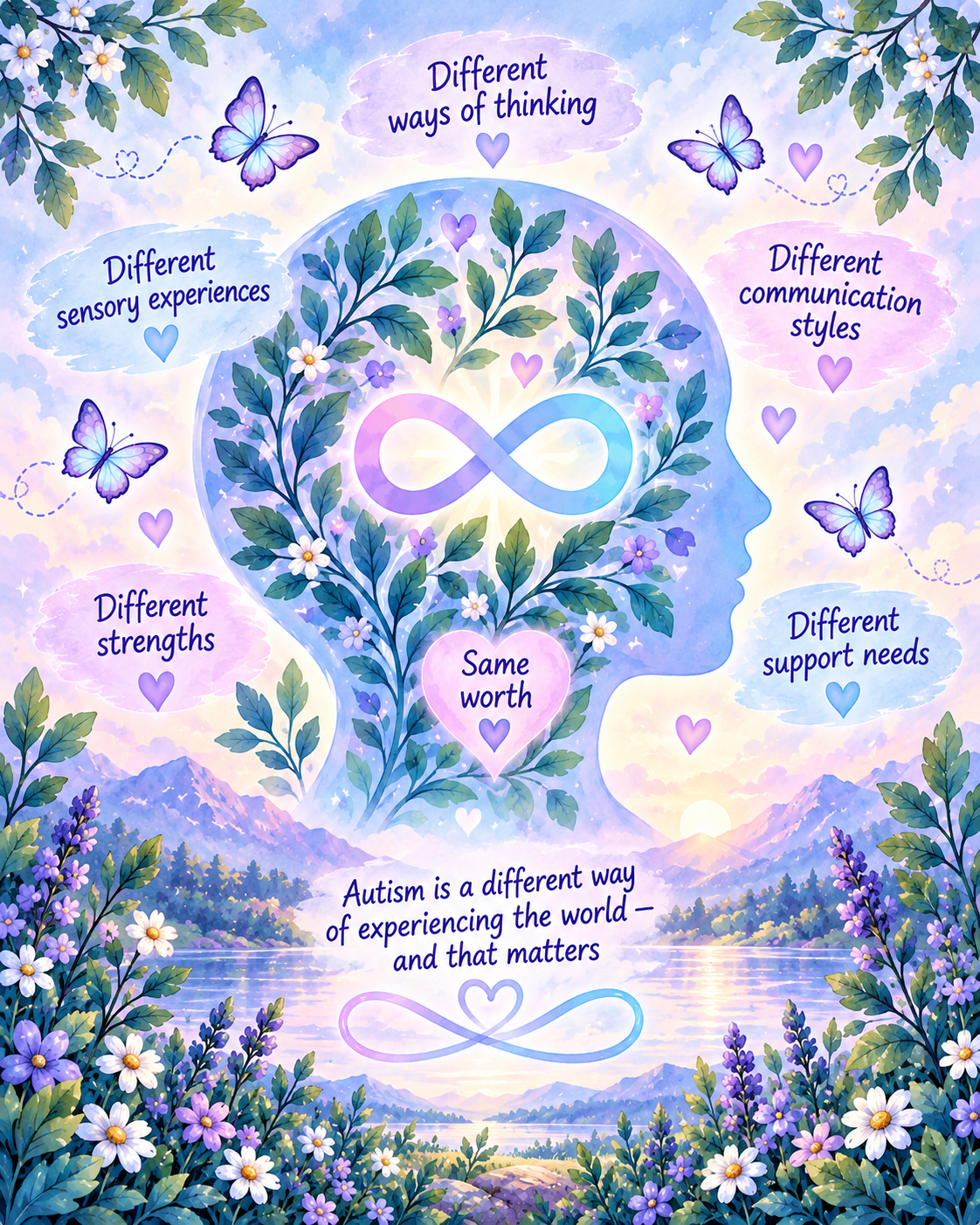
Difference does not reduce value
Different communication, sensory processing, routines, interests or support needs do not make someone less capable of belonging, contributing or being respected.
Understanding autism is not about expecting autistic people to hide differences so they appear more typical. It is about creating environments where differences can be understood and where useful accommodations are available.

Better understanding can create better environments
When people understand autism more accurately, there is greater opportunity to reduce unnecessary barriers, communicate more clearly and provide support that fits the individual rather than forcing the person to fit the environment.
Behaviour often communicates something
What looks like refusal, withdrawal, unusual behaviour or a strong reaction may sometimes be connected to sensory overload, communication difficulty, uncertainty, fatigue, anxiety, pain, executive-function demands or unmet support needs.
Understanding the reason behind an experience is often more useful than focusing only on how the behaviour appears from the outside.
Understanding is a starting point
Learning what autism is can make it easier to understand why different environments, communication styles and kinds of support may work better for different people.
From here, you can explore autism support, sensory experiences, communication, routines, masking, burnout, education, employment, relationships and other parts of autistic life throughout Aspie Answers.
You do not need to learn everything at once. One useful idea, one adjustment or one better conversation can still make a meaningful difference.
Keep exploring at your own pace
Understanding Autism is the foundational explainer within the wider Aspie Answers Autism family. Return to the Autism doorway when you want to move into practical support, everyday experiences and connected pathways.
Different minds. Better connection.