
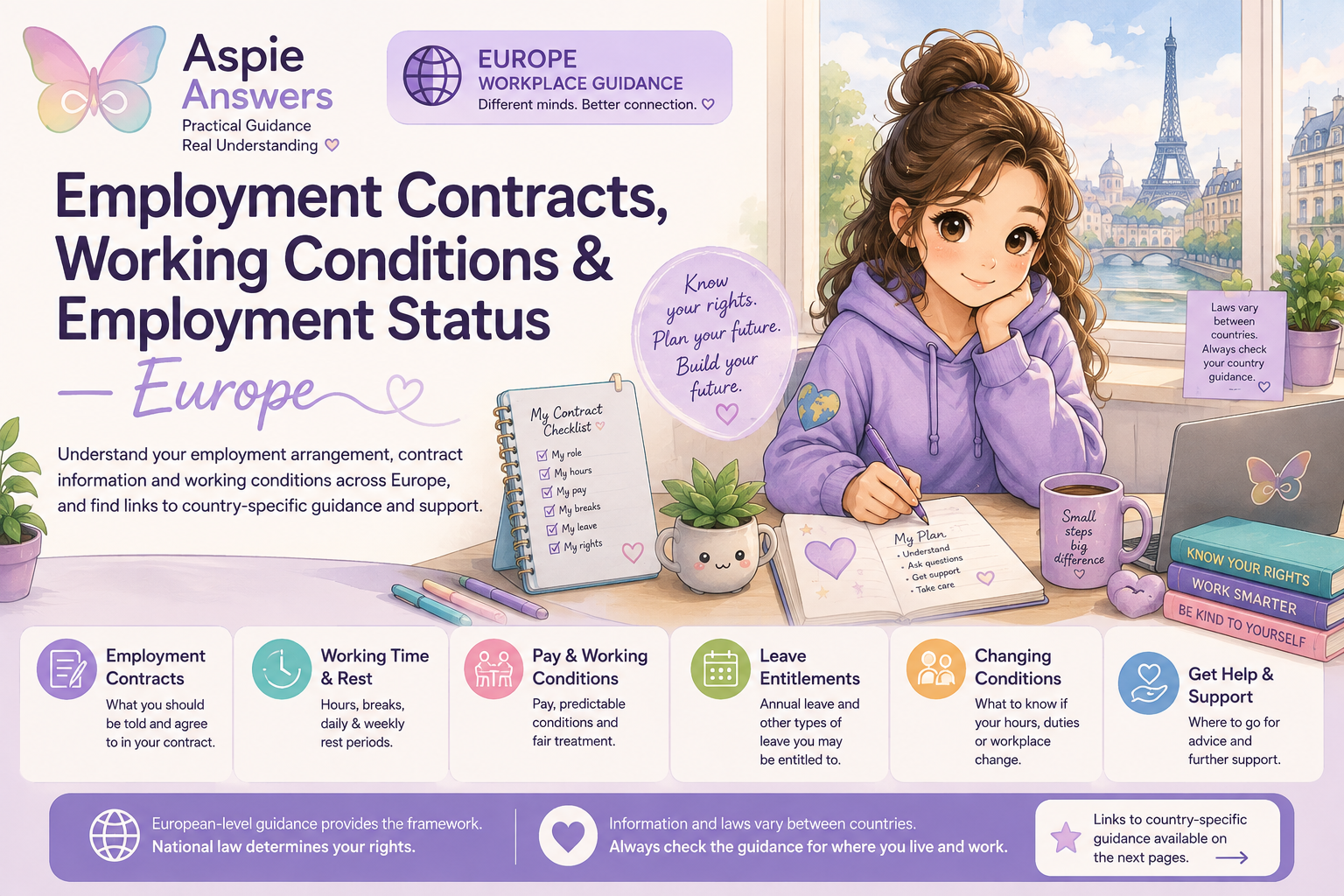
Employment contracts, working conditions & employment status
Employment information can sometimes feel like a wall of unfamiliar words, rules and expectations. This page breaks the basics into smaller sections so you can find the information most relevant to you.
Use it as a starting point when reviewing a job offer, starting a new role, checking your working conditions, or preparing questions for an employer, support person or employment adviser.
Try words such as contract, hours, pay, leave, part-time, fixed-term, self-employed or support.
Try another word or use the quick-navigation links below.
📄 Understanding your employment contract
Your contract or written employment information helps explain the relationship between you and your employer and the conditions attached to your role.
Your role
Look for your job title, duties or job description and information about where your work will normally take place.
Your start date
Check when the employment relationship begins and, for temporary or fixed-term work, whether an expected end date or duration is given.
Your pay
Understand your basic pay, how often payment is made and whether additional payments, allowances or other remuneration may apply.
Your normal working pattern
Check your normal working hours or schedule and how shifts or working-time arrangements will be communicated.
📝 Information you may receive in writing
Written information can make employment expectations easier to understand and gives you something to refer back to later.
- Who the employer and worker are
- Where the work will normally take place
- Your role or description of the work
- Your employment start date
- Duration where an arrangement is fixed-term
- Basic pay and relevant remuneration information
- Your normal working pattern or scheduling arrangements
- Relevant information about paid leave
- Information about ending the employment relationship
🪪 Different employment arrangements
Different types of work may come with different rights, responsibilities and procedures. Exact definitions vary by country.
Permanent / open-ended employment
Employment without a predetermined end date, subject to the rules applying in the relevant country.
Fixed-term work
Employment that ends on an agreed date, after a defined period, or after a particular event or project.
Part-time work
Part-time workers generally work fewer hours than comparable full-time workers.
Temporary or agency work
Some people work through temporary employment agencies or other short-term arrangements. Different rules may apply.
Self-employment
Self-employed people work under a different legal relationship from employees and may have different tax, social-protection and legal responsibilities.
Variable or unpredictable work
If your hours or schedules vary, ask how work will be offered, when schedules are provided and how changes are communicated.
🕒 Working time, breaks & rest
Working-time rules can cover hours, breaks and rest periods. The exact arrangements and any exceptions depend on applicable law.
- Your normal weekly working hours
- When your working day normally starts and finishes
- Break arrangements during the working day
- Daily and weekly rest
- Night-work or shift-work requirements
- Overtime arrangements
- How working time is recorded
💶 Pay & working conditions
Basic pay
Check your agreed rate or salary and how frequently you will be paid.
Additional payments
Ask about overtime, shift premiums, allowances, bonuses or other payments where relevant.
Deductions
Understand which deductions may appear and where you can ask for an explanation if something is unclear.
Collective agreements
In some workplaces or countries, collective agreements can affect pay, working time, leave and other employment conditions.
🌿 Leave & time away from work
Leave arrangements vary between countries and workplaces. Areas to check can include:
- Paid annual leave
- Sick leave
- Public-holiday arrangements
- Maternity, paternity or parental leave
- Carer or family-related leave
- Other statutory or contractual leave
🔄 When your working conditions change
Changes to duties
Ask for clarification if your responsibilities become significantly different from what you understood when accepting the role.
Changes to hours
Keep useful records if shifts, schedules or agreed hours change.
Changes to work location
Changes can include relocation, hybrid arrangements, remote work or another regular work location.
Ask for written clarification
Having important changes written down can make them easier to process, remember and refer back to.
🧠 Neurodivergent-friendly contract & workplace tips
Employment information is often formal, dense or unfamiliar. You do not need to process everything at once.
Ask for information in writing
Written instructions, schedules and changes can reduce reliance on memory and verbal processing.
Highlight unclear wording
Mark words or clauses you do not understand and ask what they mean before agreeing to something important.
Break documents into sections
Review duties, hours, pay, leave and workplace rules separately rather than trying to process everything at once.
Bring support if useful
A trusted person, advocate, union representative or employment adviser may help you prepare questions or understand information.
✅ My contract & working-conditions checklist
- I know what my job is and what my main duties are.
- I know where I will normally work.
- I understand my normal hours or scheduling arrangements.
- I understand my basic pay and payment frequency.
- I know whether the job is permanent, fixed-term or another arrangement.
- I know what breaks and rest arrangements normally apply.
- I know where to find information about leave.
- I know who to ask if my contract or working conditions are unclear.
- I have kept copies of important employment documents.
- I know where to find country-specific official employment guidance.
🌍 European-level guidance vs country-specific law
This distinction is important throughout the Aspie Answers Europe workplace collection.
🇪🇺 European-level guidance
European frameworks can establish common standards or broad protections in certain areas of employment.
🗺️ Country-specific guidance
National law determines how many rights operate in practice and can provide additional rules, entitlements and procedures.
Helpful rule: Use this page to understand the broad concepts, then check the official employment guidance for the country where you actually work.
🤝 Getting help if something is unclear
Depending on your country and circumstances, useful support may include national labour or employment authorities, trade unions, employee representatives, legal advice services, disability organisations, advocacy services or neurodivergent employment support.
If you are unsure whether an employment arrangement is lawful or how a rule applies to your individual circumstances, seek appropriate country-specific advice rather than relying only on general information.
🌍 Continue through Europe Workplace Guidance
This is a supporting topic page within the wider Europe Workplace Guidance collection and the Aspie Answers Work & Employment Hub.