

Worldwide community • peer connection • practical pathways
Neurodivergent Community Support (Worldwide)
Find ways to connect with neurodivergent communities, peer support, advocacy, family support, learning and work communities, and inclusive organisations — locally, online or across regions. Use the finder below to narrow the page to the kinds of support that fit you.
Start broad, choose only the filters that matter to you, or use .
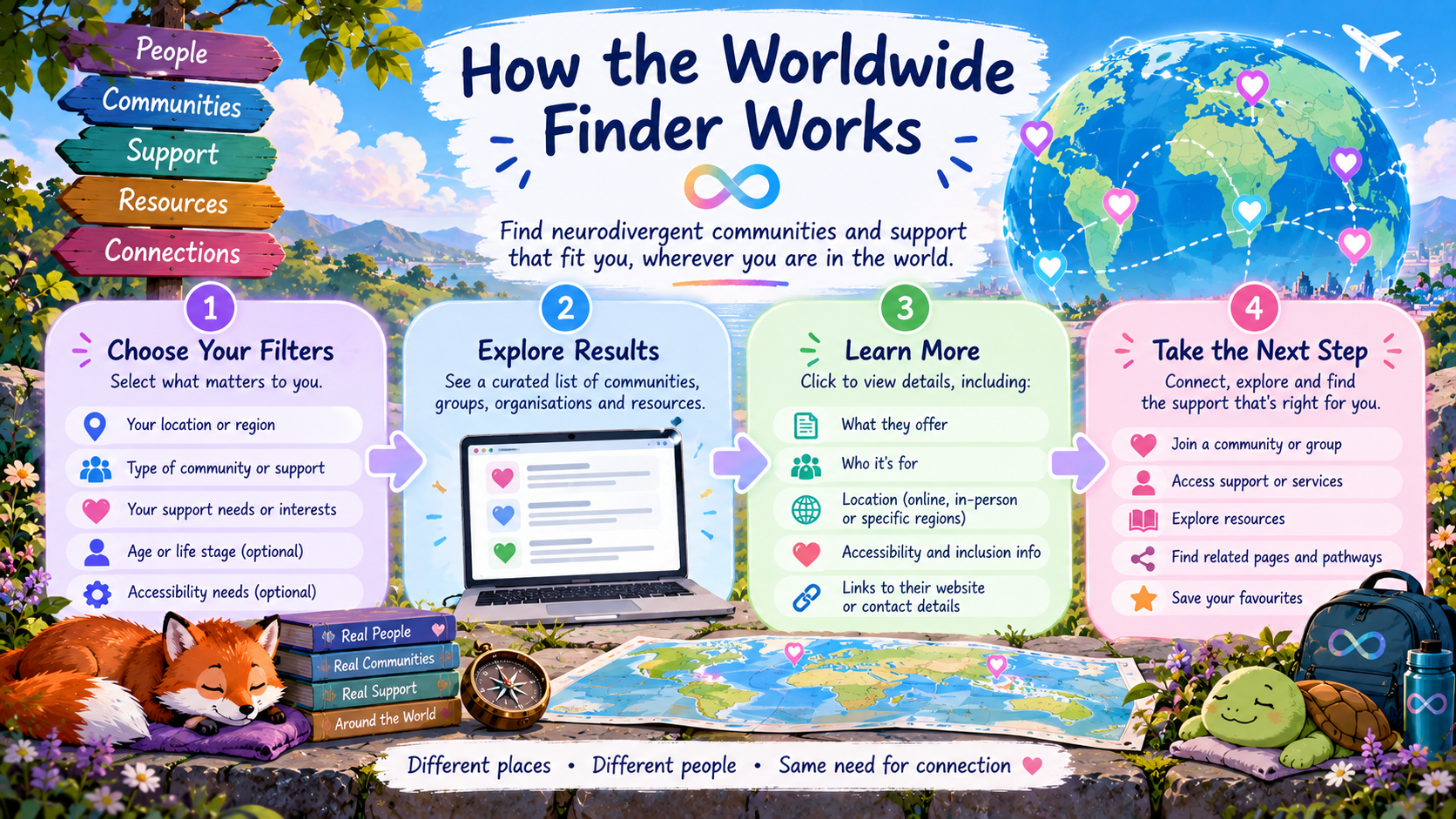
Interactive finder
What kind of community or support are you looking for?
Choose as much or as little as you like. The support pathways below update automatically.
Your support pathways
Explore matching community and support options
Showing all pathways
Peer connection
Neurodivergent peer communities
Spaces where neurodivergent people can share lived experience, practical ideas, interests, identity and everyday life with people who understand.
- Useful for belonging and shared experience
- Can be online, local, interest-based or identity-based
- Look for clear community rules and respectful moderation
Autistic community
Autistic-led and autism community spaces
Community, peer-led, advocacy and organisation pathways centred on autistic people and autistic lived experience.
- May include social groups, advocacy, information and mentoring
- Check whether a space is autistic-led, family-led, professional-led or mixed
- Choose the approach that best fits your needs and values
ADHD community
ADHD peer, community and practical support
Support pathways for attention, executive function, daily life, work, study, relationships, identity and shared ADHD experience.
- Peer groups can reduce isolation and provide practical ideas
- Mentoring-style community support may suit some people
- Look for realistic, non-shaming approaches
Overlapping neurodivergence
AuDHD and multi-neurotype communities
Spaces for people whose experiences cross more than one neurodivergent area, including autism and ADHD together.
- Useful when one label does not describe the whole experience
- Can support discussion of conflicting needs and strategies
- Identity-inclusive and low-demand formats can be especially helpful
Learning & executive function
Learning-difference and executive-function support
Community and support pathways for planning, memory, processing, learning differences, study skills and practical daily functioning.
- May include study groups, mentoring, learning support and community organisations
- Useful across school, tertiary study, training and adult life
- Ask about accessible formats and communication preferences
Family & whānau
Family, parent and whānau support
Communities where parents, carers, siblings, partners and whānau can learn, connect and support a neurodivergent person without losing sight of the person’s own voice.
- Can include parent groups, family education and practical support
- Look for respectful, neurodiversity-aware approaches
- Useful for navigating school, services and everyday life
Children & young people
Youth-friendly neurodivergent community
Age-appropriate communities, groups, mentoring and support designed for children, teens and young adults.
- Check safeguarding, moderation and privacy arrangements
- Look for age-appropriate communication and sensory options
- Family involvement needs can differ by age and person
Work & study
Work, study and transition communities
Support for education, employment, transitions, self-advocacy, routines, executive function and finding environments that fit.
- May include mentoring, peer groups and practical organisations
- Useful for transitions into study, training or employment
- Can complement formal workplace or education supports
Advocacy & rights
Advocacy, rights and self-advocacy communities
Groups and organisations that help people understand rights, communicate needs, build self-advocacy skills and connect with wider disability or neurodivergent communities.
- Useful around education, work, healthcare and public services
- May include peer advocacy or formal advocacy organisations
- Check the organisation’s remit and geographic coverage
Organisations & services
Neurodivergent organisations and community services
Structured organisations that may provide information, referrals, groups, advocacy, education, programmes or local community connections.
- Check eligibility, location, cost and referral requirements
- Look for clear descriptions of who the service is for
- Use the worldwide region section to narrow your search
Lower-pressure connection
Text-first and low-demand online spaces
Online communities where participation can be slower, quieter or mostly text-based, which may suit people who find live conversation, travel or large groups tiring.
- Look for clear moderation and privacy guidance
- Participation should not require constant availability
- Mute, pause and leave options can help protect energy
Worldwide & online
Global communities when local options are limited
Worldwide and online support can help when local services are unavailable, inaccessible, too narrow or simply not the right fit.
- Time zones and language may affect access
- Online groups can widen identity and interest-based choices
- Check whether advice is relevant to your country or legal system
No exact combination matched
That does not mean there are no options. Try removing one filter, choose “Any” for one category, or start broad and explore by region.
Specialist worldwide pathways
Move into a dedicated directory when you know the area you need
This worldwide community finder stays broad on purpose. Autism and ADHD now have their own dedicated worldwide directories, while the wider neurodivergent support hub brings together additional support and resource pathways.

Worldwide finder
Explore support by region
Start with Worldwide if you are open to global or online options, or choose a region to focus your search. Regional availability, terminology, eligibility and service models vary.
Worldwide & Online
Useful when you want broad neurodivergent community, specialist identity-based groups, peer connection, international organisations or online options that are not limited to one country.
North America
Search country, state/province and city-level organisations as well as national neurodivergent, autism, ADHD, disability, family and peer networks. Eligibility and service systems can vary considerably.
Latin America & Caribbean
Look for national disability and neurodivergent organisations, community groups, family networks, Spanish-, Portuguese- and locally relevant language resources, plus global online options where local coverage is limited.
UK & Europe
Explore national charities and organisations, peer-led communities, disability-rights networks, local support groups and region-specific services. Access and referral pathways differ between countries.
Africa
Availability can vary greatly by country and city. Search national disability organisations, local advocacy, family networks, community groups and international or online neurodivergent spaces when local options are limited.
Middle East
Search country-specific organisations, disability and family networks, community groups, culturally relevant services and online peer spaces. Language, availability and service models vary by country.
Asia
Explore national and city-level organisations, disability and neurodivergent groups, family networks, peer communities and online options. Consider language, cultural fit and whether a group is local, regional or international.
Australia, New Zealand & Pacific
Search national and regional neurodivergent, autism, ADHD and disability organisations, peer-led groups, whānau/family support, local community services and online options across Australia, Aotearoa New Zealand and Pacific communities.
Before you join
Check whether the space actually works for you
A community can look welcoming and still be the wrong fit. These checks can help you compare options without assuming every group or service will meet the same standard.
Communication choice
Can you communicate by text, speech, AAC or another method that works for you? Is camera use optional online?
Sensory environment
For in-person spaces, ask about noise, lighting, crowds, breaks and quiet areas. Online spaces should allow pauses and lower-pressure participation.
Physical & digital access
Check venue access, captions, readable formats, screen-reader compatibility, transport and any other access needs that matter to you.
Identity & cultural safety
Look for respect for gender, sexuality, culture, race, disability, language, faith and other parts of identity that shape your experience.
Moderation & boundaries
Online communities should explain rules, moderation, privacy and reporting. Peer support should not pressure people to disclose more than they want.
Scope & expectations
Know whether you are joining a peer community, advocacy group, information service or professional service. Each has a different role.
Keep exploring
Resources, related pathways & next steps
Community is only one part of support. These Aspie Answers pathways can help you continue with practical support, learning, mental health, family guidance, education or professional information.
There is no single “right” community
The best fit can depend on your energy, communication style, identity, age, location, interests, access needs and what you want from connection right now. It is okay to try a space, step away, choose something quieter or use more than one kind of support.