Dog Island Lighthouse New Zealand
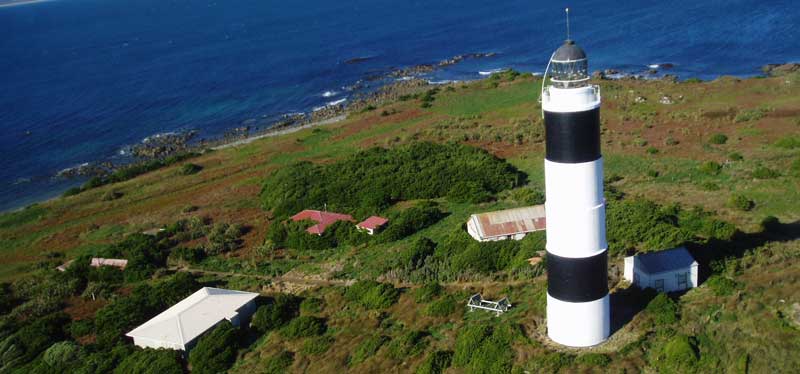
The Dog Island Lighthouse on Dog Island in Foveaux Strait is New Zealand’s tallest lighthouse and one of its oldest. It is notable for its masonry construction and is a work example by an engineer who was prominent at the time. The lighthouse employed the first revolving beam in New Zealand, and the unique original light apparatus was in use for 60 years. Dog Island Lighthouse is one of the most distinct lighthouses in New Zealand, with only two others having stripes painted on them for better visibility at the daytime. The lighthouse is registered by Heritage New Zealand as a Category I structure, and the adjacent lighthouse keepers cottage has a Category II registration. Originally operated by three lighthouse keepers, the structure has since 1989 been remote-controlled from Maritime New Zealand’s Wellington office, with Dog Island since having been uninhabited. Dog Island Lighthouse has twice featured on New Zealand stamps. Lighthouse overview Dog Island Lighthouse lights the eastern approaches of Foveaux Strait about 5 kilometres from the entrance to Bluff Harbour. Lighthouse feature: Details Location: latitude 46°39’ south, longitude 168°25’ east Elevation: 46 metres above sea level Construction: white stone tower Tower height: 36 metres Light configuration: 35 watt rotating beacon Light flash character: white light flashing once every 10 seconds Power source: batteries charged by solar panels Range: 19 nautical miles (35 kilometres) Date light first lit: 1865 Automated: 1989 Demanned: 1989 Getting to Dog Island Lighthouse Dog Island Lighthouse is not accessible to the public. There is no public access to enter the lighthouse. It can be clearly seen from Bluff on a fine day, with its distinctive black and white striped paintwork. Background It was clear that a lighthouse was needed in Foveaux Strait, but there were long discussions in the 1860s about where to place it. Captains with local experience were asked for their opinion, and they suggested possible sites on Centre Island, Ruapuke Island, Stewart Island, Solander Islands, and Dog Island The latter was chosen as Southland’s first site for a lighthouse; the recommendation was made by the Invercargill Harbour Master to James Alexander Robertson Menzies, the first Superintendent of the Southland Province. The Harbour Master’s rationale was that the island was dangerous, as “it is very low and not seen till close upon it”. At the time, the Southland Province had just split from Otago Province, and both provincial governments were involved. There was confusion over who would take ownership of the situation, and in the end, the central government assumed responsibility for the construction of all lighthouses throughout the colony. Construction James Balfour, at the time marine engineer to the Otago Provincial Council and later to the Colonial Government of New Zealand, was commissioned in 1863 to design the lighthouse. Balfour ordered the lighthouse equipment and the light apparatus from the renowned Edinburgh lighthouse designer Alan Stevenson. Balfour had trained under Stevenson’s brothers David and Thomas Stevenson. David Stevenson (11 January 1815 – 17 July 1886) was a Scottish lighthouse designer, who designed over 30 lighthouses in and around Scotland and helped continue the dynasty of lighthouse engineering founded by his father. Life He was born on 11 January 1815 at 2 Baxters Place at the top of Leith Walk in Edinburgh, the son of Jean Smith and engineer Robert Stevenson. He was the brother of the lighthouse engineers, Alan and Thomas Stevenson. He was educated at the High School in Edinburgh and then studied at the University of Edinburgh. In 1838 he became a partner in his father’s (and uncle’s) firm of R & A Stevenson. In 1844 he was elected a Fellow of the Royal Society of Edinburgh his proposer being David Milne-Home. In 1853 he moved to the Northern Lighthouse Board. Between 1854 and 1880 he designed many lighthouses, all with his brother Thomas. In addition, he helped Richard Henry Brunton design lighthouses for Japan, inventing a novel method for allowing them to withstand earthquakes. His sons David Alan Stevenson and Charles Alexander Stevenson continued his work after his death, building nearly thirty further lighthouses. In the 1860s he lived at 25 Royal Terrace, Edinburgh. Non-lighthouse engineering included the Edinburgh and Leith Sewerage Scheme and the widening of the North Bridge in Edinburgh. In 1868 and 1869 he served as president of the Royal Scottish Society of the Arts. He died in North Berwick on 17 July 1886. He is buried in Dean Cemetery in west Edinburgh. The grave lies on the north wall of the original cemetery backing onto the first northern extension. Publications Thomas Stevenson PRSE MInstCE FRSSA FSAScot (22 July 1818 – 8 May 1887) was a pioneering Scottish civil engineer, lighthouse designer and meteorologist, who designed over thirty lighthouses in and around Scotland, as well as the Stevenson screen used in meteorology. His designs, celebrated as groundbreaking, ushered in a new era of lighthouse creation. He served as president of the Royal Scottish Society of Arts (1859–60), as president of the Royal Society of Edinburgh (1884–86), and was a co-founder of the Scottish Meteorological Society In 1848, Balfour’s older sister Maggie had married Thomas Stevenson, hence the Stevensons were his brothers-in-law. The equipment arrived on the ship City Of Dunedin from Glasgow in Port Chalmers on 3 September 1863, and the light apparatus arrived via the ship Resolute on 17 March 1864. The light apparatus for the Taiaroa Head lighthouse also arrived on the Resolute. Dog Island is low-lying and rocky, and its highest (natural) point is about 15 metres (49 ft) above sea level. Calculations showed that the lighthouse would have to be some 110 feet (34 m) tall if built on the highest point to be effective. An investigation showed that there was enough rock that could be quarried on the island for the structure and that it would be too expensive to build such a tall tower from steel. The tower designed by Balfour was 36 metres (118 ft) tall. It had a diameter of 6.6 metres (22 ft) at its base, and 5.0 metres (16.4 ft) below the balcony. The lantern was placed at a height of 30.5 metres (100 ft). Two dwellings, also designed by Balfour, were constructed for the lighthouse keepers and their families. The total cost came to £10,480-12s-8d, which was significantly more than the average cost of between £4,000 and £6,000 at the time. The light apparatus was specifically designed for the remoteness of the location. Instead of the usual central burner system with one lamp, sixteen lamps were used arranged