Who & What
The employer and employee names and a description of the work to be performed.

Work & Employment • Workplace Rights & Employment Guidance
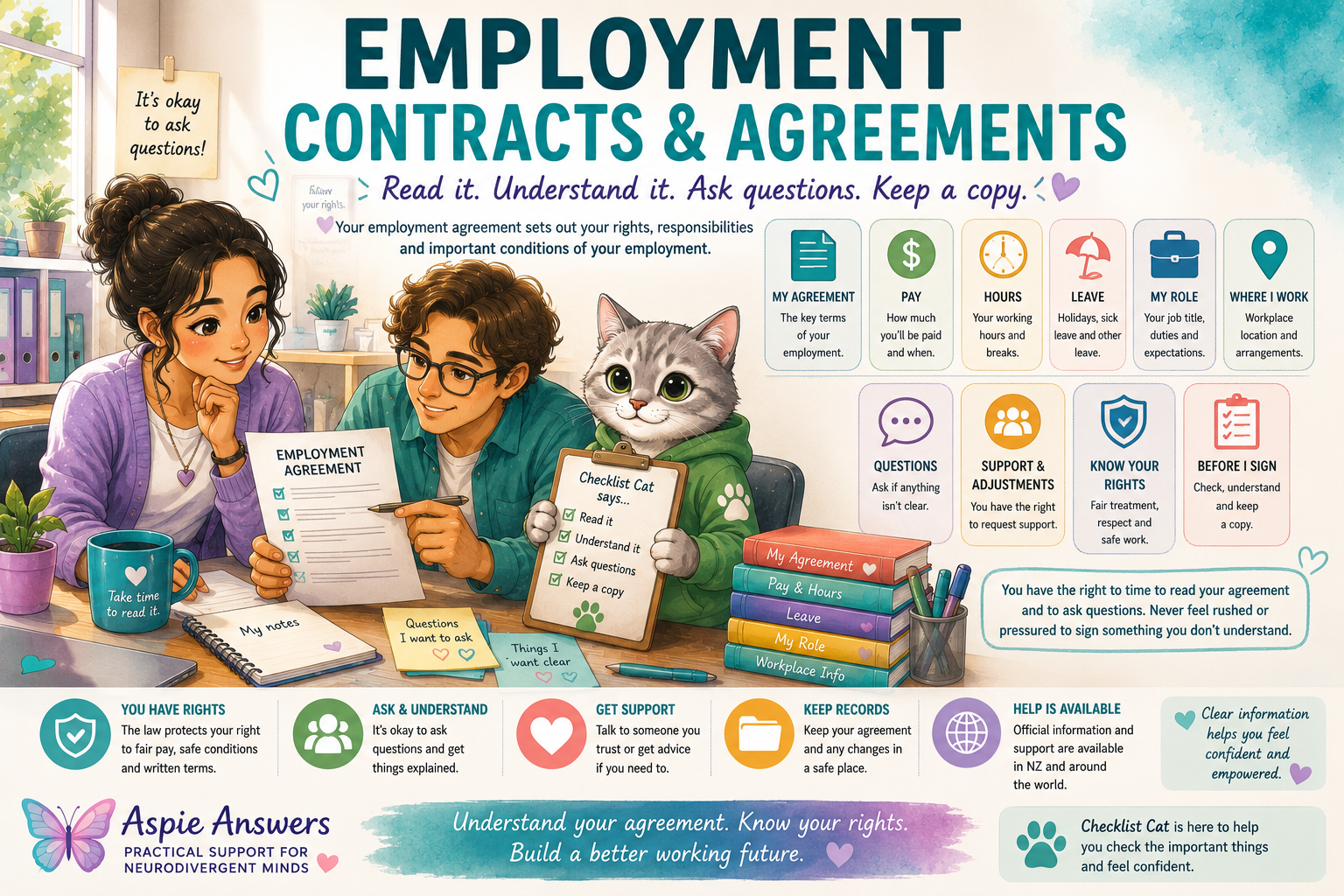
Employment agreements can feel formal, dense or overwhelming. This page breaks the important parts into manageable pieces so you can understand what you are agreeing to, identify questions and know where to find reliable help.
An employment agreement is the written document that sets out the terms and conditions agreed between an employer and employee. In New Zealand, every employee must have a written employment agreement.
Read it in sections. Highlight unfamiliar words. Write down questions. Ask for clarification and seek independent advice if you want it.
Work through the agreement at a pace that works for you.
Highlight anything unclear, unexpected or important.
Request explanations or proposed changes where needed.
You may seek independent advice before agreeing.
Keep your own copy of the final agreement.
New Zealand law requires certain information. Other agreed conditions may also be included.
The employer and employee names and a description of the work to be performed.
An indication of the place of work and the agreed hours or an indication of the hours to be worked.
The wage rate or salary and how it will be paid, plus legally required public-holiday payment wording.
Where relevant, fixed-term details and other agreed matters such as trial, probation or availability provisions.
Relevant employees require an employment-protection provision for certain business sales, transfers or contracting situations.
A clear, plain-language explanation of how employment relationship problems can be resolved, including applicable personal-grievance timeframes.
Negotiated between an employer and an individual employee. It applies to that employee and records their agreed terms and conditions.
Negotiated between an employer and a registered union and covers union members whose work falls within the agreement's coverage.
The label used for a job can affect expectations, but the real working relationship and legal requirements also matter.
Employment continues until the employee or employer lawfully ends it. It may be full-time or part-time.
Ends at an agreed time or event. In New Zealand there must be a genuine reason, and the agreement must record how and why the employment will end.
Casual work generally has no guaranteed ongoing pattern of work. If work becomes regular and predictable, the actual relationship may need closer consideration.
Some minimum leave rights apply by law even when every detail is not written into the employment agreement. An agreement can also provide terms that are better than the legal minimum.
A New Zealand trial period can be up to 90 calendar days, has specific legal requirements and can only be used where the employee has not worked for that employer before.
A probationary period is an agreed period for assessing suitability. Its timeframe must be reasonable, it must be included in the employment agreement, and different dismissal rules apply.
Try to understand what the written terms will mean in everyday working life.
What work am I expected to do? Are the duties clear enough to understand?
Where will I work? When? Is travel expected? Can the schedule change?
Who do I report to? How are instructions, feedback, changes and performance expectations communicated?
If an agreed adjustment or working arrangement is important to your ability to do the job, consider whether it should be clearly documented rather than relying only on memory or an informal conversation.
Explore Workplace Adjustments Explore Disclosure at WorkYou are allowed to need clarification. You do not have to know the perfect legal wording before asking a question.
You do not need to pretend you understand.
Identify the exact clause or missing information.
Request clarification or a proposed change.
Compare it with current official guidance.
Seek independent advice when the issue matters or remains unclear.
Employment terms can change over time, but changes should not simply be assumed. Important changes should be discussed, agreed where required, and documented in writing.
Keep the final version you agreed to.
Keep written variations and important emails about changed terms.
Keep relevant written agreements about adjustments, flexibility or other important arrangements.
Employment New Zealand's main pathway for written employment agreements.
Employment agreementsUnderstand the differences and what an individual employment agreement must contain.
Individual & collective guidanceOfficial guidance about reviewing, discussing and accepting an intended employment agreement.
Negotiating & acceptingOfficial information about fixed-term requirements and genuine reasons.
Permanent & fixed-termThis Aspie Answers page is general educational information, not individual legal advice. Employment rules can change, so use current official guidance for decisions about your own agreement.
Employment-contract rules, minimum terms, unions, probation, notice and worker classifications vary between countries and regions.
These are strong candidates for the Work & Employment collection inside the wider Aspie Answers Resources & Downloads Library.
A step-by-step check of the important parts of an agreement.
Record what you understand, what needs clarification and what you want to ask.
A structured page for clauses, questions, answers and follow-up.
Turn a long agreement into a simple personal reference for pay, hours, role, location and key conditions.
Keep important explanations and discussions together.
Track the agreement and other documents you need to receive, read, return or keep.
Review the wider minimum-rights foundation that sits behind employment agreements.
Explore Employment RightsExplore practical adjustments and accessibility supports that may matter in your working arrangements.
Explore Workplace AdjustmentsThink through whether, when and how to share disability, neurodivergence, health or support needs at work.
Explore Disclosure at WorkAn employment agreement should help create a shared understanding of the job. Taking time to read, ask questions and keep good records can make the beginning of employment clearer and more manageable.