
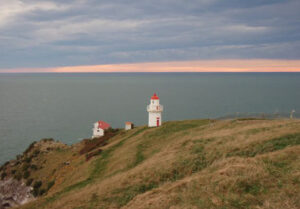
Tairoa Head New Zealand
Taiaroa Head is a headland at the end of the Otago Peninsula in New Zealand, overlooking the mouth of the Otago Harbour. It lies within the city limits of Dunedin. The nearest settlement, Otakou, lies three kilometres to the south. The cape is home to a lighthouse, built in 1864, and a colony of over 100 northern royal albatrosses, which established itself in 1919 – the only such colony on the inhabited mainland. There is also the Royal Albatross Centre. History Armstrong RBL 6-inch disappearing gun at Taiaroa Head The headland is named for Te Mātenga Taiaroa, a 19th-century Māori chief of the Ngāi Tahu iwi. Pukekura, a significant Māori pā was located on the headland, having been established about 1650 and still occupied by Māori in the 1840s. It is associated with a daring warrior called Tarewai who was active in the 18th century. Pilot’s Beach was formerly known as ‘Hobart Town Beach’ from the whaling try-works established there in 1836 by the Weller brothers employing men from Hobart. Previously it was called ‘Measly Beach’ from its being a place where Māori went to bathe when afflicted by a measles epidemic in 1835. Historically, several commercial whaling stations were established on the peninsula and the number of whales in this area were heavily exploited. Ruins of former coastal defences are located nearby, notably a restored Armstrong disappearing gun emplacement built in 1886 following a scare that New Zealand might be invaded by the Russians. Wildlife Otago Harbour and the northeast tip of the Otago Peninsula as seen from Buttar’s Peak, near Mount Cargill. A small beach, Pilots Beach, is located just inside the harbour entrance to the south of the head, and many forms of marine life, such as New Zealand fur seals and Hooker’s sea lions are often to be seen. At Pilots beach is the largest colony of little or blue penguins remaining on the Otago Peninsula. Nearby are important breeding habitats of the threatened yellow-eyed penguin. Northern royal albatross chick at Taiaroa Head There may also be seen a number of dusky dolphins, orcas and migratory large whales such as southern rights and humpbacks. Their sightings in these areas are on the increase and Taiaroa Head may be one of the best vantage points along the Otago coast. The part of Taiaroa Head where northern royal albatrosses breed is managed by the NZ Department of Conservation as a nature reserve with restricted entry. On adjacent land, the Otago Peninsula Trust manage a visitor centre and run guided tours into the Nature Reserve. Pilots Beach is managed as a recreation reserve by Dunedin City. Royal albatross colony The first albatross egg at the head was discovered in 1919, although it was not until 1938 that ornithologist Dr Lance Richdale saw the first live fledging. Since they first successfully raised a chick at Taiaroa Head, royal albatross numbers have increased due to intensive management by reserve rangers. As time has progressed intensive wildlife husbandry methods such as are found in any threatened species programme have been developed and refined. The one important difference has been that both the adults and progeny are not held in captivity but in the wild and in the case of the adults leave the colony each day while raising chicks to gather food. Intensive methods include predator control for cats, ferrets, stoats and weasels. Also in the early 1990s, a new blowfly arrived and caused the death of a number of chicks by laying eggs in them while the chick was still attempting to hatch. Removing eggs from young or inexperienced parents has also occurred with these eggs being hatched in brooders. Taiaroa Head Nature Reserve Introduction Located on the windswept end of the Otago Peninsula, Taiaroa Head or Pukekura is world renowned as the only mainland colony of albatross in the Southern Hemisphere. Taiaroa Head or Pukekura was an important site for Maori and (later) European settlers. Today it is world-renowned as the only mainland colony of albatross in the Southern Hemisphere. Image Gallery Northern royal albatross and its chick Image: | DOC Northern royal albatross feeding Image: | DOC Albatross in flight with GPS unit attached Image: J Sugishita © New Zealand fur seal pup at Sandymount Image: John Barkla | DOC Southern little blue penguins peeping out of nest burrow Image: Rod Morris Bird and wildlife watching Taiaroa Head map – view larger (JPG, 277K) There are around 10,000 seabirds residing on Taiaroa Head/Pukekura. But the birds aren’t always around. Some species are: only present for part of the year nocturnal with their land-based activities, and some can only be viewed from a tour from the Royal Albatross Centre (external site). Others like the giant albatross prefer certain weather, where there is wind to soar. Albatross Every year about half of the headland’s 200 northern royal albatross make landfall for courtship or to nest. With a breeding cycle of 11 months, viewing albatross is almost a year round event. The Otago Peninsula Trust operates guided tours to the albatross observatory overlooking part of the nature reserve. The Trust also manage the visitor centre situated near the car park at Taiaroa Head. On windy days, albatross can be seen from the visitor centre gliding over the headland, however, a visit to the observatory is required to see the nesting and courtship activity. Watch a live stream of northern royal albatross parents and chick nesting on our Royal cam. Otago shags Likewise, views of the threatened Otago shags can best be seen from the observatory at Taiaroa Head where their chimney pot type nests are a distinctive feature on the slope below. They are only found between Oamaru and the Catlins and there are less than 3000 of them. Little penguins Throughout the year little penguins can be viewed at Pilots Beach on the western side of the headland. At dusk these birds return to their nests after spending time at sea in search of fish. The Pukekura Trust operates night time viewing for this species and over summer over 200 birds can be seen arriving on the beach. Little penguins nest underground so are only visible above ground at dusk. Taiaroa Head/Pukekura is a strong-hold for this species on the Otago Peninsula. There are around 600