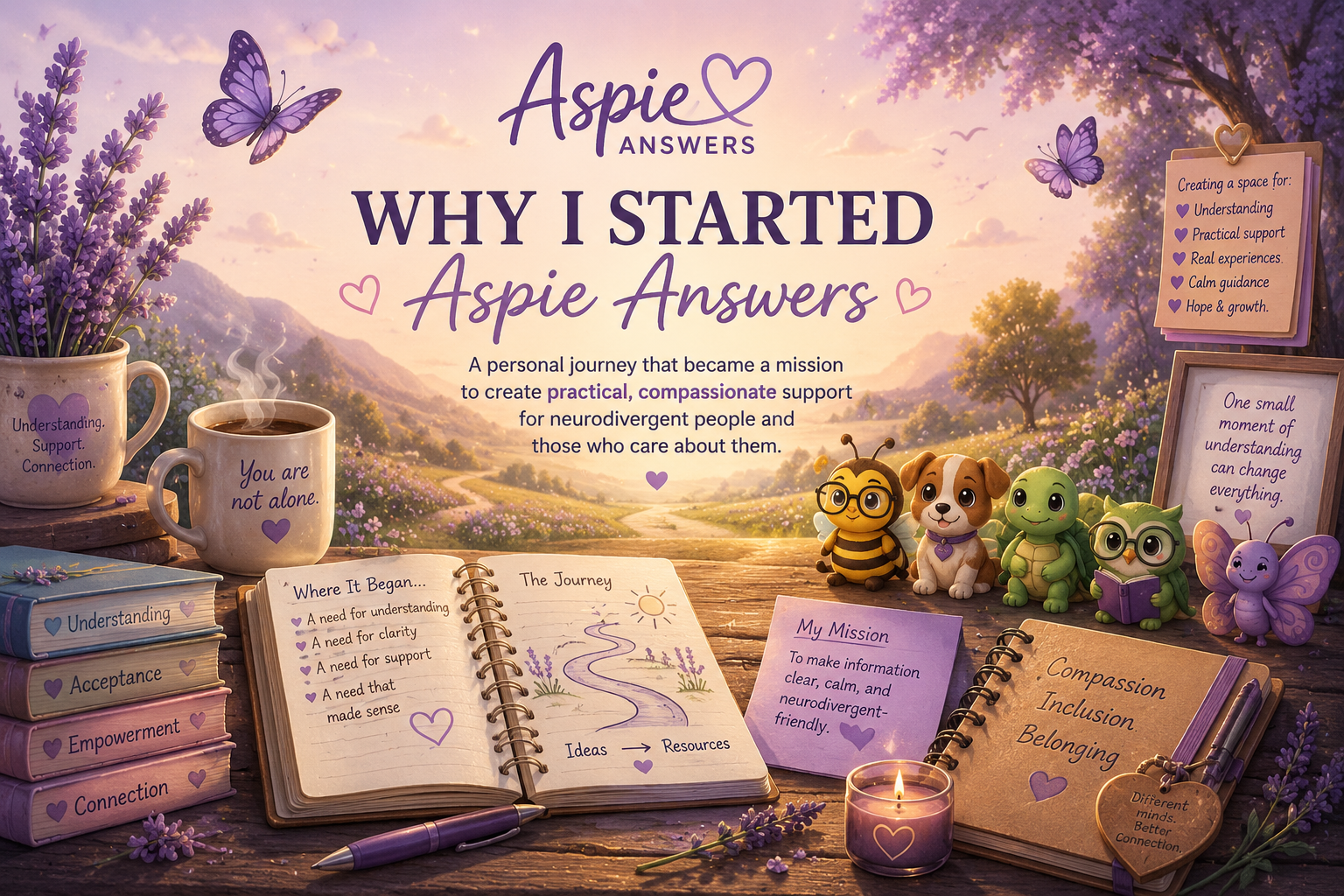
A personal journey — from feeling different and unseen, to creating a gentle, neurodivergent-friendly corner of the internet where people can learn, breathe, and remember they’re not alone.
Growing up, I knew I experienced the world differently. Sounds, lights, emotions, and social rules all landed in ways that didn’t quite match what people expected. For a long time, I carried questions about why I struggled in some areas yet seemed to thrive in others.
Eventually, discovering I was autistic — and later learning more about ADHD and other forms of neurodivergence — gave me language for experiences I’d never been able to explain. But it also showed me how few resources felt truly accessible, realistic, or kind. So much information was either highly clinical, or oversimplified in a way that didn’t match real life.
Aspie Answers grew out of that space: a desire to create the kind of support, education, and validation I wish I had when I was younger — and the kind I still need as an adult navigating life, mental health, relationships, and identity.
“I built the platform I needed when I was younger — clear, kind, and neurodivergent-friendly.”
Over the years, I realised that neurodivergent people — especially women, teens, parents and carers — are often overlooked by mainstream mental-health education. Many resources assume everyone copes the same way, communicates the same way, or experiences the world in the same sensory “volume.”
From my own lived experience, I know how confusing, invalidating, or isolating that can feel. You’re told to “just ask for help,” but the help isn’t built for brains like yours. You’re given strategies that ignore sensory overload, masking, executive function, exhaustion, trauma, or cultural context.
I created Aspie Answers because I wanted a space rooted in real-life understanding — where mental health, neurodivergence, self-care, and identity are handled with compassion, clarity and inclusion. A place where you don’t have to choose between “science” and “lived experience,” because both are honoured side by side.
“If one person feels less confused or more understood after visiting this site, my mission is working.”
This platform is more than a collection of pages. It’s a living project with a few core hopes at its heart:
• A Safe Place to Be Understood. A platform built by someone who “gets it,” where neurodivergent and diverse people won’t be dismissed, talked over, or treated as a problem to fix.
• Accessible & Practical Tools. Printable worksheets, planners, checklists, guides, and calm corners that meet people where they are — on low-energy days, in sensory overload, or during big life changes.
• Education + Empowerment. Helping people understand their brain, body, triggers and strengths so they can advocate for themselves and make informed choices about support, therapy, diagnosis, and self-care.
• Connection & Belonging. A sense of “Oh, it’s not just me.” Even when you’re reading alone on a screen, I want you to feel like there is someone on the other side who understands.
• Respect for Neurodiversity. Recognising that there isn’t one “right” way to think, feel or communicate. Differences are not flaws — they’re part of human variety.
• Hope, Growth & Healing. Not a promise that everything will be easy, but a quiet reminder that your story isn’t over, and small steps forward still count.
I’m constantly learning from other creators, educators and advocates. These talks are examples of the kind of perspectives that fuel my work on Aspie Answers — blending honesty, lived experience, and education.
Talks like this remind me how important it is to have resources that are neurodivergent-friendly, validating and hopeful — not shaming or oversimplified.
Hearing others talk openly about ADHD and diagnosis helps me keep weaving lived experience, education and compassion into the guides I create, especially for teens, adults and parents who are still piecing their own stories together.
Little snapshots that remind me why I keep building Aspie Answers, even on the tired or wobbly days:
“Aspie Answers exists because nobody should have to figure themselves out alone.”
A few words that many autistic and neurodivergent people (including me) come back to when things feel heavy:
If this page brings up big feelings — grief, relief, anger, hope — that’s okay. Stories about diagnosis, identity and mental health can be a lot to sit with. You’re allowed to take this slowly.