
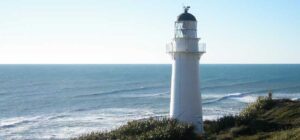
Kahurangi Point Lighthouse New Zealand
Kahurangi Point is a headland on the West Coast of New Zealand’s South Island, overlooking the Tasman Sea. It is located in Kahurangi National Park between Karamea and Farewell Spit. Kahurangi Point is traditionally regarded as the northernmost point of the West Coast region, although for most purposes it is considered part of the Tasman District region. View towards Mt Patriarch, Wangapeka Track Kahurangi Point is an unmarked route, mostly along the beach. If time allows, plan to stay overnight at Kahurangi Keepers’ House, close to Kahurangi Point. Lighthouse overview Kahurangi Point Lighthouse stands on the northern end of the Karamea Bight on the north-western tip of the South Island of New Zealand. Lighthouse feature: Details Location: latitude 40°47’ south, longitude 172°13’ east Elevation: 47 metres above sea level Construction: cast iron tower Tower height: 18 metres Light configuration: flashing LED beacon Light flash character: white light flashing twice every 15 seconds Power source: batteries charged by solar panels Range: 9 nautical miles (16 kilometres) Date light first lit: 1903 Automated: 1926 Demanned: 1960 Getting to Kahurangi Point Lighthouse Kahurangi Point Lighthouse is accessible to the public. There is no public access to enter the lighthouse. All that remains of the light station is the lighthouse; the other buildings have all been removed. The lighthouse is situated within the Kahurangi National Park and can be reached on foot, taking several hours. Contact the Department of Conservation for more information about this challenging walk. Walking route to Kahurangi Point Lighthouse Find this on the map: Kahurangi Point Kahurangi Point Route Located in Kahurangi National Park in the Nelson/Tasman region Walking and tramping 3-4 hr one wayExpert: Route Allow 4 hours from Anatori or 3 hours from Turimawiwi River to walk to Kahurangi Point. Cross Anatori River on foot and head out to the coastline. The walk to Kahurangi Point is an unmarked route along the beach; a wild and often windswept coastline in a vast, isolated landscape. The weather, sea and tide conditions can make travel dangerous and in some cases impossible. There are two rivers that must be crossed at or close to low water. Do not attempt to cross when they are in flood and always cross cautiously as river conditions change daily. Check the tide tables in the newspaper or at the Golden Bay i-SITE Information Centre. Anaweka River must be crossed at the beach as there is no way around the wide estuary inland. At Big River it is occasionally possible to cross at the river mouth if it’s shallow enough and sea conditions allow. If not, head up the estuary and wade across where its seems the shallowest. Exercise personal judgement as to whether the crossing can be made safely. After Big River, the beach gives way to huge inter-tidal rock platforms near Kahurangi Point. Just before the point is Kahurangi Keepers’ House. This house was made originally from the nearby houses of the former lighthouse keepers and altered to its present shape in 2003. A short walk further on around the coast takes you to the lighthouse, built in 1903. The house is not visible from the beach so look for the sign and orange marker. If you sight the lighthouse you have gone too far. Kahurangi Keepers house Category: Standard Facilities: 25 bunk beds, heating, mattresses, toilets – non-flush, water from tap – not treated, boil before use Bookings not required – first come, first served The History of Kahurangi Point Lighthouse Construction of the Kahurangi Point Lighthouse was difficult. Access to the site was limited and surrounding areas were practically unexplored, so no one knew quite what to expect. The tower was made by Judd Engineering Works of Thames. It was shipped to the station in sections and landed at the mouth of Big River. From there it was carted over 3 kilometres along the beach and then winched by tramway 50 metres up a cliff to the site. Landing the tower sections was a difficult task. Two small boats were damaged in the landing, and one worker broke his leg. Needing treatment, this man had to be carried across 32 kilometres of rough country to Westhaven, and from there to Collingwood where a steamer took him to Nelson. In total more than 145 kilometres were covered before he could be treated. Operation of the Kahurangi Point light The incandescent kerosene light was first lit in November 1903. In September 1926 the kerosene light was converted to an automatic acetylene gas light owing to the difficulties in servicing the light station. Despite the introduction of the automatic light the keepers remained at the station until the Murchison earthquake in June 1929. The Murchison earthquake caused serious damage at the light station. The light was shattered, but the tower remained standing. The tower was propped up by the landslide but the bottom floor was buried. One of the keepers’ homes was completely covered by earth. The lighthouse remained out of action for 2 months following the earthquake, until a temporary light could be set up. The tower was repaired and a new automatic light was put into operation in March 1931. The keepers returned once the new automatic light was installed in 1931. The last keeper was finally withdrawn in 1960. In May 1997, the original diesel powered light and associated equipment was removed and replaced with a flashing beacon placed on the balcony of the lighthouse. This was powered by batteries and solar panels. In 2007 this beacon was replaced with a LED beacon, again placed on the balcony of the lighthouse. The light is monitored remotely from Maritime New Zealand’s Wellington office. Life at Kahurangi Point light station Although access to the station was a problem, the keepers seemed to enjoy their time at this lighthouse. The area is very lush and green. Growing vegetables and keeping livestock was no trouble, so the keepers’ diet was varied. The area also had good supplies of fish and seafood, wild berries and mushrooms. Getting other supplies to the station was not so easy. At first a