
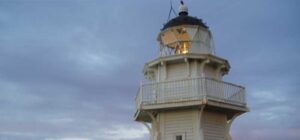
Kātiki Point Lighthouse
Kātiki Point Lighthouse The Katiki Point Lighthouse, also known as Moeraki Lighthouse, shone for the first time in 1878, following several accidents on the dangerous reefs around the area, to make the area safer for ships that sailed past on their way to Port Chalmers, Dunedin. The lighthouse was built between the settlements of Moeraki and Katiki, on the tip of the Moeraki Peninsula, which is known as Katiki Point or Moeraki Point. Lighthouse overview Katiki Point Lighthouse is located on the southern tip of the Moeraki peninsula, about 80 kilometres north of Dunedin. Lighthouse feature: Details Location: latitude 45°24’ south, longitude 170°52’ east Elevation: 52 metres above sea level Construction: wooden tower Tower height: 8 metres Light configuration: LED flashing beacon Light flash character: white light flashing once every 12 seconds Power source: mains electricity Range: 14 nautical miles (29.5 kilometres) Date light first lit: 1878 Automated: 1975 Demanned: 1975 Getting to Katiki Point Lighthouse Katiki Point Lighthouse is located within the Katiki Point Historic Reserve and is accessible to the public. There is no public access to enter the lighthouse. The Katiki Point Historic Reserve is administered by the Department of Conservation. The reserve and lighthouse can be reached on foot from the car park on Lighthouse Road. Turn off State Highway one at Moeraki Township. Tower Constructed 1878 Construction wooden tower Automated 1975 Height 8 metres (26 ft) Shape hexagonal tower with balcony and lantern Markings white tower, red trim, black lantern Power source mains electricity Operator Maritime New Zealand Light First lit 1878 Focal height 58 metres (190 ft). Lens light-emitting diode Range 10 nautical miles (19 km; 12 mi) Characteristic Fl W 12s. History The point has a long history of wrecks, notably the wrecking of the ancestral waka atua on a return trip from Hawaiki, leaving some of the cargo is on the beach at Katiki, below the lighthouse. Tradition holds that the remains of the cargo are the Moeraki Boulders. Just before the light was to be lit for the first time, a storm shook the tower to the extent that the lamp glass broke. A new one had to be ordered, and the tower was strengthened, before the light was lit on 22 April 1878. Katiki Point Lighthouse from the Northern side The wooden tower stands 26 feet (8 m) high and 190 feet (58 m) above sea level. The light flashes on for 6 seconds and off for 6 seconds, and can be seen for 10 nautical miles (20 km). The light-emitting diode beacon is supplied by mains electricity, with a battery for standby power. The original lens operated with a 1000-watt lamp supplied by mains electricity, with a diesel generator for standby power. It can still be seen in the lantern room at the top of the tower. The light was fully automated in 1975 and the lighthouse keeper was withdrawn. The operation of the light is now fully automatic and is monitored by a computer and Maritime New Zealand staff in Wellington. The lighthouse was restored by Maritime New Zealand in 2006. Moeraki was a busy port during the 1840s with the transportation of oil from nearby whaling stations. When the whaling industry declined, the port began to struggle. In time, Oamaru, which was directly linked to Dunedin and Christchurch by rail, became the preferred port for shipping and trade. In 1876 the Marine Department decided to build a light at Katiki Point, to make it safer for ships that sailed past en route to Port Chalmers near Dunedin. This decision followed several accidents on the dangerous reefs around the area. Construction of the lighthouse began in 1876, but was delayed because of bad weather. Just before the light was first lit the lighthouse was struck by a storm which shook the tower so violently the lamp glass broke. The light then had to be replaced and the tower strengthened before the light could finally be lit in 1878. The station was automated, and the last keeper was withdrawn in 1975. Operation of the Katiki Point light In December 2005 the original light and associated equipment were replaced with an LED beacon installed on the balcony of the lighthouse. The original light is still in place today. The new beacon is powered by mains electricity backed up by battery power in the event of a mains failure. The light is monitored remotely from Maritime New Zealand’s Wellington office. Life at Katiki Point light station While shipping in and out of the port at Moeraki declined, the town was still as busy as ever, making this a favourite station for keepers. They had easy access to the local school and shops. The nearby railway meant keeper’s families could visit Dunedin and Christchurch. The keepers themselves could not leave the station for more than a couple of hours at a time however, unless they were on holiday leave. Permission was required from the Marine Department before guests could stay at this, or any other, light station. At Moeraki, there were two permanent keepers and their families, each with their own small, two-bedroom house. A temporary keeper was often stationed at Moeraki, boarding a month at a time with each of the keepers. In 1940 the principal keeper wrote to the Marine Department requesting a hut be built for the temporary keeper. It was hard enough for a family to live around the shifts of one keeper, but when boarding the temporary keeper as well it was impossible. The keepers both had families with small children, who in bad weather would be shut inside, trying to be quiet after the shifts of both their father and the boarder. The following month the situation had become desperate. Another letter appeared in the letter book from the head keeper, requesting permission to build the hut, even offering to pay for it himself. A two room hut was built and paid for by the Marine Department a few months later. See also New Zealand portal Engineering portal List of lighthouses in New Zealand References ^ “Maritime New Zealand”. Archived from the original on 18 July 2007. Retrieved 27