
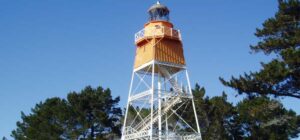
Farewell Spit Lighthouse New Zealand
The Farewell Spit Lighthouse is located at the end of New Zealand’s longest sand spit in Golden Bay / Mohua, near the northern tip of the South Island. It guides vessels entering Cook Strait from the west and south. Golden Bay / Mohua is a shallow, paraboloid-shaped bay in New Zealand, near the northern tip of the South Island. An arm of the Tasman Sea, the bay lies northwest of Tasman Bay / Te Tai-o-Aorere and Cook Strait. It is protected in the north by Farewell Spit, a 26 km long arm of fine golden sand that is the country’s longest sandspit. The Aorere and Tākaka rivers are the major waterways to flow into the bay from the south and the west. It is part of the Tasman Region, one of the territorial authorities of New Zealand. The bay was once a resting area for migrating whales and dolphins such as southern right whales and humpback whales, and pygmy blue whales may be observed off the bay as well. The west and northern regions of the bay are largely unpopulated. Along its southern coast are the towns of Tākaka and Collingwood, and the Abel Tasman National Park. Separation Point, the natural boundary between Golden and Tasman Bays, is in the park. North-eastern parts of Kahurangi National Park are in Golden Bay. It is known for being a popular tourist destination, because of its good weather and relaxed, friendly lifestyle. Beaches such as Tata Beach are popular locations for retirees and holiday homes. Name The Lightband Gully Memorial in Parapara commemorates the discovery of gold and this event gave the area part of its current name The official name is Golden Bay / Mohua. Māori called the area Mohua, potentially after the bird. In 1642, Abel Tasman named the bay Moordenaarsbaai, meaning “Killers’ Bay” or “Murderers’ Bay”, after four of his crew were killed there in a clash with Maori. In 1770, Cook included it as part of Tasman Bay, which he called “Blind Bay”. 50 years later, Dumont d’Urville named it Massacre Bay, but following the discovery of coal in Takaka in 1842 it was renamed Coal Bay. In 1857, gold was found near inland from Parapara, prompting another change, this time to Golden Bay. Yellowhead bird Lighthouse overview Farewell Spit Lighthouse was solarized in June 2019 and mains power to the lighthouse station was disconnected. Tower Constructed 1896 Construction metal (artificial physical structure) Automated 1984 Height 27 m (89 ft) Markings grey (tower), orange (top) Power source solar power Light First lit 19 January 1897 Focal height 30 m (98 ft) Lens second order Fresnel lens Light source rotating LED beacon Range 19 nmi (35 km; 22 mi) (red) Characteristic Fl WR 15s Original lighthouse Constructed 1870 Construction lumber Height 34.4 m (113 ft) Markings white (tower) First lit 17 June 1870 Deactivated 17 January 1897 Focal height 36.6 m (120 ft) Lens second order Fresnel lens Range 17 nmi (31 km; 20 mi) Characteristic Fl WR 60s The LED rotating beacon flashes white or red, once every 15 seconds. It has a range of 19 nautical miles (35 km; 22 mi). Red is shown to warn approaching vessels of extensive shoaling. Standing 27 metres (89 ft) tall, the tower needs to be taller than the support structures of most lighthouses built on cliffs or headlands, because the sand foundations it is built upon are almost at sea level. The tower is constructed of an open steel lattice to withstand abrasive sand and salt-laden winds. Getting to Farewell Spit Lighthouse The spit is now a wildlife sanctuary administered by the Department of Conservation. Public access is restricted to people visiting the spit as part of a tour. There is no public access to enter the lighthouse. The lighthouse is located approximately 27 kilometres (17 mi) along the sand spit.Farewell Spit / Onetahua is a wildlife sanctuary run by the Department of Conservation. The area is an important bird nesting area, especially for Australasian gannet. It is closed to casual visitors, and public access to the lighthouse site is restricted to people on an ecotour. The public is not permitted to climb the lighthouse structure. Find this on the map: Farewell Spit The History of Farewell Spit Lighthouse Before the lighthouse was built, many ships had been wrecked upon the spit; it had been feared by mariners for years. Construction of the light station at the end of the spit began in 1869. Because the ground was almost at sea level the tower needed to be taller than those built on cliffs or headlands, so it could be seen easily by seafarers. In 1891 it was found that the hardwood used for the tower was rapidly decaying because of the weather and abrasive sand. The tower was replaced with a steel latticework construction. The new light was ready in January 1897. Building lighthouses was never an easy task and Sandy Farewell Spit offered a unique set of challenges. The light station stood on a very windy beach and one night the stormy weather whipped up the sand, completely covering a pile of bricks. They were never found, and a new lot had to be shipped to the station. The drifting sand dunes of Farewell Spit is low-lying and interspersed with freshwater lagoons, with an extensive shoal area on the southern side. The need for a lighthouse to warn mariners was identified in 1856, in the days of early European settlement, in response to a growing number of strandings and wrecks. An initial proposal was made for a floating lighthouse, moored 2 miles (3.2 km) off the end of the spit. In 1866, there were protests about government delays in establishing a lighthouse on Farewell Spit. Eventually, under the direction of James Balfour, Colonial Marine Engineer and Superintendent of Lighthouses, a design was prepared for a lighthouse to be built at Bush End Point, near the end of the sandspit. The first lighthouse was constructed on a wooden lattice tower in 1870. However, it was no match for the abrasive sand and salt-laden winds. Tenders were called in December 1894 for a replacement steel lattice tower, and a new lighthouse was commissioned in January 1897. The original oil-burning lamp was converted to a 1000-watt electric lamp in 1954, and the diesel power supply was replaced by a buried