
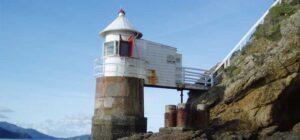
French Pass Lighthouse New Zealand
The French Pass Lighthouse together with a stone beacon marks a channel through the turbulent waters between Rangitoto ki te Tonga / D’Urville Island and the South Island. The New Zealand List of Lights calls the lighthouse Channel Point. Standing at an elevation of 3 metres (9.8 ft) above sea level, it is New Zealand’s lowest lighthouse. Even its companion beacon, placed on the outer edge of the reef, is higher, with an elevation of 5 metres (16 ft). French Pass (Māori: Te Aumiti; officially Te Aumiti / French Pass) is a narrow and treacherous stretch of water that separates D’Urville Island, at the north end of the South Island of New Zealand, from the mainland coast. At one end is Tasman Bay, and at the other end, the outer Pelorus Sound / Te Hoiere leads out to Cook Strait. French Pass has the fastest tidal flows in New Zealand, reaching 8 knots (4 m/s). When the tide changes, the current can be strong enough to stun fish. The local tribes are Ngāti Koata and Ngāti Kuia. History In the oral tradition of some Māori tribes, Te Aumiti (French Pass) is the resting place of Kupe’s pet king shag, called Te Kawau-a-Toru. Kupe was a pioneer Polynesian navigator who discovered Cook Strait in his canoe. While he was exploring Cook Strait, Kupe was attacked by a giant octopus. In the furious battle to kill the octopus, the coast was gouged into the convoluted shapes that today make up the Sounds. Kupe’s loyal shag then led Kupe to the French Pass passage and explored the area on Kupe’s behalf. Te Kawau-a-Toru had a huge wingspan and was reputed to be a sacred bird with “the eye of the ancestor”, insight into ancient knowledge. However, while testing the channel to see if it was safe for Kupe’s canoe, Te Kawau-a-Toru got caught in the tidal rip, broke a wing and drowned. The broken reef adjacent to the channel is Kupe’s loyal bird turned to stone – Te Aumiti a te Kawau-a-Toru (the currents that swallowed Toru’s shag). A nearby rocky point where a lighthouse now stands is the bird’s petrified bones. The first recorded European navigation of the pass occurred in 1827. Admiral Jules Dumont d’Urville navigated the pass during his second voyage to New Zealand, in the French Navy corvette Astrolabe. Approaching the narrowest part of the pass, the vessel swung sideward and did not respond to steerage. The corvette struck rocks twice and was then washed over the reef and into Admiralty Bay. The high energy and complexity of the location were summed up by d’Urville suggesting that no one should attempt to navigate French Pass except in an extreme emergency. In 1888, a Risso’s dolphin appeared in the area. For the next 24 years, this dolphin accompanied boats to and from French Pass. He became famous as Pelorus Jack and was the first dolphin in the world to receive the protection of the law. Pelorus Jack stayed in the Pelorus Sounds, and did not navigate the pass into Tasman Bay. He would meet boats as they came out of the pass, riding their bow waves for 8 kilometres (5.0 mi) to Pelorus Sound. Then he would join boats returning to Nelson at the entrance to Pelorus Sound / Te Hoiere and escort them back to the pass. Pelorus Jack was last seen in April 1912. The lightkeeper at French Pass claimed he found the body of Pelorus Jack decomposing on the shore. In August 2014, the name of French Pass was officially altered to Te Aumiti / French Pass. The tidal stream changes direction four times a day and does not follow the channel. At equinoctial spring tide, the north-east-going stream has been known to reach 8 knots (4 m/s or 8.5 knots (15.7 km/h; 9.8 mph) and the south-west-going stream 8.5 knots (15.7 km/h; 9.8 mph). Neap tide rates are less, but still strong. A daily table of times is published by Toitū Te Whenua Land Information New Zealand (LINZ) The tide times listed are the time of, apparent, slack water, and the NE and SW directions listed are the direction the tide will start to flow towards at the time listed. The change does not coincide with low water or high water at nearby Elmslie Bay. Lighthouse overview Lighthouse feature: Details Location: latitude 40°55’ south, longitude 173°50’ east Elevation: 3 metres above sea level Construction: cast iron tower Tower height: 7 metres Light configuration: drum type lense, illuminated by a 50 watt incandescent bulb Light flash character: fixed light with red and white sectors Power source: mains electricity Range: 10 nautical miles (18 kilometres) white sector, 7 nautical miles (13 kilometres) red sector Date light first lit: 1884 Automated: 1961 Demanned: 1967 Getting to French Pass Lighthouse French Pass Lighthouse is not accessible to the public. There is no public access to enter the lighthouse It can be seen from a boat on the seaward side. Find this on the map: French Pass The History of French Pass Lighthouse French Pass separates the mainland from D’Urville Island. Before the lighthouse was built the channel was used by small boats. During the 1870s, with the growing settlements in Wellington and Nelson, passenger and mail steamers also began to use French Pass. It was a quicker and more comfortable trip, provided the ship avoided the reef between the mainland and D’Urville Island. During the 1860s a stone beacon had been placed on the outer edge of the reef, but at night this was difficult to see. By 1880 the Wellington to Nelson mail steamer was using the pass regularly at night, to the horror of the Secretary of Marine who wrote: “Some serious casualty will arise if a light is not put up.” Despite this, it was 2 years before a light was fitted to the beacon. Then, as soon as it was finished, the beacon was struck by a steamer, causing considerable damage to both the beacon and the boat. In 1884 the French Pass Lighthouse was built on the mainland, facing out to the repaired beacon. The lighthouse was first lit on 1 October 1884. Operation of the French Pass light In 1961 the acetylene-powered lighthouse became one of the first to be automated. A keeper remained as caretaker for