
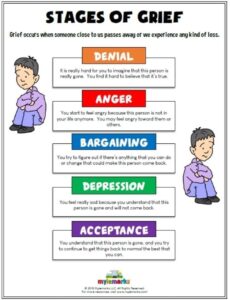
UNDERSTANDING THE STAGES OF GRIEF
Everyone experiences grief differently. Many people who lose a friend or loved one experience several stages of grief as they deal with a loss. Psychologists who work with people as they grieve have noticed the ways that people cope with the loss. There are some commonalities including distinct stages such as denial, anger, and depression. There are a few more to name, but what you may not know is that these stages aren’t about the grief of someone dying, but rather something extremely different. There is now more to it than the five that we hear about of the stages of grief which I’ll explain in a minute. Types of Loss Most people associate the word ‘grief’ with the sadness that surrounds the death of a loved one. Yet people can experience grief after many other losses, including a breakup, losing a job or a home, having a part of the body like an arm or leg removed, being diagnosed with a terminal illness, or having to drop out of college. The Grief Process People go through a number of stages when they lose a loved one. You may experience them in any order and any number of times. You may feel sad at the beginning, move on to anger, and then return to feeling sad. The crucial thing to remember is to take your time to grieve. Allow yourself to do it in your own unique way. Never let anyone tell you how to grieve or for how long. It’s up to you! Accept any help if it is given to you while you’re grieving. What You Probably Don’t Know About Grief Many people think that the stages of grief are about the loss of a loved one. However, they are actually related to people who are dying, rather than a personal loss. Dr. Kübler-Ross is credited with developing the stages of grief, but most people don’t realize that what she created was for people with a terminal illness. She wrote a book called On Death and Dying. In this book, Dr. Kübler-Ross writes about the stages of death: denial and isolation, anger, bargaining, depression, and acceptance. Dr. Kübler-Ross interviews terminally ill patients and discusses how impending death affects a person. She writes about how the patient, their family, and loved ones cope with the loss. She did not develop the stages to describe the stages of loss people go through when some dies, however, they are about what terminally ill people experience. The stage includes – denial, anger, bargaining, depression, and acceptance. After some time, people adopted these phases to apply to their personal loss, and they seem to fit well. Below you will find the stages of grief as a terminally ill person experiences them. They are also applicable to losing a loved one. *Just as a quick note that not everyone will go through these stages of all of these. Some miss a few stages while grieving. This will only be for some people not all. Kubler Ross Stages of Grief Dr Elizabeth Dr. Kübler-Ross, a Swiss psychiatrist, introduced the concept of the five stages of grief in 1969. What are the five stages of grief? According to Dr. Kübler-Ross’ model, there are several stages of grief. Through denial, anger, bargaining, depression, and acceptance people process their loss, whether that’s a terminally ill patient or a person coping with losing a loved one. She was also interested in the way people communicate their grief to others through their words, emotions, and behaviour. Denial When you’re in denial about the loss, you try to convince yourself or others that the event hasn’t happened or isn’t permanent. You know the facts, of course. If your spouse has died, you might accept that it happened but then believe for a time that his death means nothing to you. If your parents have divorced, you might try to get them back together even after they’ve moved on to other relationships. Following a job loss, you might go back to work thinking they didn’t really mean it when they fired you. Anger Anger is a typical reaction to loss, and it’s one of Dr. Kübler-Ross’ stages of grief. You may be angry with the person who left you, or you may feel angry with yourself. You might express anger by shouting at people through sarcasm, or by showing irritation at everything from significant letdowns to minor problems. This stage can also happen at any time, even after you go through a period of acceptance. The benefit of the grief stages is that they help you deal with the loss and move on. Anger can energize you to do just that. Bargaining At some point, you may find yourself bargaining, trying to get back what you lost. This part of the stages of grief and the higher power help the person cope with the loss. People often promise their God that they will live a better life if only they can take back what they lost. A child may promise to pick up their toys and stop arguing with their siblings if their parents will get back together. Bargaining is a stage that sometimes brings up uncomfortable discussions that go nowhere. Depression Next in the five stages of grief is depression. The depression can present with any of the symptoms of clinical depression. You may feel sad and cry often. You might notice changes in your appetite or sleep patterns. You might have unexplained aches and pains. This stage can be too painful in a breakup in a relationship and in the death of a loved one. If you’re moving through these stages of grief, divorce can seem like the end of your life, so it’s natural to become depressed. It is a situational depression that may soon pass naturally as you move toward acceptance. Acceptance The last of the Dr. Kübler-Ross stages of grief is acceptance. You understand what you lost and recognize how important that thing or person was