
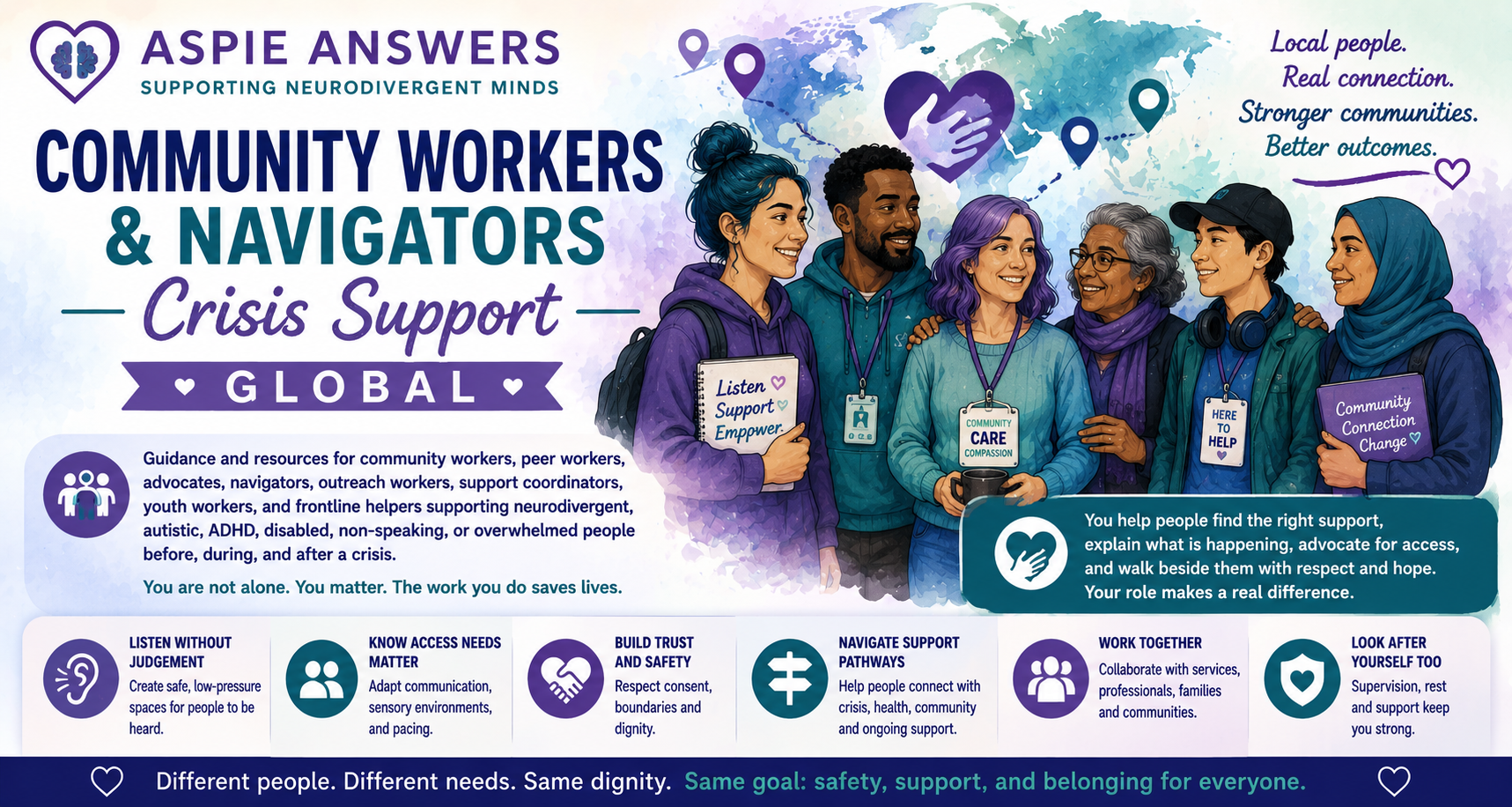
Community Workers & Navigators Crisis Support – Global
A practical support page for community workers, peer workers, disability support workers, advocates, navigators, outreach workers, youth workers, support coordinators, family support workers, and trusted community helpers supporting neurodivergent, autistic, ADHD, disabled, non-speaking, overwhelmed, masking, or sensory-sensitive people before, during, or after crisis.
If there is immediate danger
If someone is in immediate danger, medically unsafe, at risk of serious harm, missing, or unable to stay safe, use local emergency, safeguarding, crisis, or escalation pathways immediately.
- Emergency risk: contact local emergency services.
- Safeguarding risk: follow your local safeguarding process.
- Medical risk: escalate to urgent health support.
- Communication barriers: adapt communication while help is arranged.
Gentle content note
This page mentions crisis, safety risk, trauma, self-harm risk, suicide risk, overload, shutdowns, burnout, and safeguarding. It is written as supportive signposting and does not replace local policy, emergency protocols, supervision, or professional duties.
Your role can matter deeply
Community workers and navigators often help people feel believed, understood, and less alone. You may be the person who helps bridge the gap between crisis, services, family, community, and ongoing support.
Look after yourself too
Supporting people in crisis can be heavy. Use supervision, debriefing, boundaries, peer support, and rest where possible. Sustainable support protects both you and the people you help.
Quick support pathways
Use these pathways to choose the safest next step when supporting someone through crisis or overwhelm.
Immediate risk or emergency
If someone cannot stay safe, is medically unsafe, missing, or at immediate risk, use emergency or safeguarding pathways first.
Open emergency numbersCommunication or access barriers
Use text, writing, AAC, visuals, plain language, support people, and extra processing time where needed.
Open communication accessHelp finding the right pathway
Use location, directory, and support pathway pages to connect the person with crisis, health, disability, or community support.
Open support directoriesSearch & filter community support topics
Use this section to quickly find the support pathway that fits your role or situation.
Safety and escalation
Know when to use emergency services, safeguarding pathways, urgent health support, or crisis teams.
Communication access
Support communication through AAC, typing, writing, visuals, plain language, support people, and time.
Open communication accessSensory and overload support
Reduce noise, light, crowding, pressure, questions, and pace when someone is overwhelmed.
Open sensory supportService navigation
Help the person find the right crisis, health, disability, community, peer, or ongoing support pathway.
Open support directoriesSupporter wellbeing
Use boundaries, supervision, debriefing, peer support, and rest to keep support sustainable.
Find support by location
Use the location hub for emergency numbers, crisis pathways, and country or region support pages.
Open location hubYour role in a crisis support pathway
Community workers and navigators may not be the emergency service, clinician, or decision-maker — but they can still provide safety, connection, advocacy, access support, and practical next steps.
Listen
Listen without judgement and believe distress even when it is hidden or hard to explain.
Adapt
Adapt communication, environment, pace, and expectations to the person’s needs.
Connect
Help connect the person to crisis, medical, disability, community, or ongoing support.
Follow up
Where appropriate, help the person plan what happens after the urgent moment passes.
Helpful reminder
You do not need to have every answer. It can still help to stay calm, reduce pressure, believe the person, and help them reach the right next support.
Adapt support for neurodivergent and disabled people
Support is safer when it respects communication, sensory, trauma, culture, disability, and access needs.
Communication support
- Use simple, clear language.
- Offer text, writing, AAC, or visuals.
- Ask one question at a time.
- Allow extra processing time.
Sensory support
- Move to a quieter space if safe.
- Reduce noise, lights, crowds, and interruptions.
- Allow safe stimming or comfort items.
- Lower demands where possible.
Trauma-informed support
- Explain what is happening.
- Offer choices where possible.
- Ask before touch if safe to do so.
- Protect dignity and privacy.
Community support pathways by country / region
Community support systems vary by country. Use local emergency, safeguarding, health, disability, social service, and community protocols first. This section is broad signposting only.
New Zealand
In an emergency, use 111. For mental health support, 1737 can be called or texted within New Zealand. Community workers may also connect people with local health, disability, social service, iwi, peer, or community supports.
Australia
In an emergency, use 000. Community workers can follow state/territory crisis, health, disability, social service, and safeguarding pathways.
United States
In an emergency, use 911. 988 may support mental health crisis pathways. Community workers can help connect people to local crisis, disability, health, housing, or peer supports.
Canada
In an emergency, use 911. Follow provincial or territorial crisis, healthcare, disability, social service, and safeguarding pathways.
United Kingdom
In an emergency, use 999 or 112. Community workers can connect people with NHS, local authority, safeguarding, crisis team, disability, housing, and community support pathways.
Ireland
In an emergency, use 112 or 999. Follow local HSE, crisis, safeguarding, disability, social care, and community support pathways.
Europe
In many European countries, 112 is the emergency number. Use local crisis, health, disability, safeguarding, and community support systems.
International / worldwide
Use the Crisis Support by Location hub to locate country, region, and emergency pathways where available.
Open location hubIf the pathway is unclear
Start with safety, reduce barriers, document needs, use local crisis or safeguarding guidance, and connect with trusted services or supervisors.
Where to go next
This page connects into the wider Aspie Answers crisis support structure.
Medical & Health Professionals
For clinical, emergency, mental health, and healthcare support pathways.
Open medical professional supportCommunication Access Crisis Support
For AAC, text, writing, Easy Read, plain language, support people, and non-phone options.
Open communication accessTrauma-Informed Neurodivergent Support
For calmer, safer, consent-aware, dignity-focused support.
Open trauma-informed supportMasking, Overload & Crisis Support
For hidden distress, masking, burnout, shutdown, and risk that may not be visible.
Open masking supportSupport & Directories Hub
For ongoing support, organisations, services, groups, and non-urgent contacts.
Open support directoriesCrisis Support by Location
Find support by country, region, or local pathway.
Open location support