
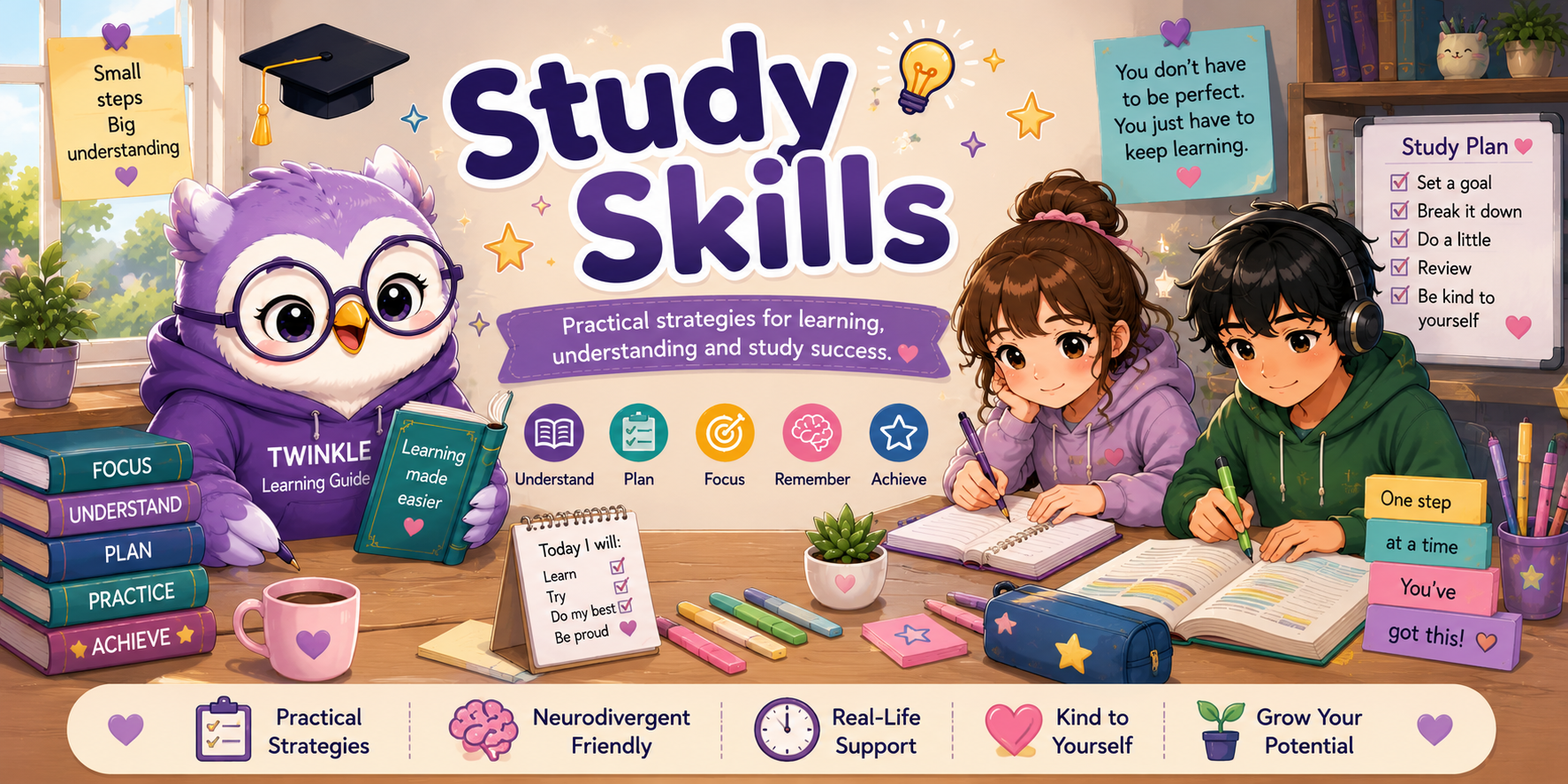
📚 Welcome to Study Skills
Studying is not only about sitting down and concentrating. Learning can involve understanding information, remembering ideas, organising materials, starting tasks and deciding what matters most.
This page brings practical study strategies together so you can explore different ways to learn, focus and make study tasks feel more manageable.
Needing a different way to learn does not mean you are bad at learning. The right strategy may look different from the method somebody else uses.
🧭 Quick Navigation
Jump to the study area you need right now.
🔎 Find Study Support
Search by what feels difficult or choose a study support area.
I Can't Get Started
Find a smaller first step and reduce the pressure to begin the whole task at once.
Explore Getting StartedI Don't Understand the Information
Try different ways of breaking ideas down, rewriting and using examples.
Explore UnderstandingI Keep Losing Focus
Explore practical ways to reduce distractions and support changing attention.
Explore Focus SupportI Forget What I Study
Explore strategies that support retrieval, repetition and remembering key information.
Explore Memory SupportMy Study Materials Feel Disorganised
Reduce clutter and create simpler systems for notes, resources and study tasks.
Explore Study OrganisationI Don't Know What to Study First
Choose one priority and build a study session around a clear task.
Build a Study SessionMy Study Environment Isn't Working
Explore lighting, sound, seating and other environmental factors that may affect study.
Explore Study EnvironmentI'm Too Tired to Study
Explore pacing, shorter sessions, breaks and lower-energy study options.
Explore Energy & BreaksVisual Support Helps Me Learn
Use diagrams, visual notes and other visual tools to make information easier to work with.
Explore Visual Study Ideas🧠 Why Studying Can Feel Hard
Task Initiation
Knowing you need to study does not always make starting easy.
Unclear Material
Information may be too broad, too abstract or not explained in a way that connects.
Working Memory
Holding instructions, ideas and multiple steps in mind can take extra effort.
Attention Changes
Focus may move, fluctuate or become locked onto something else.
Sensory Environment
Noise, lighting, movement and other input can make concentrating harder.
Information Overload
Too much information at once can make it harder to see the main idea.
Tiredness & Burnout
Learning can feel very different when energy and capacity are reduced.
🌱 Start With the Study Task
You do not need to understand or complete everything before you begin.
Name the topic, subject or task.
Read the instruction and identify the actual task.
Open the document, read one section or gather one resource.
Choose a timer, notes, headphones, visual support or another helpful tool.
Try one manageable study block.
Notice what helped and change what did not.
💡 Understanding Information
Understanding does not always happen the first time you read or hear something. Changing the format can make a big difference.
Read Smaller Sections
Work with one paragraph, example or idea at a time.
Highlight Key Ideas
Try to identify only the most important words or concepts.
Use Your Own Words
Rewrite the idea in language that feels clearer to you.
Use an Example
Connect an abstract idea with a practical or familiar example.
Make a Diagram
Turn information into a picture, flow chart or simple visual layout.
Explain It Aloud
Try explaining the idea as though you are teaching it to somebody else.
Find the Main Idea
Ask: “What is the one thing this section is trying to tell me?”
🎯 Focus While Studying
Focus is not always something you can switch on instantly. Sometimes it helps to change the task, environment or support around your attention.
- 🎯 Choose one study task rather than several at once.
- 🔕 Remove or reduce one distraction if possible.
- 🎧 Use headphones or background sound if it supports you.
- ⏱️ Try a visible timer or short focus block.
- 📝 Keep a “later” note for distracting thoughts or ideas.
- 📱 Move your phone or silence notifications if that helps.
- 🌱 Begin with a very small action.
Buzzy Brain may appear in study resources where executive function, busy thoughts and changing attention need extra support.
🧠 Supporting Memory
Remembering information often becomes easier when you actively return to it in different ways.
Short Notes
Write down key ideas rather than trying to remember an entire page.
Cue Cards
Use short questions, terms or prompts to practise remembering.
Repetition
Return to important information more than once over time.
Visual Reminders
Use diagrams, symbols, colour or visible prompts where helpful.
Retrieval Practice
Close the notes and ask yourself what you can remember before checking.
Make Connections
Link new information to something you already understand or remember.
📋 Build a Study Session
A simple structure can reduce some of the decision-making involved in studying.
Prepare
Gather the materials and support tools you need.
Choose
Select one clear task or learning goal.
Focus
Work for a manageable amount of time.
Pause
Take a break or check your energy and attention.
Review
Notice what you learned and identify the next step.
🏠 Your Study Environment
A study environment does not need to look like a perfect desk setup. Consider what helps your brain and body work with the task.
💡 Lighting
Is the space too bright, too dark or visually uncomfortable?
🎧 Sound
Would quiet, headphones or consistent background sound help?
🪑 Seating
Can you sit, stand or move in a way that feels more comfortable?
🌡️ Temperature
Are you too warm or cold to focus comfortably?
🚶 Movement
Would pacing, stretching or changing position support attention?
✏️ Supplies
Keep the materials you need visible or within easy reach.
📱 Digital Distractions
Consider notifications, open tabs and apps that compete for attention.
🐢 Breaks, Energy & Pacing
A break can support studying. It is not automatically avoiding the work.
Toby Turtle may appear in study resources where pacing, patience and burnout-aware support are especially important.
Pause Before Overload
Take a break before your energy is completely depleted where possible.
Shorter Sessions
Several short study blocks may work better than one long session.
Match the Task to Your Energy
Use lower-energy times for lighter tasks where you can.
Move During Breaks
Movement may help some people reset attention or reduce restlessness.
Check Basic Needs
Notice hydration, food, temperature and physical comfort.
Be Kind to Yourself
A difficult study day does not erase your ability to learn.
🦉 Twinkle's Study Support
Twinkle Owl is one of the Aspie Answers learning guides. Her role connects with learning, understanding information, study support and breaking large ideas into smaller pieces.
“Big ideas can become smaller steps.”
Twinkle may appear across study planners, understanding-information resources, homework support and other learning tools where her role naturally fits.
🎨 Different Study Support Styles
Companion Resources
Twinkle and other appropriate companions may guide learning resources where their roles fit.
Kawaii Study Helpers
Friendly study-themed characters and objects can make specific tasks feel more approachable.
Kawaii Students
Relatable Kawaii people can represent different study experiences, emotions and learning situations.
Semi-Realistic Students
A more mature visual style may be used for older students, tertiary learning and real-life study situations.
🔗 Related Study Support
📝 Homework & Assignments
Break larger learning tasks into clearer steps.
Explore⏰ Time Management for Study
Support deadlines, study sessions and upcoming work.
Explore🏫 School Support
Explore practical everyday school support.
Explore🎓 College & University
Explore learning and organisation support for tertiary study.
Explore🗂️ School & Study Organisation
Organise materials, assignments and study spaces.
Explore🎯 Productivity
Find supportive ways to approach tasks and progress.
Explore📥 Study Resources & Downloads
Study resources may include practical planners, checklists, visual supports and worksheets designed around learning and study needs.
📋 Study Session Planner
Plan one manageable study session.
✅ Study Checklist
Use clear steps to prepare, study and review.
🎯 Focus Planner
Identify one focus task and the support you may need.
🔁 Revision Planner
Plan when and how to return to key information.
💡 Understanding Information Worksheet
Break down a topic and identify the main idea.
🏠 Study Environment Checklist
Notice what may help or hinder your study environment.
Individual resources can be connected as they are reviewed, organised and made available.
Explore Work & Study Resources & Downloads🌈 Work & Study Life Collections
Study resources may also be organised through Classic, Companion and Kawaii collection styles.
Classic Editions
Clear and practical study resources with straightforward layouts.
Companion Editions
Study resources featuring Twinkle and other appropriate companions where their roles fit.
Kawaii Editions
Friendly visual resources featuring Kawaii students, helpers and study scenes.
💛 A Gentle Reminder
A difficult focus day does not mean you have forgotten how to learn.
A strategy that worked yesterday may need adjusting today. That is okay.
Study support is about finding ways to make learning more accessible — not forcing yourself to copy somebody else's learning style.