Supportive Workspaces
Create a workspace that considers comfort, accessibility, sensory needs, available space and the way you work best.

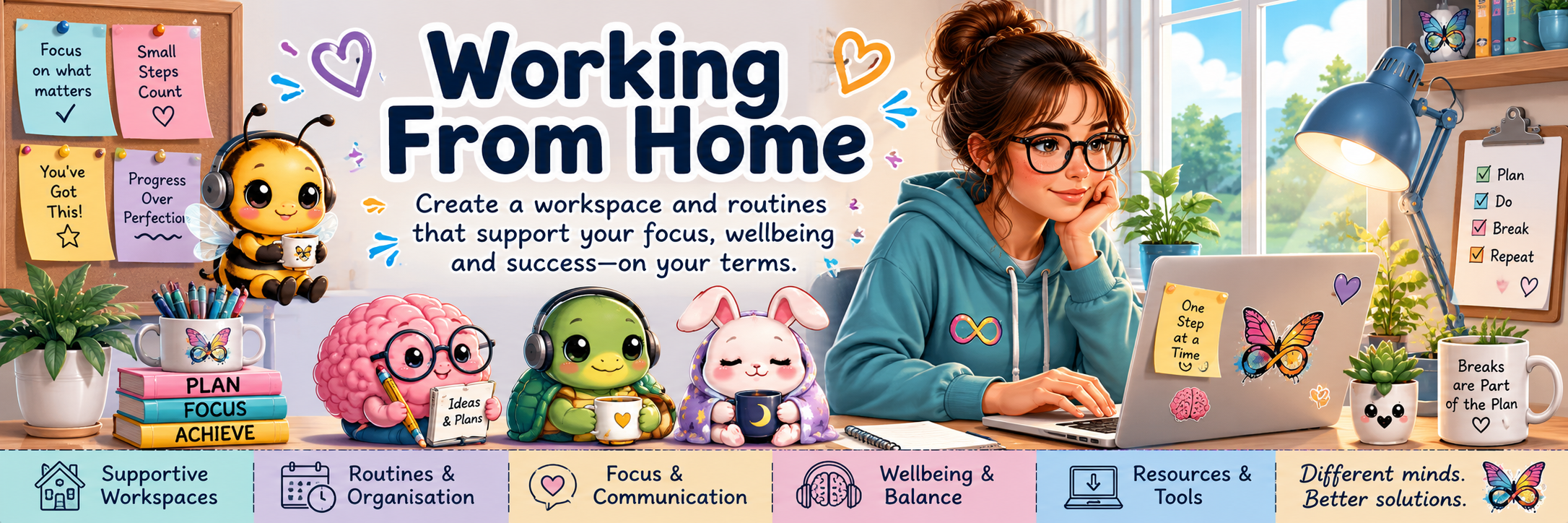
Working from home can offer comfort, flexibility and greater control over your environment—but it can also bring challenges with routines, focus, organisation, communication, boundaries and switching off at the end of the day.
This section brings together practical, neurodivergent-friendly guidance to help you create a home-working approach that supports your needs. You do not need a perfect office, a flawless routine or constant productivity. The aim is to find realistic strategies that make working from home feel more manageable, sustainable and supportive.
You can explore this section in order or go directly to the topic that best matches the challenge you are currently facing.
Explore guidance and practical tools for the different parts of working successfully and comfortably from home.
Create a workspace that considers comfort, accessibility, sensory needs, available space and the way you work best.
Build flexible routines, organise digital tasks and reduce the mental load of planning your working day.
Manage distractions, online meetings, communication expectations and executive-function challenges.
Protect your energy, include meaningful breaks and create clearer boundaries between working time and home life.
This section may be useful if one or more of these experiences sound familiar.
You find it difficult to begin work without the structure of a workplace.
You become distracted by household tasks, noise, devices or other people.
Your workspace does not feel comfortable, calm or sensory-friendly.
You struggle to plan your day, estimate time or remember priorities.
Online meetings and digital communication feel tiring or overwhelming.
You work for too long without taking breaks or noticing your energy level.
You find it difficult to separate working time from personal time.
You want practical strategies that can be adjusted to suit your own needs.
You do not need to relate to everything listed here. Choose the support that feels relevant and leave anything that does not suit you.
Begin with the main guide for a broader introduction to working from home, including workspace setup, routines, focus, communication, wellbeing and sustainable working practices.
Explore the Working From Home GuideSelect a topic below to find practical explanations, ideas and supportive strategies.
You do not need to redesign your entire working day at once. One small adjustment can be a meaningful beginning.
Write down the first small action rather than holding the whole project in your head.
Change your lighting, chair position, noise level or another part of the environment.
Decide when you will pause before you become completely drained or lose awareness of time.
Close your work tabs, write tomorrow’s first task and physically move away from the workspace.
Explore printable tools, planners, checklists and grouped resources that can help you put the strategies into practice.
These Aspie Answers companions represent different kinds of support you may find throughout this section.
Helps with planning, task steps, routines, organisation and making priorities feel more manageable.
Supports executive function, working memory, focus, time awareness and remembering what comes next.
Encourages pacing, restorative breaks, energy awareness and sustainable progress without rushing.
Supports calm transitions, rest, end-of-day routines and creating space between work and personal life.
Open a question below for a short, practical answer.
Home may remove some workplace pressures, but it can also remove external structure, environmental cues and natural transitions. You may need to create your own supports for starting, prioritising, taking breaks and finishing work.
No. A supportive workspace can be a desk, a table, a quiet corner or a portable setup that you pack away. The most important factors are accessibility, comfort and whether the space helps signal that it is time to work.
Reduce the task to a visible first action, such as opening the document, writing the heading or checking one message. A timer, body doubling, visual checklist or short starting routine may also help.
Write distracting thoughts or household jobs on a “later” list, reduce visible distractions where possible and create short focus periods rather than expecting uninterrupted concentration all day.
There is no single correct schedule. Short, regular breaks often work better than waiting until you are exhausted. Experiment with different intervals and notice what helps you return with more energy.
Choose a finishing time, record unfinished tasks and write down tomorrow’s first step. Closing programs, turning off equipment and leaving the workspace can create a clearer transition.
That does not mean you failed. Your workload, energy, environment and needs can change. Review what is no longer helping and adjust the routine rather than trying to force the old system.
Choose your next step or return to the wider Work & Study Life section.