
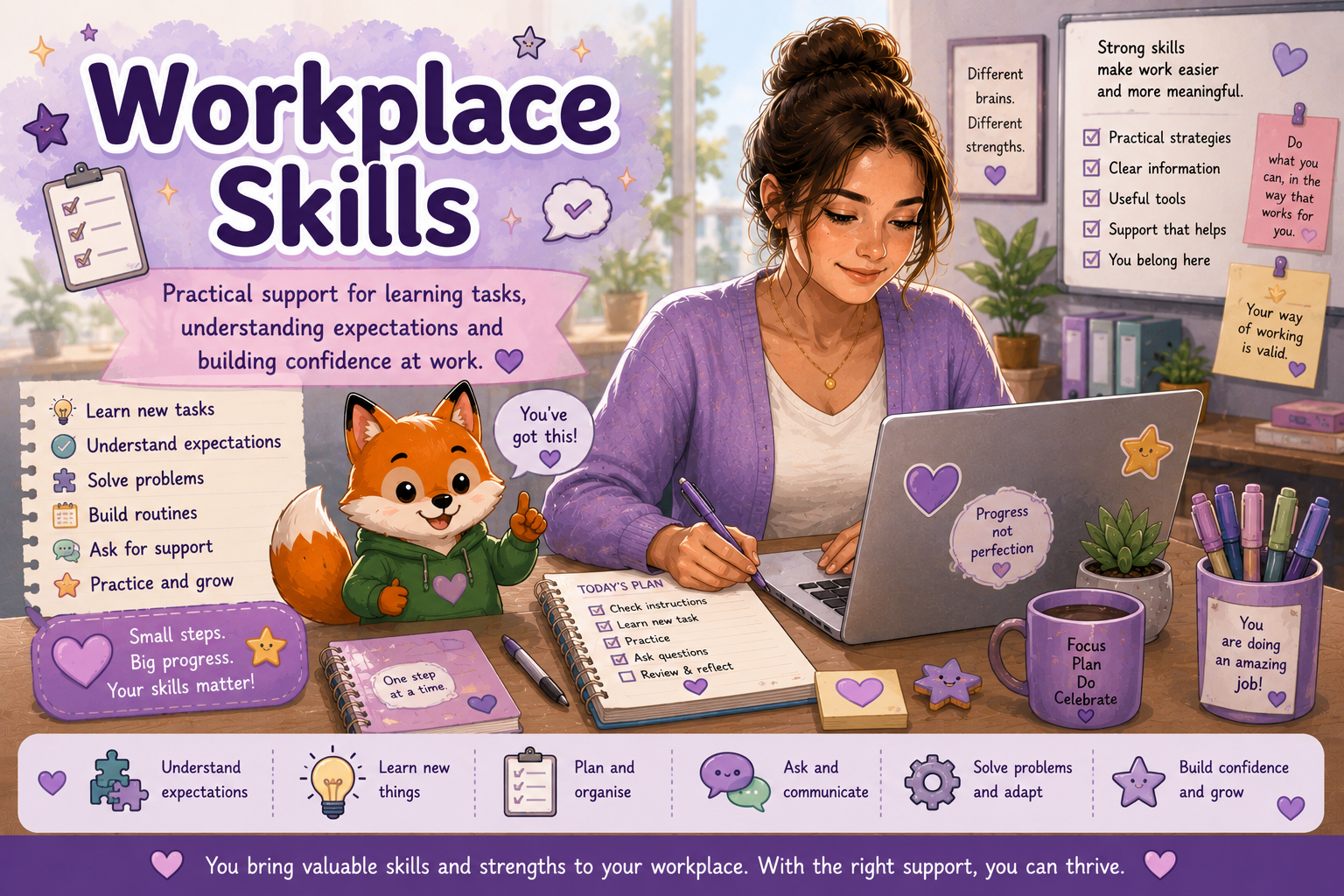
Workplace Skills
Workplace skills are not just about knowing how to complete a job. They can include understanding expectations, learning new tasks, communicating when something is unclear, solving everyday problems and finding ways to work that support your brain.
This page offers practical, neurodivergent-friendly ideas for building workplace skills one manageable step at a time.
🔎 Find Workplace Skills Support
Search this page for topics such as instructions, expectations, feedback, problem-solving, routines or confidence.
What Can Workplace Skills Include?
Different workplaces and roles use different skills. You may already have many of these strengths while needing more support in other areas.
Learning New Tasks
Understanding a new task, watching it being demonstrated, practising and finding the learning method that works best for you.
Understanding Expectations
Knowing what needs to be done, what the priority is and how your work will be completed or reviewed.
Following Instructions
Using written steps, checklists, demonstrations or other tools to make instructions easier to understand and remember.
Building Work Routines
Creating repeatable steps and practical routines that make everyday work tasks easier to start and complete.
Problem-Solving
Identifying what is happening, exploring possible options and deciding on a practical next step.
Building Confidence
Recognising progress, practising skills and allowing confidence to grow through experience rather than expecting instant perfection.
Understanding Workplace Expectations
Workplace expectations are not always explained clearly. Some may be written down, while others are assumed or communicated informally.
❓ When Expectations Feel Unclear
You may find yourself wondering:
- Which task should I do first?
- When exactly is this due?
- How detailed does this need to be?
- Am I allowed to ask for help?
- How will I know when the task is finished?
- Is this an instruction or just a suggestion?
📝 Information That May Help
- A clear description of the task.
- The priority or order of tasks.
- A specific deadline or time frame.
- An example of a completed task.
- Written instructions or a checklist.
- Knowing who to ask if something changes.
💡 Learning a New Task
New tasks can become easier when the learning process is broken into smaller stages. You do not have to remember everything after hearing it once.
See
Watch a demonstration or look at an example.
Clarify
Ask about anything that is unclear or uncertain.
Break It Down
Turn the task into smaller steps or a checklist.
Practise
Try the task and use the supports that help you.
Review
Notice what worked and what may need adjusting.
💬 Asking for Clarification
Asking a question can prevent confusion and help you complete a task more accurately. If finding the words is difficult, a prepared sentence may help.
🦊 Problem-Solving at Work
Problems do not always mean that you have failed. Sometimes they are information that something needs to be clarified, changed or approached in another way.
Finn Fox's Problem-Solving Questions
- What is happening?
- What part is making this difficult?
- What information am I missing?
- What could I try next?
- Do I need to ask someone for help?
- What can I learn for next time?
🌱 Possible Next Steps
- Check the instructions again.
- Break the task into smaller steps.
- Look at a previous example.
- Ask a specific question.
- Write down the problem before discussing it.
- Try a different strategy or tool.
- Take a short reset if stress is making thinking harder.
Working With Feedback
Feedback can sometimes feel confusing, vague or emotionally difficult. Clear and specific information can make feedback more useful.
Listen or Read
Give yourself time to process the information. Written feedback may be easier to revisit later.
Clarify
Ask for a specific example or a clear description of what needs to change.
Identify the Next Step
Turn feedback into one or two practical actions rather than trying to change everything at once.
Meet Your Workplace Skills Companions
Different Aspie Answers companions can support different parts of workplace learning, planning and skill-building.
Finn Fox
Finn is the lead companion for Workplace Skills, supporting problem-solving, independence and finding practical ways forward.
Buzzy Brain
Buzzy Brain supports memory, focus, processing instructions and understanding how executive function can affect workplace tasks.
Busy Bee
Busy Bee encourages manageable goals, practice, motivation and recognising the small wins that build confidence.
Helpful Workplace Skills Resources
These are some of the practical resources planned for the growing Aspie Answers Work & Employment library.
📋 My Workplace Skills Profile
Identify current skills, strengths and areas where support may help.
💡 Learning a New Task
Break a new workplace task into clear, manageable learning steps.
🧩 Workplace Expectations Checklist
Clarify priorities, deadlines, instructions and task expectations.
🦊 Workplace Problem-Solving Sheet
Use Finn Fox's practical questions to explore a workplace challenge.
⭐ My Strengths at Work
Recognise skills, qualities, interests and strengths you bring to work.
🌱 Daily Work Reflection
Notice what worked, what felt difficult and what may help next time.
📚 Workplace Foundations Collection
A future Aspie Answers Workplace Foundations collection is planned to bring practical workplace skill-building resources together in one supportive set. This will form part of the wider Neurodivergent Work & Employment Collection.
Classic Edition
Clear and practical workplace worksheets, checklists and planning tools.
Companion Edition
Guided workplace skill-building with Finn Fox and supporting Aspie Answers companions.
Kawaii Edition
A colourful, friendly visual edition using gentle kawaii design and engaging practical tools.
Continue Exploring Work & Employment
Workplace skills connect with job preparation, communication, executive function and wellbeing.
Small Steps. Real Skills. Your Progress Matters.
Workplace skills can be learned, practised and adapted. You are allowed to use tools, ask questions and find strategies that make work clearer and more manageable for you.