
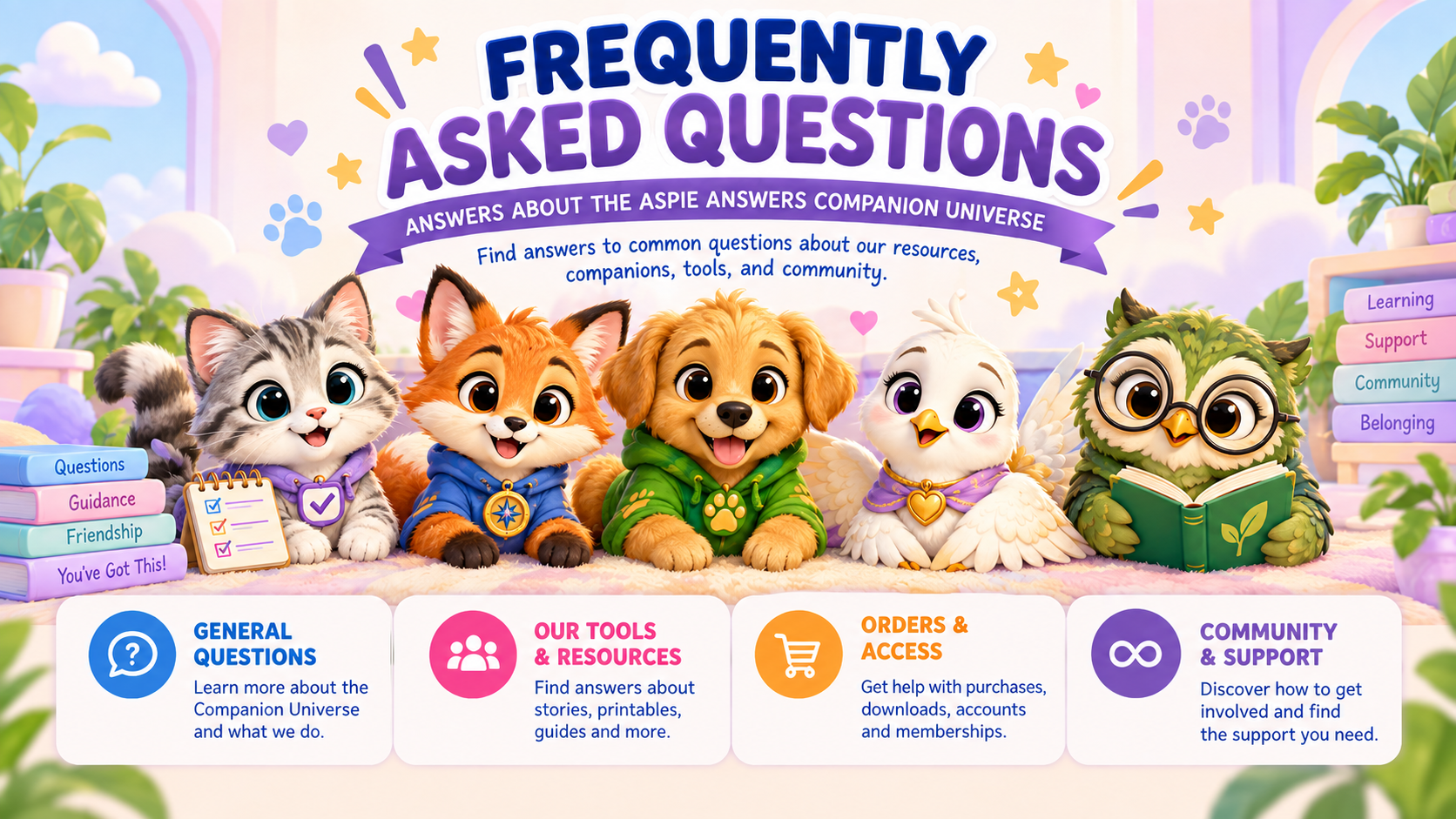
Friendly answers in one place
Frequently Asked Questions
Find clear answers about the official Companions, teams, resources, accessibility, audience pathways and how the Aspie Answers Companion Universe works.
Showing all questions.

Getting Started
Helpful answers for visitors who are new to the Companion Universe.
What is the Aspie Answers Companion Universe?
It is the home of fourteen official Aspie Answers Companions who help visitors explore planning, learning, emotional wellbeing, everyday life, rest, problem-solving and other useful pathways across Aspie Answers.
Where should I begin?
You can begin with the Welcome page, explore the Companion Universe Map, meet the Companions, or open How the Companions Help to start with the kind of support you need.
Do I need to learn about every companion first?
No. You can meet one companion, choose one team, follow one goal or begin with a resource that feels relevant today.
Is the Companion Universe only for children?
No. The companions can support resources for children, teenagers, adults, families, educators, support workers and professionals. The tone and design may change depending on the audience.
About the Official Companions
Answers about identities, roles and official profile guides.
How many official Companions are there?
There are fourteen official Companions: Checklist Cat, Busy Bee, Calendar Cat, Buzzy Brain, Finn Fox, Olive Owl, Twinkle Owl, Luna Bunny, Toby Turtle, Ollie Octopus, Scout, Maple Cat, Flutter Butterfly and Hope. Busy Bee is gender-neutral, and Hope is the official dove Companion.
Does every companion have a different role?
Yes. Each companion has their own personality, strengths, core role and areas where they help. Some roles overlap naturally when companions collaborate.
What information will be included on a companion profile page?
Profiles may include a biography, personality, favourite saying, superpower, fun facts, areas they help with, where visitors may find them, team membership and related resources.
Where does the information for each profile come from?
Detailed Companion reference material keeps biography, personality, visual identity, role and areas of help consistent. Website profile pages then present the parts that are most useful for visitors.
Will the Companions stay visually consistent?
Yes. Different scenes can change pose, expression, background and suitable props, while each Companion keeps their recognisable species, colours, personality, role and key visual identity.
Companion Teams
How the companions work together around shared purposes.
What are the official Companion teams?
There are four official teams: the Executive Function Team — Busy Bee, Checklist Cat, Buzzy Brain and Calendar Cat; the Learning Team — Olive Owl, Finn Fox and Twinkle Owl; the Emotional Wellbeing Team — Scout, Hope, Maple Cat and Flutter Butterfly; and the Rest & Wellbeing Team — Luna Bunny and Toby Turtle. Ollie Octopus remains one of the fourteen official Companions and works across suitable pathways rather than being forced into one of the four teams.
Can companions work with members of another team?
Yes. Companions can work across teams when a guide, resource or activity genuinely needs more than one kind of support. The aim is to preserve each Companion’s established role rather than add extra characters unnecessarily.
Does every activity need a whole team?
No. A resource may use one Companion, a natural pair, or a team depending on what genuinely fits the activity. The four official teams provide structure without forcing every topic into a group.
Are the team banners the official character references?
No. Team banners are supporting scenes. Each Companion’s established individual identity remains the reference for how they should look and be represented.
Resources, Guides and Downloads
How companions may appear in practical Aspie Answers resources.
What kinds of resources may feature the companions?
Companions may appear in planners, calendars, checklists, worksheets, guides, workbooks, journals, posters, cards, activities, books, printable packs and suitable interactive tools.
Will every resource use all fourteen companions?
No. Resources should feature the companion or team whose role best matches the topic, audience and purpose.
Will resources be available in different editions?
Where they genuinely fit, resources can use Classic, Plain, Family, Kawaii, Companion, Teacher, Support Worker, Healthcare, Easy Read, Large Print, Low Ink, Black & White or interactive editions.
Where can I find current resources?
Use the Aspie Answers Resource and Downloads Library to browse available resources and collections.
Will some resources be free and others paid?
Yes. Aspie Answers resources can include free downloads as well as paid resources, books, workbooks and products.
Website and Navigation
How the Companion Universe connects with the wider Aspie Answers website.
Do the Companions only appear inside the Companion Universe?
No. Companions can also appear where their role genuinely fits across relevant hubs, resources, books, activities, member content and digital tools.
Why are only some Companion pages shown in the main navigation?
The main navigation is kept concise so it stays easier to scan. Deeper Companion pages can be reached through the Companion Universe Hub, the Universe Map, profiles and contextual links.
How can I find a deeper Companion page?
Start with the main Hub, Meet the Companions, Meet the Teams, How the Companions Help or the Universe Map.
Can Companion pages link into the wider Aspie Answers website?
Yes. Companion pathways can lead into relevant areas such as Neurodiversity, Mental Health, Everyday Help, Learning, Work, Support, Accessibility and the Resource Library when those connections are useful.
Parents, Families, Educators and Professionals
How Companion resources can be adapted for different audiences.
Can families use Companion resources?
Yes. Family-friendly resources can support routines, communication, planning, emotional wellbeing and everyday practical needs.
Can teachers and educators use Companion resources?
Yes. Suitable resources can be adapted for classroom tools, visual supports, learning activities and inclusive educational guidance.
Can support workers and professionals use them?
Yes. Appropriate resources can support communication, planning, meetings, daily living and collaborative support while keeping the individual’s needs and choices central.
Can one resource be useful for more than one audience?
Yes. A resource may work for several audiences, but the page or resource should make its intended use clear rather than assuming one format suits everyone.

Accessibility and Inclusive Design
How the website aims to support different access needs.
Is the Companion Universe designed with accessibility in mind?
Yes. Page layouts aim to use clear headings, readable spacing, strong contrast, descriptive links, meaningful alt text, large touch targets and responsive designs.
Can the FAQ page be used with a keyboard?
Yes. The search box, category links, disclosure questions and navigation buttons are designed to be keyboard accessible.
What happens for visitors who prefer reduced motion?
The page respects reduced-motion preferences and removes non-essential reveal and smooth-scrolling effects.
Will there be Easy Read, Large Print or low-ink resources?
Suitable resources can use Easy Read, Large Print, Low Ink and other accessible editions when those formats genuinely help. Not every resource needs every edition.
Can Companion content use audio or translated formats?
Audio, text-to-speech, voice and multilingual formats can be useful when they improve access. They should be added thoughtfully, with readable text and other accessible alternatives still available.
How the Companion Universe Can Grow
More ways to explore the official Companions without losing their established identities.
Can the Companion Universe grow beyond the current pages?
Yes. The current official fourteen Companions can support new stories, activities, resources, learning experiences and accessible digital tools while keeping their established roles and identities consistent.
Could new characters ever be explored?
The current official roster is the fourteen Companions shown across the Companion Universe. Any future character would need a clear purpose and would only become official after it had been deliberately developed and approved.
Can there be Companion stories and adventures?
Yes. Stories, everyday scenarios, activities and learning journeys can give the Companions more ways to support their established roles.
Can apps, audio or animation use the Companions?
Yes, where the Companion role genuinely adds value. Digital experiences should remain accessible, lightweight and compatible with reduced-motion and Low-Stim needs.
Can human characters appear alongside the Companions?
Yes. Semi-realistic human characters can provide relatable everyday examples alongside the Companions without replacing the official Companion identities.
Character Consistency
How the Companions stay familiar across different scenes and resources.
What stays consistent about each Companion?
Each Companion keeps their recognisable species, colours, markings, established identity, personality, key accessories and core role.
What can change between illustrations?
Pose, expression, background, scene and suitable props can change. Clothing can vary only where it still preserves the established character identity.
What if a group scene looks slightly different from an individual profile?
Group scenes are supporting illustrations. The Companion’s established individual identity should remain the guide for future artwork and resources.
Why does consistency matter?
Familiar characters are easier to recognise and trust. Consistency also helps the same Companion role make sense across pages, resources, books, activities and digital tools.
Support, Crisis Information and Contact
Important distinctions between friendly guidance and professional support.
Do the companions replace professional support?
No. The companions are educational and supportive guides. They do not replace healthcare professionals, emergency services, qualified support providers or personalised professional advice.
Will the Companions appear throughout Crisis Support?
Usually not as the main visual focus. Crisis information should stay direct and centred on immediate safety and professional help. Companions may appear carefully in preventative coping or grounding resources where appropriate. Open Crisis Support.
Where can I find organisations and ongoing support options?
Use Support & Directories for organisations, services, community support, advocacy and other ongoing pathways.
How can I ask a question that is not answered here?
Use the Aspie Answers contact pathway, or return to the Companion Universe Hub and explore the related pages.

Can’t find the answer you need?
Try a shorter search word, browse a category above, visit the Companion Universe Hub, or use the related links below.
Continue exploring
Choose your next Companion Universe page
Still have a question?
Explore the Companion Universe Hub, browse the resources, or use the contact pathway if your question is not covered here.