
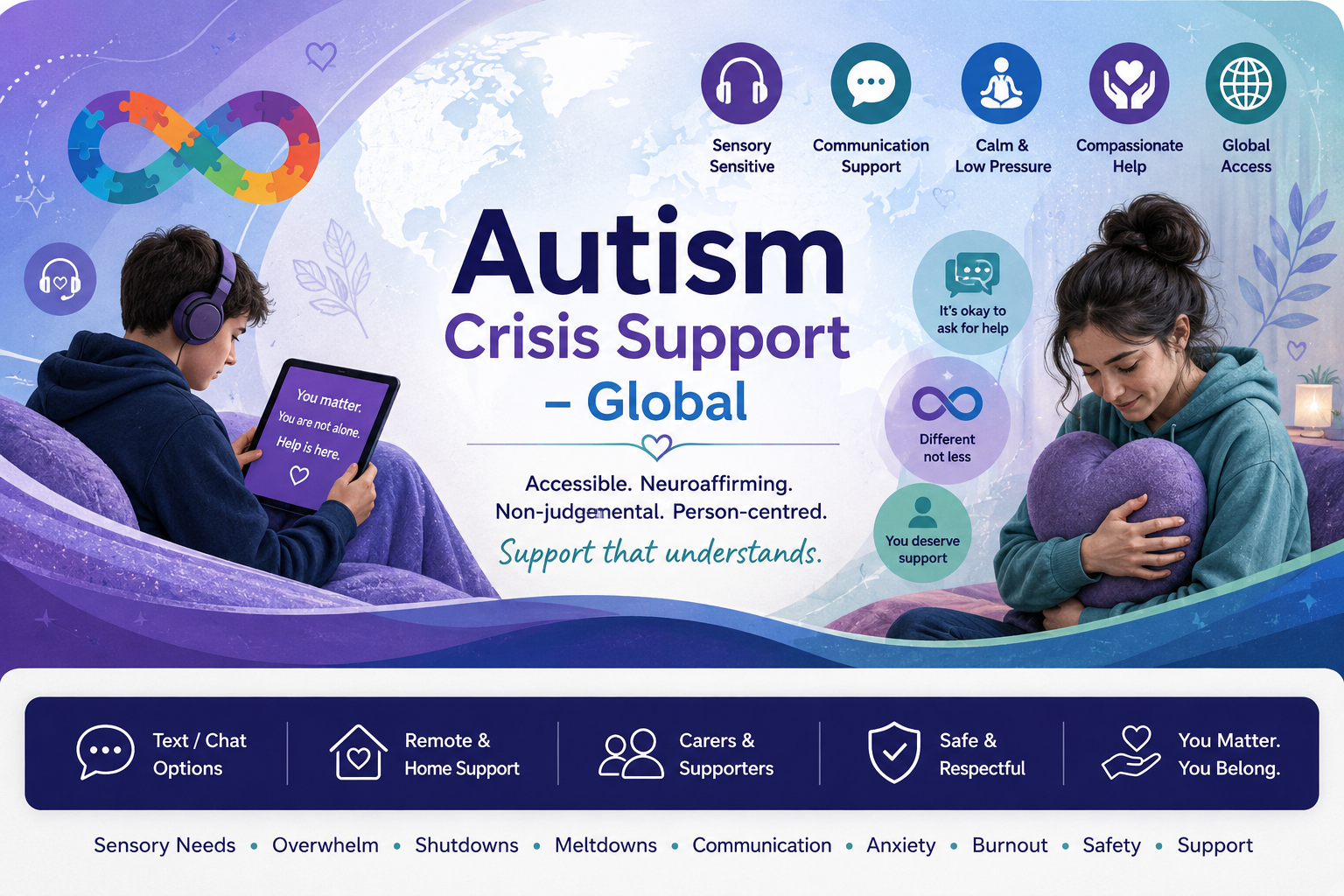
Autism Crisis Support – Global
A calm starting point for autistic people, families, carers, teachers, support workers, and professionals looking for safer crisis pathways. This page recognises sensory overwhelm, shutdowns, meltdowns, burnout, communication barriers, masking, trauma, and the need for low-pressure support.
If you need help right now
If you or someone else is in immediate danger, at risk of harm, or unable to stay safe, contact local emergency services now.
- New Zealand: 111
- Australia: 000
- United States / Canada: 911
- UK: 999 or 112
- Europe: 112
Gentle note
Autistic crisis can look different for each person. Someone may be silent, panicked, frozen, pacing, crying, angry, masking, unable to explain, or overwhelmed by sensory input. Support should focus on safety, dignity, communication access, and reducing pressure.
Quick pathways
Choose the pathway that feels closest to what is happening right now. You can always move to another option if the first one does not fit.
I need emergency help now
Use local emergency services first if there is immediate danger, medical risk, violence, suicide risk, or someone cannot stay safe.
Open emergency numbersI need text or chat support
Text, chat, online messaging, or relay-style support may feel safer if speaking on the phone is too hard.
Open text/chat supportI need autism-aware access support
Find support options that consider sensory needs, communication barriers, shutdown, meltdown, and processing time.
Open accessibility supportSearch & filter autism crisis pathways
Use this section to quickly find the type of support pathway you are looking for.
Sensory overwhelm
Support for autistic people who are overwhelmed by noise, light, touch, crowds, smells, pain, or too many demands at once.
Open sensory supportShutdowns & meltdowns
Support for moments when someone cannot speak, cannot process, feels out of control, or needs safety without shame.
Open shutdown/meltdown supportAutistic burnout
Burnout can make communication, daily tasks, safety planning, and asking for help feel much harder. Gentle support matters.
Open burnout supportText, chat & non-phone support
Useful if speaking is hard, phone calls feel unsafe, or written communication is easier during distress.
Open text/chat optionsCommunication access
Support for autistic people who use AAC, written notes, text, support people, scripts, visuals, or extra processing time.
Open access supportParents, carers & whānau
Guidance for families and carers supporting an autistic person through distress, overwhelm, shutdown, meltdown, or urgent safety concerns.
Open carers supportTeachers & education staff
Support for school staff, teachers, learning support teams, and education professionals responding to autistic student distress safely.
Open education supportMedical & health professionals
A pathway for doctors, nurses, counsellors, therapists, allied health workers, and mental health teams supporting autistic people in crisis.
Open professional supportSupport workers & navigators
For disability support workers, peer supporters, advocates, social workers, and community helpers supporting an autistic person in distress.
Open community supportFind support by location
Start with your country or region if you need emergency numbers, crisis helplines, or local support pathways.
Open location hubLow-demand safe space
Support may need to begin with reducing noise, light, touch, questions, instructions, and social pressure.
View autism support needsSimple scripts
Short phrases can help when explaining everything feels too hard or speech is unreliable during distress.
View scriptsAutistic crisis needs this page recognises
Autistic crisis is not always obvious from the outside. Support should look at sensory load, communication access, safety, trauma, masking, and the person’s usual support needs.
Sensory overload
Noise, light, touch, smell, crowds, pain, or too many demands can push the nervous system past capacity.
Shutdown
A person may become quiet, frozen, unable to speak, unable to move, or unable to respond quickly.
Meltdown
A meltdown is a distress response, not bad behaviour. The person needs safety, space, and reduced pressure.
Burnout
Long-term masking, stress, demands, trauma, or lack of support can lead to deep exhaustion and reduced capacity.
Autism-aware support starts with reducing pressure
Before asking lots of questions, try lowering sensory input, slowing down, offering written options, giving space, and checking whether the person wants a trusted supporter involved.
Communication access during autistic crisis
During distress, an autistic person may lose speech, struggle to process questions, repeat words, freeze, panic, or need extra time. This does not mean they are refusing help.
If speaking is hard
- Use text, chat, written notes, AAC, or visuals if available.
- Ask yes/no or choice-based questions.
- Allow silence and processing time.
- Ask if a trusted person can help communicate.
- Use emergency services if there is immediate danger.
If explaining is hard
- Start with the most urgent safety need.
- Use short statements instead of full explanations.
- Ask for information to be written down.
- Ask people to slow down and repeat key steps.
- Move to a quieter space if possible.
Simple phrase someone can use
“I am autistic and I am in crisis. I may need less noise, extra time, written information, or help from a trusted person.”
For parents, carers, whānau, friends, and supporters
If you are supporting an autistic person in crisis, the goal is safety, calm, dignity, and reducing overwhelm.
Helpful things to do
- Use calm, simple language.
- Reduce noise, light, crowding, and demands.
- Offer choices instead of pressure.
- Ask what communication method is easiest.
- Allow space and processing time.
- Contact emergency help if safety is at risk.
Things to avoid
- Do not shame, threaten, argue, or crowd the person.
- Do not demand eye contact or quick answers.
- Do not treat sensory distress as bad behaviour.
- Do not remove coping tools unless there is immediate danger.
- Do not assume silence means they are ignoring you.
Supporter pathway
If you are unsure what to do, choose the safest immediate option first, then use text/chat, accessibility, location, or professional support pathways.
Open carers supportFor professionals and frontline helpers
Autistic people may need crisis support that is sensory-aware, communication-accessible, trauma-informed, and flexible enough to reduce escalation rather than increase it.
Ask access questions
- “What helps you communicate right now?”
- “Would written information help?”
- “Do you need a quieter space?”
- “Is there someone you trust who can help?”
Reduce escalation risks
- Use plain language.
- Give one step at a time.
- Allow extra processing time.
- Reduce sensory demands where possible.
- Avoid unnecessary restraint, shame, or confrontation.
Professional pathway
Use professional support pages for safeguarding, referral, crisis response, accessibility, and follow-up planning.
Open professional supportWhere to go next
This page connects into the wider Aspie Answers crisis support structure. Use these links to move into related support pathways.
Neurodivergent Crisis Support
Return to the main neurodivergent crisis support doorway.
Open neurodivergent supportSensory Overwhelm Crisis Support
For sensory overload, environmental distress, and low-demand safety support.
Open sensory supportShutdown & Meltdown Crisis Support
For moments when someone cannot process, cannot speak, feels overwhelmed, or needs safety without shame.
Open shutdown/meltdown supportText / Chat Crisis Support
Use text, chat, or online options if speaking on the phone feels too hard.
Open text/chat supportAccessibility-Specific Crisis Support
Find crisis support pathways focused on access needs, disability barriers, communication, and inclusive support.
Open accessibility supportCrisis Support by Location
Find crisis support by country, region, or wider location pathway.
Open location hubParents & Carers Crisis Support
For people supporting someone else through crisis, distress, overwhelm, or urgent safety concerns.
Open carers supportMedical & Health Professionals
For professionals supporting autistic people safely during crisis or urgent distress.
Open professional supportCrisis Support Main Index
Return to the main crisis support hub and choose a broader pathway.
Open main indexAutistic people deserve crisis support that is calm, accessible, respectful, sensory-aware, and communication-friendly. If one pathway does not feel right, it is okay to try another option, ask someone trusted to help, or use emergency services if safety is urgent.