
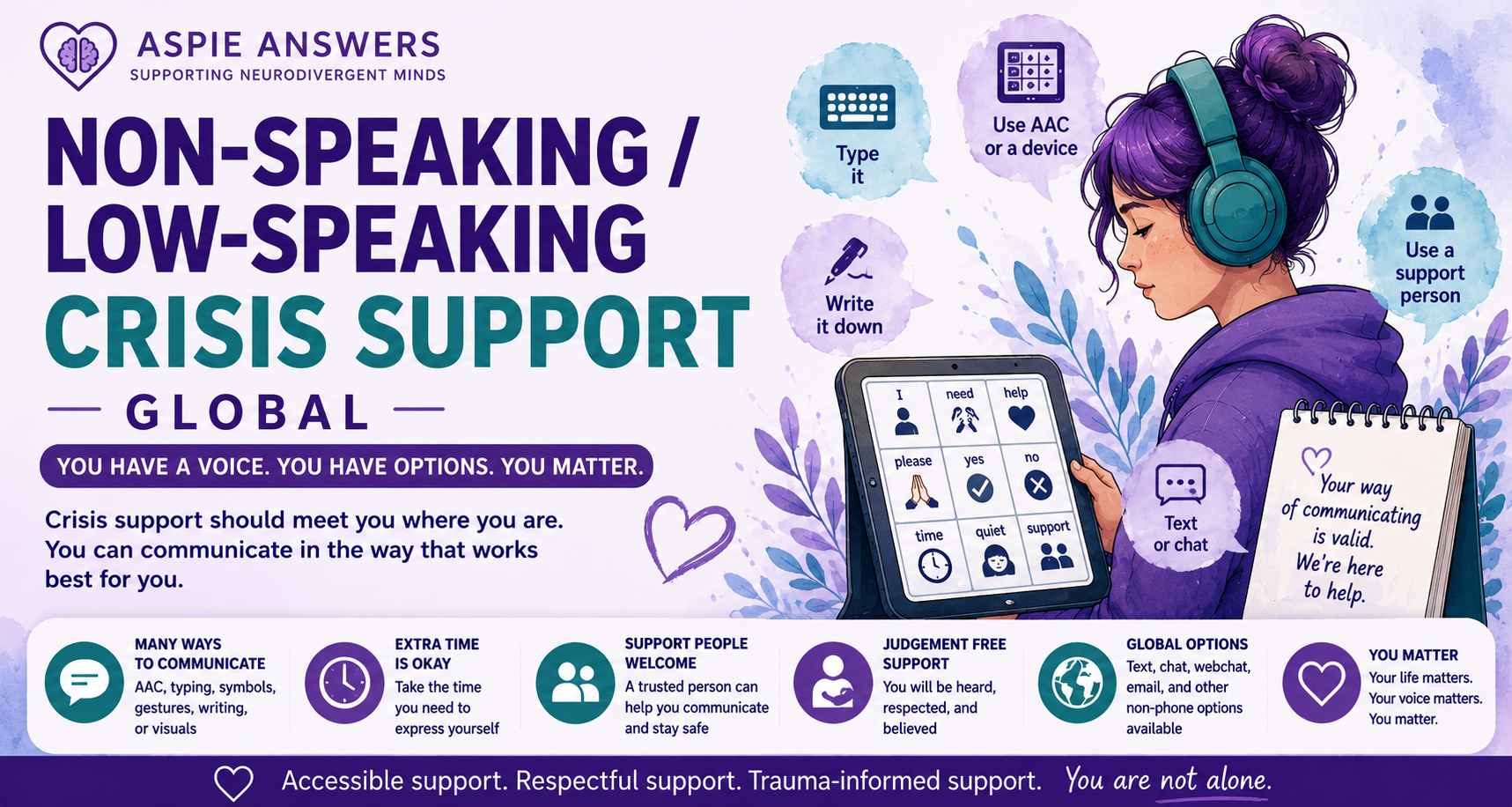
Non-Speaking / Low-Speaking Crisis Support – Global
A calm support page for people who are non-speaking, low-speaking, intermittently speaking, unreliably speaking, or unable to speak during crisis, shutdown, sensory overwhelm, trauma, panic, pain, fatigue, or distress.
If there is immediate danger
If you or someone else is in immediate danger, medically unsafe, at risk of serious harm, or unable to stay safe, contact local emergency services now.
- New Zealand: 111
- Australia: 000
- United States / Canada: 911
- UK: 999 or 112
- Europe: 112
Gentle reminder
Not speaking does not mean not understanding. Low speech, lost speech, AAC, typing, gestures, visuals, or support-person communication should be respected. Your way of communicating is valid.
Quick pathways
Choose the option that best fits what is happening right now.
I cannot speak right now
Use typing, writing, AAC, gestures, pointing, saved messages, or ask a trusted person to help communicate.
Open communication accessI need non-phone support
Use text, chat, webchat, email, relay, or messaging options if phone calls are not accessible.
Open text/chat supportI am overwhelmed or shut down
Use sensory, shutdown, meltdown, and trauma-informed pathways if speech has become harder during distress.
Open shutdown/meltdown supportSearch & filter support pathways
Use this section to quickly find the support pathway that fits your situation.
AAC and communication devices
Support for people who use AAC apps, devices, picture boards, symbol cards, or prepared messages.
Open communication accessTyping, writing, or pointing
Typing on a phone, writing a note, pointing to words, or using saved messages can be easier than speech.
Using a support person
A trusted person can help explain needs, share access information, or support communication with crisis services.
Loss of speech during overload
Speech can disappear or become unreliable during shutdown, meltdown, panic, trauma, pain, or sensory overwhelm.
Open sensory supportText, chat, and non-phone support
Useful if phone calls are inaccessible, unsafe, overwhelming, or not possible.
Open text/chat supportFind help by location
Use the location hub to find emergency numbers, crisis helplines, and regional pathways.
Open location hubCommunication needs during crisis
Some people do not use speech. Some people speak sometimes but lose speech during stress. Some people can speak but cannot reliably explain what they need in crisis. Support should adapt to the person.
Speech may change
Someone may become non-speaking or low-speaking during overwhelm, pain, fear, or shutdown.
AAC must stay available
Communication devices, cards, or tools should not be removed unless there is immediate danger.
Understanding still matters
Do not assume someone does not understand because they are not speaking.
Time helps
Extra processing time can make communication safer and clearer.
AAC and alternative communication options
Different people communicate in different ways. In crisis, support should respect the easiest and safest communication method available.
AAC tools
- Communication devices or tablets
- AAC apps
- Picture boards or symbol cards
- Printed emergency cards
- Prepared crisis messages
Low-tech options
- Writing on paper
- Typing on a phone
- Pointing to words or pictures
- Thumbs up/down or gestures
- Yes/no cards
Support-person options
- A trusted person explains access needs
- Someone helps type or read messages
- A carer shares a crisis plan
- An advocate helps communicate safely
Helpful reminder
A person’s communication method is not optional extra support — it may be the only way they can safely ask for help.
Non-speaking / low-speaking support by country / region
Some crisis services offer text, chat, webchat, relay, or other non-phone options. Availability can change, so always check the official service page for the most current details.
New Zealand
In an emergency, call 111. For mental health support, 1737 can be called or texted within New Zealand, which may help when speaking out loud is not possible.
Australia
In an emergency, call 000. Some Australian crisis and support services offer phone, text, or online chat options depending on the service.
United States
In an emergency, call 911. The 988 Lifeline offers call, text, chat, and access options for Deaf and Hard-of-Hearing people.
Canada
In an emergency, call 911. Some Canadian crisis pathways may include phone, text, or chat options depending on the service and region.
United Kingdom
In an emergency, call 999 or 112. Some UK support services offer text, webchat, or non-phone pathways for people who cannot call.
Ireland
In an emergency, call 112 or 999. Some Irish crisis services may offer text or online support options for people who find phone calls difficult.
Europe
In many European countries, 112 is the emergency number. Check your country’s local services for chat, text, relay, or accessible communication options.
International / worldwide
If you are outside these countries, use the location hub to look for local text, chat, phone, or accessible support options.
Open location hubIf phone support is not accessible
Look for text, chat, relay, webchat, email, interpreter, Easy Read, AAC, or support-person options. In immediate danger, use the safest emergency contact method available.
Simple crisis scripts
These scripts can be copied, saved, printed, or adapted for yourself or someone you support.
If you cannot speak
“I cannot speak right now. I need help. Please let me type, write, point, or use AAC.”
If you use AAC
“I use AAC to communicate. Please do not take my device or communication tools away.”
If speech is unreliable
“I may speak sometimes, but I cannot explain clearly right now. Please give me time and written options.”
If you need a support person
“This person helps me communicate. Please include them so I can understand and be understood.”
For family, carers, support people, and professionals
Non-speaking, low-speaking, or unreliable speech should be treated with respect. The person still has rights, preferences, understanding, and a valid way of communicating.
What helps
- Offer AAC, typing, writing, visuals, or gestures.
- Ask one question at a time.
- Give processing time.
- Respect support people and communication tools.
What to avoid
- Do not assume silence means refusal.
- Do not talk over the person.
- Do not remove AAC or communication tools.
- Do not pressure speech if another method works better.
When urgent help is needed
If someone cannot stay safe, may harm themselves or someone else, is medically unsafe, missing, or in immediate danger, use emergency or crisis support immediately.
Where to go next
This page connects into the wider Aspie Answers crisis support structure.
Communication Access Crisis Support
For AAC, text, writing, Easy Read, plain language, support people, and non-phone options.
Open communication accessText / Chat Crisis Support
For non-phone support pathways and lower-pressure ways to reach out.
Open text/chat supportShutdown & Meltdown Crisis Support
For crisis moments involving loss of speech, overwhelm, panic, shutdown, or meltdown.
Open shutdown/meltdown supportTrauma-Informed Neurodivergent Crisis Support
For calmer, safer, consent-aware, dignity-focused support.
Open trauma-informed supportAccessibility-Specific Crisis Support
For crisis support adapted around disability, sensory, communication, and access needs.
Open accessibility supportSupport & Directories Hub
For ongoing support, organisations, services, groups, and non-urgent contacts.
Open support directories