
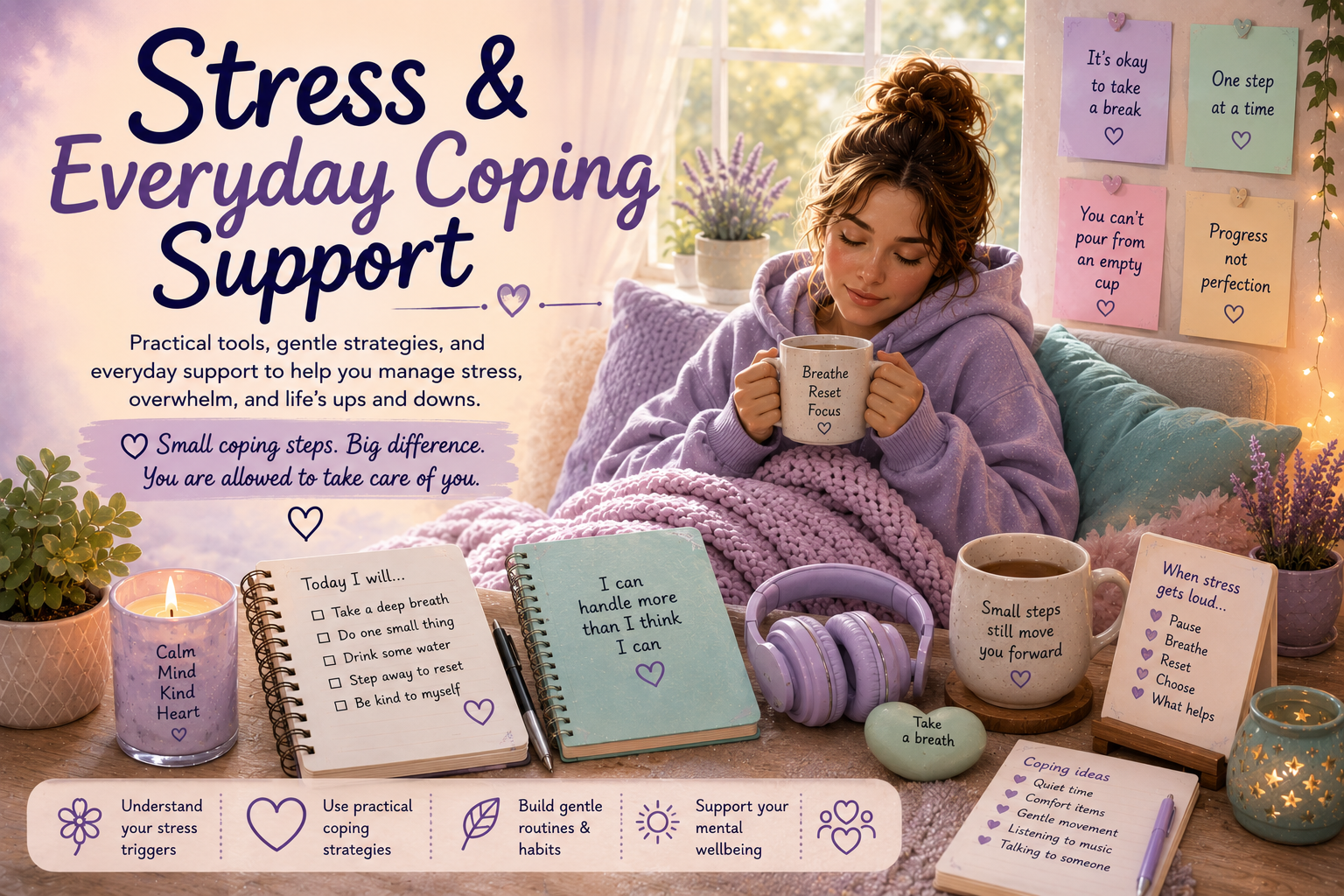
Stress & Everyday Coping Support
Practical tools, gentle strategies, and everyday support for managing stress, overwhelm, daily pressures, emotional load, and life’s ups and downs.
What everyday stress can feel like
Stress can build up slowly or arrive all at once. It may come from responsibilities, uncertainty, sensory input, relationships, work, school, health, money, routines, or simply too much happening at the same time.
Too much to hold
You may feel like your brain is full, your body is tense, and even small tasks feel heavier than usual.
Busy thoughts
Stress can make thoughts race, repeat, jump between tasks, or focus on everything that could go wrong.
Energy drain
Even ordinary daily life can use a lot of energy when your nervous system is already working hard.
Noticing what adds pressure
Stress triggers are not always dramatic. Sometimes they are small repeated pressures that stack up throughout the day.
| Trigger area | What it might look like | Gentle support |
|---|---|---|
| Tasks | Too many things to do, unclear steps, unfinished jobs, or decision fatigue. | Write one next step or use a small checklist. |
| Sensory input | Noise, light, clutter, smells, crowds, or too much movement around you. | Reduce input, use headphones, dim lights, or change spaces. |
| People pressure | Messages, expectations, conflict, appointments, or needing to explain yourself. | Use a short script, pause replies, or ask for time. |
| Uncertainty | Changes, waiting, unclear plans, money worries, or not knowing what happens next. | Make a tiny plan for what you can control right now. |
How stress can show up in the body
Your body may notice stress before your mind has words for it. These signs are information, not failure.
Fast or tight feelings
Racing heart, tight chest, shallow breathing, headaches, jaw tension, or stomach discomfort.
Restless or frozen
Fidgeting, pacing, feeling stuck, zoning out, struggling to start, or feeling unable to settle.
Tired after coping
Stress can be exhausting. You may need rest, food, water, quiet, comfort, or lower demands.
Everyday coping tools that may help
Coping tools work best when they are realistic. Choose one small support that fits the moment.
Pause and breathe out
Take one slow breath out. You do not need perfect breathing — just a small pause.
Brain dump
Write down the noisy thoughts, tasks, or worries. Then circle one thing that needs attention first.
Comfort anchor
Use a warm drink, soft blanket, calming audio, fidget, or grounding object to help your body settle.
One-step list
Instead of a long list, write one next step only. Small coping steps can still move you forward.
Reduce input
Lower noise, dim light, reduce notifications, pause messages, or move to a less busy space.
Ask for support
Try: “I’m stressed and need a little help choosing the next step.”
Simple routines for stressful days
Routines can give the brain fewer decisions to make. Keep them gentle, flexible, and easy to restart.
Morning anchor
- Drink water.
- Open curtains or turn on soft light.
- Check one priority.
- Choose one supportive phrase for the day.
Evening reset
- Clear one small space.
- Write tomorrow’s first step.
- Lower stimulation where possible.
- Do one comfort activity before rest.
Reducing stress with small boundaries
Boundaries do not have to be harsh. They can be gentle limits that protect your energy, time, focus, and wellbeing.
Message boundary
“I’ve seen this and will reply when I have more capacity.”
Time boundary
“I can help for 20 minutes, then I need a break.”
Energy boundary
“I can’t do that today, but I can look at it later this week.”
Printable supports to connect later
This section can grow with stress check-ins, coping cards, routine planners, boundary scripts, and everyday support tools.
Stress Check-In Sheet
A gentle worksheet for triggers, body signs, support needs, and one next step.
Coming SoonEveryday Coping Cards
Simple reminders for calm pauses, grounding, boundaries, and small steps.
Coming SoonGentle Routine Planner
A low-pressure planner for morning anchors, evening resets, and stressful days.
Coming SoonSmall coping steps can make a big difference
You do not have to manage stress perfectly. Pause, breathe, lower one demand, choose one support tool, or reach out to someone safe.