
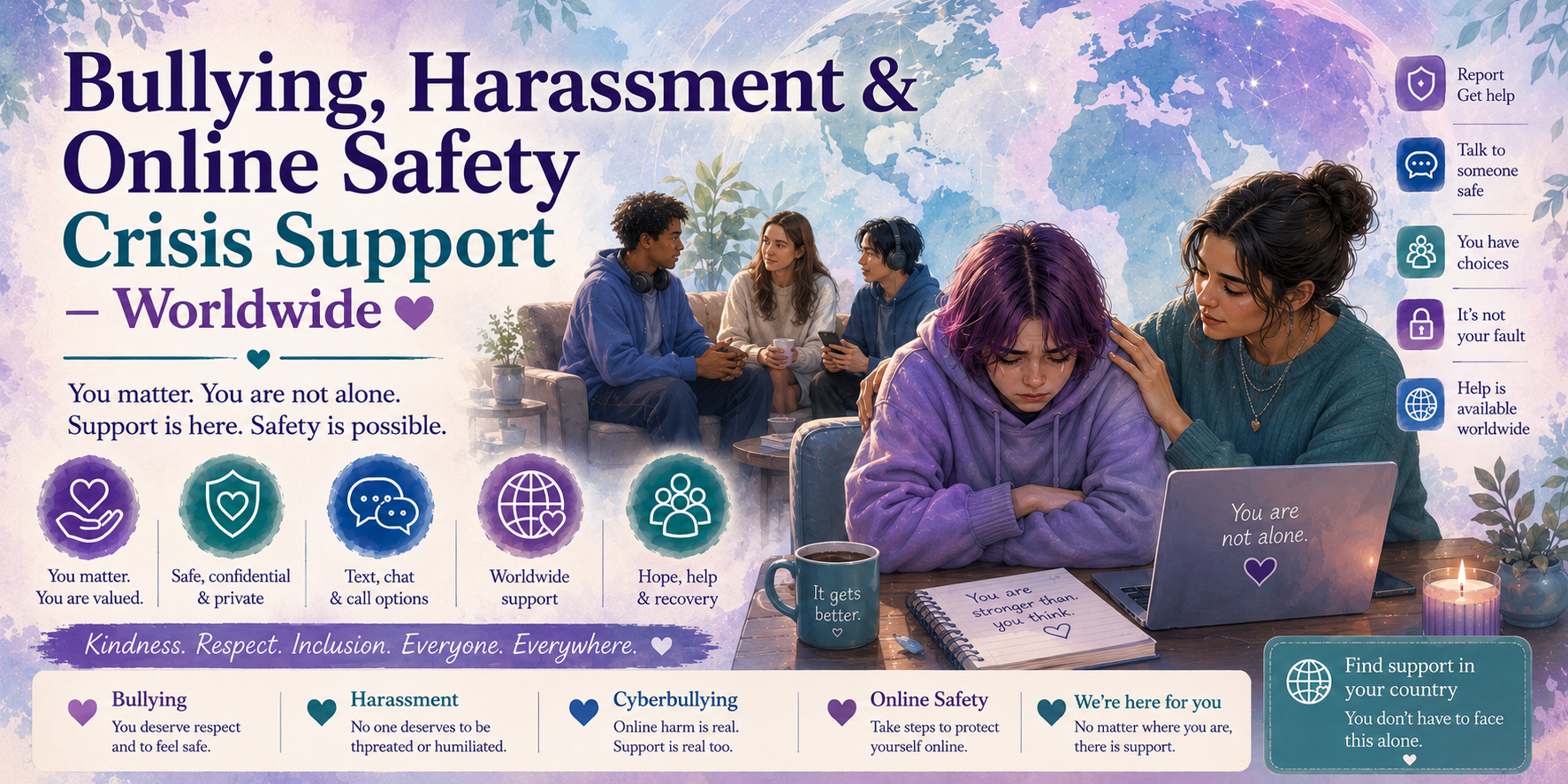
Bullying, Harassment & Online Safety Crisis Support – Worldwide
This page is for anyone dealing with bullying, harassment, cyberbullying, online threats, doxxing, stalking-style behaviour, hate messages, image-based harm, social media pile-ons, or feeling unsafe because of something happening online or offline.
Bullying and harassment can affect your mental health, safety, confidence, relationships, school, work, and sense of belonging. You deserve support that takes it seriously and helps you choose safer next steps.
If you are in immediate danger
If someone is threatening to harm you, sharing your location, stalking you, blackmailing you, encouraging self-harm, or you feel unable to stay safe, contact emergency services or a crisis line now.
- New Zealand: 111
- Australia: 000
- United States / Canada: 911
- UK / Europe: 999, 112, or your local emergency number
Gentle content notice
This page discusses bullying, harassment, cyberbullying, online abuse, threats, self-harm risk, reporting, evidence-saving, and safety planning. Please read slowly and pause if needed.
Online harm is real harm
If it is happening through messages, comments, group chats, games, social media, emails, images, or forums, it still counts. You are allowed to ask for help and protection.
You do not have to handle it alone
A trusted person, school, workplace, platform report system, helpline, police, cyber safety service, or crisis support can help depending on what is happening and how unsafe it feels.
Quick safety steps for right now
Choose the safest next step. You do not need to reply, explain yourself, or solve everything immediately.
Do not engage if it feels unsafe
If replying may escalate things, pause. You can mute, block, leave the chat, step away, or ask someone trusted to help you manage the messages.
Save evidence
If it is safe, screenshot messages, usernames, dates, links, threats, images, group chats, and profile details before blocking or deleting.
Tell someone safe
Tell a trusted person, teacher, manager, support worker, family member, helpline, cyber safety service, or emergency service if there is immediate risk.
One small safety plan
- Move away from the screen for a moment if you can.
- Save evidence if safe and possible.
- Block, mute, report, or tighten privacy settings if it helps.
- Tell one trusted person what is happening.
- Use emergency help if there are threats, stalking, blackmail, exploitation, or self-harm risk.
When bullying, harassment or online harm becomes a crisis
Bullying can become urgent when it affects safety, mental health, privacy, school/work attendance, housing, relationships, or physical wellbeing.
| Concern | What it may look like | Helpful next step |
|---|---|---|
| Threats or stalking | Threats of violence, repeated unwanted contact, location tracking, showing up in person, or fear that someone may harm you. | Contact emergency services or police if there is immediate danger. Save evidence if safe. |
| Doxxing or privacy harm | Your address, phone number, workplace, school, family details, private images, or personal information is shared without consent. | Document it, report to the platform, tighten privacy, and contact local cyber safety or police support if risk is high. |
| Image-based abuse or blackmail | Someone threatens to share private images, pressures you for images, or uses images to control, shame, or exploit you. | Do not pay or send more images. Save evidence and contact specialist support, police, or child protection if under 18. |
| Mental health crisis | You feel trapped, panicked, ashamed, unsafe, suicidal, or like you cannot cope with the bullying anymore. | Contact a crisis line, emergency service, or trusted person now. You deserve immediate support. |
If this is happening to you
If you are being bullied or harassed, it can make you feel powerless, embarrassed, angry, scared, or alone. The harm is not made smaller because it happened online.
Try this first
- Do not reply if it may make things worse.
- Save screenshots and links if safe.
- Block or mute the person if it helps you feel safer.
- Report the content to the platform, school, workplace, or service.
- Tell a trusted person and ask them to help you make a plan.
Copy-and-send message
“I’m being bullied/harassed and I don’t feel okay handling it alone. Can you help me save evidence, report it, and work out what to do next?”
If you are supporting someone else
Believe them, do not minimise it, and help them focus on safety, evidence, reporting, and emotional support.
What can help
- Say: “I’m glad you told me.”
- Help save screenshots and links.
- Help block/report if they want support doing that.
- Contact school, workplace, platform, police, or helpline if needed.
- Check if they feel safe with themselves and others.
What to avoid
- Do not say “just ignore it” if they feel unsafe.
- Do not blame them for being targeted.
- Do not share their screenshots publicly without consent.
- Do not confront the person if it may escalate danger.
- Do not leave self-harm or suicide comments unsupported.
Helpful phrase
“You do not deserve this. We can save what happened, get support, and work out the safest next step together.”
Worldwide bullying, harassment & online safety support contacts
Contact options can change, so check official service pages where possible. If there is immediate danger, use emergency services first.
New Zealand / Aotearoa
- Emergency: 111
- 1737: free call or text 1737 any time for counselling support
- Netsafe: support for online harm, cyberbullying, scams, harassment, and harmful digital communication
- Youthline: youth support by phone, text, webchat, and email where available
Australia
- Emergency: 000
- eSafety Commissioner: online safety reporting and support pathways
- Kids Helpline: 1800 55 1800 for children and young people
- Lifeline Australia: 13 11 14 for crisis support
United States
- Emergency: 911
- 988 Lifeline: call, text, or chat 988 for emotional distress and crisis support
- StopBullying.gov: bullying and cyberbullying information and reporting guidance
- NCMEC CyberTipline: for online exploitation or child sexual abuse material concerns
Canada
- Emergency: 911
- Kids Help Phone: call 1-800-668-6868 or text 686868
- 9-8-8 Canada: call or text 9-8-8 for suicide crisis support
- Cybertip.ca: reporting online sexual exploitation of children
United Kingdom
- Emergency: 999 or 112
- Childline: 0800 1111 for children and young people
- The Cyber Helpline: free support for cybercrime and online harm
- Samaritans: 116 123 for emotional crisis support
Ireland
- Emergency: 112 or 999
- Childline Ireland: support for children and young people
- Samaritans: 116 123
- Hotline.ie: reporting child sexual abuse material and related online harm
Europe
- Emergency: 112 in many European countries
- Better Internet for Kids / Safer Internet Centres: child online safety helplines and reporting routes in many European countries
- Local support: search for cyberbullying, online safety, victim support, school safety, or harassment services in your country
International / worldwide
- Find a Helpline: search by country and topic, including bullying, abuse, anxiety, self-harm, and suicide prevention
- Cybersmile Global Support Service: digital wellbeing and online harm support guidance
- Child Helpline International: country-based child helpline information
If you are unsure what to use
Choose the safest urgent option: emergency services for immediate danger, crisis lines for emotional safety, cyber safety services for online harm, or a trusted adult/school/workplace if you need help reporting.
Accessible support options
Bullying and online harm can be especially overwhelming if you are neurodivergent, disabled, non-speaking, anxious, traumatised, isolated, or worried about not being believed.
Text or chat support
Text and webchat can be easier when speaking feels hard, shame feels high, or you need lower-pressure support.
Open text/chat supportCommunication access
For AAC, typing, writing, yes/no answers, non-speaking support, and extra processing time.
Open communication accessNeurodivergent crisis support
For crisis support alongside shutdown, overwhelm, masking, burnout, trauma responses, rejection sensitivity, or sensory distress.
Open ND crisis supportWhere to go next
These pages can help connect this topic into the wider crisis support structure.
Crisis Support by Topic
Return to the main topic doorway for different types of crisis support.
Open topic supportAnxiety, Panic & Overwhelm
For panic, overwhelm, online pile-ons, fear, or intense distress.
Open anxiety supportSuicide & Self-Harm Crisis Support
For suicidal thoughts, self-harm urges, or feeling unable to stay safe.
Open suicide/self-harm supportAbuse & Domestic Violence Support
For coercive control, stalking, threats, unsafe relationships, or tech-facilitated abuse.
Open abuse supportText & Chat Crisis Support
For lower-pressure non-phone crisis support options.
Open text/chat supportCrisis Support by Location
Find emergency and crisis support by country or region.
Open location support