
Work & Employment Glossary & Definitions
Clearer Words Can Make Work Easier to Navigate
Employment comes with its own language — applications, contracts, workplace support, pay, leave, rights, qualifications, recruitment, self-employment, volunteering, career pathways and much more. You do not need to know all of these terms already.
Use this glossary to look up a word, understand a document, prepare for a conversation, explore your options or simply learn at your own pace.
🔎 Find a Term
Try a word or phrase such as CV, casual, disclosure, salary, burnout, contractor, KiwiSaver, volunteering or adjustments. Search also recognises many common alternative words, abbreviations and spellings.
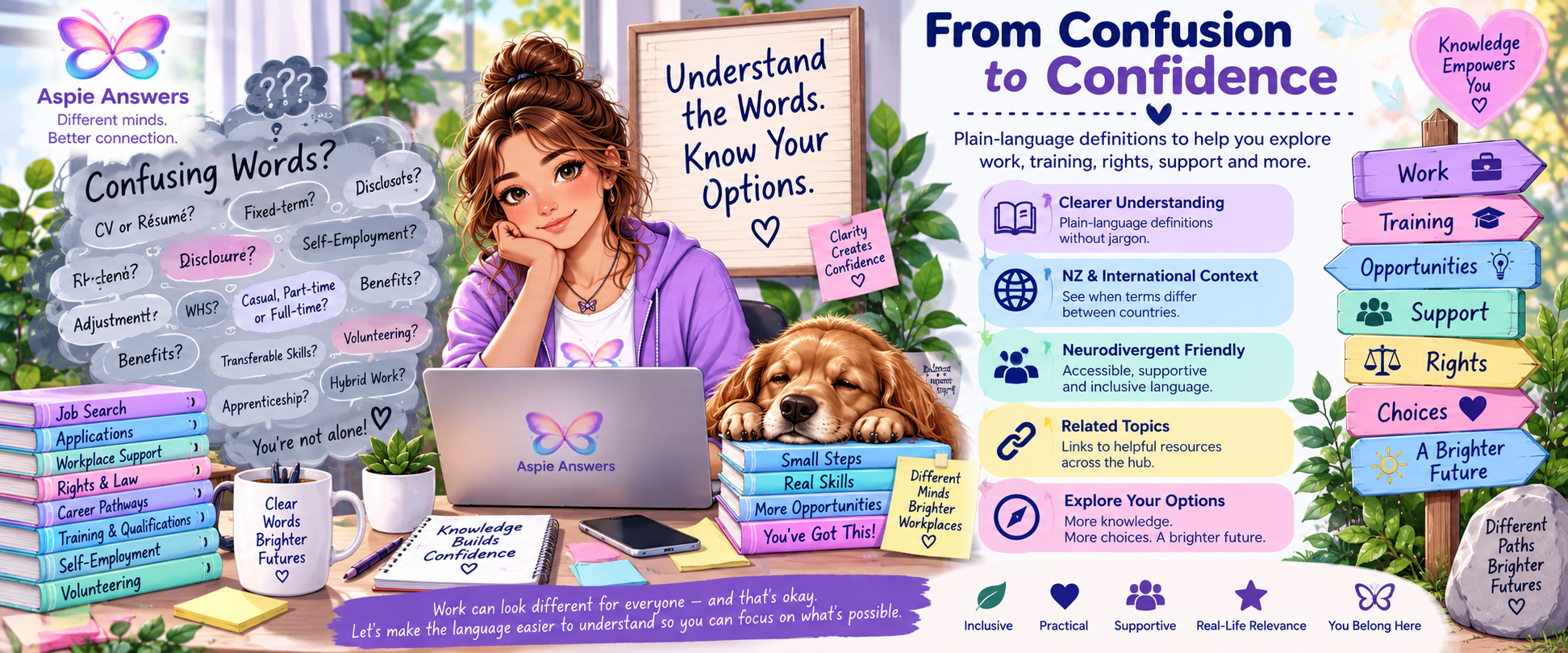
📖 How to Use This Glossary
Search, browse, learn, return later — there is no correct order.
🔎 Look Something Up
Use search when you see an unfamiliar word in a job advertisement, employment agreement, form, email, payslip, policy, meeting or support service.
🔤 Browse A–Z
Use the alphabet when you know the word but are not sure which broader Work & Employment topic it belongs to.
🧭 Explore by Theme
Use the topic filters to focus on applications, pay, rights, accessibility, self-employment, careers, remote work and other areas.
🌍 Check the Context
Legal, workplace, visa, tax and qualification terminology can differ between countries. Look for NZ and international context notes where this matters.
♾️ Use Language That Fits
People may prefer different disability, neurodivergence and identity language. The glossary explains terminology without telling people how they must describe themselves.
🔗 Keep Exploring
Definitions are starting points. Related Aspie Answers pathways help you move from understanding a word to finding practical information and tools.
🧭 Find Help by Situation
You do not need to know the right employment term before you can find the right doorway.
📄 I’m applying for work
Start with job searching, applications, CVs, interviews and career planning.
Start Here →🌱 I’m starting a new job
Explore onboarding, expectations, communication, routines and settling into a workplace.
Workplace Success →⚙️ I need workplace support
Explore adjustments, access needs, communication preferences, wellbeing and support.
Explore support →⚖️ I have a problem at work
Use the rights pathway and current official guidance when legal rules or formal processes matter.
Rights & Guidance →🔄 I’m leaving or changing work
Explore resignation, redundancy, career change, retraining, return-to-work and next steps.
Career Planning →💡 I’m considering self-employment
Learn the language of freelancing, clients, invoices, business expenses and independent work.
Self-Employment →🤝 I want to volunteer
Explore community participation, supported volunteering, experience, confidence and pathways into work.
Volunteering →🛤️ I’m exploring career options
Explore industries, occupations, training routes, qualifications and different ways into work.
Career Pathways →📚 I’m balancing work & study
Explore the practical overlap between employment, study or training, organisation, deadlines, energy and transitions.
Work & Study Life →📑 Documents You May Come Across
Knowing what a document is can make the next step feel much clearer.
CV / Résumé
A summary of your experience, skills, education and other information relevant to work.
Cover Letter
A short letter explaining your interest in a role and highlighting relevant strengths or experience.
Job Advertisement
A notice describing a vacancy, what the employer is looking for and how to apply.
Job Description
A description of a role’s purpose, duties, responsibilities and sometimes required skills.
Employment Agreement
The written terms and conditions of employment. Exact legal requirements vary by country.
Roster / Timesheet
A roster shows scheduled work times; a timesheet records hours worked or time spent on tasks.
Payslip / Pay Statement
A record of earnings and relevant deductions for a pay period.
Workplace Policy
Written organisational rules or guidance about areas such as conduct, leave, safety, privacy or technology.
Performance Review
A planned discussion about work, goals, feedback, performance or development.
Reference
Information from a referee about work history, skills, reliability or suitability.
Invoice / Quote
Common business documents used to propose a price or request payment for goods or services.
Adjustment / Support Documentation
Information used to explain workplace needs, agreed adjustments or support arrangements where appropriate.
🔠 Common Abbreviations & Short Forms
Short forms can make workplace documents feel more confusing than they need to.
🧩 What This Glossary Covers
Employment is bigger than finding a job — so the glossary is too.
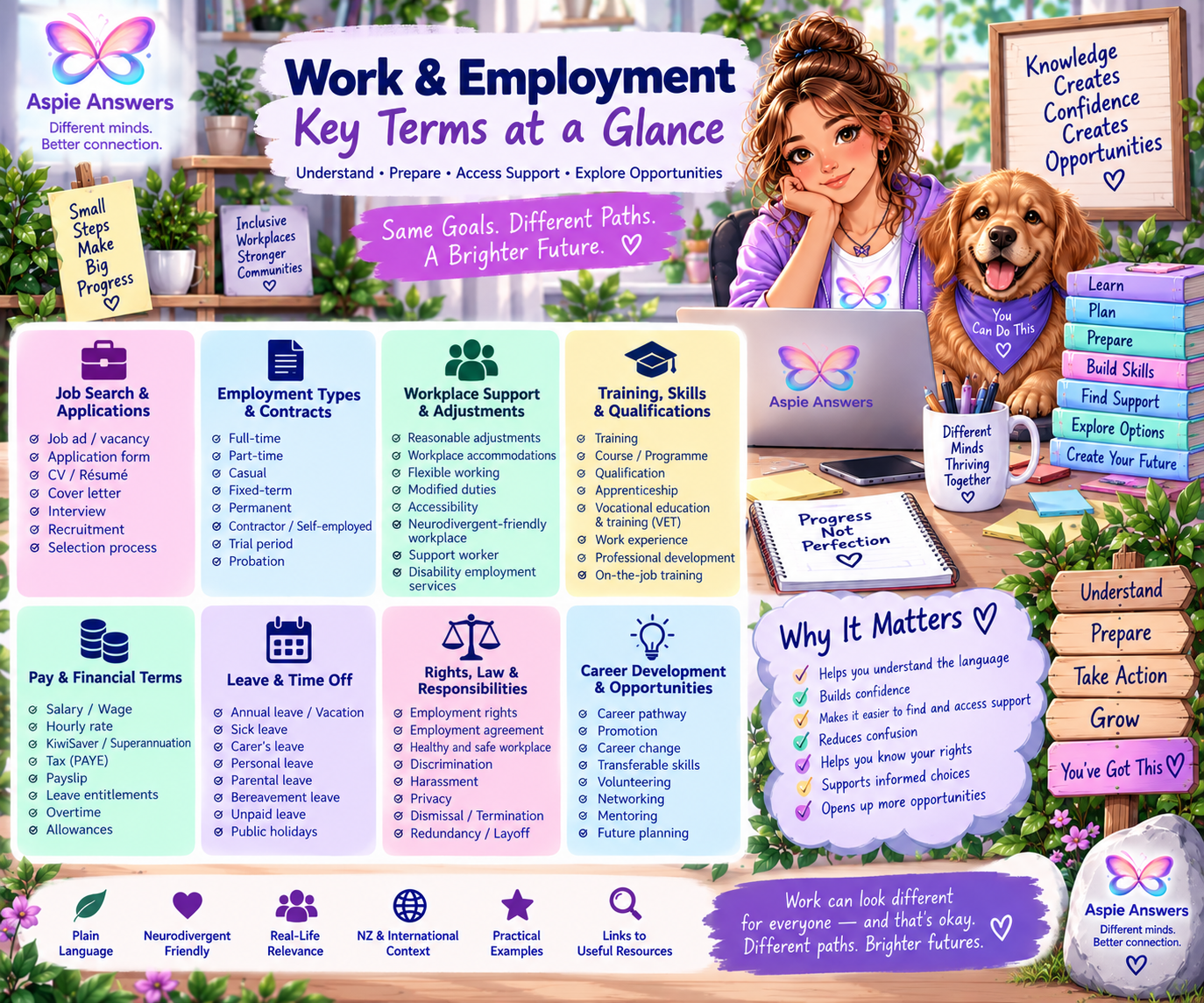
↔️ Commonly Confused Terms
Similar words are not always identical — and different countries may use different labels.
CV ↔ Résumé
Both describe documents used to present skills, experience and work history. Which word is most common depends partly on country and context.
Employee ↔ Contractor
An employee works within an employment relationship. A contractor usually provides services independently. The legal distinction matters and is not decided only by the label used.
Salary ↔ Wage
A salary is commonly expressed as an annual amount. A wage is commonly based on hours worked, although everyday usage can overlap.
Part-Time ↔ Casual
Part-time usually describes fewer regular hours than full-time. Casual work commonly involves less predictable or irregular work. Rules and definitions vary.
Remote ↔ Hybrid
Remote work happens away from the usual workplace. Hybrid work combines remote work with time in a workplace or other location.
Adjustments ↔ Accommodations
Both can describe changes that reduce workplace barriers. “Reasonable adjustments” is common in some countries; “reasonable accommodations” is more common in others.
Trial ↔ Probation
Both relate to an early employment period, but they can have different legal rules. In New Zealand they are distinct concepts rather than interchangeable labels.
Redundancy ↔ Dismissal
Redundancy generally relates to a role no longer being required. Dismissal means the employer ends an individual’s employment. Processes and legal rules differ.
Qualification ↔ Micro-Credential
A qualification usually represents a larger recognised programme of learning. A micro-credential is a smaller credential focused on particular skills or knowledge.
Gross Pay ↔ Net Pay
Gross pay is earnings before relevant deductions. Net pay is what remains after deductions such as tax and other authorised amounts.
Job Description ↔ Employment Agreement
A job description focuses on the role and responsibilities. An employment agreement sets out employment terms and conditions.
Apprenticeship ↔ Internship
An apprenticeship usually combines structured work and training toward occupational skills. An internship is typically a temporary learning or experience opportunity. Arrangements vary.
Industry ↔ Occupation
An industry is a broad area of economic activity. An occupation is the type of job or work a person does. The same occupation can exist in several industries.
Certification ↔ Licence
Certification confirms a standard or achievement. A licence is formal permission to carry out an activity where it is required. Some roles need one, both or neither.
Job Advertisement ↔ Job Description
A job advertisement invites people to apply for a vacancy. A job description explains the role, duties and responsibilities in more detail.
Employee ↔ Worker ↔ Contractor
These labels can describe different working relationships. Their legal meanings vary by country, so the real arrangement matters more than the label alone.
Workplace Adjustment ↔ Flexible Working
An adjustment is intended to reduce a barrier or support access. Flexible working changes when, where or sometimes how work is done. One arrangement can sometimes be both.
Freelancer ↔ Sole Trader
Freelancer describes a way of working independently for clients. Sole trader is a business structure used in some countries, including New Zealand. A freelancer may operate as a sole trader, but the terms are not identical.
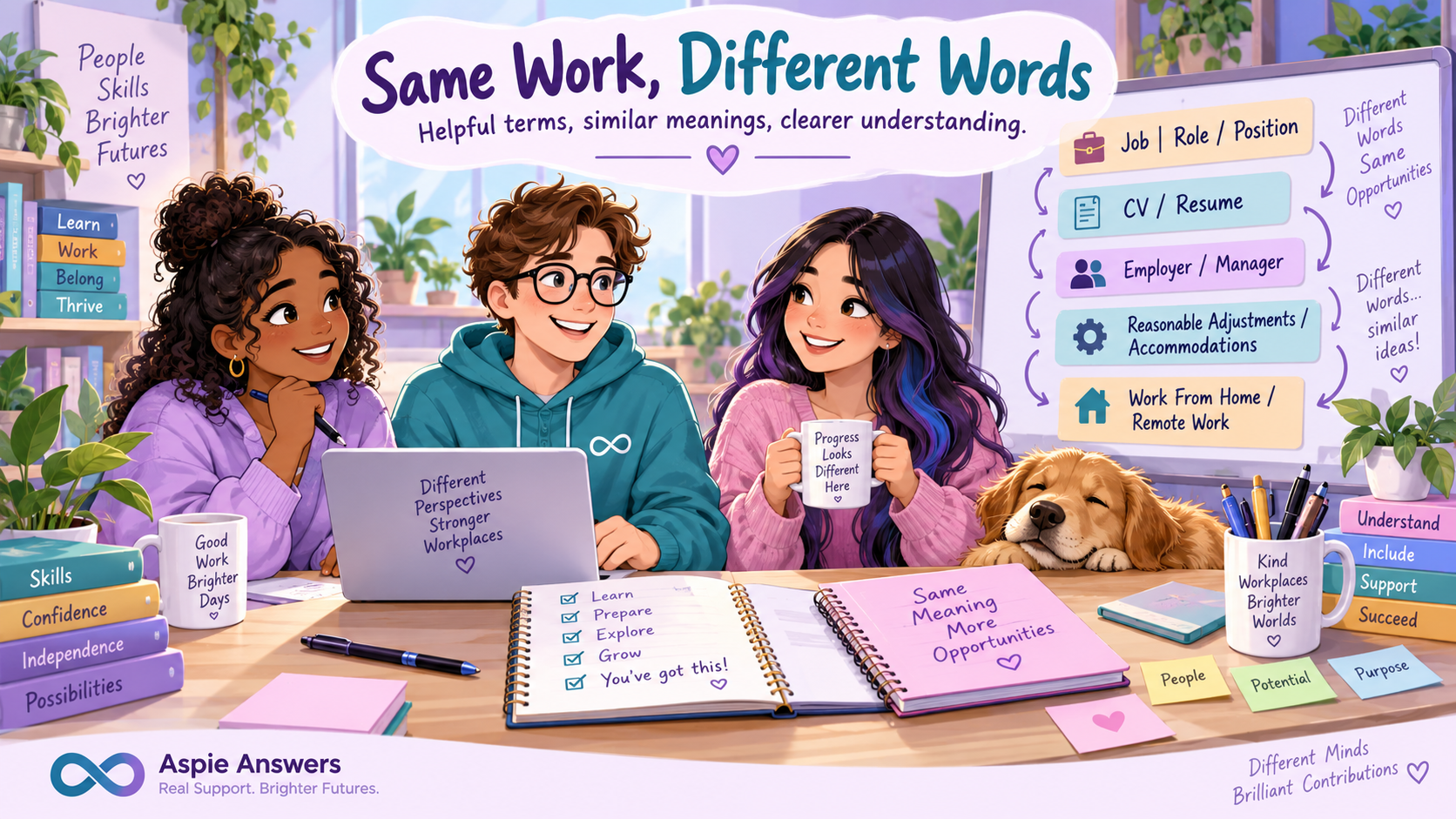
🌏 NZ & International Employment Language
Aspie Answers begins from an Aotearoa New Zealand perspective while welcoming an international audience. The same idea can have different names — and words that sound similar may have different legal meanings.
This section explains terminology only. It does not replace current country-specific employment, tax, immigration, qualification or rights guidance.
“CV” is widely used in New Zealand and many other countries. “Résumé” is especially common in North America.
“Annual leave” is common in New Zealand. Other countries may use terms such as vacation, vacation leave or paid time off.
These terms may both describe changes intended to reduce disability-related barriers, but legal wording varies between countries.
These words are used differently around the world and should not automatically be treated as exact legal equivalents.
A New Zealand tax term for income tax generally deducted from salary or wages through payroll.
A New Zealand work-based retirement savings scheme. Contribution settings and rules can change, so current details should be checked with Inland Revenue.
A New Zealand employment-law term for certain employment relationship complaints. Other countries use different legal processes and terminology.
The New Zealand Qualifications and Credentials Framework lists quality-assured qualifications and credentials and helps describe their levels.
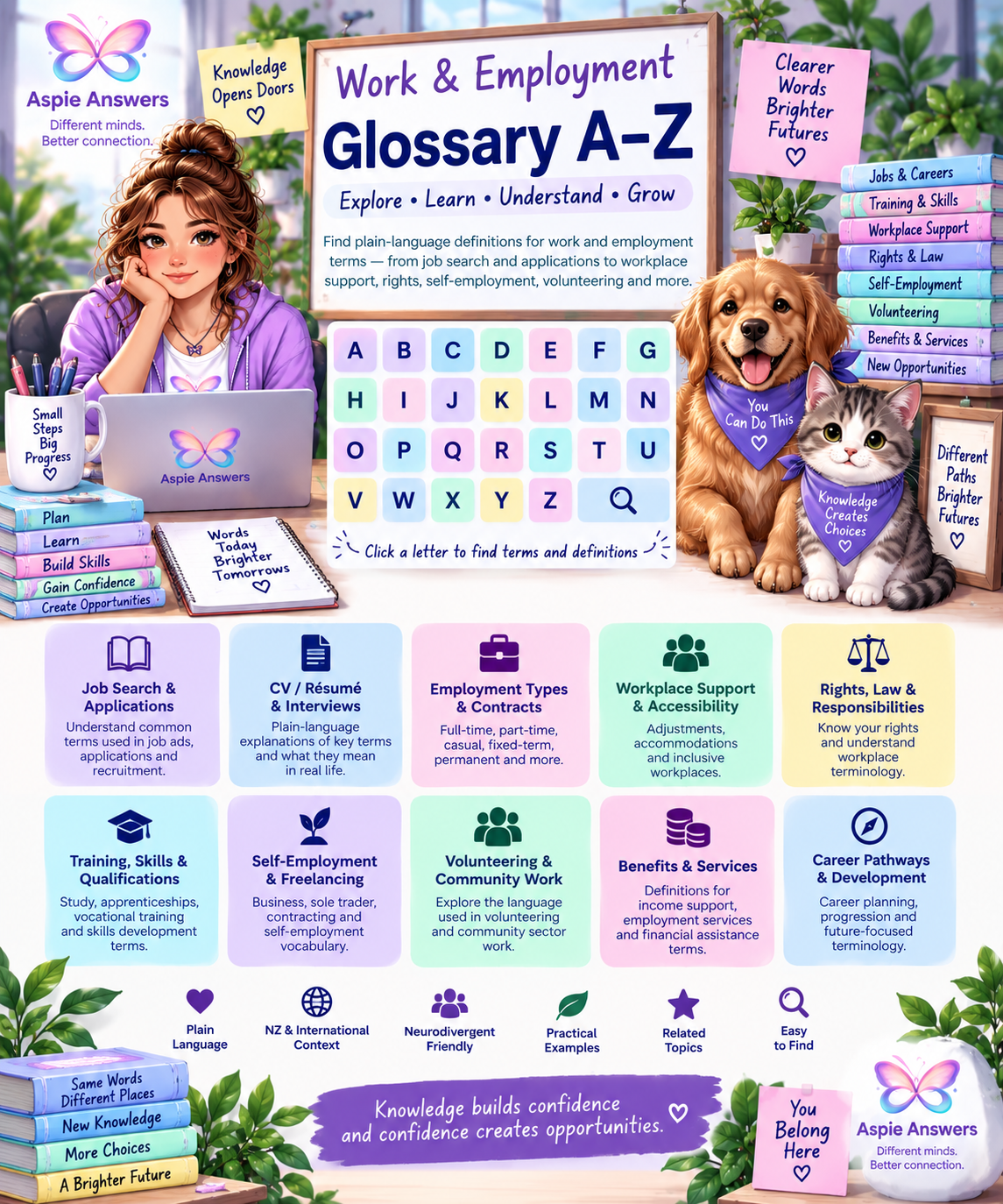
🔤 Work & Employment Glossary A–Z
Plain-language definitions, practical context and related terminology.
Try a shorter word, a different spelling or one of the broader topic filters above.
A Terms
Ableism
Attitudes, systems or actions that disadvantage disabled people or assume non-disabled ways of doing things are the normal or preferred standard.
Absence
Time away from work because someone is not attending a scheduled shift or workday. How an absence should be reported depends on the workplace and reason.
Access Needs
Things a person may need in order to access information, environments, communication, technology or workplace participation.
Accessibility
Designing information, environments, technology, services and ways of working so people with different needs can access and participate in them.
Accommodation International
A change or support intended to reduce a barrier at work. In some countries this is commonly called a reasonable accommodation; elsewhere “adjustment” is more common.
Accreditation
Formal recognition that a person, programme, organisation or service meets particular standards set by an authorised or professional body.
ADHD at Work
A broad phrase for how ADHD may interact with attention, working memory, time, task initiation, communication, energy and workplace demands.
Advocacy
Supporting yourself or another person to communicate needs, understand options, express concerns and have rights or preferences considered.
Allowance
An additional payment that may be provided for particular work-related costs, duties or circumstances. Rules depend on the employer and employment arrangement.
Annual Leave NZ term
Paid time away from work that eligible employees can take for rest and holidays. Entitlements and rules vary by country.
Applicant
A person who has applied, or is applying, for a job, programme, placement or opportunity.
Applicant Tracking System (ATS)
Software some employers use to organise applications, track candidates and sometimes assist with screening or recruitment workflows.
Application Form
A form used by an employer or recruitment service to collect information from someone applying for a job.
Apprenticeship
A structured pathway that combines practical work with training and learning toward skills or credentials for an occupation or trade.
Assessment Centre
A recruitment process that may use several activities such as interviews, group tasks, exercises or simulations to assess candidates.
Assistive Technology
Technology that helps reduce barriers or supports access, communication, organisation, reading, writing, hearing, vision, movement or other activities.
Asynchronous Communication
Communication that does not require everyone to respond at the same time, such as email, shared documents or recorded updates.
Autism at Work
A broad phrase for autistic experiences of work, including strengths, communication, sensory needs, routines, predictability, access and support.
Availability
The days, times or periods someone is available to work. Employers may ask about availability during recruitment or rostering.
B Terms
Background Check
A check an employer may carry out as part of recruitment, depending on the role and local law. Examples may include references, qualifications or authorised record checks.
Base Pay
The ordinary rate of pay before additional payments such as overtime, bonuses or some allowances are added.
Benefits
Extra employment-related advantages or support beyond ordinary pay, or government assistance depending on context. Always check which meaning is being used.
Bereavement Leave
Time away from work following a bereavement. Entitlements, eligibility and terminology vary by location.
Break
A period during or between work when someone is not carrying out ordinary work duties. Entitlements and rules vary by country and workplace.
Bullying
Harmful workplace behaviour that may involve intimidation, humiliation, threats, exclusion or repeated unreasonable conduct. Formal definitions vary by jurisdiction and policy.
Burnout
Severe physical, emotional or mental exhaustion associated with prolonged demands or stress. Autistic burnout can involve additional disability-related and sensory factors.
Business Expense
A cost connected with operating a business or providing self-employed services. Tax treatment depends on local tax rules.
Business Income
Money a business receives from its activities before or after particular costs are considered, depending on the context in which the term is used.
Business Model
A description of how a business creates, delivers and sustains value, including who it serves and how income and costs fit together.
Business Plan
A document or working plan describing a business idea, goals, market, operations, finances and next steps. It can be simple or detailed depending on purpose.
Business Registration
A formal registration a business may need with a government, tax, licensing or other authority. Requirements depend on location and business type.
C Terms
Candidate
A person being considered for a job, promotion, programme or other opportunity during a selection process.
Career
The broader journey of work, learning, experience and roles a person may have over time. A career does not have to follow one straight path.
Career Break
A period away from paid employment for reasons such as caring, health, study, travel, recovery or personal priorities.
Career Change
Moving from one type of work, occupation or career direction into another.
Career Development
The ongoing process of building skills, experience, knowledge, responsibilities and opportunities across a working life.
Career Exploration
Learning about interests, strengths, occupations, industries and work environments before deciding what may fit.
Career Pathway
One possible route through learning, experience, training and employment toward a type of work or career goal.
Career Planning
Exploring strengths, interests, values, options and possible next steps in order to make informed decisions about work and learning.
Career Progression
Movement or development through different responsibilities, roles, skills or opportunities over time.
Cash Flow
Money moving into and out of a business over time. Positive income does not always mean cash is available at every moment.
Casual Employment
An employment arrangement commonly associated with irregular or less predictable work. The legal meaning and rights attached to casual work vary by country.
Certification
Formal confirmation that someone has met a particular standard, requirement or assessment. The meaning depends on the industry or credentialing body.
Client
A person or organisation that purchases professional services from a freelancer, contractor or business.
Code of Conduct
A set of expected standards for behaviour within an organisation, profession or workplace.
Cognitive Load
The amount of mental effort needed to process information or complete a task. Reducing unnecessary complexity can lower cognitive load.
Collective Agreement
An employment agreement negotiated collectively between a union and one or more employers for employees covered by that agreement.
Collective Bargaining
A process where authorised representatives of workers and employers negotiate employment terms collectively.
Communication at Work
The ways people exchange information at work, including spoken, written, visual, digital and non-verbal communication.
Communication Preference
The way a person finds it easiest to receive, process or share information, such as written instructions, email, visual information or spoken conversation.
Commute
Travel between home and a workplace, study location or other regular destination.
Competency
The demonstrated ability to apply knowledge, skills or behaviours to an expected standard.
Confidentiality
Keeping information private and sharing it only with people who have an appropriate reason or permission to receive it.
Conflict of Interest
A situation where personal, financial or other interests could affect — or appear to affect — someone’s workplace judgement or responsibilities.
Conflict Resolution
Ways of addressing disagreements or problems in order to clarify issues, reduce harm and work toward an appropriate outcome.
Consultation
A process of seeking views, sharing relevant information or discussing proposed changes before decisions are made. Formal requirements vary by situation and jurisdiction.
Contractor / Independent Contractor
A person or business that provides services under a contracting arrangement rather than an employment relationship. Legal status depends on the real working relationship and local law.
Cover Letter / Application Letter
A short document sent with a job application to explain interest in the role and highlight relevant strengths, skills or experience.
Credential
A recognised record that shows learning, skills, competence, registration or another achievement. Credentials can range from small awards to formal qualifications.
Customer Service
Helping customers before, during or after they use a product or service, including answering questions, solving problems and communicating information.
CV / Résumé
A document summarising experience, skills, education and other information relevant to work. Preferred format and terminology vary by country.
D Terms
Deadline
The date or time by which a task, application, project or other piece of work is expected to be completed.
Deduction
Money taken from gross pay for an authorised or legally required reason, such as tax or another permitted deduction.
Digital Accessibility
Designing digital information, websites, documents, software and communication so people with different access needs can use them.
Digital Organisation
Using systems for files, email, calendars, notes, tasks and digital information so work is easier to find and manage.
Disability
A broad term connected with physical, sensory, neurological, intellectual, learning, mental-health or other impairments and the barriers people may encounter.
Disciplinary Process
A workplace process used when an employer is addressing alleged conduct or performance concerns. Fair-process requirements depend on local employment law.
Disclosure
Sharing personal information about a disability, neurodivergence, health condition or support need. What someone chooses or is legally required to disclose depends on context and law.
Discrimination
Unfair or unlawful treatment connected with a protected characteristic or another legally recognised ground. Exact protections vary by jurisdiction.
Dismissal / Termination
When an employer ends a person’s employment. Reasons, required processes and employee rights vary by country and circumstances.
Diversity
The presence of people with different identities, backgrounds, experiences, abilities, perspectives or characteristics within a group or workplace.
Duties / Responsibilities
The tasks, functions and expectations connected with a job or role.
E Terms
Earnings
Money received for work or business activity. The term can refer to wages, salary, self-employment income or other forms of work-related income.
Emotional Regulation at Work
Ways of noticing, understanding and responding to emotions while navigating workplace demands, communication and stress.
Employee
A person who works for an employer within an employment relationship and receives the rights and responsibilities attached to employee status.
Employee Assistance Programme (EAP)
A workplace service that may provide confidential short-term support or referral for personal, wellbeing or work-related concerns. What is offered varies by employer.
Employer
A person, company or organisation that employs employees.
Employment Agreement NZ context
A written agreement describing employment terms and conditions. Requirements vary by location; in New Zealand every employee must have a written employment agreement.
Employment Gap
A period in a work history when someone was not in paid employment. Gaps can have many reasons and do not automatically indicate a problem.
Employment Service
An organisation or service that supports people with finding, preparing for, entering or maintaining employment.
Employment Status
The legal or practical category describing a working relationship, such as employee, contractor or another status. Exact categories and tests vary by country.
Entrepreneurship
The process of developing, organising and running a business or income-generating venture, often involving uncertainty and decision-making.
Entry-Level Role
A role intended for people who are new to a field or need relatively limited prior experience. “Entry-level” does not always mean no experience or training is required.
Equality
Treating people equally in rights, opportunities or access. Equal treatment does not always remove different barriers people face.
Equity
A fairness-focused approach that recognises people may need different resources, supports or changes to achieve meaningful access and participation.
Ergonomics
Designing tasks, equipment and workspaces to better fit the person using them and reduce unnecessary physical strain or discomfort.
Executive Function
Mental processes involved in planning, starting tasks, remembering information, shifting attention, organising, prioritising and managing time or impulses.
Exit Interview
A conversation or questionnaire sometimes offered when someone leaves a workplace to gather feedback about their experience.
Expense Reimbursement
Repayment of an approved work-related cost a worker or volunteer has paid.
F Terms
Feedback
Information about work, behaviour, results or progress that can help someone understand expectations, recognise strengths or make changes.
Fixed-Term Employment
Employment intended to last for a specified period or until a defined event or project ends. Rules around valid fixed-term arrangements vary.
Flexible Hours
A working arrangement that allows some flexibility in start times, finish times or how agreed hours are scheduled.
Flexible Working
Changes or flexibility around when, where or sometimes how work is performed, such as altered hours, schedules or working locations.
Focus Time
A protected period set aside for concentrated work with fewer interruptions or competing demands.
Freelance Contract
An agreement describing services, payment, scope, timing or other terms between a freelancer and client. Legal requirements vary by location.
Freelancer
A self-employed person who provides services to clients, often for individual projects or periods of work.
Full-Time Employment
Employment involving the hours an organisation or jurisdiction generally regards as full-time. There is not one universal number of hours worldwide.
Full-Time Equivalent (FTE)
A way of expressing workload or staffing relative to a full-time position. For example, a part-time position may represent a fraction of one FTE.
G Terms
Gig Work
Short-term, task-based or on-demand work, sometimes organised through digital platforms. Employment status and legal protections vary.
Goal Setting
Choosing an outcome or direction and identifying useful steps, timeframes or measures for working toward it.
Good Faith NZ
A key New Zealand employment concept requiring parties in an employment relationship to deal with each other in an active, constructive and responsive way.
Graduate Role / Graduate Programme
A job or structured programme aimed at recent graduates, often including training, rotations, mentoring or development.
Graduated Return
A gradual return to work in which hours, duties or demands may increase over time. The exact arrangement depends on the person, workplace and relevant guidance.
Grievance
A complaint or concern about treatment, decisions or events at work. Formal grievance processes differ between workplaces and countries.
Gross Pay
Pay before tax and other relevant deductions are taken out.
GST NZ
Goods and Services Tax in New Zealand. Registration, charging and filing requirements depend on current tax rules and business circumstances.
H Terms
Harassment
Unwanted behaviour that causes harm, humiliation, intimidation or an unsafe environment. Legal definitions and protected grounds vary.
Hazard
Something that can cause harm in or through work. Hazards can be physical, chemical, biological, ergonomic or psychosocial.
Health & Safety
The systems, duties and practices used to prevent work-related harm and manage workplace risks.
Hidden / Non-Visible Disability
A disability or condition that may not be immediately apparent to other people.
Holiday Pay
Pay connected with holidays or annual leave. The exact calculation and rules vary by jurisdiction.
Home Office
A space used for work at home, whether a separate room or another intentionally arranged working area.
Hourly Rate
The amount of pay earned for each hour of work before relevant deductions.
Hours of Work
The amount of time someone is expected or agreed to work. Rules about hours, breaks and scheduling vary by country and employment arrangement.
Human Resources (HR)
A workplace function that may deal with recruitment, employment policies, staff records, pay processes, workplace issues, development and employee support.
Hybrid Meeting
A meeting where some people attend in person and others join remotely.
Hybrid Work
A working arrangement that combines remote work with work at an employer’s workplace or another shared location.
I Terms
Inclusion
Creating environments where different people are welcomed, respected, able to participate and able to contribute meaningfully.
Inclusive Workplace
A workplace that aims to reduce barriers and support meaningful participation, respect and belonging for people with different needs and backgrounds.
Induction
The process of introducing a new worker to their workplace, role, policies, people, systems and expectations.
Industry
A broad area of economic activity or work, such as healthcare, construction, education, hospitality, technology or agriculture.
Internship
A temporary work-based learning or experience opportunity. Payment, employment status and structure vary by arrangement and country.
Interview
A recruitment conversation where an employer and applicant discuss the role, experience, skills and suitability, and the applicant can usually ask questions too.
Interview Adjustment
A change to a recruitment or interview process intended to reduce an access barrier, such as a different format, extra processing time or accessible communication.
Interview Panel
Two or more people who take part together in interviewing or assessing a candidate.
Interview Question
A question asked during recruitment to learn about a candidate's experience, skills, approach or suitability for a role.
Invoice
A document requesting payment for goods or services, commonly used by businesses, contractors and freelancers.
J Terms
Job Advertisement / Vacancy
A notice describing an available job and usually giving information about duties, requirements, location and how to apply.
Job Application
Information a person submits to be considered for a job, which may include forms, a CV, cover letter or other requested material.
Job Board
A website, service or noticeboard that lists job vacancies or employment opportunities.
Job Coach
A person who provides practical employment support such as preparing for work, learning tasks, developing workplace strategies or communicating with an employer.
Job Description
A document or description explaining the purpose, duties, responsibilities and sometimes required skills or experience for a job.
Job Matching
A process of comparing a person's skills, interests, needs or experience with available roles or employers.
Job Offer
An employer’s offer of employment to a chosen candidate. It may be conditional on particular requirements being met.
Job Seeker
A person looking for paid employment or exploring work opportunities.
Job Shadowing
Observing someone doing their job to learn more about the role, workplace or career area.
Job Sharing
An arrangement where two or more people share the responsibilities and working hours of a role that might otherwise be held by one person.
K Terms
Key Performance Indicator (KPI)
A measure used by an organisation to track progress or performance toward a particular goal or expected result.
Key Responsibilities
The main duties or areas of responsibility expected within a job.
KiwiSaver NZ
New Zealand’s work-based retirement savings scheme. Contribution settings and rules can change, so current information should be checked with Inland Revenue.
Knowledge
Information, understanding or expertise gained through learning, work, lived experience or practice.
L Terms
Layoff International
A term used differently across countries for an employer ending or suspending work, often for business reasons. It is not an exact universal equivalent of redundancy.
Leadership
Guiding, coordinating or supporting people, work or decisions toward shared goals. Leadership can exist with or without a formal management title.
Leave Entitlement
Leave a worker is entitled to under law, an employment agreement or workplace policy.
Licence / License
Formal permission to carry out a particular activity or occupation where a regulator or law requires it. Terminology and spelling vary by country.
Line Manager
A manager with direct responsibility for supervising an employee's day-to-day work, although organisations may use different titles.
Lived Experience
Knowledge and understanding gained through directly experiencing a situation, identity, disability, system or life circumstance.
Long-Term Unemployment
Being without paid work for an extended period. Definitions used by agencies and researchers may differ.
Low-Energy Workday
A day when available energy or capacity is lower than usual, making pacing, prioritising and realistic expectations especially important.
M Terms
Mahi Aotearoa NZ
A Māori word commonly used for work, activity or work being done. Context matters, as Māori words can carry broader meanings than a single English translation.
Manager / Supervisor
A person responsible for overseeing work, people, tasks or a team. Exact responsibilities vary between workplaces.
Marketing
Activities used to communicate what a business, product or service offers and help suitable customers find it.
Masking
Hiding, suppressing or changing natural behaviours, communication or responses to meet perceived social or workplace expectations. Sustained masking can be exhausting.
Mediation
A structured process where an impartial mediator helps people discuss a disagreement and try to reach a resolution.
Mental Health at Work
A broad phrase covering how work can affect mental wellbeing and how mental health may interact with workplace demands, support and participation.
Mentoring
Guidance and support from someone who shares experience, knowledge or perspective to help another person learn or develop.
Micro-Credential
A smaller credential focused on particular skills or knowledge. Recognition and framework rules depend on the education system involved.
Migrant Worker
A person working in a country where they are a migrant. Employment and immigration requirements need to be considered separately and checked with current official sources.
Minimum Wage
The lowest legal rate of pay that applies to eligible workers under relevant law. Rates and categories can change.
Misconduct
Behaviour that may breach workplace standards, policies or employment obligations. Seriousness and required process depend on the circumstances and law.
Modified Duties
Temporary or ongoing changes to tasks or responsibilities, often used when someone is returning to work or needs work made more accessible or sustainable.
Motivation
The internal or external reasons that influence whether someone starts, continues or returns to a task or goal.
N Terms
Net Pay
The amount of pay left after tax and other authorised deductions have been taken from gross pay.
Networking
Building and maintaining professional or community connections that can support learning, collaboration, information sharing or employment opportunities.
Neurodivergent-Friendly Workplace
A workplace that actively reduces unnecessary barriers and supports different ways of communicating, processing information, organising, focusing and working.
Neurodiversity
The idea that human brains and nervous systems vary naturally, including differences in attention, learning, communication, sensory processing and cognition.
Non-Disclosure Agreement (NDA)
An agreement intended to limit how specified confidential information may be shared. Its scope and enforceability depend on the wording and local law.
Notice of Termination
Formal notice that employment will end. Who gives the notice, the required period and the process depend on the circumstances, agreement and local law.
Notice Period
The period of notice required before employment ends, where applicable. Requirements may come from law, an employment agreement or both.
O Terms
Occupation
A type of job or work someone does, usually defined by the main tasks, skills or field involved.
Occupational Health
A field concerned with protecting and supporting health in relation to work, workplaces and work-related risks.
Occupational Therapist (OT)
A regulated health professional in many countries who may support participation in everyday activities, including work, through assessment, strategies or environmental changes.
On-Call Work
An arrangement where a worker may need to be available to work when called or requested. Rules around availability and compensation vary.
Onboarding
The broader process of helping a new worker join an organisation, understand their role and become familiar with people, systems, expectations and support.
Online Interview
A job interview held through video, audio or another online platform rather than face to face.
Online Meeting
A meeting held using video, audio or other digital communication tools.
Orientation
An introduction to a workplace, role, programme or organisation, often covering people, procedures, expectations and practical information.
Overtime
Work performed beyond ordinary or agreed hours. Whether additional pay applies depends on the employment agreement and local rules.
P Terms
Pacing
Balancing activity, demands and recovery in a way that aims to make participation more sustainable.
Parental Leave
Time away from work connected with the birth or care of a child. Eligibility, payment and length vary by country and situation.
Part-Time Employment
Employment involving fewer hours than the organisation or context generally considers full-time, often on a regular schedule.
Pay Period
The regular period used to calculate and pay earnings, such as weekly, fortnightly or monthly.
PAYE NZ
“Pay As You Earn” — the New Zealand system through which employers generally deduct income tax and certain other amounts from employee pay.
Payroll
The system a workplace uses to calculate and process employee pay, deductions and related records.
Payslip / Pay Statement
A record showing information about a person’s pay, such as earnings, hours or deductions. Requirements vary by jurisdiction.
Peer Support
Support from someone with relevant shared or lived experience, which may involve understanding, practical ideas, connection or encouragement.
Performance Management
Processes used to clarify expectations, discuss performance, provide feedback and address areas that may need support or improvement.
Performance Review
A planned discussion about work, progress, goals, feedback, development or performance.
Permanent Employment
Employment that does not have a predetermined end date, although it can still end through resignation, dismissal, redundancy or another lawful process.
Personal Grievance NZ
A New Zealand employment-law process for certain complaints relating to an employment relationship, such as some unjustified dismissal or disadvantage concerns.
Placement
A period of practical experience in a workplace or organisation, often connected with education, training or career exploration.
Portfolio
A collection of work samples, projects, achievements or evidence that demonstrates skills and experience.
Portfolio Career
A working life made up of several roles, projects, contracts, businesses or income sources rather than one traditional full-time job.
Privacy
How personal information is collected, stored, used and shared. Privacy obligations vary according to law, workplace context and the type of information involved.
Private Sector
Businesses and organisations that are privately owned rather than part of government. The exact boundary can vary by country.
Probationary Period NZ context
An agreed period used to assess suitability or performance in a role. In New Zealand it is distinct from a trial period and different rules apply.
Profession
A type of occupation that commonly involves specialised knowledge, training, standards or professional responsibilities. Some professions are regulated and others are not.
Professional Development
Learning and development that helps someone maintain, expand or improve skills and knowledge relevant to their work or career.
Professional Reference
A reference from someone who can comment on a person's work, skills, reliability or professional experience.
Promotion
Moving into a role with greater responsibility, seniority, authority or sometimes higher pay within an organisation.
Protected Disclosure / Whistleblowing
Reporting serious wrongdoing through a process protected or recognised by law. The legal definition and protections vary by country.
Psychological Safety
A workplace climate where people feel safer to ask questions, raise concerns, share ideas or acknowledge mistakes without unreasonable fear of humiliation or punishment.
Psychosocial Hazard
A work-related factor that may cause psychological or physical harm, such as harmful behaviour, excessive demands or poorly managed workplace risks.
Public Holiday
A legally recognised holiday. Pay, work and leave rules vary by country and situation.
Public Sector
Government departments, agencies and other public bodies. Structures and terminology vary between countries.
Q Terms
Qualification
A formally recognised achievement showing completion of a programme of learning or demonstrated knowledge and skills.
Quiet Workspace
A work area with reduced noise or interruptions, which may support concentration, communication or sensory needs.
Quote / Quotation
A proposed price for providing goods or services, commonly used in self-employment or business before work is agreed.
R Terms
Reasonable Adjustment / Accommodation
A change intended to reduce disability-related barriers so someone can access or participate in work. Legal terminology and tests vary between countries.
Recruitment
The process an organisation uses to attract, assess and select people for available roles.
Recruitment Agency
An organisation that helps employers find candidates and may help job seekers identify suitable vacancies.
Redundancy
A situation where a role is no longer required, usually for business or organisational reasons rather than because of the individual worker’s conduct.
Referee
A person an applicant nominates who may be contacted to provide information about their work, skills, experience or suitability.
Reference
Information provided by a referee about an applicant’s work history, skills, reliability or other relevant qualities.
Reimbursement
Repayment of an approved expense someone has paid, such as travel or work-related costs.
Remote-First Workplace
An organisation designed mainly around remote work even if offices or in-person activities are also available.
Remote Work
Work performed away from the employer’s usual workplace, often from home or another agreed location.
Resignation
When an employee chooses to end their employment, usually by giving the required notice.
Reskilling
Learning new skills for a different role, occupation or type of work.
Restraint of Trade
An employment-agreement clause that may restrict certain competitive activities after employment ends. Enforceability depends on local law and circumstances.
Restructuring
Changes to the way an organisation, team or roles are arranged. A restructure may affect duties, reporting lines, roles or staffing.
Return-to-Work Plan
A plan for resuming work after illness, injury, burnout, extended leave or another absence, sometimes using gradual hours or modified duties.
Risk
The possibility that a hazard or situation will cause harm, together with the likelihood and potential seriousness of that harm.
Role
A position or set of responsibilities someone holds within a workplace, organisation, project or community activity.
Roster
A schedule showing when employees are expected to work particular days, times or shifts.
S Terms
Safeguarding
Policies and actions intended to help protect people from abuse, neglect, exploitation or other harm, especially in services or roles involving children or vulnerable people.
Salary
Pay commonly expressed as a yearly amount rather than an hourly rate, although payment arrangements differ between workplaces.
Schedule
A plan showing when work, shifts, meetings, tasks or other activities are expected to happen.
Sector
A broad part of the economy or workforce, such as public, private, community, health, education or technology.
Selection Criteria
The skills, experience, qualifications, capabilities or other requirements an employer may use to assess applicants.
Self-Advocacy
Speaking up for your needs, preferences, boundaries or rights and taking part in decisions that affect you.
Self-Employment
Earning income by operating your own business or providing services independently rather than working as an employee.
Sensory Needs
Needs connected with how someone experiences sensory input such as sound, light, movement, temperature, texture or smell.
Serious Misconduct
A term used for particularly serious alleged workplace behaviour. Its meaning and the process required before dismissal depend on law and circumstances.
Shift Work
Work organised into scheduled periods such as morning, evening, overnight or rotating shifts.
Shortlisting
Selecting a smaller group of applicants to move to the next stage of recruitment.
Sick Leave
Time away from work for illness or health-related reasons under applicable law, agreements or workplace policies.
Skilled Trade
An occupation built around practical or technical skills, often learned through vocational training, apprenticeship or substantial hands-on experience.
Skills
Abilities developed through learning, work, everyday life, hobbies, volunteering, education or experience.
Skills Gap
A difference between the skills currently available and the skills needed for a particular role, goal or task.
Social Enterprise
A business or organisation that uses trading activity to pursue a social, community or environmental purpose.
Soft Skills
A broad informal term for interpersonal and self-management skills such as communication, teamwork, organisation or adaptability.
Sole Trader
A person who operates a business in their own name rather than through a separate company structure. Legal and tax rules differ by country.
STAR Method
An interview-answer structure using Situation, Task, Action and Result to explain a real example clearly.
Stigma
Negative stereotypes, assumptions or social judgement that can affect how people are treated or how safe they feel to disclose or seek support.
Subcontractor
A contractor engaged by another contractor or business to complete part of a larger job or service. Employment and tax status depend on the real arrangement.
Superannuation
A general term for retirement savings or pension arrangements. Systems vary substantially between countries.
Support Person
Someone who attends a meeting or process to provide emotional or practical support. Their role and permitted involvement can depend on the situation.
Support Worker
A person who provides practical, community, disability, wellbeing or daily-life support according to a person’s needs and goals.
Supported Employment
Employment supported by tailored assistance that may help with finding work, learning a role, workplace communication or maintaining employment.
Supported Internship
A structured work-based learning or employment-preparation programme with support. The term and model vary by country and provider.
Supported Volunteering
Volunteering where a person receives tailored support to take part, build confidence, learn tasks or participate in the community.
T Terms
Task Initiation
The process of getting started on a task, which can be difficult when there is uncertainty, low motivation, overwhelm or executive-function demand.
Task Switching
Moving attention and effort from one task, activity or context to another.
Tax
Money collected by government under tax law. Employees and self-employed people can have different tax responsibilities.
Teamwork
Working with other people toward shared tasks or goals while communicating, coordinating and contributing in ways appropriate to the role.
Telework
An older or alternative term for work carried out away from the usual workplace using communication technology.
Temporary Employment
Employment intended to last for a limited period. The legal structure may be fixed-term, casual, agency-based or another arrangement depending on context.
Time Management
Planning and using time in relation to tasks, deadlines, meetings, breaks and priorities.
Timesheet
A record of hours worked or time spent on tasks, often used for payroll, billing, project tracking or attendance.
Trade
A practical or technical occupation, often associated with vocational training, apprenticeship, licensing or recognised skill.
Traineeship International
A work-and-training arrangement used in some countries or industries. Its formal meaning and structure vary by location.
Training
Structured learning designed to develop knowledge, skills or competence for a task, job, qualification or career.
Training Provider
An organisation or person that delivers education, vocational learning, qualifications or skills training.
Transferable Skills
Skills that can be useful across different jobs, industries or life situations, such as communication, organisation, problem-solving or technical abilities.
Trial Period NZ context
An agreed period at the beginning of employment used under specific legal rules. In New Zealand a trial period and probationary period are different arrangements.
Turnover / Staff Turnover
The rate at which employees leave an organisation and are replaced over a period of time.
U Terms
Unconscious Bias
Automatic assumptions or associations that can influence judgement without deliberate intent.
Underemployment
A situation where someone has less paid work than they want or where their work does not fully use their available skills or capacity, depending on context.
Unemployment
A state of not being in paid employment while definitions used for statistics, benefits or services may have additional criteria.
Union / Trade Union
An organisation that represents workers and may support members with collective bargaining, workplace rights and employment issues.
Universal Design
Designing environments, systems, information or services so they are usable by as many people as practical without relying only on individual adaptations.
Unpaid Leave
Approved time away from work without ordinary pay. Eligibility and approval requirements vary.
Unpaid Work
Work done without ordinary wages. Whether an unpaid arrangement is lawful or classed as volunteering, work experience or employment depends on context and local rules.
Upskilling
Developing or expanding skills to improve capability in a current or related area of work.
V Terms
Vacancy
A job or position that is currently available to be filled.
Values
Principles or priorities that matter to a person and can influence decisions about roles, organisations, industries and ways of working.
Virtual Meeting
A meeting held through an online platform rather than everyone being in the same physical location.
Vocational Education & Training (VET)
Education and training focused on practical skills and knowledge for occupations, trades and industries.
Vocational Rehabilitation
Support aimed at helping someone prepare for, return to, remain in or adapt to employment following disability, illness, injury or another barrier.
Volunteer
A person who gives time and skills to support an organisation, cause or community without ordinary wages.
Volunteer Agreement
A document or understanding that may describe a volunteer role, expectations, support, conduct or practical arrangements. It is not necessarily an employment agreement.
Volunteer Coordinator
A person who organises, supports or manages volunteers and volunteer activities within an organisation or project.
Volunteer Expenses
Costs connected with volunteering that an organisation may reimburse or help cover, depending on its policy.
Volunteer Role
An unpaid role in which someone contributes time or skills to an organisation, cause or community under agreed expectations.
Volunteering
Giving time and skills to support an organisation, cause or community without ordinary wages. Volunteering can also build experience, confidence and connections.
W Terms
Wage
Pay for work, often calculated by hours worked, though the word can also be used more generally.
Work & Study Life
The practical overlap between employment, study or training, organisation, productivity, transitions, energy and everyday responsibilities.
Work Experience
Practical experience gained through paid work, volunteering, placements, projects, internships or other real-world activities.
Work From Home (WFH)
Working from home rather than travelling to a traditional workplace, either regularly or for part of the working week.
Work–Life Balance
How work demands fit alongside rest, relationships, health, responsibilities, interests and other parts of life.
Work Visa
Immigration permission allowing someone to work in a country under stated conditions. Visa rules should always be checked with the relevant immigration authority.
Worker
A broad everyday term for someone who works. In some legal systems it is also a specific employment-status category, so context matters.
Working Hours
The hours someone works or is scheduled to work, including patterns such as fixed, flexible, shift or variable hours.
Working Memory at Work
The ability to hold and use information for a short time while doing a task; notes, checklists and reminders can reduce the load on working memory.
Workload
The amount, complexity and pace of work expected within a period of time.
Workplace Adjustment
A change to a workplace, process, schedule, communication method, environment or task arrangement intended to reduce a barrier.
Workplace Bullying
Bullying occurring in a work context. Definitions, complaint processes and legal thresholds differ between jurisdictions.
Workplace Communication
The exchange of information at work through conversations, meetings, email, messaging, documents and other formats.
Workplace Conflict
A disagreement or difficult relationship at work that may need clarification, problem-solving, support or a formal process depending on severity.
Workplace Culture
The shared practices, expectations, behaviours and norms that shape what it feels like to work within an organisation or team.
Workplace Flexibility
How much flexibility exists around hours, location, scheduling, tasks or other ways work is organised.
Workplace Policy
An organisation’s documented rules or guidance about workplace matters such as conduct, safety, leave, technology, privacy or complaints.
Workplace Rights
Legal and contractual rights connected with work, such as minimum employment standards, fair treatment, safety and agreed conditions.
Workplace Wellbeing
A broad term for factors that affect how safe, healthy and sustainable work feels, including demands, support, relationships, environment and recovery.
X Terms
Y Terms
Youth Employment
Employment involving younger workers. Age-related rules, working hours, education obligations and minimum employment protections vary by country.
Z Terms
Zero-Hours Contract International
A term used in some countries for work arrangements where no minimum number of working hours is guaranteed. Laws and permissible arrangements vary significantly by country.
🔄 Leaving, Changing or Returning to Work
Work journeys can include pauses, endings, restarts and new directions.
Resignation & Notice
Leaving by choice may involve a resignation and a notice period set by an agreement or local rules.
Redundancy & Restructuring
Organisational change can affect roles, duties and staffing. Formal processes and rights vary by country.
Dismissal & Workplace Processes
When an employer ends employment, process, reasons and rights matter. Use current official guidance where the situation is formal or disputed.
Career Breaks
Time away from paid work can happen for caring, health, burnout, study, travel, recovery or personal reasons.
Return to Work
A gradual return, modified duties or a return-to-work plan may help after illness, injury, burnout or extended leave.
Reskilling & Career Change
New training or transferable skills can support movement into a different role, industry or career direction.
🛤️ Industry, Career Pathways & Volunteering
These pathways connect industry, training, career exploration, volunteering and experience.
Industry & Career Pathways
This glossary already includes language such as industry, occupation, profession, skilled trade, qualification, credential, apprenticeship, vocational education, career pathway and transferable skills.
Use the Industry & Career Pathways area when you want to move from terminology into industries, roles, training and career routes.
Explore Industry & Career Pathways →Volunteering & Community Work
This glossary includes volunteering, volunteer, supported volunteering, reimbursement, work experience, job coaching and community-to-employment language.
Use the Volunteering & Community Work pathway for practical guidance about roles, fit, support, boundaries, community participation and moving into employment where wanted.
Explore Volunteering & Community Work →🇳🇿 Aotearoa New Zealand Language You May See
Some Māori words are increasingly visible in workplaces, careers information and public services.
Mahi
A Māori word commonly used for work, activity or work being done. Context matters, as Māori words can carry broader meanings than a single English translation.
Kaimahi
A Māori term commonly used for worker or workers.
Aotearoa
The Māori name commonly used for New Zealand. You may see “Aotearoa New Zealand” used together in employment, education and public-service information.
🧠 Neurodivergence, Disability & Work Language
Workplace terminology is not only about contracts and job applications.
Different Brains, Different Working Styles
Planning, communication, attention, memory, sensory processing, social interaction and energy can all affect how someone experiences work.
Access Is Not Special Treatment
Accessible environments and appropriate adjustments can reduce barriers so people can participate more meaningfully.
Disclosure Is Personal
People may have different reasons for sharing or not sharing disability, neurodivergence or health information. Legal obligations and safety-critical contexts may affect particular situations.
Support Needs Can Change
Someone may need different support at different times because of workload, environment, health, burnout, life events or changing responsibilities.
Strengths Matter Too
Support conversations can include barriers and needs while also recognising skills, interests, knowledge, preferred working styles and strengths.
No Single Definition of Success
Full-time work, part-time work, self-employment, supported employment, volunteering, study, career exploration and periods away from work can all be meaningful.
🤝 Who Might Help?
The right person depends on the question, workplace and country.
Manager / Supervisor
May help with daily work, expectations, priorities, feedback, scheduling and some workplace support.
Human Resources (HR)
May help with policies, recruitment, employment processes, workplace concerns and organisational support.
Union
May represent and support members in collective bargaining, employment rights and workplace issues.
Support Person / Advocate
Can provide practical or emotional support and may help someone prepare for or attend a meeting.
Job Coach / Employment Service
May help with job searching, applications, workplace learning, communication or maintaining employment.
Vocational Rehabilitation
May support preparing for, returning to, staying in or adapting to employment after disability, illness or injury.
✅ When a Definition Is Not Enough
Some words have legal, financial, tax, qualification or immigration consequences.
Use this glossary to understand the basic language, then check the current official source when the exact rule matters.
⚖️ Employment New Zealand
Current New Zealand information about employment agreements, leave, pay, trial and probationary periods, workplace issues, employment rights and responsibilities.
Visit Employment New Zealand ↗💜 Work and Income
New Zealand work, employment, financial-assistance and support information, including help while looking for or being in work.
Visit Work and Income ↗💰 Inland Revenue
Official New Zealand information about PAYE, KiwiSaver, income tax and tax responsibilities.
Visit Inland Revenue ↗🎓 NZQA
Information about New Zealand qualifications, credentials, standards and the New Zealand Qualifications and Credentials Framework.
Visit NZQA ↗🧭 Tahatū Career Navigator
New Zealand career ideas, qualifications, courses, interests, skills and pathways into work and training.
Visit Tahatū ↗♿ Workbridge
A New Zealand employment service supporting eligible people with disabilities or health conditions to find and maintain employment.
Visit Workbridge ↗🧭 Explore the Work & Employment System
Understanding the word is often only the first step.
🔎 Still Can’t Find the Word?
The wider Aspie Answers glossary and A–Z index may help.
💜 Clearer Language. More Informed Choices.
You do not need to understand every workplace word at once. Look up what you need, ask questions, check the current rules when they matter, and build your understanding one step at a time.