
Friendly guides for different kinds of support
How the Companions Help
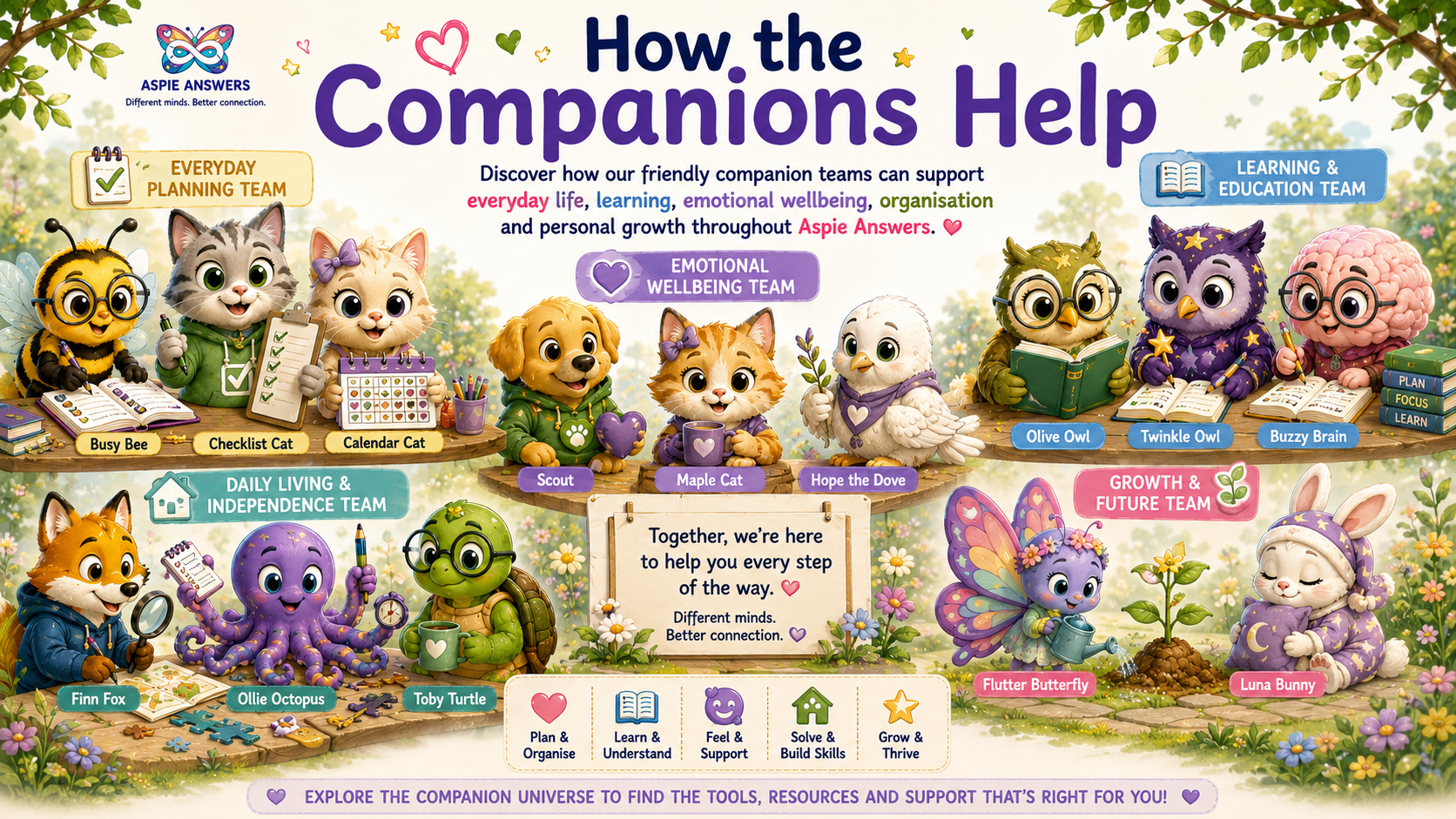
The Aspie Answers Companions make different kinds of support easier to recognise and explore. Each Companion keeps their own established role, while some situations naturally bring two or more different strengths together.
You do not need to memorise every Companion before you begin. Start with what feels difficult, what you want help with, or the kind of support that would make today a little easier.

Start with what matters today
What would you like help with?
These are Companion pathways, not rigid boxes. A person may use one Companion, several Companions, or none at all depending on what works for them.
Planning, routines & manageable steps
For busy days, starting tasks, checklists, routines, schedules, appointments and breaking bigger jobs down.
Busy Bee · Checklist Cat · Calendar Cat
Focus, memory & executive function
For focus, working memory, holding steps in mind, task switching and understanding executive-function needs.
Buzzy Brain, often alongside the Executive Function Team.
Learning, study & understanding
For learning, study, homework, curiosity, confidence, understanding information and finding another way through a problem.
Olive Owl · Finn Fox · Twinkle Owl
Feelings, reassurance & self-kindness
For recognising feelings, emotional regulation, reassurance, belonging, encouragement, self-compassion and gentle growth.
Scout · Hope · Maple Cat · Flutter Butterfly
Rest, sleep, pacing & energy
For calmer routines, rest, bedtime, protecting energy, pacing and reducing the risk of pushing beyond what is sustainable.
Luna Bunny · Toby Turtle
Juggling demands & sensory overload
For too many demands at once, sensory overload, organisation, multitasking and finding a clearer way to hold several needs together.
Ollie Octopus
Everyday independence & problem-solving
For practical choices, flexible thinking, everyday challenges, confidence and learning skills that make daily life more manageable.
Finn Fox, with other Companions where their roles genuinely overlap.
Finding the next useful pathway
If the issue is bigger than one Companion role, use the wider Aspie Answers hubs, the Universe Map or Find Your Support Path.
The current official team structure
Four teams, with clear roles
Teams group related strengths together. They do not erase each Companion’s individual role, and they do not mean every activity needs the entire team.
Planning, focus and keeping track of what comes next
Busy Bee · Checklist Cat · Buzzy Brain · Calendar Cat
Planning, productivity, steps, routines, focus, working memory, schedules, deadlines and time planning.
Meet the team →Learning, problem-solving and finding different ways forward
Olive Owl · Finn Fox · Twinkle Owl
Learning, study, problem-solving, flexibility, independence, creativity, curiosity and understanding.
Meet the team →Feelings, reassurance and gentle encouragement
Scout · Hope · Maple Cat · Flutter Butterfly
Feelings, emotional regulation, reassurance, self-kindness, encouragement, growth and emotional wellbeing.
Meet the team →Rest, calm routines, pacing and protecting energy
Luna Bunny · Toby Turtle
Sleep, rest, bedtime and calm routines alongside pacing, energy awareness and burnout prevention.
Meet the team →Ollie Octopus is not forced into one of the four teams
Juggling demands · sensory overload · organisation · multitasking
Ollie is one of the fourteen official Companions and can work alongside different Companions when an activity genuinely overlaps with Ollie’s established role.
Meet Ollie and the other Companions →
Working together without forcing a match
Sometimes one activity genuinely needs two kinds of support
Companion teamwork works best when the overlap is real. The aim is not to attach several Companions to everything — it is to use the right strengths for the situation.
Planning + pacing
A plan can be clearer with an Executive Function Companion while Toby Turtle helps protect energy and prevent overloading the schedule.
Learning + emotional support
A difficult learning task may need Olive, Finn or Twinkle alongside reassurance from an Emotional Wellbeing Companion.
Too many demands + executive function
Ollie can help with juggling or overload while an Executive Function Companion helps clarify steps, priorities or reminders.
Rest + reassurance
Luna Bunny or Toby Turtle may support rest and pacing while Hope, Maple Cat, Scout or Flutter Butterfly supports the emotional side of the moment.
Companions are signposts, not the whole website
Companion support can lead into wider Aspie Answers pathways
The Companions can make a doorway feel friendlier, while the deeper information stays in the hub or specialist pathway that is designed for that subject.

Where friendly guidance becomes practical
A Companion idea can become something you can actually use
A strategy may appear as website guidance, a worksheet, planner, guide, activity, book or suitable digital experience. The format can change while the helpful idea stays familiar.
Planners & checklists
Clear steps, routines, schedules, reminders and practical planning supports.
Guides & learning tools
Explanations, study supports, step-by-step strategies and accessible learning resources.
Wellbeing tools
Feelings check-ins, emotional-regulation supports, reassurance and self-compassion activities.
Everyday-life resources
Home routines, practical skills, problem-solving and independence supports.
Rest & pacing supports
Energy awareness, calmer routines, sleep, rest and burnout-prevention tools.
Digital experiences
Interactive tools can use Companion roles when that genuinely improves support or understanding.
Different kinds of help have different jobs
Companion guidance, support services and crisis help are not the same thing
Companions can make information and everyday tools friendlier. They do not replace professional, emergency or crisis support.
Companion guidance
Friendly ways to approach everyday planning, learning, emotions, pacing, sensory overload and practical resources.
Meet the CompanionsSupport & Directories
Use the wider support pathways for organisations, services, community help, advocacy and external support options.
Explore Support & DirectoriesCrisis & immediate support
Use the dedicated Crisis Support pathway when someone may need urgent help, emergency information or immediate safety support.
Open Crisis SupportA gentle way to begin
One useful next step is enough
There is no single correct route through the Companion Universe.
Notice the need
What feels hard, confusing, tiring or important right now?
Choose a Companion route
Pick the role or team that seems closest to that need.
Follow the wider pathway
Move into the relevant hub, resource or support area if you need more.
Try one small thing
Use one strategy, resource or next step rather than trying to do everything.
Gentle Notice
Use the Companion support that helps — and leave what does not
The Companions are educational and supportive guides. They are not a test, a treatment plan, or something you have to use in a particular way.
Different people may prefer different Companions, different tools, or direct support from another person or service.
Different strengths. One welcoming universe.
Where would you like to go next?
Start with one Companion, one team, one map district or one practical resource. You can always come back and choose another pathway later.