
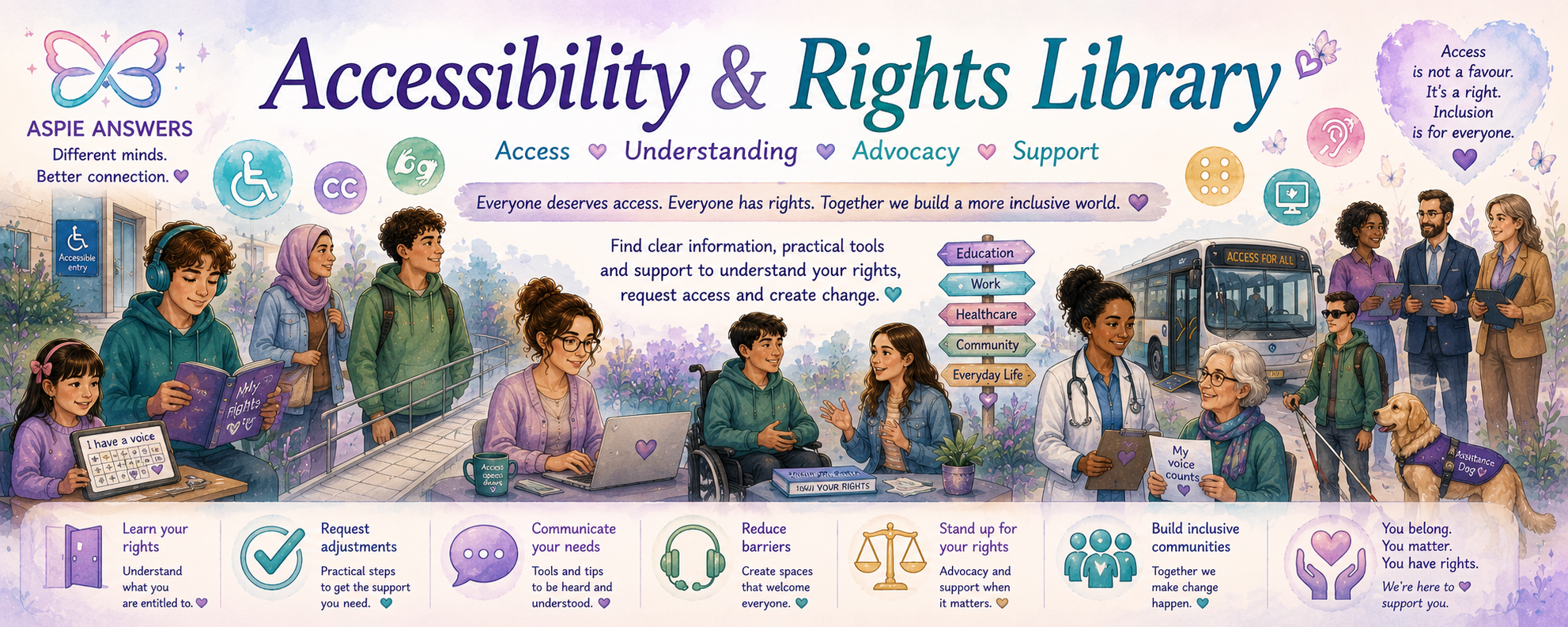
Accessibility & Rights Library
Accessibility should help people participate, communicate and belong.
The Accessibility & Rights Library brings together practical information,
learning resources and pathways about accessibility, adjustments, communication,
sensory needs, hidden and non-visible disabilities, digital access, education,
employment, healthcare, community participation, rights and self-advocacy.
You do not need to know the legal or accessibility term first. Start with the barrier or situation you are dealing with.
I Need an Adjustment
Find practical ways to describe a barrier, identify what may help and prepare to ask.
I Need Communication Access
Explore AAC, interpreters, captions, written information, communication preferences and support.
I Think My Rights Are Not Being Respected
Understand possible next steps, documentation, complaints pathways and where to find help.
I Need Fewer Sensory Barriers
Explore noise, lighting, sensory load, quiet spaces, flexibility and sensory-friendly environments.
My Needs Are Not Obvious to Others
Explore hidden/non-visible disability, fluctuating needs, disclosure and being believed.
Accessibility can involve physical spaces, information, communication, sensory environments, technology, attitudes, routines and the way services are designed.
Accessibility Basics
Understand barriers, participation, inclusion and why accessibility can look different for different people.
Explore Accessibility Basics →Communication Access
AAC, interpreters, captions, communication preferences, written information and making communication easier to access.
Communication Access →Sensory Accessibility
Noise, lighting, smells, textures, sensory breaks, quiet spaces and creating lower-barrier environments.
Sensory Accessibility →Hidden & Non-Visible Disabilities
Support needs that may not be obvious, fluctuating needs, disclosure, misunderstanding and being believed.
Hidden Disabilities →Mobility & Physical Access
Ramps, lifts, seating, accessible toilets, routes, mobility aids, transport and the physical design of spaces.
Physical Access →Digital Accessibility
Accessible websites, documents, captions, screen-reader support, keyboard access, contrast and usable technology.
Digital Accessibility →Neurodivergent Access Needs
Sensory, executive-function, communication, predictability and flexibility needs across autism, ADHD, AuDHD and other ND experiences.
Neurodivergent Accessibility →Vision & Hearing Access
Low vision, blindness, Deaf/hard-of-hearing access, captions, audio, visual information and assistive supports.
Vision & Hearing Access →Good access reduces barriers instead of asking people to push through them
Accessibility can involve adjustments to environments, information, communication, expectations, technology, timing, routines or the way a service is delivered.
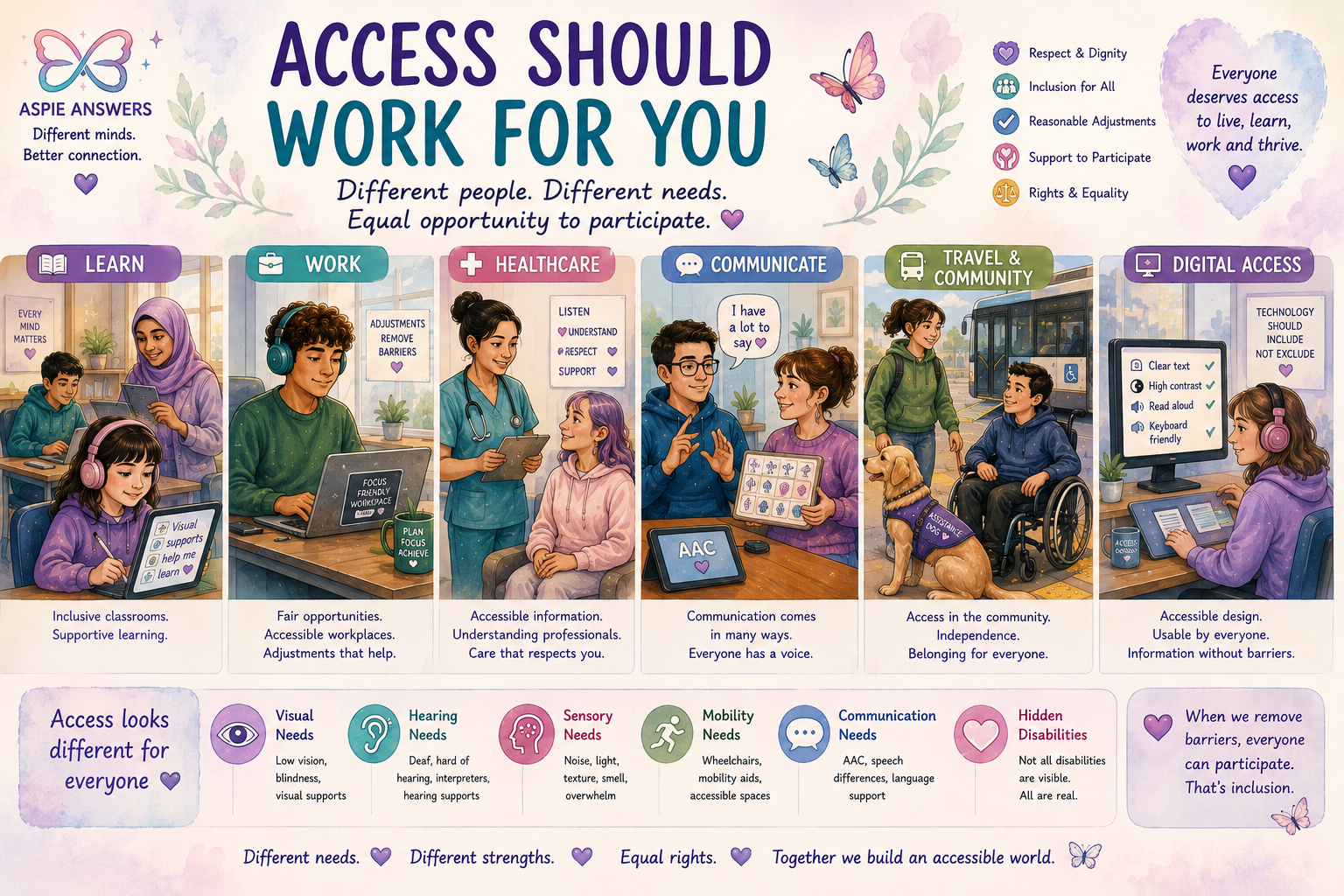
Understanding Adjustments
Learn what adjustments/accommodations are, why they matter and how they can reduce barriers.
Understanding Adjustments →Requesting an Adjustment
Prepare what you want to say, describe the barrier, identify what may help and keep a record where useful.
How to Request Support →Access Plans & Communication Profiles
Tools for recording access needs, preferences, supports and information that others may need to know.
Access Planning Tools →Bringing Support
Explore advocates, trusted people, interpreters, carers and support workers who may help you communicate or participate.
Support People →Rights depend on where you live and the situation involved. This section helps you understand the kinds of rights issues that may arise and where to look next.
Understanding Your Rights
Learn about dignity, equality, participation, privacy, fair treatment and the idea of disability rights.
Rights Basics →Discrimination & Unfair Treatment
Recognise possible discrimination, harassment or exclusion and explore options for documenting and responding.
Discrimination & Support →Privacy, Disclosure & Information
Think through privacy, sharing disability or neurodivergence information, consent and who needs to know what.
Privacy & Disclosure →Complaints & Raising Concerns
Prepare a concern, gather information, keep records and find the correct complaints or advocacy pathway.
Raising a Concern →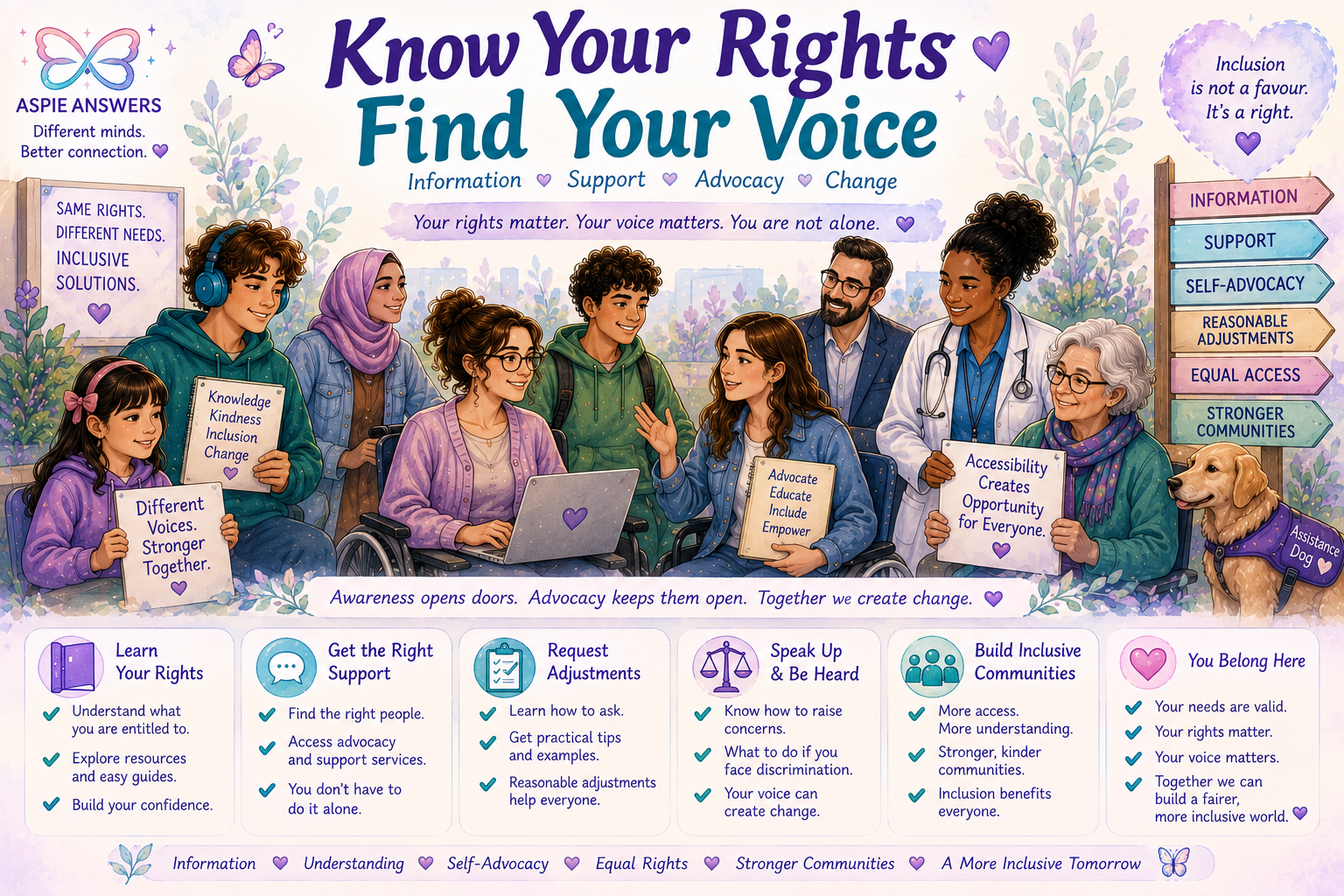
Self-Advocacy
Identify your needs, preferences and boundaries, and practise communicating them in ways that work for you.
Self-Advocacy →Preparing to Speak Up
Use notes, questions, scripts, support people and preparation tools before important conversations.
Prepare for a Conversation →Choice, Boundaries & Dignity
Explore autonomy, respectful treatment, informed choice, boundaries and having your preferences taken seriously.
Choice & Dignity →Advocacy With Support
Self-advocacy does not always mean doing everything alone. Trusted people and advocates can be part of the process.
Supported Advocacy →🎓 Learning & Education
Education access, learning adjustments, communication, sensory needs, support planning and routes into Learning Support.
Learning Support Pathways →💼 Work & Employment
Workplace adjustments, employment rights, disclosure, accessible communication, sensory needs and getting help with workplace problems.
Work & Employment Library →🩺 Healthcare Access
Accessible appointments, communication preferences, sensory consideration, support people, informed choices and respectful care.
Healthcare Access →🏙️ Community & Public Life
Transport, venues, services, events, public spaces and community participation without unnecessary barriers.
Community Access →🏡 Everyday Living
Access needs can affect home life, appointments, shopping, travel, communication, relationships and daily routines.
Everyday Living Library →💜 Mental Health & Wellbeing
Mental health services also need to be accessible. Route into the dedicated support and wellbeing areas when that is the main need.
Mental Health Support →Rights and legal processes differ between countries. Use regional pathways to find current official information rather than assuming one country's rules apply everywhere.
🇳🇿 New Zealand
Explore the dedicated New Zealand pathway for disability rights, accessibility, complaints, official information and useful next steps.
New Zealand Rights →🇦🇺 Australia
Explore the dedicated Australia pathway for disability rights, accessibility, adjustments, complaints and official information.
Australia Rights →🌏 Worldwide / Other Regions
Find regional and country-specific rights information, official services and support directories.
Regional & Country Rights Pathways →Downloads & Practical Resources
Move from information into practical guides, worksheets, checklists, planners and self-advocacy tools connected with accessibility and rights.
Downloads & Resources →Accessibility & Rights Collections
Explore grouped pathways that bring related accessibility, adjustments, advocacy, digital access, complaints and regional-rights content together.
Browse Collections →Accessibility & Rights Topics A–Z
Browse access and rights topics alphabetically when you already know what you are looking for: AAC, adjustments, advocacy, captions, discrimination, disclosure, sensory access, workplace rights and more.
Accessibility & Rights Topics A–Z →Accessibility & Rights Glossary & Definitions
Clear explanations of terms such as accessibility, accommodation, reasonable adjustment, advocacy, discrimination, disclosure, AAC, universal design and inclusion.
Glossary & Definitions →Find advocacy, services or specialist support
Some accessibility and rights issues need more than an information page. You may need an advocate, disability organisation, employment/education service, legal information, complaints body or specialist professional who understands your situation.
Browse Support & Directories →Immediate safety or crisis?
If there is immediate danger, abuse, serious risk or an urgent crisis, use appropriate emergency services and the dedicated Crisis Support pathways rather than waiting on a rights process.
Crisis Support — Start Here →Is this legal advice?
No. This library is for general education, preparation, accessibility information and routing. Laws and rights vary by country and circumstances, so specific legal issues should be checked against current official sources or appropriate professional advice.
Are accessibility needs only about physical disability?
No. Access can involve mobility, sensory needs, communication, vision, hearing, executive function, cognition, mental health, neurodivergence, hidden disabilities, technology, information and more.
Do I have to advocate for myself alone?
No. Self-advocacy can include preparing your own words, but it can also include advocates, interpreters, support workers, carers, trusted people or professionals where appropriate.
How do the Topics A–Z and Glossary fit with this Library?
The Library helps you browse by need and pathway. Topics A–Z is useful when you already know the subject you want, while Glossaries & Definitions helps when you need a clearer explanation of a word or term.