
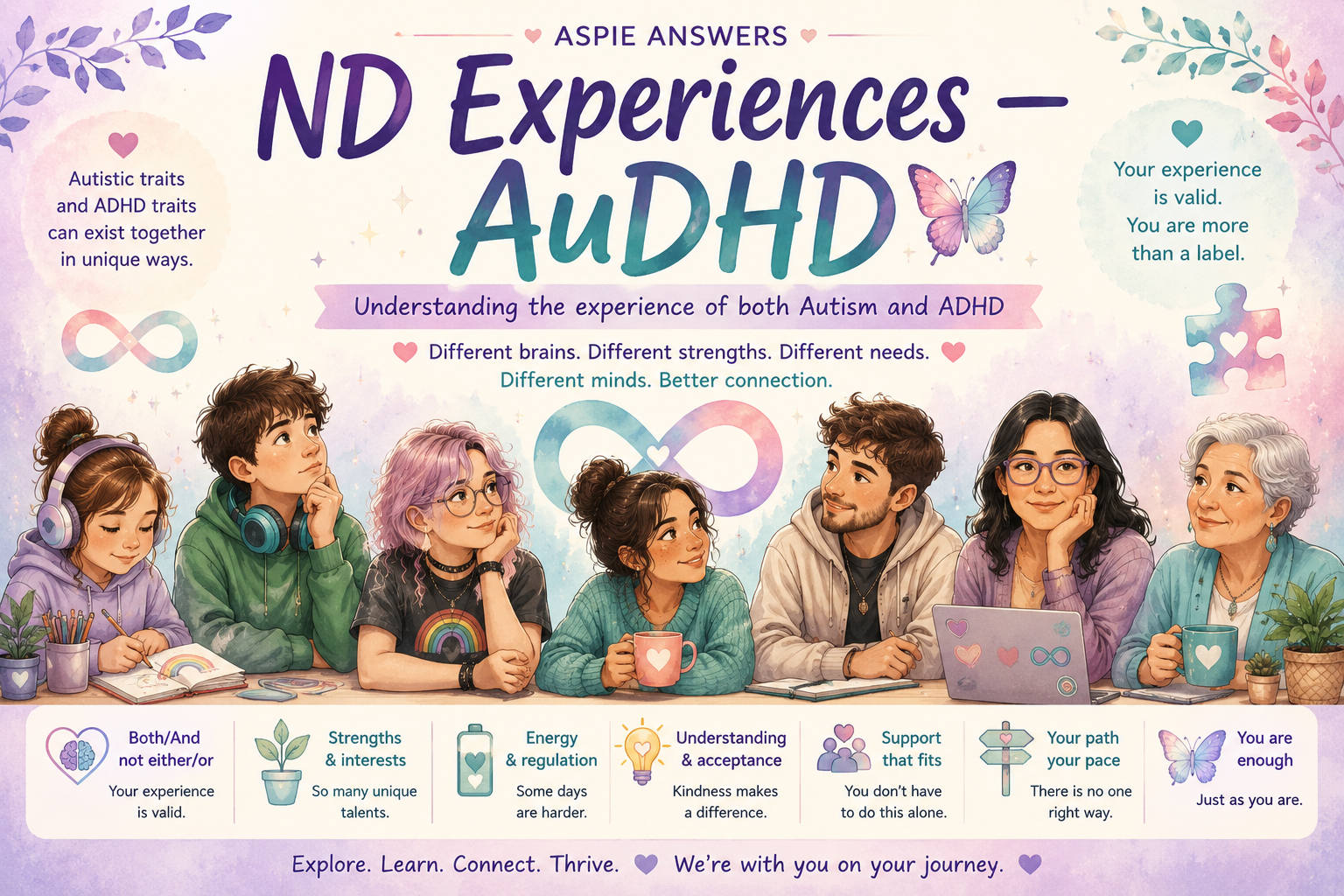
Welcome to ND Experiences — AuDHD
AuDHD is a commonly used community term for the experience of being both autistic and having ADHD. This page explores how those experiences can interact in everyday life — sometimes complementing one another, sometimes pulling in different directions, and always varying from person to person.
Autism and ADHD are distinct forms of neurodivergence, but one person can experience both. AuDHD is not simply “half autism and half ADHD”; the interaction can create its own patterns, needs, strengths and contradictions.
Both Autism & ADHD
Explore how autistic and ADHD traits can coexist, overlap and influence one another without reducing either experience.
No Two AuDHD Experiences Are the Same
Support needs, sensory profiles, energy, communication, interests and executive functioning can vary widely.
Language & Self-Understanding
Some people use AuDHD as a helpful community term for understanding themselves; others may prefer different language.
Support Should Fit the Person
Useful support is often flexible, sensory-aware, executive-function-friendly and responsive to changing energy and context.
Some AuDHD people describe feeling pulled between needs that can seem contradictory. These examples are not a checklist; they are simply ways that autism and ADHD can sometimes interact.
Wanting predictability and familiar patterns while also craving stimulation, change or something new.
Becoming intensely absorbed in something meaningful while struggling to begin tasks that feel unclear, boring or overwhelming.
Seeking movement, sound or stimulation at some times while needing quiet, control or reduced input at others.
Having creativity, enthusiasm and possibilities while finding sequencing, prioritising or completing them difficult.
Enjoying people, conversation or shared interests while needing substantial downtime after social or sensory demands.
Wanting freedom and flexibility while also feeling safer when plans, expectations and changes are known in advance.
Different needs can show up on different days
Attention, sensory tolerance, social energy, motivation, routines and emotional capacity can change depending on context, stress, sleep, health, demands and what is happening around you.
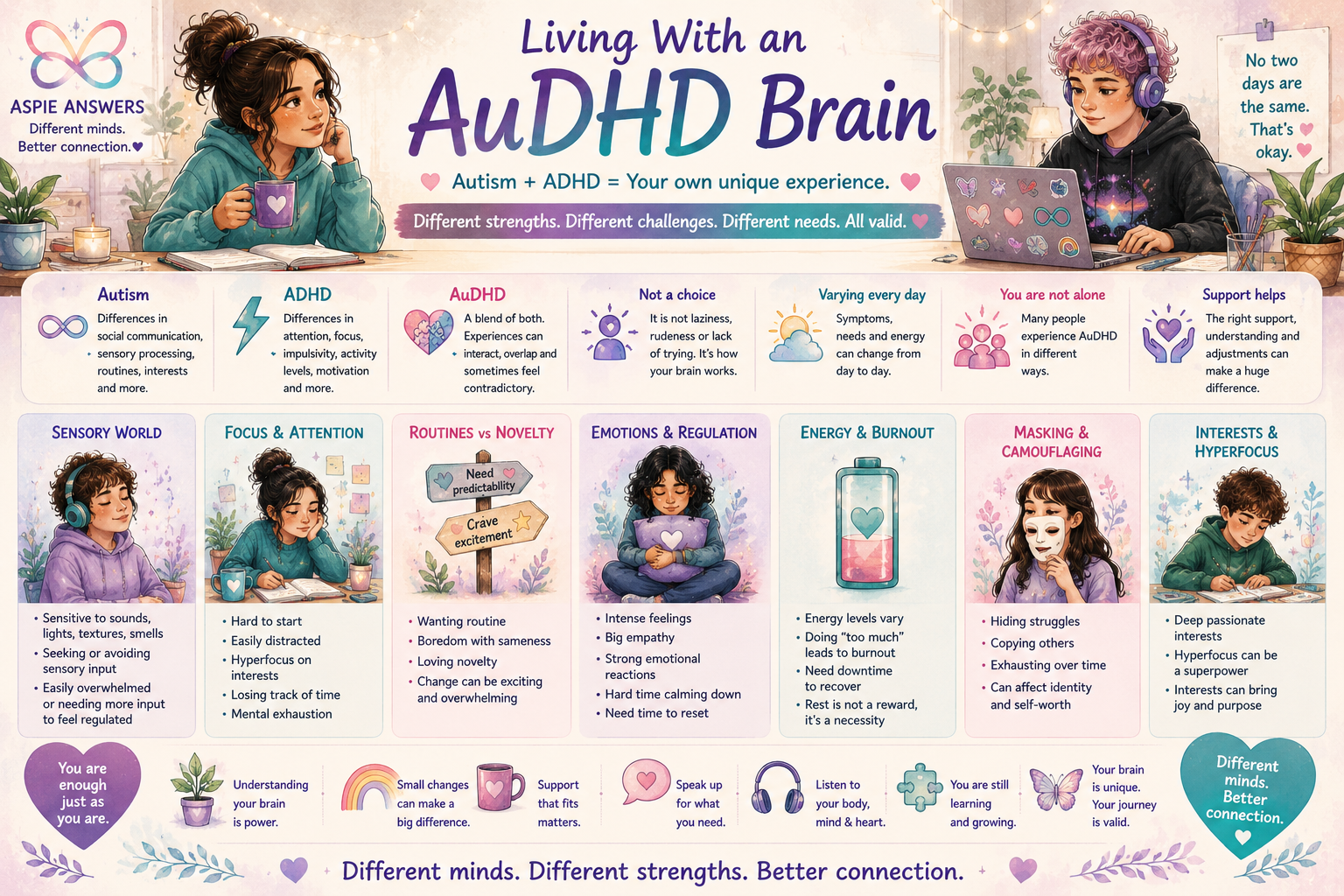
Sensory World
Sounds, lights, textures, movement, smells and sensory input may affect focus, comfort, regulation and participation.
Focus & Attention
Attention may be highly interest-based, easily redirected by competing input or intensely focused when something captures the brain.
Executive Function
Starting, sequencing, remembering, switching, planning and finishing tasks can require additional supports.
Routine, Predictability & Novelty
Structure can create safety while novelty can create motivation — and both needs may be present at the same time.
Interests & Hyperfocus
Deep interests can support learning, joy, skill-building and motivation, while also making transitions away from them difficult.
Emotions & Regulation
Strong emotions, frustration, excitement and recovery needs may interact with sensory and executive-function demands.
Masking & Camouflaging
Trying to appear more neurotypical can hide support needs and contribute to exhaustion, disconnection or burnout.
Energy, Overwhelm & Burnout
High demands, sensory load, masking and executive effort can accumulate, making pacing and recovery important.
Communication & Relationships
Communication preferences, emotional intensity, social energy, boundaries and shared routines can all influence relationships.
Learning & Education
Interest, sensory needs, movement, executive functioning and predictability can shape learning in very individual ways.
Learning & Neurodivergence →Work & Employment
AuDHD can affect work routines, sensory comfort, communication, pacing, motivation, planning and support needs.
Work & Employment →Everyday Living
Planning, home tasks, appointments, food, travel, energy and daily routines can all benefit from flexible practical support.
Everyday Living Library →Mental Health & Wellbeing
Mental health support should remain separate from AuDHD education while recognising that neurodivergent experiences can affect wellbeing.
Mental Health Support →Accessibility, Adjustments & Rights
Accessible environments, reasonable adjustments, communication preferences and self-advocacy can reduce unnecessary barriers.
Accessibility & Rights →Health & Appointments
Preparation, sensory needs, communication preferences and written prompts can make appointments easier to navigate.
Support From Other People
Families, supporters, educators and professionals can help best when they listen to the person and adapt support collaboratively.
AuDHD is not only about difficulty. Understanding your own patterns can also make room for strengths, values, interests, creativity and a clearer sense of self.
Identity & Self-Understanding
Learning why certain things have felt difficult — or why certain strengths are so strong — can bring relief and context.
Strengths & Positive Experiences
Creativity, curiosity, deep interests, pattern-spotting, enthusiasm, empathy and problem-solving may be meaningful strengths for some people.
Self-Advocacy
Understanding your needs can make it easier to explain what helps, ask for adjustments and set clearer boundaries.
Self-Acceptance & Flexibility
Support is not about forcing yourself to function exactly like someone else; it is about finding sustainable ways that work for you.
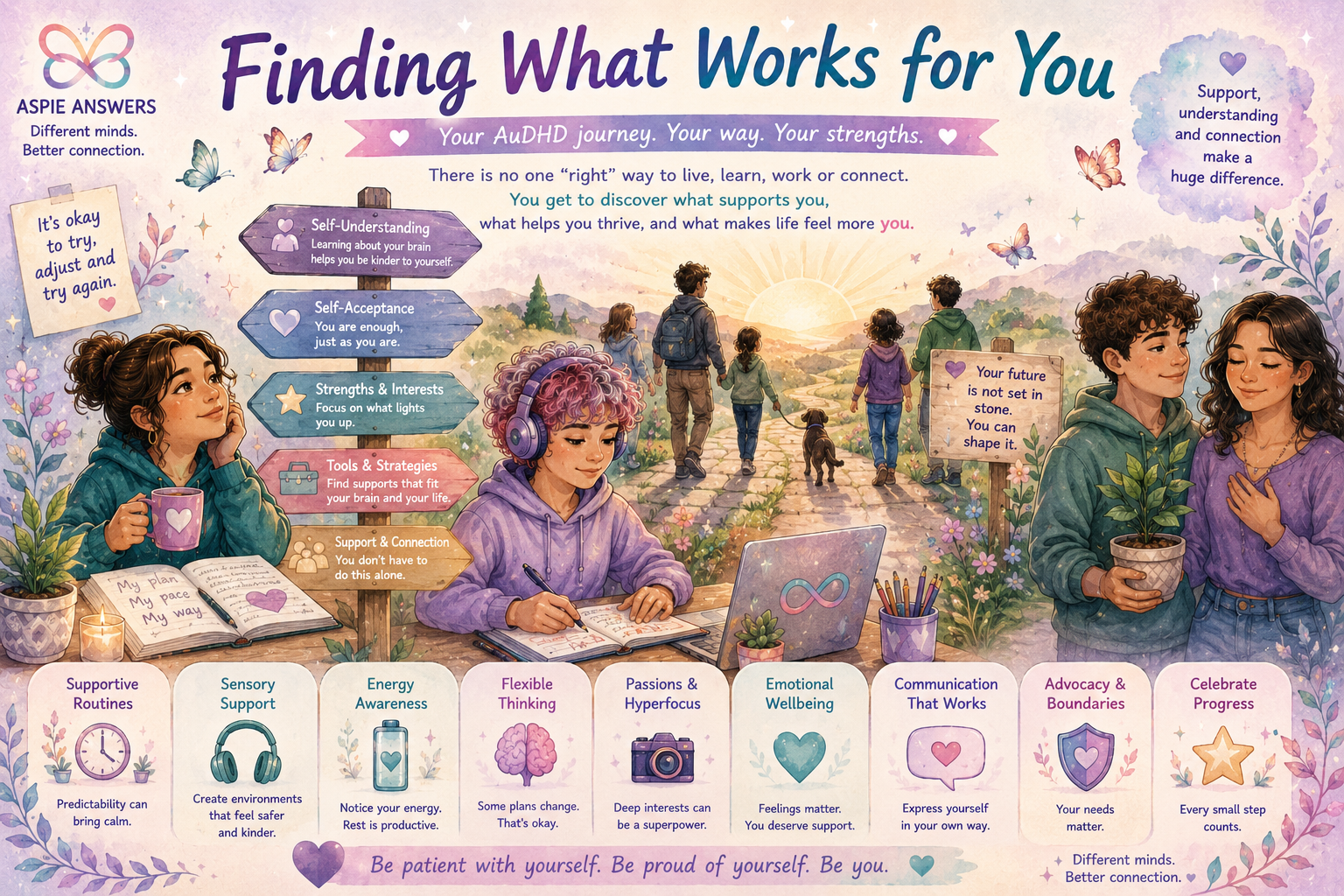
Your supports can be as individual as your brain
There is no single perfect AuDHD routine, productivity system, sensory toolkit or communication style. Useful support is often built through experimentation, reflection and permission to adjust.
Externalise Memory
Calendars, notes, visual reminders, checklists and prompts can reduce the amount your brain must hold at once.
Reduce Sensory Load
Headphones, lighting changes, clothing choices, quieter spaces or recovery time can make participation more sustainable.
Make Tasks Smaller
Clear next actions can be easier to begin than large or vague instructions.
Use Interest & Motivation
Pairing tasks with interest, novelty, movement, body doubling or visible progress may support engagement.
Plan for Recovery
Busy, social, sensory or highly focused periods may need quieter recovery time afterward.
Allow Flexible Strategies
A strategy that works today may need changing tomorrow. Adaptation is part of support, not failure.
AuDHD experiences can appear across the lifespan. Representation matters, but we should audit existing audience pages before creating unnecessary duplicates.
AuDHD Topics A–Z
Future alphabetical browsing for AuDHD topics such as burnout, executive function, hyperfocus, masking, routines, sensory needs and self-advocacy.
AuDHD Topics A–Z →AuDHD Glossary & Definitions
Future plain-language explanations of AuDHD-related terms, while linking back to broader Autism, ADHD and Neurodiversity glossaries where appropriate.
Glossary & Definitions →Looking for assessment, practical support or services?
Use Support & Directories when you are looking for organisations, professional support, community services or a more specialised pathway.
Support & Directories →Need urgent help?
If there is immediate danger or you need urgent crisis support, use the dedicated Crisis Support area and local emergency services where appropriate.
Crisis Support — Start Here →Is AuDHD a separate diagnosis?
AuDHD is commonly used as a community term for someone who is both autistic and has ADHD. This page uses it as an accessible way to discuss the combined experience, not as a diagnostic test.
Does every AuDHD person have the same push-and-pull experiences?
No. The examples on this page show possible patterns, not requirements. People can have very different sensory profiles, executive-function needs, strengths and life experiences.
Why does this page link to Autism and ADHD instead of explaining everything here?
This page focuses on the interaction between autistic and ADHD experiences. Deeper Autism and ADHD education should remain in their own established areas so content is easier to maintain and does not become duplicated.
Will Aspie Answers have a broader ND Experiences page?
That is currently planned as a light orientation doorway, but existing Neurodiversity pages should be audited first so we do not recreate something that already exists.