Employment Rights
Understand core workplace rights, responsibilities and where to find reliable information.
Rights & responsibilities
Work & Employment Hub
Understand workplace rights, explore your options and find accessible guidance for navigating work. This section is designed to support neurodivergent people, disabled people, people experiencing mental-health challenges, and anyone who wants clearer, more understandable employment information.
Start with the situation, not the jargon
Work can involve contracts, pay, leave, health and safety, workplace expectations, adjustments, difficult conversations and decisions about staying, returning or leaving. These topics can feel especially overwhelming when policies or legal language are hard to understand.
This section breaks workplace-rights topics into smaller, clearer pathways so you can identify the issue, understand useful questions to ask and find the right place for current professional or legal information when needed.

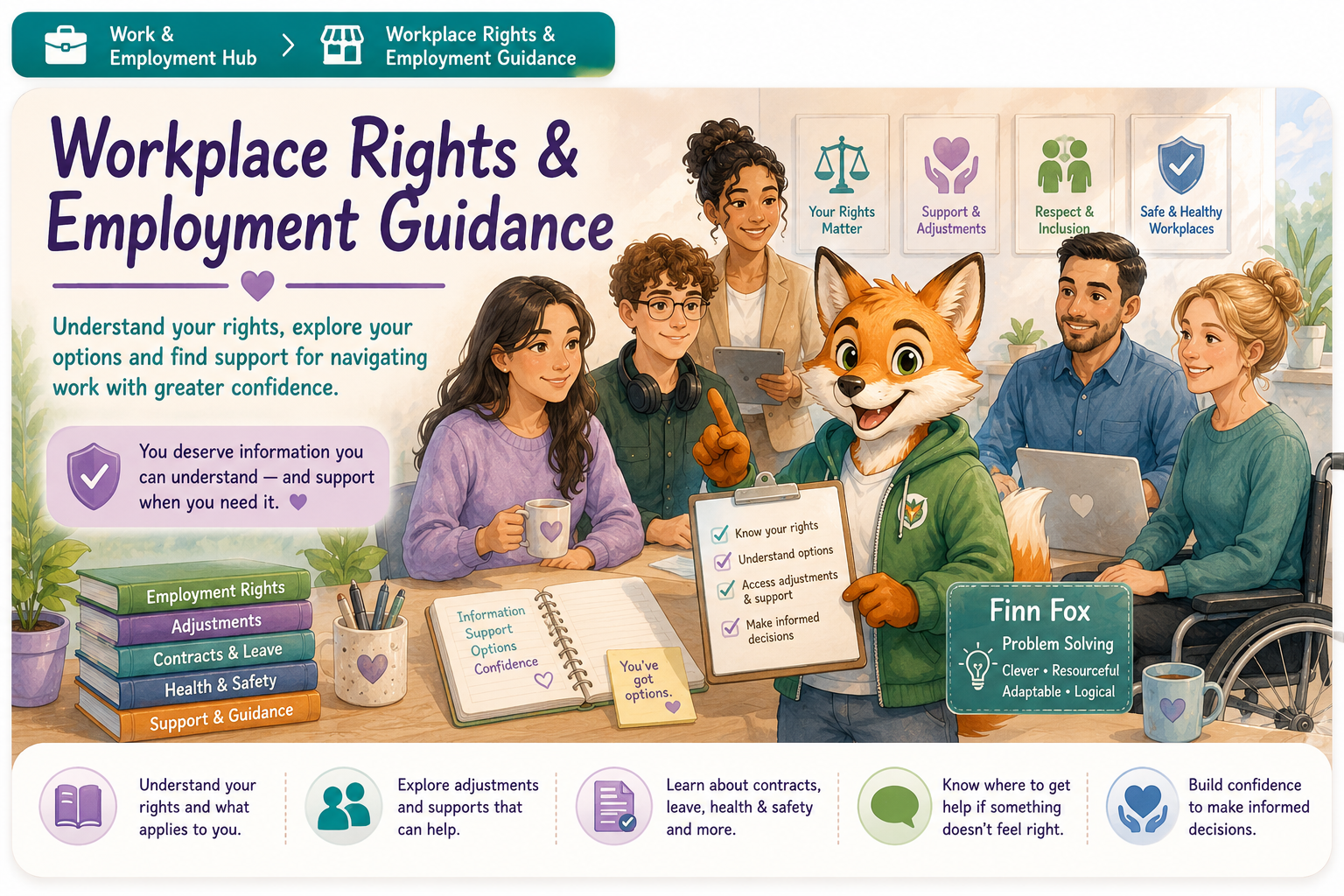
Finn can help break a workplace problem into smaller pieces: what happened, what information you need, what your options may be and who could help you with the next step.
Different workplace questions need different kinds of information. Start with the topic that feels closest to your situation.
Core workplace rights topics
Choose the topic closest to your situation. Where a dedicated deeper page is already available, the card links directly to it. Broader starting pages are used where a more focused page is still being developed, so there are no deliberately broken links.
Understand core workplace rights, responsibilities and where to find reliable information.
Rights & responsibilitiesExplore practical changes that may reduce barriers and make work more accessible or sustainable.
Accessibility supportThink through what disclosure means, what information you may want to share and what support you may need.
Communication & choiceUnderstand workplace health and safety, reporting concerns and where to find current official guidance.
Safety & wellbeingLearn what to look for in an employment agreement and which questions may be useful before signing or changing terms.
Agreements & conditionsExplore pay arrangements, workplace entitlements and where to check the current rules that apply to you.
Pay & entitlementsFind clearer pathways into leave, holidays, time away from work and current entitlement information.
Leave & time awayExplore changes to hours, location, schedules, remote work and other arrangements that may affect how you work.
Working arrangementsPlan a return after illness, injury, burnout, leave or another period away from employment.
Returning & transitionWork through concerns such as performance processes, conflict, restructuring, disciplinary issues or difficult workplace situations.
Problems at workRecognise concerning behaviour, document what is happening and identify appropriate sources of support.
Safety & supportExplore resigning, notice, endings, transitions and practical steps when employment is coming to an end.
Leaving & moving onPrepare questions, gather information and find appropriate independent or professional support.
Advocacy & helpLocation and work arrangement matter
Employment rules are not identical everywhere. Your location, type of work, employment arrangement, contract and circumstances can all affect which rules or processes apply.
Aspie Answers begins from a New Zealand perspective, but this website is designed for an international audience. If you are outside New Zealand, use your country's official employment or labour authority for current legal information.
Employee, contractor, casual, fixed-term, part-time and other arrangements may involve different rights or responsibilities. If you are unsure which category applies, get reliable advice rather than guessing.
Workplace rights are not only about legal language — they are also about whether people can participate, communicate and work safely.
Inclusive workplaces
A helpful workplace-rights resource should not assume that everybody communicates, processes information, moves through spaces, manages energy or responds to stress in the same way.
Written instructions, clear expectations, extra processing time or different meeting formats may make information easier to use.
Noise, lighting, layout, equipment, mobility access and environmental demands can affect whether work is accessible.
Breaks, pacing, predictable scheduling, flexibility or gradual return plans may matter when health or energy fluctuates.
Task clarity, written priorities, reminders, structured systems and predictable processes can reduce unnecessary barriers.
Stress, anxiety, trauma, low mood or other mental-health challenges can make workplace processes harder to navigate.
Some people may benefit from a support person, advocate, union representative or trusted professional when dealing with difficult issues.
When you are not sure what the issue is
You do not always need to know exactly what the legal issue is before asking for help. Start by describing what happened, what you were told, what changed and what outcome you are worried about.
Depending on the issue, support might come from a manager, HR, union, advocate, support person, employment adviser, regulator, community organisation or legal professional.
If a situation involves immediate safety concerns, urgent legal deadlines or serious harm, seek appropriate professional or emergency support rather than relying only on general website information.
Use official sources when law, entitlements, time limits or formal processes matter, then use practical tools to organise what you need to do.
Country and regional starting points
Employment laws, safety rules, discrimination protections, complaint processes and time limits vary by location. Use the official sources for the country or region where you work, and check state, province or territory rules when those also apply.
Employment rights, agreements, pay, leave, workplace problems, health and safety, discrimination and human-rights information.
Minimum employment entitlements, workplace protections, workplace health and safety, disability discrimination and workplace adjustments.
Employment status and rights, workplace problems and dispute guidance, health and safety, equality and disability discrimination.
Federal wage and hour protections, workplace safety, discrimination and disability-accommodation information. State law may add further protections.
Federal labour standards apply to federally regulated workplaces, while provinces and territories have their own employment standards. Health-and-safety and human-rights rules also vary by jurisdiction.
EU rules set minimum standards in areas such as working conditions, equal treatment and labour law, while national authorities and laws remain important.
Start with the labour ministry, employment authority, labour inspectorate, workplace-safety regulator or human-rights body for your own country. International Labour Organization country information can help provide a wider starting point.
For broader accessibility, discrimination, advocacy and complaint pathways that overlap with employment, continue through the dedicated Aspie Answers Rights & Accessibility area.
Reduce the mental load
Use the pathway that matches what you need: practical downloads for something to use, the Work & Employment Library for deeper information, Topics A–Z when you know the subject, and the Glossary when the terminology itself is the problem.
Browse practical worksheets, planners, checklists, templates, guides and downloadable support tools.
Explore groups of related resources built around shared work, career, workplace and self-employment needs.
Browse deeper information across applications, workplace life, rights, support and different ways of working.
Use the alphabetical topic index when you know roughly what you are looking for but not which pathway contains it.
Look up work, employment, rights, support, pay, leave and workplace terminology in plain language.
Explore broader accessibility, advocacy, discrimination, adjustments and rights information that can overlap with work.
This page now connects back into the main Work & Employment system, so you can move directly to the wider hub, reference pages, libraries and collections without having to hunt for them again.