
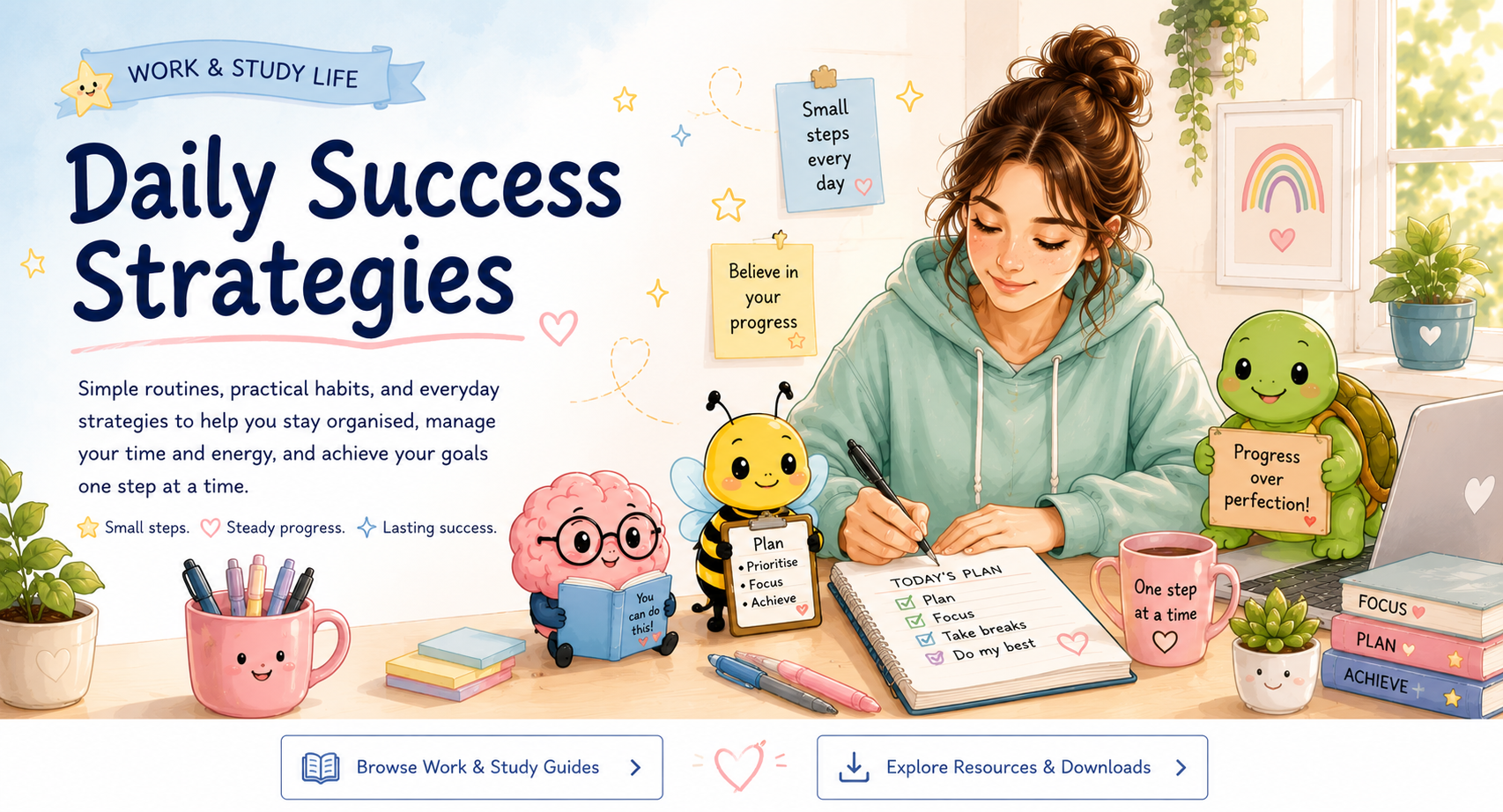
Daily Success Strategies
Success does not have to mean completing everything perfectly. It can mean starting one task, protecting your energy, asking for help, remembering an appointment, taking a needed break or trying again tomorrow.
This practical guide brings together supportive strategies for planning, focus, routines, motivation, energy and emotional wellbeing. Choose the ideas that fit your needs and leave the rest for another day.
Find a strategy
Search this page or use the topic buttons to focus on the kind of support you need today.
How to use this guide
You do not need to read or use everything at once.
Notice what feels difficult today
Is the main difficulty starting, remembering, focusing, managing energy, handling emotions or knowing what to do next?
Choose one strategy
Pick the smallest idea that feels realistic. You can return for another strategy when you are ready.
Adapt it to suit you
Change the wording, timing, format or amount of support. A strategy should work with your brain, needs and circumstances.
Review without judgement
Ask what helped, what got in the way and what you may adjust next time. A strategy not working is useful information, not failure.
What daily success can look like
Success can be practical, personal, flexible and quiet.
Starting
Opening the document, gathering supplies or completing the first two minutes of a task.
Continuing
Returning after a break, asking for clarification or changing the plan when something is not working.
Protecting energy
Resting before exhaustion, reducing demands or choosing a slower and more sustainable pace.
Meeting a need
Eating, drinking, using sensory supports, taking medication or attending an appointment.
Connecting
Sending a message, asking for support or spending time with somebody who feels safe.
Trying again
Beginning again tomorrow without treating today's difficulties as proof that you cannot succeed.
Core daily success strategies
Explore the cards below or use the search and filters above.
Choose a small number of priorities
Separate what truly needs attention from what could wait. One to three priorities may be easier to manage than a long list.
- Must do
- Helpful to do
- Can wait
Break tasks into visible steps
Replace a broad task such as “work on assignment” with a clear next action such as “open the instructions.”
Use external reminders
Calendars, timers, alarms, visual lists and reminder notes can reduce the pressure placed on working memory.
Reduce avoidable distractions
Silence notifications, close unused tabs or move to a quieter space when the environment is making focus harder.
Work in manageable time blocks
A short focus period followed by a real break may be more sustainable than expecting uninterrupted concentration.
Match tasks to your energy
Use higher-energy periods for demanding tasks and lower-energy periods for simpler or familiar activities.
Prepare before you need to act
Setting out clothes, packing a bag or preparing materials can reduce morning decisions and difficult transitions.
Create repeatable sequences
A short routine or checklist can make familiar tasks easier to begin, remember and complete.
Check basic needs
Hunger, thirst, pain, sensory overload and missed medication can make planning and focus much harder.
Schedule recovery, not only work
Breaks are part of the plan. Waiting until you are completely depleted can make recovery take much longer.
Use flexible expectations
Adjust the plan when circumstances change. A reduced version of a task still counts.
Ask for support earlier
Clarification, practical help, accommodations or emotional support can prevent a manageable difficulty from becoming a crisis.
When getting started feels difficult
Reduce the size of the beginning.
Try a two-minute beginning
Commit only to the first two minutes. You may stop afterwards or continue if momentum begins to develop.
Make the first action physical
Stand up, open the laptop, place the item on the table or write the heading. Concrete actions can reduce uncertainty.
Use body doubling
Work near another person, join a quiet online session or tell someone what you are about to begin.
Lower the standard for starting
The first version can be rough. Starting imperfectly is often what makes improvement possible.
A gentle daily reset
Use this when the day feels scattered or overwhelming.
- Pause: Stop adding new demands for a moment.
- Check: Notice hunger, thirst, pain, tiredness and sensory needs.
- Clear: Write down everything competing for your attention.
- Choose: Select one next step or decide that recovery comes first.
- Prepare: Gather only what is needed for that step.
- Begin: Work for a short and clearly defined period.
- Review: Decide whether to continue, pause, ask for help or adjust.
- I have had something to drink.
- I have eaten or planned food.
- I know my next small step.
- I have reduced one distraction.
- I have planned a break.
- I know who I can contact for support.
Success strategies for hard days
Some days need a different definition of progress.
Use the minimum version
Choose the smallest safe and useful version of the task rather than abandoning it or pushing beyond your capacity.
Protect essential needs
Prioritise food, hydration, medication, safety, communication and rest before optional productivity.
Move non-urgent tasks
Rescheduling can be a responsible decision when continuing would worsen overload, exhaustion or burnout.
Use familiar supports
Return to a known checklist, sensory tool, calming activity or safe person instead of trying to invent a new system.
Communicate briefly
A short message such as “I need more time” or “I need help deciding the next step” can reduce pressure.
End the day gently
Record one thing you managed, prepare one item for tomorrow and allow the day to finish.
Meet the support companions
Different companions can support different parts of daily success.
Companion resources are growing
Companion profile pages, printable tools and interactive support features will be connected here as they become available.
Daily success resources and downloads
Practical printables and support tools will be gathered here and connected to the wider Everyday Help resource library.
Daily planning tools
Daily planners, priority sheets and simple next-step planning resources.
Weekly planning tools
Weekly overview pages, routine planners and flexible scheduling supports.
Task and focus tools
Task-breakdown sheets, focus-session planners and distraction checklists.
Energy and pacing tools
Energy check-ins, recovery planning and sustainable workload supports.
Routine supports
Morning, evening and transition checklists that can be adapted to individual needs.
Reflection tools
Gentle reviews for noticing what worked, what was difficult and what support may help next.
Resources & Downloads Library
Existing Daily Success resources will be organised and added to the correct library sections. New links will appear here as the resource pages and downloads are completed.
Daily success collections
Resources can be brought together into organised volumes and made available in different visual editions.
Classic Edition
Clean, practical and straightforward pages designed for flexible everyday use.
Companion Edition
Supportive versions featuring the Aspie Answers companions, prompts and encouragement.
Kawaii Edition
Friendly and playful versions, including selected planner designs that may already have been started.
Daily Success Collection — Volume 1
The first volume may bring together selected daily planning, weekly planning, routine, focus, energy and reflection resources. Existing designs will be checked first so completed work can be included rather than recreated.
Collections and Store pathway
When ready, the collection page will introduce each volume and edition. The Aspie Answers Store can then provide access to complete collections, bundles and future editions.
Frequently asked questions
Common questions about using daily success strategies.
Do I need to use every strategy?
No. Choose only the strategies that match your current needs, energy and situation. Different approaches may help on different days.
What if planners and routines usually stop working for me?
This is common. A system may need to be simplified, refreshed or replaced. You can also use several small supports rather than one permanent routine.
Is resting part of being successful?
Yes. Rest and recovery protect your health, energy and ability to continue. They are not rewards that must be earned through exhaustion.
What if I cannot complete my priorities?
Review what changed, whether the task was too large and whether more time or support is needed. Move unfinished tasks forward without treating them as a personal failure.
Will printable resources be added to this page?
Yes. Existing resources will first be checked and organised. Additional Classic, Companion and Kawaii resources can then be added through the Resources & Downloads Library, collections and the Aspie Answers Store.
Small steps still move life forward
You do not need a perfect routine, endless motivation or a highly productive day to be making progress. Choose one supportive next step, make room for your needs and recognise what you have already managed.