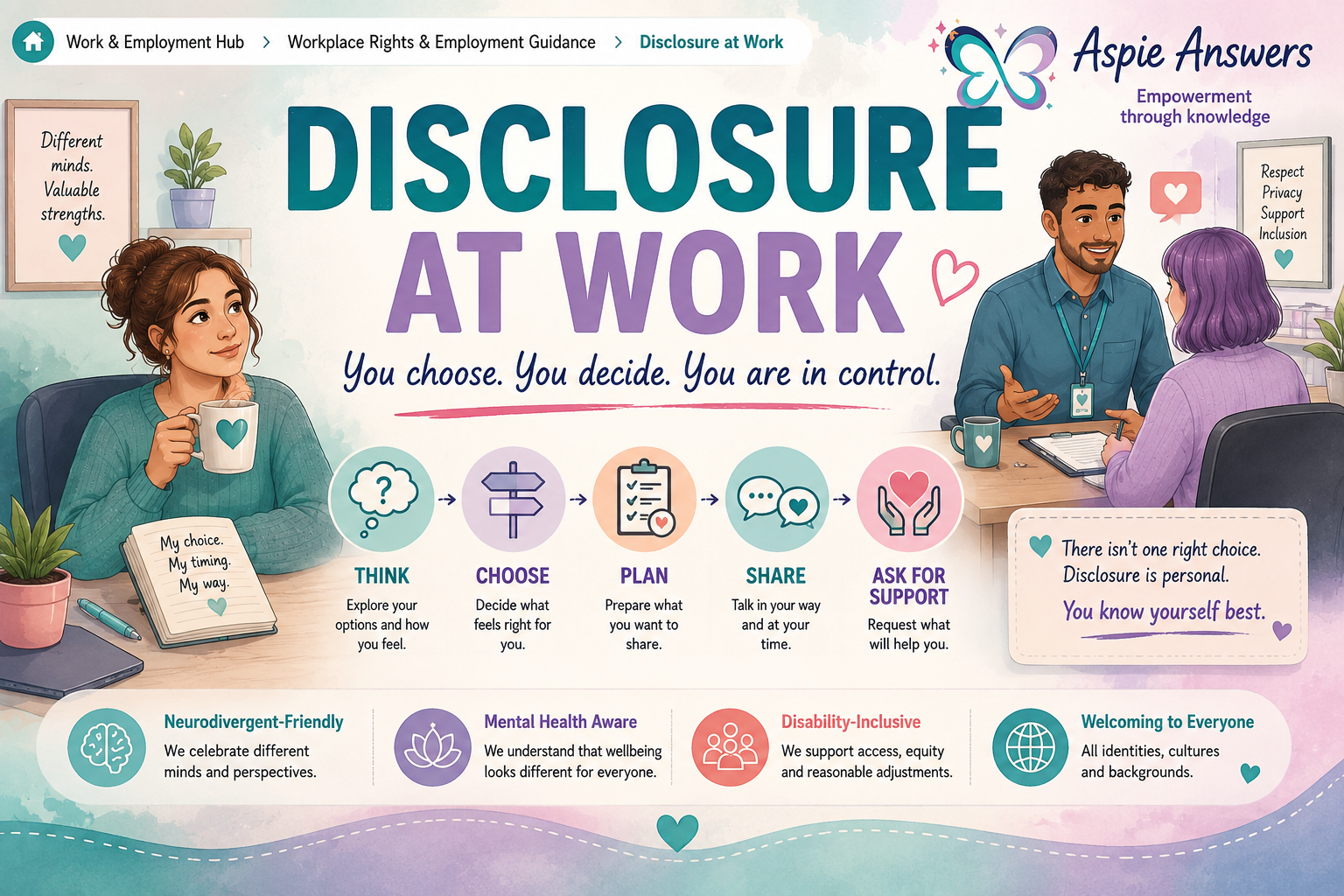
1. Think
What is happening, what do I need, and what outcome am I hoping for?

Work & Employment • Workplace Rights & Employment Guidance
Disclosure is personal. This page can help you think through whether, when, how and how much you may want to share about disability, neurodivergence, mental health, health conditions or workplace support needs.
At work, disclosure usually means sharing personal information that another person may not otherwise know — for example a disability, health condition, neurodivergence, mental-health condition or another factor that affects work.
What is happening, what do I need, and what outcome am I hoping for?
Decide whether disclosure feels useful and what information feels relevant.
Prepare what you want to say, ask for or put in writing.
Use the communication method and timing that works best where possible.
Request the adjustment, clarification, follow-up or support you need.
In New Zealand, Employment New Zealand says job applicants and employees do not have to disclose that they are disabled or have a health condition simply because they are applying for a job or are already working.
However, there can be situations where withholding information has consequences — for example where a condition affects whether work can be performed safely or properly, or where relevant information is needed to manage a genuine workplace risk.
A useful question is not only “Should I disclose?” but also “What information is actually relevant to this workplace need?”
What part of the job, environment or process is difficult?
How does that barrier affect your ability to participate, communicate or complete work?
What change, adjustment or communication approach could help?
You may have choices about who receives the information and how the conversation happens.
A manager, HR contact, workplace health and safety person, occupational health provider, union representative, support person or another authorised contact may be appropriate depending on the situation.
Some people disclose before starting a role, some after beginning work, some when a barrier appears, and some when requesting a specific adjustment. There is no single timeline that fits everyone.
Sometimes disclosure is connected to a request for a workplace adjustment. It may be helpful to focus on the barrier, the work impact and the practical change you are asking the employer to consider.
Explore Workplace AdjustmentsIn New Zealand, employers must comply with the Privacy Act 2020 and privacy principles when collecting, storing, using and sharing employee information, including information about applicants.
If disclosure leads to an adjustment request or an important workplace decision, keep copies of relevant emails, letters, forms, meeting notes and agreed actions.
If you feel misunderstood, treated unfairly, pressured to provide unnecessary information or worried about how your information has been handled, you can pause and get advice.
Record dates, conversations, requests and responses while they are fresh.
If appropriate, ask what decision was made, why, and what process applies next.
A union, advocate, employment adviser, privacy adviser, community organisation or lawyer may be helpful depending on the issue.
Use current official information for legal, privacy and rights questions.
Official guidance covering disclosure of a health condition or disability in the employment relationship.
Read Employment NZ guidanceOfficial guidance on how employers collect, store, use and share employee information.
Read employee privacy guidanceGuidance about information employers may collect while you are working and New Zealand privacy rights.
Visit Privacy Commissioner guidanceTe Kāhui Tika Tangata / Human Rights Commission guidance on reasonable accommodation and disability rights.
Read reasonable accommodation guidanceDisclosure, privacy, disability discrimination and workplace-accommodation rules differ by country and region. Terms such as disclosure, reasonable adjustment and reasonable accommodation may also be used differently.
As matching resources are completed, this page can connect into the central Aspie Answers Resources & Downloads Library.
Think through reasons, concerns, timing, who to tell and what outcome you want.
A worksheet for separating relevant workplace information from details you prefer to keep private.
Prepare key points, questions, adjustment requests and follow-up notes.