Employment Agreements
Employees must have a written employment agreement, with minimum legal rights still applying even if something is missing or incorrect.

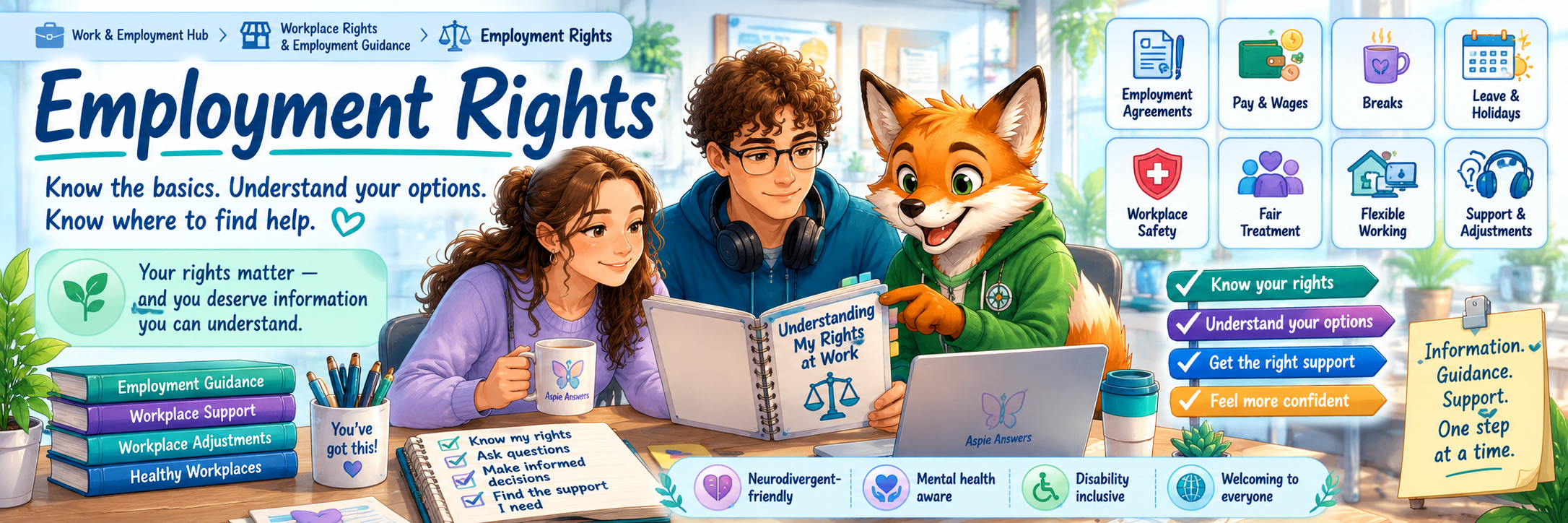
Work & Employment • Workplace Rights & Employment Guidance
Knowing the basics can make work feel less confusing. This page gives an accessible overview of employment rights, responsibilities and where to find reliable help when you need more specific or current information.
Employment rights are the minimum protections, entitlements and processes that apply to employees at work. They can cover areas such as employment agreements, pay, hours, breaks, leave, workplace safety, fair treatment, workplace change and ending employment.
You do not need to memorise every rule. A useful first step is knowing which part of employment you are dealing with, what questions you want answered and where to find current official information.
Finn Fox's Problem Solving role fits this page: identify the issue, gather the information, understand the options and decide what support may be useful next.
In New Zealand, employees are entitled to minimum employment rights. An employer cannot give an employee less than the law provides, even if the employee agreed to less.
Employees must have a written employment agreement, with minimum legal rights still applying even if something is missing or incorrect.
Employees have rights relating to how and when they are paid, minimum wage requirements where applicable, and wage records.
Hours of work should be agreed, and employees have rights relating to rest and meal breaks.
Different forms of leave and holiday entitlements can apply when eligibility requirements are met.
Workers have health and safety rights, and businesses have duties to manage workplace health and safety risks.
Employment processes should be fair, and unlawful discrimination in the workplace is prohibited.
Employees may have rights to request changes to their working arrangements under New Zealand employment law.
Restructuring, changes to work and other employment processes may involve consultation, good faith and fair-process requirements.
Resignation, dismissal and other endings involve rules, notice, process and record-keeping that can vary by situation.
In New Zealand, minimum employment rights still apply even if they are not written into an employment agreement, or if an agreement tries to provide less than the legal minimum.
An employment agreement can include terms that are more generous than the legal minimum, provided both sides agree to them.
If you are unsure whether something in your agreement is lawful or whether a minimum right applies, use current official information or seek appropriate employment advice.
Employees have rights, but they also have responsibilities in the employment relationship. These can include following lawful and reasonable instructions, taking reasonable care for health and safety, behaving responsibly, protecting confidential information and acting in good faith.
If an expectation is unclear, it is reasonable to ask what is required, where it is written, who is responsible and what happens next.
The legal category of your work arrangement matters. In New Zealand, contractors are not employees and are not covered by the same employment laws, rights and obligations as employees.
Employees are covered by New Zealand employment law and minimum employment rights.
Contractors are not employees. Different contractual and legal rules may apply.
Volunteers are generally not employees and may not have the same employment-law entitlements, although other protections can still matter.
Workplace rights information should be accessible to people with different communication, sensory, physical, cognitive, energy and mental-health needs.
You can ask for workplace information to be explained clearly and, where possible, provided in a format you can use.
Disability-related adjustments or accommodations may be relevant depending on the person, workplace and circumstances.
Written follow-up, extra processing time, support people or clearer agendas may make employment processes easier to navigate.
Stress, anxiety, trauma or other mental-health challenges can affect how easily someone can advocate for themselves or process complex workplace information.
Workplace accessibility can involve physical access, equipment, lighting, noise, layout and other environmental barriers.
A trusted support person, union representative, advocate or professional adviser may help with difficult workplace discussions.
You do not need to know the exact legal term before you start gathering information. Begin with what happened and what outcome or decision is concerning you.
Depending on the issue, help might come from a manager, HR, union, support person, advocate, employment adviser, regulator, community organisation or legal professional.
If the issue involves urgent safety concerns, serious harm or a legal deadline, seek appropriate professional help promptly.
Aspie Answers begins from a New Zealand perspective, but visitors may come from anywhere. Employment laws and minimum rights differ between countries and can change.
For current New Zealand employment-rights information, use official sources.
Employment New Zealand's official overview of minimum rights and employee responsibilities.
Read official employee-rights guidanceEmployment New Zealand provides minimum-rights information and selected rights resources in multiple languages.
View language resourcesWorkSafe New Zealand is the primary work health and safety regulator.
Visit WorkSafe NZTe Kāhui Tika Tangata / Human Rights Commission provides guidance about disability rights and reasonable accommodation.
Read reasonable accommodation guidanceAs matching resources are completed, this page can connect into the central Aspie Answers Resources & Downloads Library.
Suggested future quick-reference tool for common employment-rights areas and where to check them.
Suggested future worksheet for recording the issue, relevant documents, questions and next steps.
Suggested future printable for preparing for and recording an important workplace conversation.