
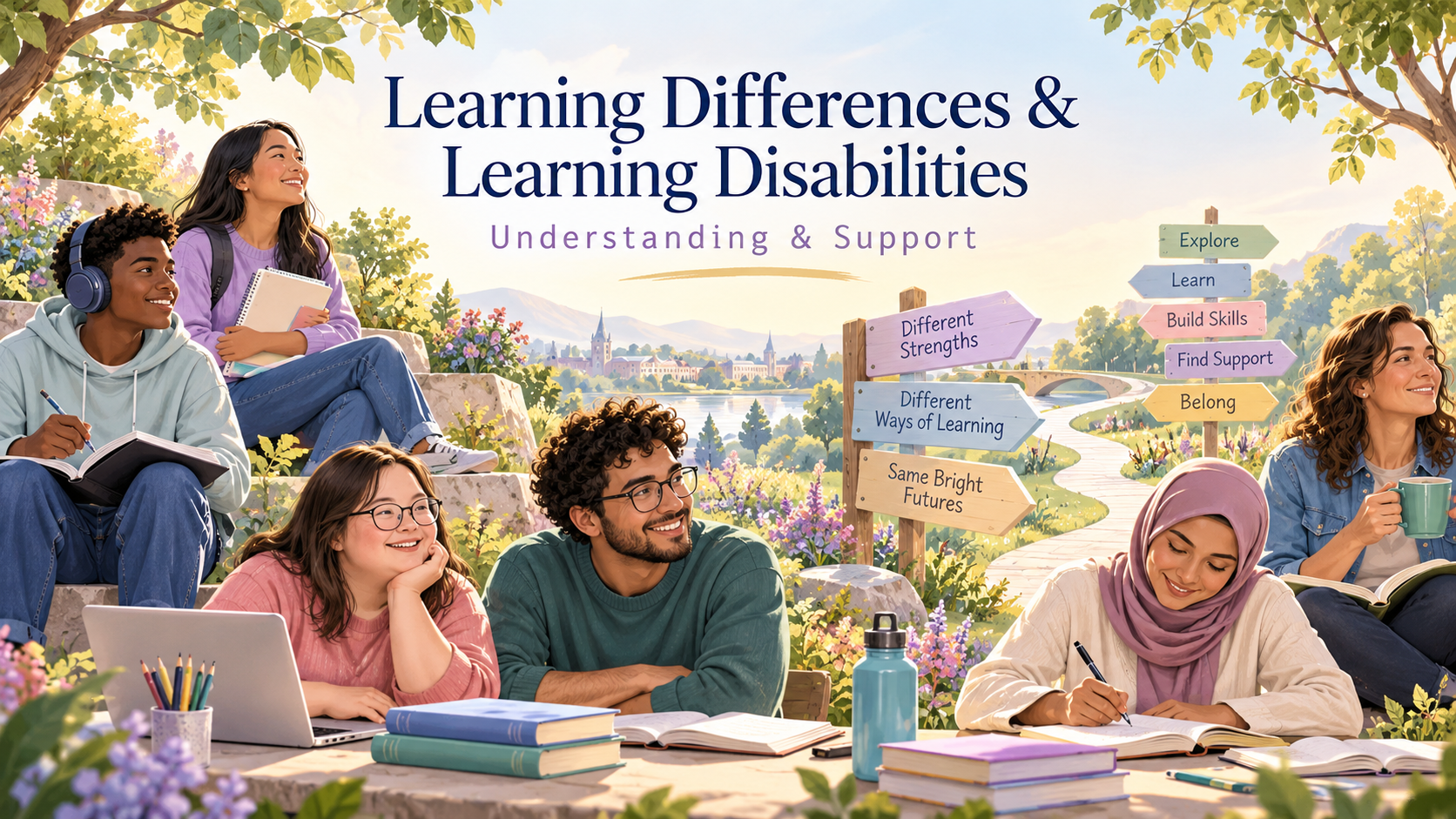
Learning · Understanding · Support · Pathways
Learning Differences & Learning Disabilities | Understanding & Support
Learning can look different from person to person. This bridge page helps you work out which Aspie Answers pathway may be most useful when reading, writing, maths, memory, processing, attention, coordination, executive function or sensory needs are affecting learning, study or everyday life.
Who This Page Is For
Learners of any age, parents and whānau, educators, support workers, employers and professionals who are trying to understand a learning need or find the most useful next pathway.
What You Will Find Here
Plain-language orientation, examples of different learning profiles, overlap with neurodivergence, education and work/study pathways, practical support ideas and routes to more detailed Aspie Answers pages.
Gentle Note
Learning difficulties can carry years of frustration, shame or being misunderstood. This page focuses on support, access and different ways of learning rather than judging intelligence or effort.
Terminology Note
Terms such as learning difference, learning difficulty, specific learning disability and learning disability are used differently across countries, services and communities. This page explains the pathways without assuming that one label means exactly the same thing everywhere.

Understanding the Difference
Different terms can describe different kinds of learning need
Learning differences
A broad, strengths-aware way of describing differences in how someone takes in, processes, remembers, organises or expresses information. It can include diagnosed conditions as well as learning patterns that do not fit a single label.
Learning disabilities / difficulties
These terms may be used for specific, persistent difficulties in areas such as reading, writing or maths, but their exact meaning varies by country and service system. Always check the terminology being used in the setting you are dealing with.
Reading & decoding
Reading speed, decoding, fluency, comprehension or keeping place on a page may require different supports.
Writing & written expression
Spelling, handwriting, organising ideas, written output or getting thoughts onto the page can all be areas of difficulty.
Maths & number processing
Number sense, calculation, sequencing, symbols, time, money or working-memory demands may affect maths learning.
Working memory
Holding instructions or information in mind while doing something else can make multi-step tasks harder.
Processing speed & information load
Some learners need more time, clearer steps or fewer competing demands to process and respond.
Motor planning & coordination
Writing, practical tasks, organisation and physical sequencing may involve extra effort for some learners.

Learning Profiles & Overlap
Learning needs do not always sit in one neat box
A person may have one recognised learning difference or several overlapping needs. Learning can also be affected by attention, executive function, sensory processing, communication, fatigue, anxiety, sleep, health conditions or the demands of the environment.
Dyslexia
Often associated with reading, spelling, phonological processing and written-language demands.
Dyscalculia
May affect number sense, calculation, mathematical concepts, quantity, time or money-related tasks.
Dysgraphia / written-expression needs
May affect handwriting, spelling, written organisation or the physical and cognitive effort involved in writing.
Dyspraxia / DCD
Coordination, motor planning, sequencing, organisation and fatigue can affect learning and daily tasks.
ADHD & executive function
Attention, working memory, time, task initiation, planning and switching can strongly affect how learning happens.
Autism & sensory/communication needs
Sensory load, predictability, communication, processing and executive-function needs may overlap with learning demands.


School, College & Lifelong Learning
Support needs can change across different stages of education
Earlier learning environments
Clear instructions, accessible materials, extra processing time, assistive technology and reduced overload can all make learning more accessible.
More independent study
Planning, deadlines, large reading loads, note-taking, executive function and navigating disability support systems can become more important.
Learning does not stop after school
Workplace training, qualifications, community courses and self-directed learning may all benefit from accessible formats and flexible strategies.
Explore the wider Education Hub
Use the Education Hub when the main question is about learning environments, educational support or study pathways.

Work & Study Life
Learning differences can continue to matter beyond the classroom
Reading-heavy work, written communication, training, meetings, deadlines, organisation, multitasking and unfamiliar systems can all bring learning and executive-function needs into adult study and employment.
Instructions & information
Written steps, examples, checklists, recordings or visual instructions can make information easier to revisit.
Planning & deadlines
Breaking larger tasks into smaller stages and making priorities explicit can reduce executive-function load.
Meetings & training
Agendas in advance, written follow-up and extra processing time may support understanding and memory.
Assistive technology
Text-to-speech, speech-to-text, audiobooks, digital reminders and accessible formatting can reduce unnecessary barriers.
Disclosure & self-advocacy
Some people describe the practical impact and what helps rather than sharing every detail of a diagnosis.
Energy & wellbeing
Learning effort, masking and compensating can be tiring. Pacing and recovery matter too.

Support, Accommodations & Next Steps
Start with the barrier, then work out what reduces it
Accessible information
- Clear headings and shorter chunks
- Plain-language instructions
- Visual examples or worked examples
- Audio or text-to-speech options
Time & processing support
- Extra processing time where appropriate
- Advance information before tasks or meetings
- Breaks during demanding work
- Fewer unnecessary time pressures
Organisation & executive-function support
- Checklists and reminders
- Chunked tasks and visible priorities
- Calendar or planning support
- Templates for repeated tasks
Environment & sensory support
- Lower-distraction spaces
- Reduced sensory load where possible
- Flexible seating or study locations
- Headphones or other tools where suitable
Assessment & documentation
Formal assessment, evidence requirements and accommodation processes vary by setting and country. Ask the relevant education, disability or workplace service what is required.
Strengths-based support
Support should reduce barriers without erasing the learner’s preferred ways of thinking, communicating or solving problems.
Education Hub
For broader learning environments, support and education pathways.
Neurodivergence
For broader neurodivergent experiences and overlapping attention, sensory, communication or executive-function needs.
Learning Disabilities Topics A–Z
Browse learning-disability topics and related subject pathways.
Learning Disabilities Glossary A–Z
Look up terminology and plain-language definitions.
Frequently Asked Questions
Learning differences and learning disabilities
Are learning differences and learning disabilities the same thing?
Not necessarily. “Learning differences” is often used broadly and in a strengths-aware way, while “learning disability” or “learning difficulty” can have more specific meanings depending on the country, service or diagnostic system. Check the terminology being used in the setting you are dealing with.
Can someone have more than one learning difference?
Yes. Reading, writing, maths, coordination, attention, executive function, sensory processing and communication needs can overlap in many different combinations.
Can ADHD or autism affect learning even if they are not learning disabilities?
Yes. Attention, working memory, sensory load, communication, processing, planning and predictability can all affect how learning is experienced. That is why this page bridges into the wider Neurodivergence pathway.
Do learning differences only matter at school?
No. They can continue to affect university, training, employment, appointments, forms, finances, organisation and many other parts of adult life.
Does needing support mean someone is less intelligent?
No. A support need tells you about access and how someone learns or performs a task; it does not provide a simple measure of intelligence, potential or worth.
Information & Assessment Boundary
Aspie Answers provides general educational and support information. This page does not diagnose a learning disability, learning difference, ADHD, autism or another condition. Assessment, terminology, legal definitions, accommodations and evidence requirements vary by country and setting. For formal assessment or decisions about specific accommodations, use an appropriately qualified professional or the relevant education, disability or workplace service.
Different ways of learning can still lead to bright futures
The aim is not to force every learner into one method. Understanding the learning profile, reducing unnecessary barriers and finding the right support can make education, study, work and everyday life more accessible.