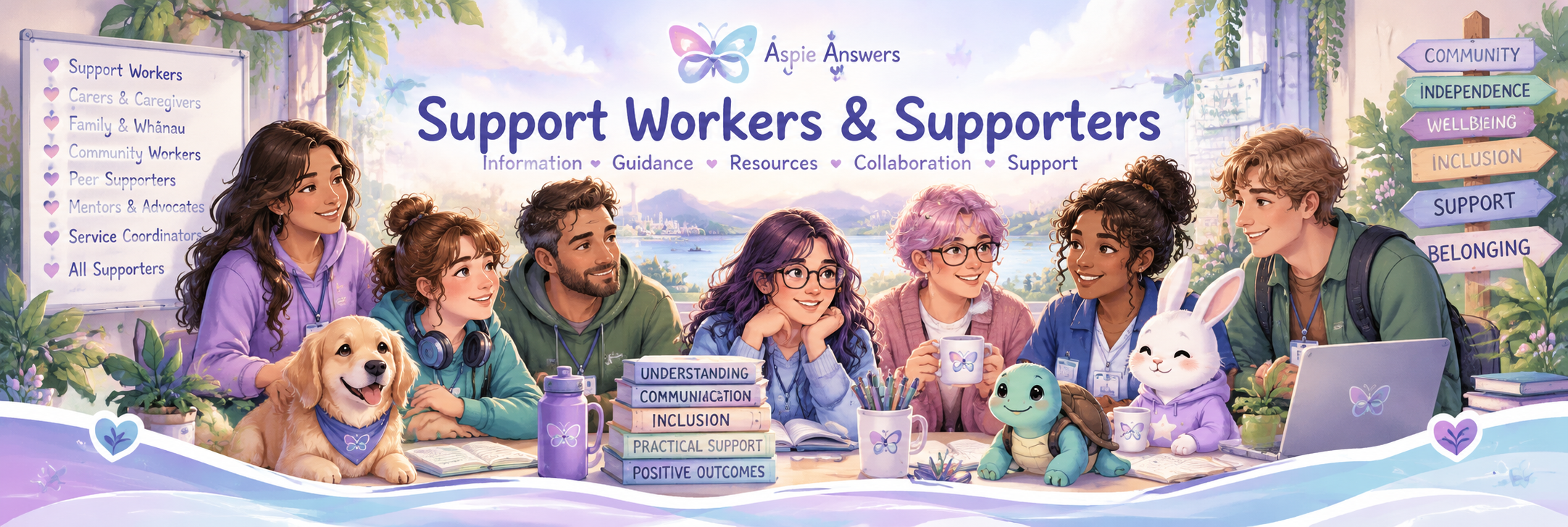
Support Workers & Disability Support Staff
For paid workers supporting daily living, routines, community participation, independence, access and wellbeing.
A practical starting point for people who provide paid, unpaid, community, peer or everyday support to neurodivergent, disabled or mentally unwell people. Explore role-based pathways, communication, access, wellbeing, collaboration, resources and next steps while keeping the person’s own priorities, autonomy and lived experience at the centre.
Aspie Answers provides practical, educational and lived-experience-informed information. It does not replace individual assessment, professional care, legal advice, safeguarding procedures, organisational policies or emergency services. Adapt information to the person, setting, local requirements and responsibilities involved.
Paid and unpaid support roles, support needs, different settings, practical resources, person-centred support, communication and adjustments, collaboration, supporter wellbeing, related Aspie Answers pathways and urgent-help links.
Support can be formal or informal, short-term or ongoing. Choose the role closest to what you do today. Many supporters will fit more than one pathway.
For paid workers supporting daily living, routines, community participation, independence, access and wellbeing.
For people providing regular practical, personal or emotional support in paid or unpaid caring roles.
For family, whānau, partners, friends and others providing everyday unpaid or informal support.
For people supporting participation, navigation, family needs, community access and practical day-to-day wellbeing.
For people using shared experience, peer relationships and community knowledge to support others.
For people helping someone build confidence, express preferences, understand choices, participate or find their way through systems.
For people connecting individuals and families with services, plans, funding, referrals and practical next steps.
For staff supporting home life, routines, choice, independence, community participation and daily living.
For workers supporting housing stability, tenancy, independent living, budgeting and practical life systems.
For support roles assisting people during acute distress, safeguarding concerns or urgent changes in circumstances.
For people who may not hold a formal caring role but regularly help with communication, practical tasks, appointments or connection.
For people helping several services, goals or practical supports work together without losing the person at the centre.
Sometimes the immediate need is clearer than the resource you are looking for. These pathways lead into established Aspie Answers areas.
The same person may need different adjustments depending on where support is happening.
Routines, daily living, energy, self-care, household tasks, communication and practical independence.
Appointments, transport, public spaces, forms, service navigation and community participation.
Supporting communication, executive function, transitions, participation and accessible learning routines.
Supporting routines, communication, adjustments, workload, travel, confidence and sustainable participation.
Preparing information, communication support, sensory access, processing time and shared decision-making.
Clear communication, reduced sensory load, safeguarding, supported decision-making and recognising distress.
Good support is not about fitting someone into a standard process. It is about understanding communication, access needs, sensory differences, strengths, priorities, culture, context and what the person says matters to them. Support works best when the person remains involved in decisions about their own life.
Aspie Answers resources are being organised in different formats and editions so people can use the style that genuinely fits the setting and audience.
Longer practical resources for understanding a topic and working through it step by step.
Reflection sheets, checklists, planning tools, communication aids and practical supports.
More accessible formats for people who benefit from simpler language, larger text or clearer presentation.
Printer-friendly versions for settings where colour printing is not practical.
Audience-specific versions where a dedicated support-worker format genuinely adds value.
Versions designed for people supporting someone in everyday home, family or community life.
Some people may prefer written information, direct language, visual supports, AAC, extra processing time or fewer open-ended questions.
Noise, lighting, touch, crowds, waiting, clothing, smells and unpredictable environments can change how manageable a situation feels.
Clear expectations, schedules, visual steps, written next actions and advance information can reduce uncertainty.
Breaks, support people, different response formats, quieter options and alternative ways of participating may improve access.
Starting, sequencing, remembering and switching tasks can create barriers even when the person understands what needs to happen.
Support plans should consider fatigue, pacing, recovery time, overload and the cost of masking or sustained demands.
Several supporters can be helpful, but support can also become confusing when roles overlap. Clear responsibilities, accessible information, realistic action plans and appropriate information-sharing can reduce duplication and overwhelm. Where possible, make sure the person understands who is doing what, what happens next and how they can ask questions or change course.
Regular support can take time, attention and emotional energy. Rest, boundaries, backup support and your own wellbeing matter.
Helping someone does not automatically mean making decisions for them. Support should preserve choice, dignity and appropriate privacy.
Be clear about what you can safely offer, when you need advice and when another service or professional pathway is more appropriate.
Start with the person’s immediate need rather than trying to read everything at once.
Start with Everyday Help for planning, routines, appointments, food, money, travel and daily living.
Start with Learning Support Pathways for learning differences, accessible study and executive-function support.
Start with Work & Employment for workplace participation, planning, adjustments and employment support.
Start with Mental Health & Wellbeing for understanding, coping, wellbeing tools and support pathways.
Start with Accessibility & Rights for inclusion, adjustments, access and rights-based information.
Start with Support & Directories when the next step is locating organisations, directories or services.
Support workers and supporters may also find these wider Aspie Answers areas useful.
If someone may be in immediate danger, needs urgent medical attention or is experiencing a crisis, use the appropriate emergency or crisis services for their location. Aspie Answers crisis resources can help with preparation and signposting but do not replace emergency response.
We use cookies to improve your experience on our site. By using our site, you consent to cookies.
Manage your cookie preferences below:
Essential cookies enable basic functions and are necessary for the proper function of the website.
These cookies are needed for adding comments on this website.
Statistics cookies collect information anonymously. This information helps us understand how visitors use our website.
Google Analytics is a powerful tool that tracks and analyzes website traffic for informed marketing decisions.
Service URL: policies.google.com (opens in a new window)
SourceBuster is used by WooCommerce for order attribution based on user source.