
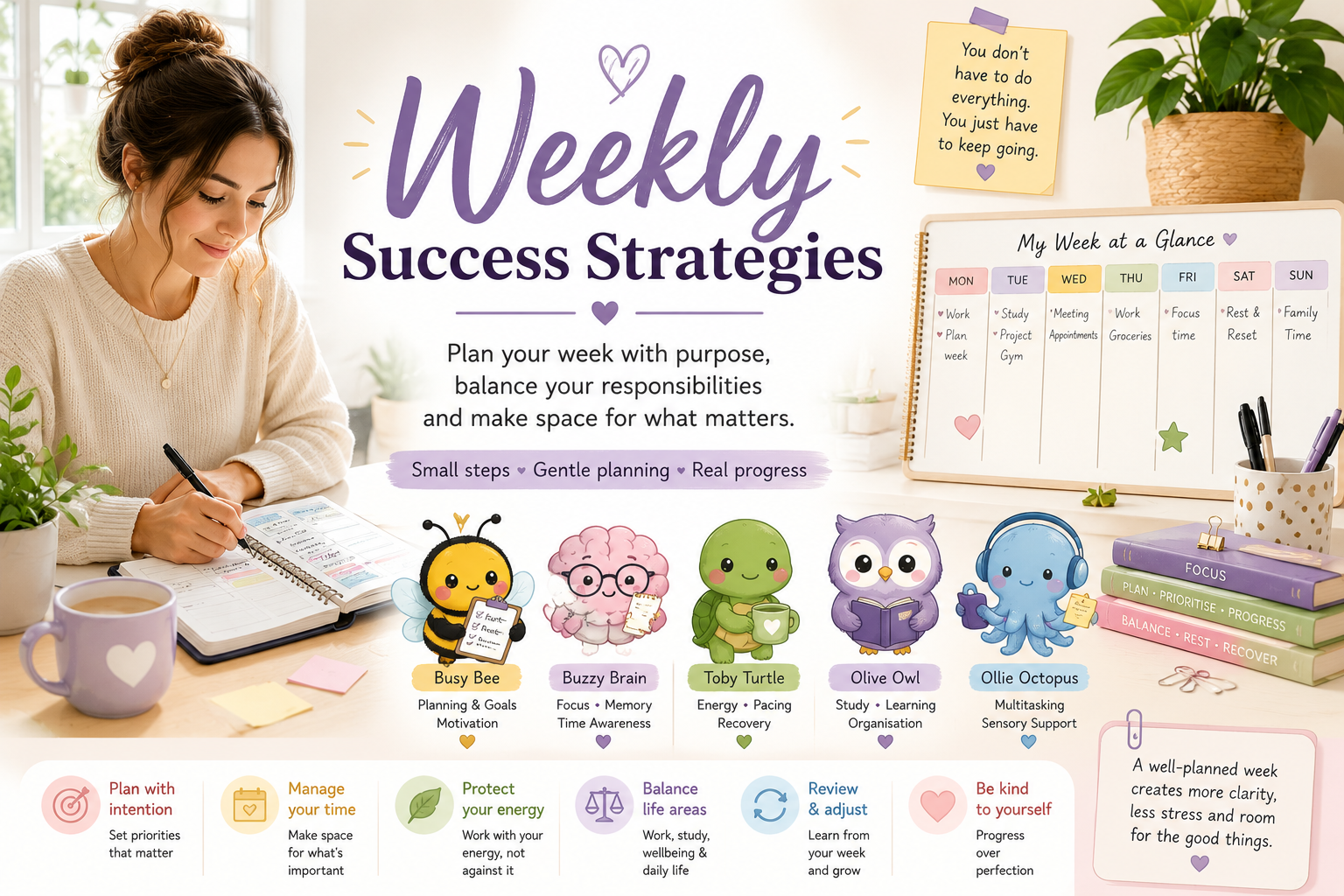
Weekly Success Strategies
Weekly planning can help you see appointments, responsibilities, study, work, household tasks, rest and personal time together instead of trying to hold everything in your head.
This guide offers flexible strategies for creating a week that feels clearer and more manageable. You do not need to plan every hour or follow your plan perfectly. The aim is to create enough structure to support you while leaving room for changing needs, energy and circumstances.
Find a weekly strategy
Search the strategy cards or select a topic that matches the support you need.
How to use this guide
Use the sections that fit your week and leave the rest.
Look at what is already fixed
Add appointments, work shifts, classes, support visits, deadlines and other commitments that cannot easily move.
Notice your available capacity
Consider your likely energy, health needs, travel, recovery time and the mental effort each commitment may require.
Choose a few flexible priorities
Decide what would be useful to complete without treating every task as equally urgent.
Review and adjust
Check your plan during the week and change it when your circumstances, needs or energy change.
What a successful week can look like
Success can include progress, care, flexibility and recovery.
Knowing what is happening
You can see important dates and commitments without relying only on memory.
Protecting recovery time
Rest is included in the plan instead of being left until everything else is complete.
Completing one priority
Progress on one meaningful task may matter more than beginning many tasks at once.
Adjusting the plan
You move, reduce or remove tasks when your week becomes fuller than expected.
Meeting basic needs
Food, medication, appointments, household needs and wellbeing are treated as important parts of the week.
Recognising your effort
You notice what you managed instead of only focusing on unfinished tasks.
Core weekly success strategies
Browse all strategies or use the search and topic filters.
Create one weekly overview
Use one main calendar, planner or weekly board so important information is not scattered across several places.
Add fixed commitments first
Begin with appointments, classes, work, support visits, deadlines and essential responsibilities.
Choose three weekly priorities
Select a small number of meaningful priorities rather than expecting every task to be completed.
Plan around energy
Avoid placing several demanding activities together when each one may require preparation or recovery.
Schedule recovery time
Add rest before your calendar becomes full. Recovery time is part of the plan, not unused space.
Include preparation and travel
Account for getting ready, packing, travelling, waiting and settling afterwards.
Check the main areas of life
Look across work, study, home, health, relationships, enjoyment and rest without expecting equal attention every week.
Give repeating tasks a usual place
Regular days for groceries, laundry, planning or meal preparation can reduce repeated decision-making.
Set reminders at the right time
Include reminders for preparation and travel, not only the exact start time of an event.
Use a midweek check-in
Pause halfway through the week to notice what has changed and what needs to move.
Carry tasks forward carefully
Decide whether an unfinished task still matters before automatically moving it into the next week.
Record what went well
End the week by noticing effort, completed tasks, helpful supports and moments of rest or enjoyment.
Planning around energy
Time may be available even when energy and capacity are not.
High-energy tasks
Appointments, meetings, studying, unfamiliar places, social demands and complex decisions may need more energy.
Lower-energy tasks
Familiar chores, simple administration, organising supplies or watching learning material may be easier during quieter periods.
Recovery tasks
Rest, sensory regulation, quiet activities, meals and time alone may help you recover between demanding activities.
Energy buffers
Leaving space before and after significant events can reduce the pressure caused by delays, transitions or exhaustion.
Balancing work, study and daily life
Balance does not have to mean giving everything equal time.
Work or study
Identify key deadlines, preparation needs and the most important task for the week.
Home responsibilities
Choose essential household tasks and spread them across the week where possible.
Health and wellbeing
Include medication, appointments, meals, movement, sleep and sensory needs.
Relationships
Plan communication or social time in ways that respect your energy and need for recovery.
Personal enjoyment
Add hobbies, favourite activities and meaningful interests rather than treating them as optional extras.
Unplanned space
Leave some room for delays, changing plans, unexpected needs or simply doing less.
When the week changes unexpectedly
A changed plan is not automatically a failed plan.
Pause before rearranging everything
Identify what actually changed and which parts of the original plan can remain.
Protect the essentials
Keep health, safety, food, medication, urgent appointments and critical deadlines visible.
Move one task at a time
Reschedule deliberately rather than shifting every unfinished item into the same day.
Reduce the task
Complete a smaller version when doing the full task is no longer realistic.
Communicate changes early
Let relevant people know when you need more time, support or a different arrangement.
Add recovery after disruption
Unexpected changes can use significant mental and emotional energy, even when the event itself seems small.
A gentle weekly reset
Use this at the beginning, end or middle of your week.
- Gather: Bring calendars, notes, messages and task lists together.
- Check dates: Add appointments, deadlines and fixed commitments.
- Review needs: Consider food, medication, transport, finances, household needs and recovery.
- Choose priorities: Select one to three important outcomes for the week.
- Prepare: Identify anything that needs booking, packing, printing or purchasing.
- Add breathing room: Keep some time unallocated where possible.
- Begin gently: Choose one small action that will make the week clearer.
- I have checked appointments and deadlines.
- I know my main weekly priorities.
- I have included preparation and travel time.
- I have protected some recovery time.
- I have checked household and personal needs.
- I know what can move if the week becomes full.
End-of-week reflection
Review your week with curiosity rather than judgement.
What helped?
Notice useful reminders, routines, people, environments and planning tools.
What was difficult?
Identify overload, unclear tasks, unrealistic timing, interruptions or missing support.
What changed?
Consider unexpected events, energy changes and priorities that became more or less important.
What will I adjust?
Choose one practical change rather than completely rebuilding your system.
Support for harder weeks
Difficult weeks may need a simpler plan and more support.
Use an essential-only plan
Focus on health, safety, food, medication, urgent communication and critical commitments.
Reduce optional demands
Postpone or remove non-urgent tasks before they add more pressure.
Ask for practical support
Help with transport, meals, decisions, communication or household tasks may protect your capacity.
Use familiar routines
Return to simple, well-known supports rather than creating a new planning system during overload.
Plan one day at a time
A full weekly view can be hidden temporarily when it feels too overwhelming.
Begin again without blame
A disrupted week does not erase your progress or mean the next week must be perfect.
Your weekly support companions
Each companion can support a different part of weekly planning.
Companion resources are being developed
Printable companion planners, prompts and activity resources can be connected here as the wider companion library grows.
Weekly resources and downloads
Existing resources will be checked and organised before new ones are created.
Weekly planner
A flexible overview for appointments, responsibilities, priorities, rest and personal time.
Weekly priority planner
A focused page for identifying must-do, helpful and optional tasks.
Energy-aware weekly planner
A planning tool that includes high, medium and lower-energy activities.
Weekly reset checklist
A gentle checklist for reviewing dates, priorities, preparation and wellbeing.
Midweek check-in
A short resource for reviewing capacity and adjusting the remaining days.
Weekly reflection
A supportive page for recording progress, difficulties, learning and next steps.
Weekly Resources & Downloads Library
The final library links will be added once existing Classic, Kawaii and Companion resources have been checked and placed in the correct sections.
Weekly planning collections
Weekly resources can later be grouped into complete volumes and visual editions.
Classic Edition
Clean, clear and practical weekly planning pages for flexible use.
Companion Edition
Weekly resources featuring Busy Bee and the wider support companion team.
Kawaii Edition
Friendly visual planner designs that may already include completed or partly completed resources.
Weekly Planning Collection — Volume 1
Volume 1 may include a weekly overview, priority planner, appointment planner, energy-aware planner, reset checklist and reflection page. Existing files should be audited before anything is recreated.
Future Store pathway
Individual free resources can remain within the website library, while completed collections and expanded editions can later connect to the Aspie Answers Store.
Frequently asked questions
Common questions about weekly planning and flexibility.
Do I need to plan every part of my week?
No. Some people only need to record fixed commitments and a few priorities. Too much detail can make a weekly plan harder to use.
What if my weekly plan changes constantly?
Use your planner as a flexible guide rather than a strict set of rules. Leave open space and review the plan during the week.
How many weekly priorities should I choose?
One to three meaningful priorities may be enough. You can still complete other tasks without treating them all as equally important.
Should rest be written into my planner?
Yes, especially when appointments, work, study, social activity or travel can use significant energy.
Will printable weekly planners be added?
Yes. Existing planners will be reviewed first, followed by any missing Classic, Companion and Kawaii resources needed for the final library and collections.
Your week can be structured without being rigid
A weekly plan is there to support your memory, priorities, energy and wellbeing. It can change when life changes. Choose what matters, protect some breathing room and adjust without judging yourself.