
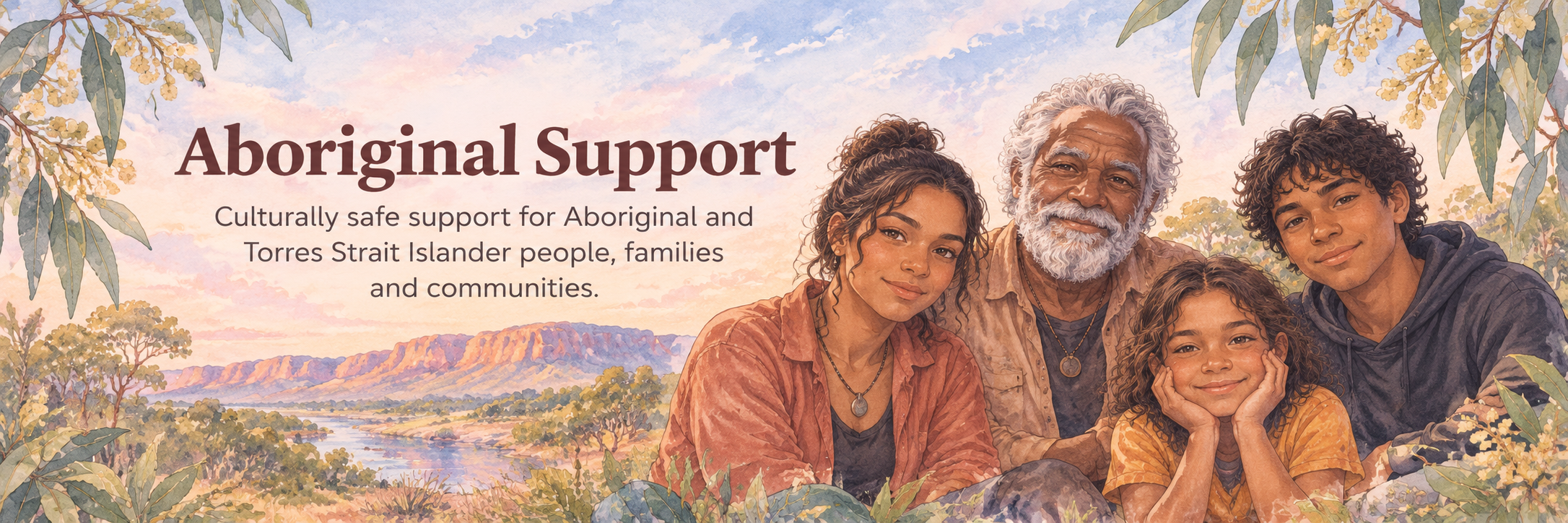
Aboriginal & Torres Strait Islander Support
Find pathways to culturally respectful crisis support, community-controlled health services, social and emotional wellbeing, family and community resources, and accessible support across Australia.
Aboriginal and Torres Strait Islander peoples belong to many distinct communities, Countries, cultures and language groups. The most useful support respects each person's choices, identity, connections and communication needs.
You can begin with one small step
You don't need to explain everything perfectly or know exactly what kind of help to ask for. You may ask for more time, a trusted support person, an interpreter, written information, or an Aboriginal or Torres Strait Islander worker where available.
If one service doesn't feel right, it is okay to ask what other options are available. Your safety, dignity and choices matter.
If you or someone else needs urgent support
If a life is in immediate danger in Australia, call Triple Zero (000). This website provides information and links; it does not operate an emergency response or counselling service.
Triple Zero — 000
Emergency police, ambulance or fire assistance.
13YARN — 13 92 76
Free, confidential telephone crisis support with Aboriginal and Torres Strait Islander crisis supporters, 24 hours a day, seven days a week.
Lifeline — 13 11 14
Australia-wide crisis support by phone, text and web chat. Lifeline is a general service, not Aboriginal-specific.
The phone numbers above are Australian services. People outside Australia should use their own local emergency or crisis-support services. Please check provider websites for current eligibility and contact options.

Find the type of support that fits
Search or filter the trusted resource pathways shown on this page. This is not a live GeoDirectory provider search and it does not show real-time appointments or service availability.
Showing all resource pathways.
13YARN
Talk with a trained Aboriginal or Torres Strait Islander crisis supporter, day or night.
Lifeline Australia
General crisis support through phone, text or online chat.
NACCHO service locator
Find Aboriginal Community Controlled Health Organisations across Australia.
Indigenous HealthInfoNet
Explore a map of Aboriginal and Torres Strait Islander health and medical services, with geographic filtering.
WellMob
Online resources about social, emotional and cultural wellbeing for Aboriginal and Torres Strait Islander people.
Australian Cultural & Community Crisis Support
Use the existing page covering Aboriginal, cultural-community, language and accessible crisis-support pathways.
Crisis Support by Audience
Explore crisis-support pathways by life stage, caring role, community, disability and access needs.
Support & Directories Hub
Continue to the wider Aspie Answers service-navigation and community resources.
No pathway matches those filters in this short list. Clear filters or try the national service locators; this does not mean help is unavailable.

Choose your state or territory
The buttons below open the same established Indigenous HealthInfoNet health-service map, where you can filter by state or territory. They do not claim that a listing has been verified for every location.
Alternatively, use the NACCHO service locator to find community-controlled health organisations.

Support should fit the person
Children, teenagers and young adults
Look for age-appropriate, culturally responsive support. Ask about privacy, trusted adults, school pathways and youth services.
Families, kinship, carers and Elders
Ask about family-centred services, caring roles, local organisations and support that respects community and personal preferences.
Disability and communication needs
Ask about accessible appointments, interpreters, plain language, AAC, sensory needs, written contact and physical access.
Teachers, health workers and supporters
Listen to the person, avoid assumptions, respect cultural identity and refer to qualified local and community-led services where appropriate.

Where to begin
1. Choose the support you need
Is it safety, health, emotional wellbeing, family support or help finding a local organisation?
2. Choose how to reach out
Use phone, online or local services as appropriate. Ask about communication formats and interpreter availability.
3. Confirm the details
Check hours, cost, eligibility, region, referral requirements and accessibility before travelling or relying on a service.
Frequently asked questions
Does this page cover areas outside Australia?
The listed phone numbers and local service finders are Australian. Use your local services if you are outside Australia, and browse the worldwide Aspie Answers crisis directory for other countries.
Can I ask for an Aboriginal or Torres Strait Islander health worker?
Yes. Ask the organisation about Aboriginal and Torres Strait Islander staff, community-controlled services and culturally responsive care. Options vary by location.
Does the finder list every organisation near me?
No. It filters the small selection of resources on this page. NACCHO and HealthInfoNet provide broader external service searches; confirm details with individual services.
What if speaking on the phone is difficult?
Lifeline provides text and chat options. You can also ask other organisations about interpreters, communication aids, accessible forms and written contact methods. 13YARN is primarily a phone service.
Respecting Country and community
We acknowledge Aboriginal and Torres Strait Islander peoples as the First Peoples of Australia and recognise the diversity of their Countries, languages, cultures and communities. We pay respect to Elders past and present.
Artwork on this page is illustrative and does not claim to reproduce the cultural designs or traditions of a particular community.
Information reviewed: October 2026, using 13YARN, Lifeline, NACCHO, Indigenous HealthInfoNet and WellMob. Service details may change. This page is informational, not medical advice or an emergency service. Contact Aspie Answers to report a broken link.