
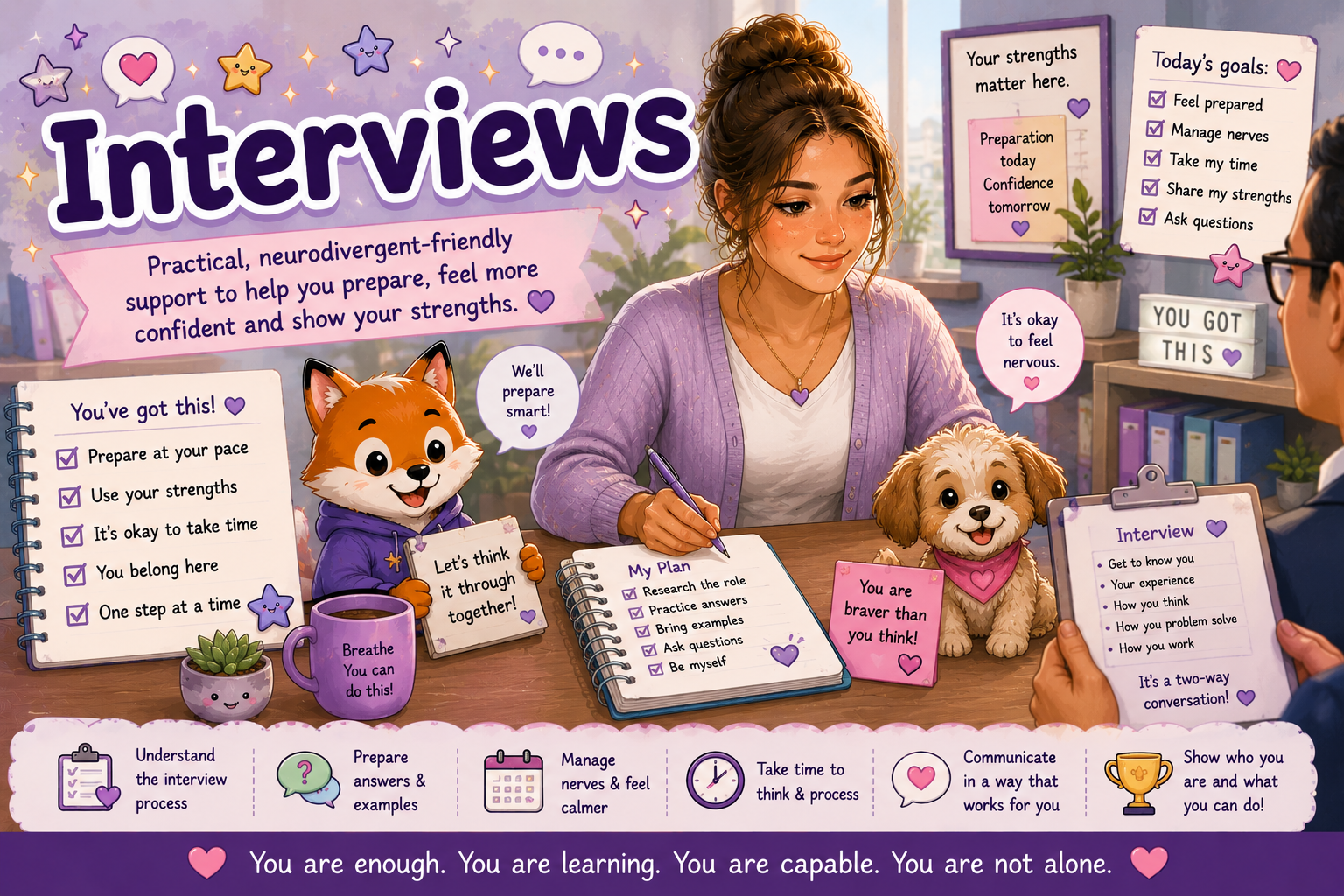
Interviews
Interviews can involve unfamiliar people, unexpected questions, time pressure, social expectations and the challenge of explaining your skills on the spot. Preparation can help make the process feel more understandable, manageable and predictable.
🌸 You do not have to interview perfectly
An interview is not a test of whether you can answer every question instantly. It is a conversation designed to help an employer learn more about you, your experience and how you may approach the role. It is also an opportunity for you to learn more about the workplace.
🧠 Why Interviews Can Feel Difficult
Interviews can combine several demands at the same time. Understanding those demands may help you prepare strategies for the parts you find most difficult.
Unexpected Questions
It can be difficult to organise an answer quickly when you have not had time to think about the question beforehand.
Processing Pressure
Feeling expected to respond immediately may make it harder to retrieve information or explain your thoughts clearly.
Social Expectations
Eye contact, body language, small talk and interpreting the interviewer's reactions may add extra mental effort.
Broad Questions
Questions such as “Tell me about yourself” can feel unclear because there are many possible ways to answer them.
Memory Retrieval
You may know that you have useful experience but struggle to remember a specific example when asked unexpectedly.
Anxiety & Nerves
Anxiety can affect speech, memory, attention, processing and your ability to show what you know.
📋 Preparing Before the Interview
You cannot predict every question, but you can prepare useful information and examples before interview day.
Research the Organisation
Read about what the organisation does, who it supports or serves and the values it communicates publicly.
Read the Job Description
Highlight the main skills, responsibilities and qualities mentioned in the job advertisement or position description.
Choose Your Examples
Prepare a few examples from work, volunteering, study, community involvement or personal projects.
Practise Out Loud
Saying an answer aloud can feel different from thinking about it. Gentle practice may help your words feel easier to access.
Plan the Location
Check the address, transport, parking, online meeting link or building entrance before interview day where possible.
Consider Your Support Needs
Think about whether there are reasonable adjustments or communication supports that may help you participate.
💬 Breaking Down Common Interview Questions
A broad interview question can become easier when you think about what information the interviewer may actually be asking for.
“Tell me about yourself.”
You usually do not need to explain your whole life story. Focus on a short overview of your relevant experience, interests and what has brought you to this opportunity.
“What are your strengths?”
Choose strengths that you genuinely recognise in yourself and, where possible, connect them with an example.
“Why do you want this job?”
Consider what interests you about the work, organisation, responsibilities or opportunity to use and develop your skills.
“Tell us about a challenge.”
The interviewer may be interested in how you responded, solved a problem, adapted or learned from the situation.
⭐ Building an Example With STAR
STAR is one way to organise an interview example. You do not need to use perfect wording. The structure can simply help you remember the main parts of the story.
Situation
Briefly explain what was happening and provide enough context to understand the example.
Task
Explain what you needed to do, solve, organise or achieve.
Action
Describe what you personally did and the steps you took.
Result
Explain what happened, what changed or what you learned.
🗨️ It Is Okay to Need Processing Time
Taking a moment to organise your thoughts can help you give a clearer answer. You may find it useful to practise a few simple phrases before the interview.
💗 Managing Interview Nerves
Feeling nervous does not mean you are unprepared or incapable. Your body may simply be responding to uncertainty, pressure or an unfamiliar situation.
Use a Calm Strategy
Try a familiar breathing, grounding or regulation strategy rather than learning something completely new on interview day.
Allow Extra Time
Where possible, reduce rushing by planning enough time for travel, parking, technology checks or finding the location.
Prepare the Night Before
Clothing, documents, transport information and useful items can be organised earlier to reduce morning decision-making.
Use a Helpful Reminder
Try reminding yourself that the goal is to share useful information, not to perform a flawless interview.
Use Sensory Supports
Before or after the interview, familiar sensory tools may help you regulate and recover from the extra demands.
Plan Recovery Time
Interviews can use a lot of energy. If possible, allow some lower-demand time afterwards.
📋 Interview Day Checklist
Your own checklist may look different. Use this as a starting point and adapt it to the interview.
❔ Questions You May Want to Ask the Employer
Interviews are also an opportunity to gather information. You do not need to ask every question below. Choose what is useful and relevant to you.
Typical Day
“What might a typical day or week in this role look like?”
Training
“What training or induction is provided when someone starts?”
Team
“Could you tell me a little about the team I would be working with?”
Success
“What would success in this role look like during the first few months?”
Communication
“How are tasks, priorities and changes usually communicated?”
Next Steps
“What are the next steps in the interview or recruitment process?”
🌱 After the Interview
The period after an interview can involve uncertainty and a lot of replaying the conversation. A short reflection may be more useful than analysing every detail repeatedly.
Write Down Key Notes
Record anything important you learned about the job, workplace or next steps while the information is still fresh.
Notice What Went Well
Identify at least one thing you handled, explained or prepared well.
Choose One Learning Point
If there is something you want to change next time, choose one manageable learning point rather than creating a long list of criticisms.
🐾 Your Interview Support Team
Different parts of an interview may need different kinds of support. Our companions each bring a different strength.
Finn Fox
Finn helps you think through questions, solve problems and prepare possible approaches before the interview.
Busy Bee
Busy Bee helps break preparation into smaller tasks, practise gradually and celebrate each completed step.
Scout
Scout supports feelings and emotional regulation, reminding you that nerves can be acknowledged while you use strategies that help you feel safer and steadier.
📘 Interview Support Resources
Aspie Answers is continuing to develop practical interview planning resources, worksheets and supportive tools. Future Interview Support Collections may help with preparing answers, organising examples, planning interview day and reflecting afterwards.
📘 Classic Editions
Clear, practical interview planners, checklists, question worksheets and reflection tools.
🐾 Companion Editions
Interview preparation with Finn Fox, Busy Bee and Scout guiding users through manageable steps.
🌸 Kawaii Editions
Friendly illustrated interview supports with gentle prompts, visual reminders and approachable planning pages.
🌸 A gentle note
Interview and recruitment processes vary between employers, industries and locations. This page provides general preparation, self-reflection and communication support. It is not legal, employment or professional recruitment advice.