
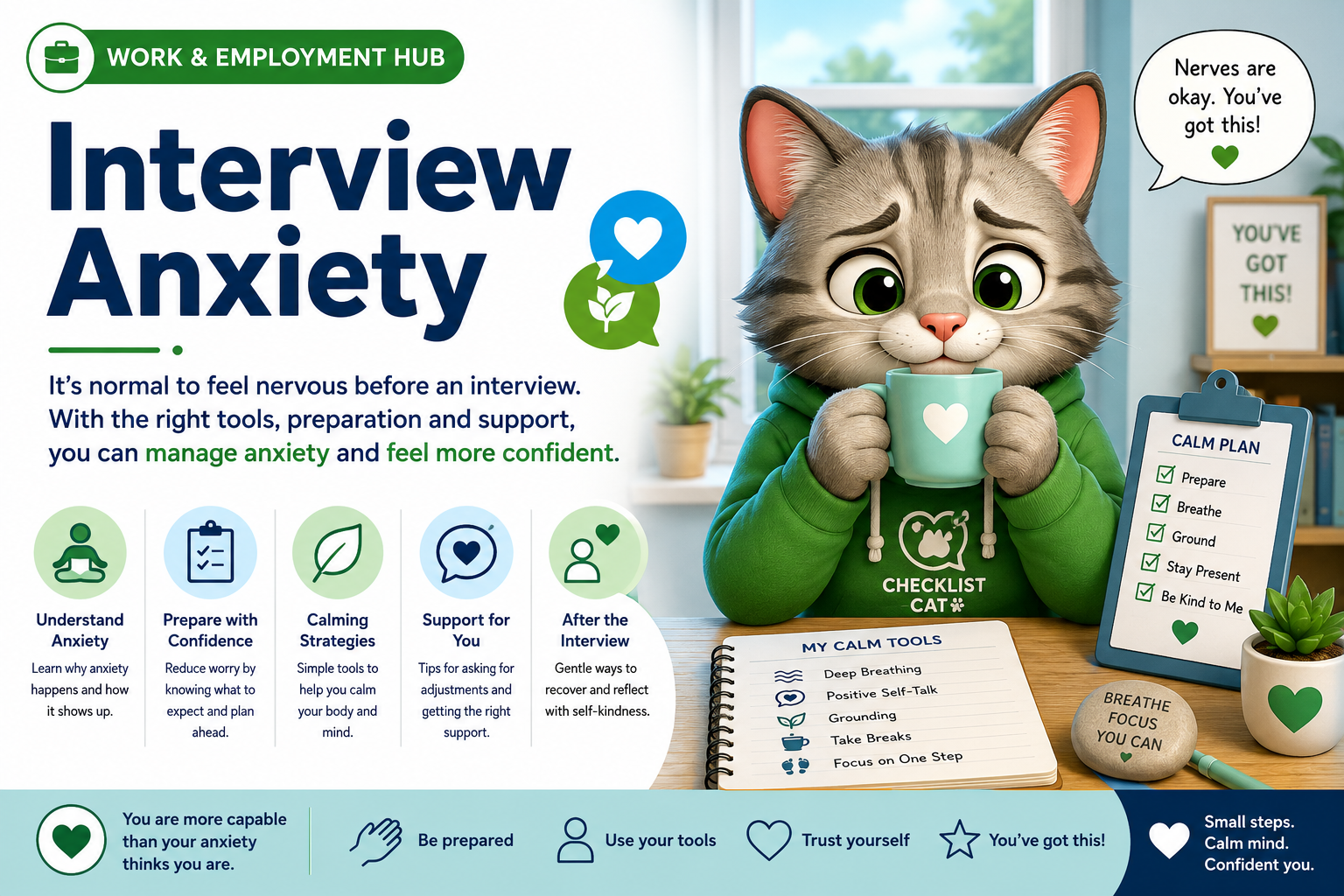
Interview Anxiety
Interviews combine uncertainty, evaluation, social communication and time pressure. Anxiety can affect memory, speech, concentration, body comfort and confidence. This guide offers practical, neurodivergent-friendly ways to reduce uncertainty, support regulation and recover afterwards.
Try words such as blank, breathing, travel, sensory, questions, processing, recovery or adjustments.
Showing all guide sections.
A stress response can become active even when you are well prepared and genuinely suitable for the role. Recognising what anxiety does can make it easier to choose support that matches the actual difficulty.
Thoughts
Worrying about mistakes, forgetting answers, being judged or not knowing what will happen.
Body
Racing heart, shaking, sweating, nausea, muscle tension, breathlessness or feeling frozen.
Communication
Talking quickly, going blank, losing your train of thought or finding social demands harder than usual.
After-effects
Exhaustion, rumination, headaches, shutdown, emotional release or needing extra recovery time.

Learn What to Expect
Confirm the date, time, location, format, likely length, names of interviewers and anything you need to bring.
Plan Your Journey or Technology
Check transport, parking and arrival time, or test your camera, microphone, internet and meeting link.
Practise Key Questions
Prepare brief points and examples rather than memorising a complete script.
Choose Comfortable Clothing
Wear something suitable that also reduces sensory discomfort and distraction where possible.
Create a Calm Plan
Choose one or two familiar strategies that help you regulate rather than trying to remember a long list.
Protect Recovery Time
Avoid unnecessary demands immediately before and after the interview when possible.
Longer Exhale Breathing
Breathe in gently, then let the exhale last a little longer. Avoid forcing very deep breaths if that feels uncomfortable.
5–4–3–2–1 Grounding
Notice five things you see, four you feel, three you hear, two you smell and one you taste.
Pressure & Movement
Press your feet into the floor, stretch your hands, take a short walk or use a discreet sensory item if appropriate.
A Helpful Phrase
Try: “I can be nervous and still answer one question at a time.”
Reduce Rushing
Allow enough time to settle without creating a very long, stressful waiting period.
Use Familiar Supports
Bring water, a short prompt card, headphones for travel or another permitted support that already works for you.

Depending on the employer, role and local requirements, you may be able to ask for changes to the usual interview process that reduce a specific barrier.
Information Beforehand
Clear instructions, an interview schedule, names of interviewers or broad question topics.
Communication Support
Written questions, extra processing time, permission to use brief notes or questions asked one at a time.
Environment
A quieter room, reduced lighting, fewer people in the room or another agreed format where appropriate.
Support Person
A support person attending where this is permitted and agreed in advance.

Decompress
Use quiet time, food, water, comfortable clothing, movement or rest if those help you regulate.
Delay the Analysis
Give your nervous system time to settle before reviewing every answer in detail.
Record Useful Notes
Write down questions asked, what helped and anything you may want to change next time.
Keep the Result in Perspective
An interview outcome can depend on many factors. One interview does not define your overall ability or future options.

Checklist Cat
Checklist Cat fits here because preparation becomes easier when the unknowns are turned into visible steps: check the details, prepare a few examples, choose your supports, then leave space for recovery afterwards.
These resource types fit this page well and can live in the central Work & Employment resource system instead of appearing here as unfinished downloads.
Is it normal to feel very nervous before an interview?
Yes. Interviews involve uncertainty and evaluation, so a strong stress response can happen. If anxiety is severe, persistent or affecting daily life more broadly, support from a qualified health professional may also be useful.
Will the interviewer judge me for looking nervous?
Some visible nervousness is common in interviews. Focus on giving relevant answers and using the preparation strategies that help you communicate.
Can I say that I am nervous?
You may briefly acknowledge it if you want to. You do not have to share personal information you would rather keep private.
What if my mind goes blank?
Pause, breathe out slowly, ask for the question again and use a phrase such as, “I need a moment to organise my thoughts.”
Should I disclose autism, ADHD or anxiety?
Disclosure is a personal decision. You can focus on the practical support you need, while remembering that employer processes and legal requirements differ by location.
What if I feel exhausted afterwards?
Interviews can use significant emotional, sensory and cognitive energy. Planning lower-demand recovery time can be a practical part of preparation.