
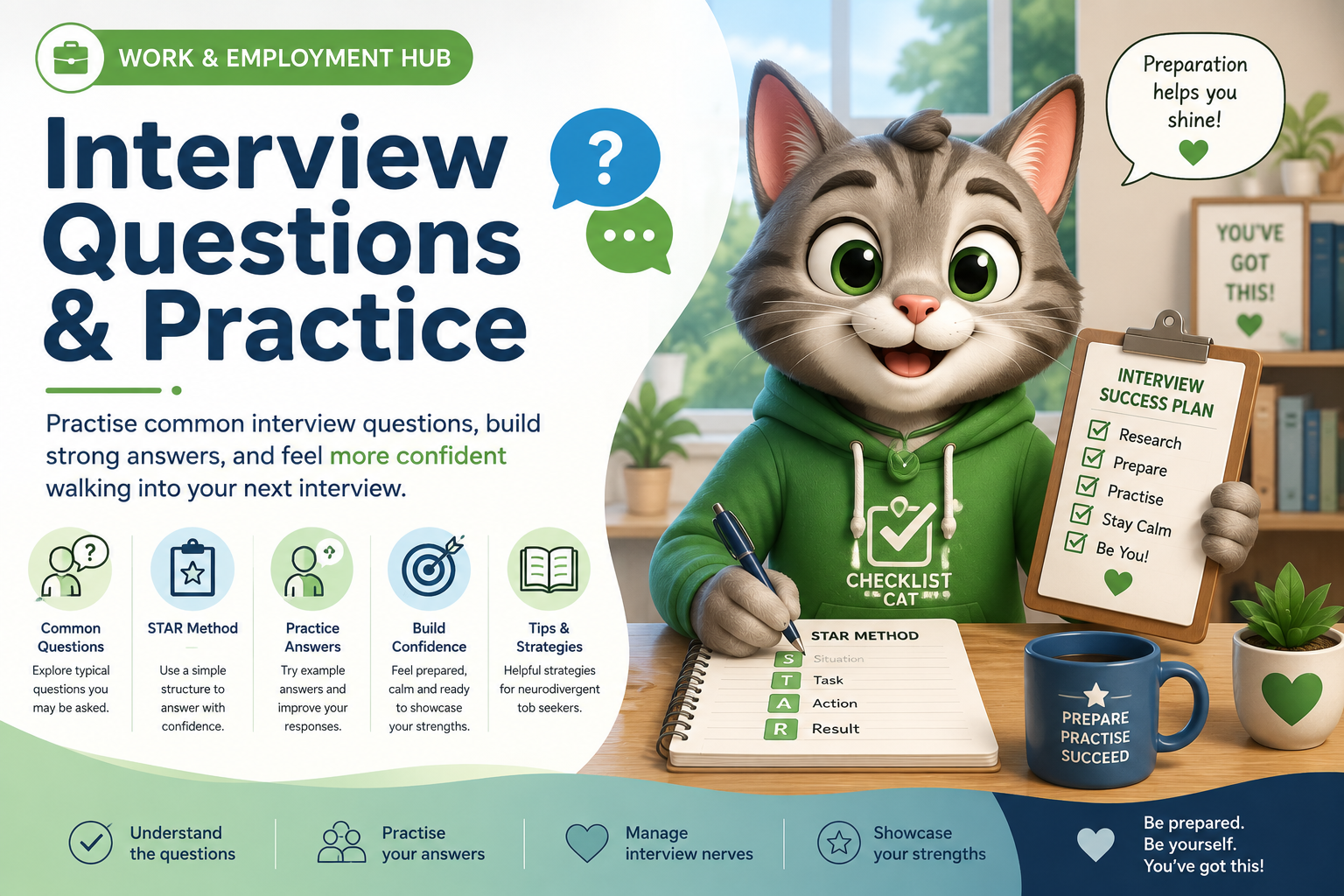
Interview Questions & Practice
Interview questions can feel easier when you know the kinds of questions that may come up, have a few examples ready and can practise in a way that suits you. This page focuses on building an answer bank rather than memorising a perfect script.
Try words such as strengths, deadlines, teamwork, STAR, notes, processing, employer or practice.
Showing all guide sections.
Understand the Question
Learn what an interviewer may be trying to find out and what kind of example could fit.
Organise Your Thoughts
Use a simple structure so your answer has a clear beginning, middle and ending.
Reduce Pressure
Familiar question types can feel less overwhelming when you have already thought about them.
Remember Your Strengths
Preparation can make useful examples easier to recall when you are nervous or need processing time.

About You
Background, interests, experience, strengths and reasons for applying.
Example: “Can you tell us a little about yourself?”
Skills & Experience
Questions asking how your abilities, training or previous experience relate to the role.
Example: “What experience do you have with customer service?”
Behavioural Questions
Questions asking for a real example of how you handled something in the past.
Example: “Tell us about a time you solved a problem.”
Situational Questions
Questions asking what you would do in a possible workplace situation.
Example: “What would you do if two tasks were both urgent?”
Motivation & Fit
Questions about why you want the role and what interests you about the organisation.
Example: “Why would you like to work here?”
Practical Questions
Availability, start dates, travel, working hours or role requirements.
Example: “When would you be available to start?”
Tell us about yourself.
Keep this professional and fairly brief. A useful structure is: what you are doing now, relevant background or strengths, then why this opportunity interests you.
Why do you want this job?
Connect your interests, values, strengths or goals with the work itself and what you know about the organisation.
What are your strengths?
Choose two or three strengths that are useful for this role. Support at least one with a short example.
What is an area you are working to improve?
Choose something genuine but manageable, then explain what you are doing to improve and what you have learned.
Tell us about a time you solved a problem.
Use a real example. Explain the situation, what needed to be done, what action you took and what happened afterwards.
How do you manage priorities or deadlines?
Describe tools or strategies you actually use, such as checklists, calendars, reminders, time blocking, prioritising or asking for clarification.
How do you work as part of a team?
Share how you communicate, contribute, listen, complete your responsibilities and support shared goals.
Why should we hire you?
Summarise your strongest match with the role: relevant skills, reliability, experience, strengths and willingness to learn.

STAR can help organise an answer when the interviewer asks about something you have done. Examples can come from paid work, volunteering, study, community activities, caring responsibilities, personal projects or everyday life.
Situation
Briefly explain the background. What was happening?
Task
What needed to be done? What was your responsibility?
Action
What did you do? Focus on your own actions and decisions.
Result
What happened, improved, was achieved or learned?
STAR Example: Managing Two Urgent Tasks
Situation: During a volunteer event, two important jobs needed to be completed before visitors arrived.
Task: I needed to organise the welcome table and make sure the information packs were ready.
Action: I wrote a short priority list, asked another volunteer to help with the packs and checked each task off as it was completed.
Result: Both jobs were finished before opening time and visitors received the correct information without delays.
Read the Job Description
Highlight duties, skills, values and qualities the employer is likely to ask about.
Create an Example Bank
Write down examples showing teamwork, communication, problem-solving, reliability, learning and organisation.
Choose a Practice Format
Write notes, speak aloud, record yourself, use prompt cards or practise with someone you trust.
Practise Key Points, Not a Full Script
Remember the main ideas rather than every sentence so you can adapt if the question is phrased differently.
Review Kindly
Notice what was clear and what could be shorter. Focus on progress rather than perfection.

Ask About Questions in Advance
Some employers may provide questions or topic areas beforehand, particularly as an interview adjustment.
Request Written Questions
Having a question visible may reduce working-memory pressure and make it easier to stay focused.
Take a Moment to Think
It is okay to pause, ask for the question to be repeated or say that you would like a moment to think.
Bring Brief Notes When Appropriate
Ask whether you may bring a short page of reminders, examples or questions for the employer.
Avoid Unnecessary Performance Pressure
Focus on communicating clearly rather than trying to copy a particular body-language or personality style.
Plan Sensory Support
Consider clothing comfort, lighting, waiting areas, travel time, hydration and a calmer recovery period afterwards.

Checklist Cat
Checklist Cat fits this page because an answer bank works best when it is built one small piece at a time: choose a question, find one useful example, write the key points and check it off.
My strongest match for this job is…
Choose one skill, experience or quality that directly relates to the role.
A useful example I could share is…
Choose a moment that shows what you personally did.
One thing I want the interviewer to remember is…
Identify the main message you want to communicate.
A question I want to ask is…
Choose something that helps you understand the role or workplace.
These resource types fit this topic well and can live in the central Work & Employment resource system rather than appearing here as unfinished downloads.
Should I memorise my answers?
Usually it is more flexible to remember key points and examples rather than every word. That makes it easier to adapt when a question is phrased differently.
Can I ask for a question to be repeated?
Yes. Asking for a question to be repeated, rephrased or clarified can help you answer what the interviewer actually intended to ask.
What if I cannot think of a workplace example?
You may be able to use study, volunteering, hobbies, community activities, caring responsibilities, personal projects or everyday problem-solving.
How long should an answer be?
There is no single perfect length. Answer the question clearly, include enough detail to show your contribution and stop once the main point is complete.
What if I lose track of my answer?
Pause and return to the main point. You can say something like “The key thing I did was…” or ask whether you have answered the question fully.