
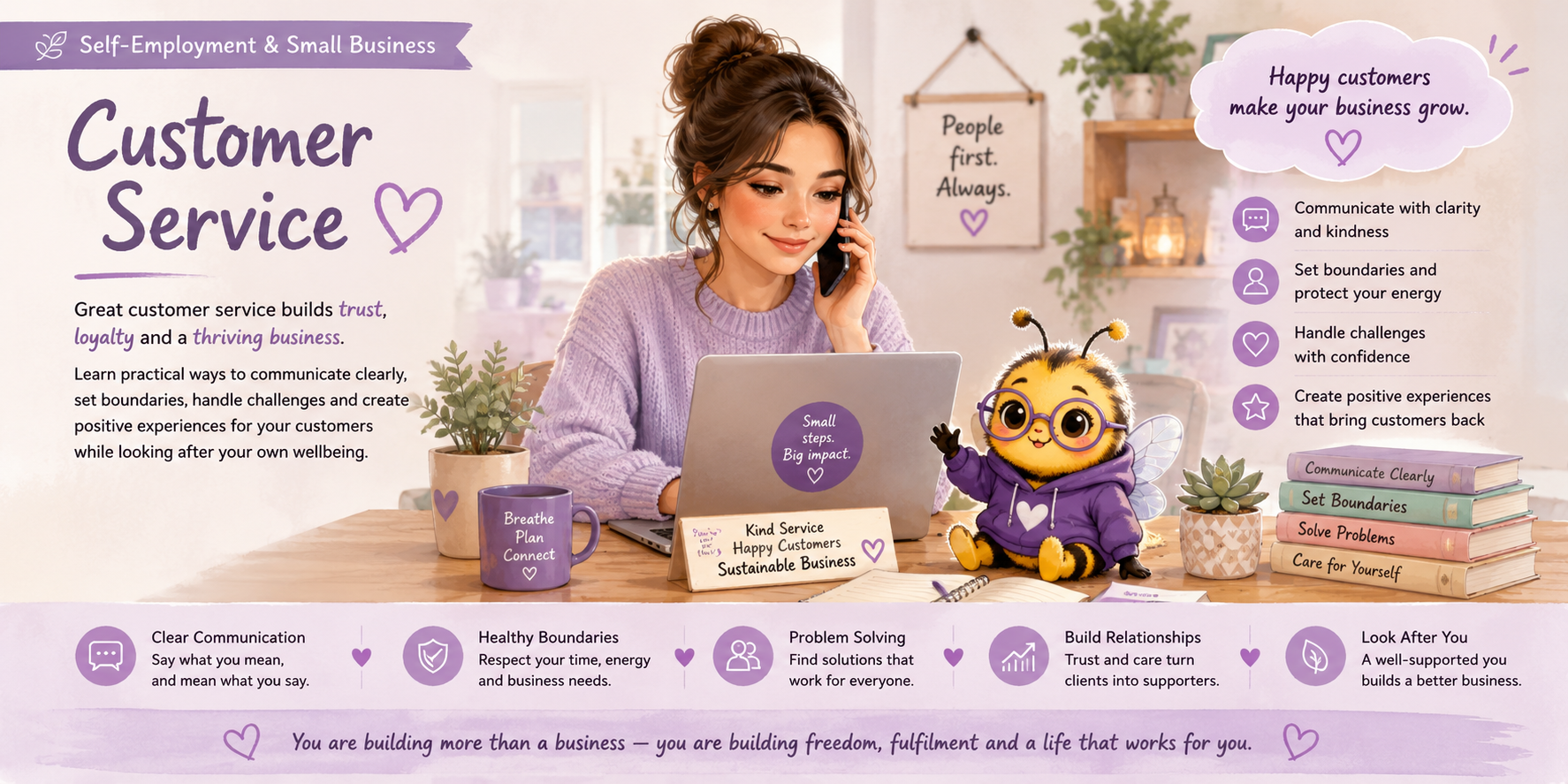
Customer Service
Healthy Boundaries
Good customer service does not mean being available all the time. Healthy boundaries help you support your customers while protecting your time, energy and wellbeing.
Set Clear Availability
Decide when you are available for customer enquiries, messages, calls and support. Let customers know your usual business hours or response times.
Explain What Customers Can Expect
Clear expectations can prevent misunderstandings. Consider explaining your turnaround times, communication methods, cancellation arrangements and other important business policies.
Protect Your Energy
Some customer interactions may take more emotional energy than others. Give yourself permission to pause, step away or use a prepared response when you need to.
Say No Professionally
You cannot provide every product, service or request. A respectful and clear “no” can be better than agreeing to something that you cannot realistically deliver.
My Customer Service Boundaries
Take a moment to think about the boundaries that will help your business work well for you.
Healthy boundaries are part of good customer service. They help create a business that works for your customers without asking you to give more than you can reasonably give.
Problem Solving
Find solutions that work for everyone.
Problems can happen in any business. A customer may be unhappy, something may not go as planned, or you may need to find another way to meet someone's needs.
Good problem solving is not about making everything perfect. It is about listening, understanding what has happened, and looking for a fair and practical way forward.
👂 Listen First
Give the person a chance to explain what has happened. Try to understand the problem before deciding what to do.
🔎 Understand the Problem
Work out what has gone wrong and what the customer actually needs help with.
💭 Explore Options
Think about realistic solutions. Sometimes there may be more than one way to solve a problem.
🤝 Agree on the Next Step
Explain what you can do, what the customer can expect, and what will happen next.
Build Relationships
Trust and care turn clients into supporters.
Customer service is about more than completing a transaction. It is also about creating positive experiences and building relationships with the people you work with.
When people feel listened to, respected and valued, they are more likely to feel comfortable working with you again and recommending your business to others.
💜 Show Genuine Care
Treat each person as an individual. Small acts of kindness, patience and understanding can make a meaningful difference.
👂 Listen and Remember
Pay attention to what people tell you and, where appropriate, remember useful details about their needs and preferences.
🌱 Be Consistent
Reliable communication and dependable service help people know what they can expect from your business.
⭐ Build Trust
Be honest about what you can provide, keep your promises and communicate openly when something changes.
Look After You
A well-supported you builds a better business.
Running a business can take time, energy and emotional effort. Looking after your own wellbeing is not something you have to earn after everything else is finished.
Your needs matter too. Building healthy routines, taking breaks and recognising when you need support can help you create a business that is sustainable for you.
Give Yourself Breaks
You don't have to work continuously to prove that you are committed. Regular pauses can give your brain and body time to reset.
Notice Your Energy
Pay attention to how different tasks affect you. Consider planning demanding tasks around the times when you have more energy and using quieter tasks when your energy is lower.
Keep Your Boundaries
Customer service is important, but your business should still have boundaries that protect your personal time, rest and wellbeing.
Ask for Support
You don't have to figure everything out alone. Trusted people, business support services, peers or professional support may be able to help when something becomes too much to manage by yourself.
My Business Wellbeing Check
What could help me look after myself while running my business?
Your wellbeing belongs in your business plan.
A successful business is not only about what you provide to other people. It is also about creating a way of working that you can continue to live with, grow with and feel good about.
When Something Goes Wrong
You don't have to solve everything perfectly. You can work through problems one step at a time.
Even when you provide excellent customer service, things can sometimes go wrong. A delivery might be late, a customer may misunderstand something, a product may not meet expectations, or you may simply make a mistake.
Having a simple process to follow can make difficult situations feel more manageable.
Listen
Give the customer an opportunity to explain what has happened. Try not to respond defensively before you understand the situation.
Ask yourself: What is the person actually concerned about?Understand
Check the facts and make sure you understand what happened. Sometimes a little clarification can prevent a much bigger misunderstanding.
Ask yourself: What do I know, and what still needs checking?Explore Options
Think about realistic ways forward. You may be able to offer a replacement, correction, explanation, adjustment or another suitable solution.
Ask yourself: What can I reasonably offer?Agree on the Next Step
Clearly explain what you can do and what the customer can expect next. If something cannot be done, explain that honestly and respectfully.
Ask yourself: Have we both understood what happens next?Learn From It
Once the situation has settled, consider whether there is anything you could change in your process, communication or policies to reduce the chance of the same problem happening again.
Ask yourself: What could I learn from this?A Simple Response Builder
When you're unsure what to say, try building your response around these four parts.
“Thank you for letting me know.”
“Let me check what happened.”
“Here is what I can do.”
“I will update you by…”
A difficult customer interaction does not mean you have failed. You can be kind and professional while still keeping your boundaries and deciding what you can reasonably provide.
Customer Service Do's & Don'ts
Small choices in how you communicate can make customer interactions clearer, kinder and easier to manage.
Do
Helpful habits to encourage
Give the person a chance to explain what they need or what has happened.
Explain important information in a way that is easy to understand.
Be honest about response times, availability, turnaround times and what you can provide.
Look for a fair way forward while respecting your own business boundaries.
If the same problem keeps happening, consider whether your process could be improved.
Don't
Things that can make interactions harder
Ask questions when you need clarification rather than guessing what the person means.
A realistic promise is better than an impossible promise that creates another problem later.
Your business can have clear communication hours and response boundaries.
A problem with a product, service or situation does not automatically mean you are a failure.
Being helpful does not mean accepting abuse, unreasonable demands or behaviour that makes you feel unsafe.
Good customer service is a balance.
You can be kind, professional and helpful while still protecting your time, energy, boundaries and wellbeing.
Difficult Customer Response Examples
Sometimes knowing what to say is harder than knowing what to do. A prepared response can make things easier.
You don't have to find the perfect words every time. Having a few prepared phrases can reduce pressure when a customer is unhappy, confused, frustrated or asking for something you cannot provide.
Adapt these examples so they sound natural for you and suit your business.
When someone is disappointed
“Thank you for letting me know. I'm sorry this hasn't gone as expected. I'd like to understand what happened so I can see what I can do.”
When you need to check something
“Thank you for your patience. I need a little more time to check this properly. I'll update you by [day/time].”
When you need to say no
“Thank you for asking. Unfortunately, that's not something I currently offer. I can explain what I am able to provide.”
When you aren't sure what they mean
“I'd like to make sure I understand what you need. Could you please tell me a little more about what you're looking for?”
When communication becomes inappropriate
“I'm happy to continue helping, but I need our communication to remain respectful.”
When you need to update a customer
“I wanted to let you know that there has been a change. Here's what this means for your order or request, and here's what I can do next.”
You can use your own words.
These are starting points, not scripts you have to memorise. Change the wording so it feels comfortable and natural for you.
When Customer Service Becomes Too Much
Being helpful does not mean you have to handle everything on your own.
Customer interactions can sometimes become stressful, repetitive or emotionally demanding. You may notice that you are becoming overwhelmed, frustrated, anxious or simply too tired to respond well.
Recognising that something has become too much is not a failure. It can be a useful signal that you need to pause, change your approach or ask for support.
Signs I May Need to Pause
Everyone responds differently, but these can be useful signals to notice.
I feel increasingly frustrated or upset.
I am finding it difficult to think clearly.
I keep checking messages because I feel I must respond immediately.
My energy is becoming very low.
One customer interaction is affecting the rest of my day.
I feel pressured to agree to something I cannot reasonably provide.
My Gentle Reset
If an interaction is becoming too much, try working through these steps.
Give yourself a moment before replying.
If possible, move away from the conversation for a short while.
Ask what you can realistically provide and what you cannot.
Ask someone you trust for advice or help when you need another perspective.
Return to the interaction when you are able to communicate clearly and safely.
You are allowed to have boundaries.
You can be kind and professional without accepting abusive, threatening, discriminatory or disrespectful behaviour. If an interaction becomes unsafe, follow your business policies and seek appropriate support.
You don't have to figure everything out alone. A trusted person, peer, business adviser or appropriate support service may be able to help you work through a difficult situation.
My Customer Service Plan
Create a customer-service approach that works for both your customers and you.
There is no single "right" way to provide customer service. Your business, your customers, your communication style and your available energy will all be different.
Use this space to decide what good customer service means for your business.
My Usual Response Time
When can customers usually expect me to respond?
My Preferred Communication
Which communication methods work best for me and my customers?
When I'm Available
What days, times or situations am I normally available for customer communication?
What I Can Help With
What products, services or customer needs can I confidently support?
What I Don't Currently Offer
Being clear about your limits can make customer conversations easier.
My Customer Service Boundary
What boundary will help protect my time, energy and wellbeing?
Who Can I Ask for Support?
Think about who you could contact if a customer situation becomes difficult or you need another perspective.
How I Want Customers to Feel
What do you hope people feel when they interact with your business?
Your customer service plan can change as your business grows. You don't have to have everything figured out today. Start with what works now and review it when your needs change.
How Is My Customer Service Going?
A quick reflection to help you notice what is working and what you may want to strengthen.
You don't need to be perfect at customer service. Think about what feels comfortable for you right now and where you might like a little more support or practice.
There are no right or wrong answers.
My Customer Service Check-In
Tick the statements that feel true for you.
Something I'm Doing Well
What part of customer service already feels like a strength?
Something I Want to Improve
What would make customer service easier or clearer for me?
Support I Could Use
Is there someone, resource or tool that could help?
Progress matters more than perfection.
Good customer service can grow and change as you, your customers and your business change. Keep the things that work, adjust the things that don't, and give yourself permission to keep learning.
Good Customer Service Starts With Good Communication
You don't have to be perfect. You need an approach that is clear, respectful, realistic and sustainable for you.
Communicate clearly. Let people know what they can expect.
Build trust. Listen, be honest and follow through where you can.
Protect your boundaries. Being helpful does not mean saying yes to everything.
Look after yourself. A sustainable business needs a sustainable you.
Take what works for you, adapt what doesn't, and keep learning as your business grows.
✨Time Management
Explore practical ways to organise your time, manage competing demands and create a working rhythm that fits your business and your needs.