
Asia Rights & Accessibility
Asia includes many countries, communities, legal systems, languages and disability-support structures. Rights, accessibility standards, complaint processes and services can therefore look very different depending on where someone lives. This page provides a regional starting point for understanding disability rights, finding trustworthy information and deciding where to look next.
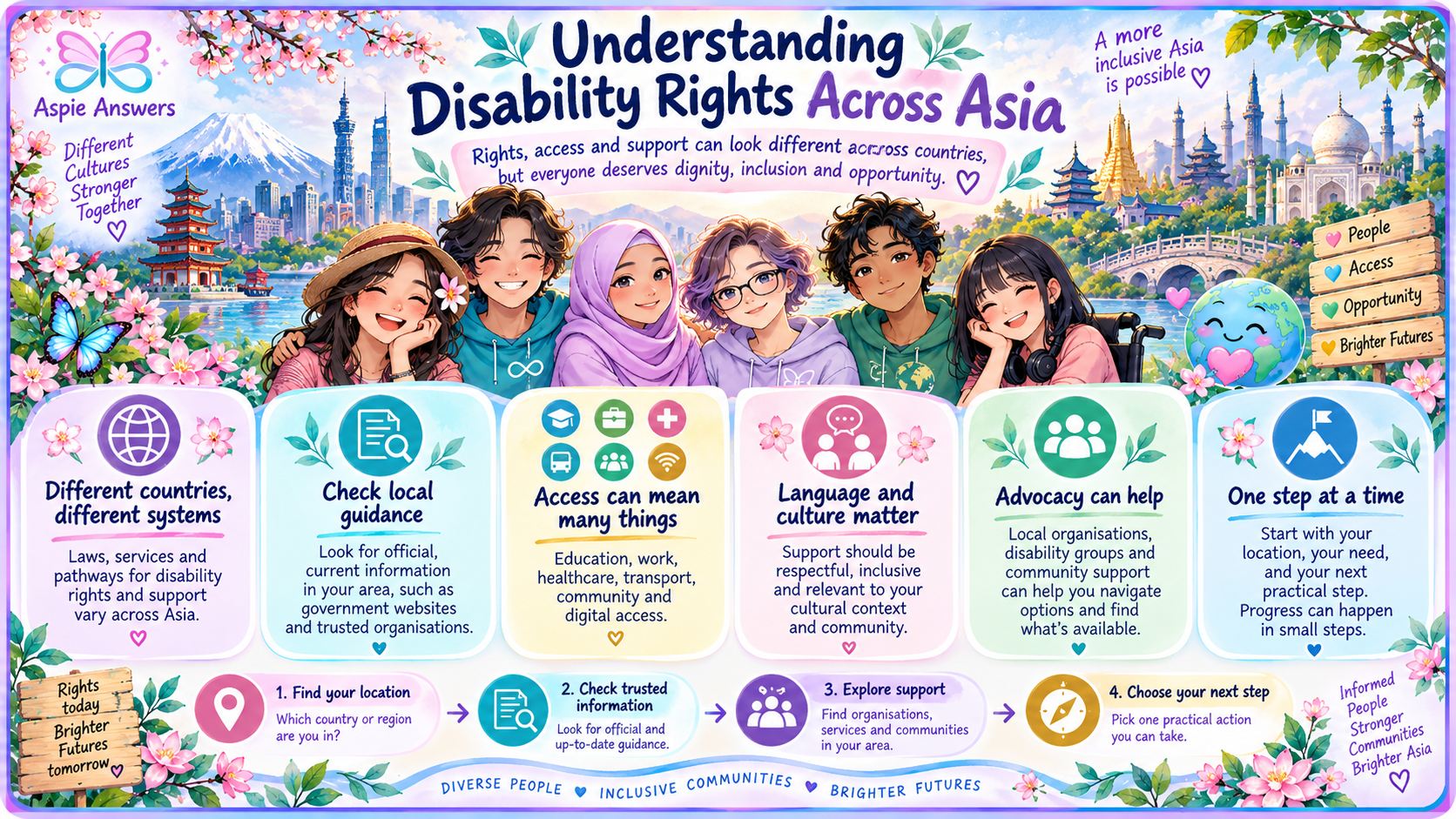
🌿 Understanding Disability Rights Across Asia
There is no single disability-rights system for the whole of Asia. National laws, enforcement mechanisms, disability definitions, accessibility requirements and available services can vary significantly.
Rights depend on location
Start by identifying the country or territory involved. National law usually determines which legal protections, complaints bodies and remedies are available.
Accessibility has many forms
Access may involve buildings, transport, communication, information, education, employment, healthcare, technology and participation in community life.
Support pathways differ
Disability organisations, legal-aid systems, ombudsman services, human-rights institutions and government departments differ from country to country.
🧭 Regional & International Rights Frameworks
International and regional frameworks can help explain broad disability-rights principles, but they do not replace the national laws and procedures that apply within each country.
UN Convention on the Rights of Persons with Disabilities
The CRPD is the major international disability-rights treaty. It covers areas including equality, accessibility, education, health, employment, independent living, participation and access to information.
Countries have different treaty statuses and national implementation arrangements, so check the current UN treaty information for the country you are researching.
Asian and Pacific Decade of Persons with Disabilities
UN ESCAP's current regional disability decade runs from 2023 to 2032 and is guided by the Jakarta Declaration, together with the continuing regional disability-inclusive development framework.
ESCAP covers Asia and the Pacific, so this framework is broader than Asia alone, but it is an important regional starting point.
Jakarta Declaration 2023–2032
The Jakarta Declaration guides the current Asian and Pacific disability decade and sets priorities for accelerating disability-inclusive development across the wider region.
National implementation matters
International commitments are implemented differently within national legal and policy systems. A country's constitution, disability laws, anti-discrimination laws, accessibility rules and complaints mechanisms may all be relevant.
🗺️ Explore Rights & Accessibility Across Asia
Dividing Asia into smaller regions can make research easier. These are discovery pathways rather than one-size-fits-all legal categories, and regional classifications can vary.
East Asia
Explore national disability-rights, accessibility, education, employment, healthcare and advocacy pathways in East Asian countries.
Southeast Asia
Look for current national disability legislation, government disability agencies, community organisations and complaint pathways within each country.
South Asia
Explore national rights frameworks, accessibility, social-support systems, education, work and disability organisations across South Asia.
Central Asia
Check individual country law, government information, CRPD status, disability organisations and current complaint or advocacy routes.
West Asia
Rights, services and legal structures vary considerably, so country-specific official information should be the starting point for individual situations.
♿ Accessibility Across Everyday Life
Disability access is not limited to ramps or buildings. Barriers can affect many parts of everyday participation.
Education
Access may involve enrolment, classroom participation, learning materials, communication, examinations, support people and reasonable adjustments.
Employment
Workplace access can include recruitment, physical environments, work methods, communication, flexible arrangements and protection from discrimination.
Healthcare
Accessible healthcare can involve communication, informed consent, physical access, sensory needs, interpreters and understandable health information.
Transport & public spaces
Access may involve transport systems, streets, public buildings, toilets, wayfinding, seating and community facilities.
Digital access
Accessible websites, apps, forms, documents, captions and digital communication can make an enormous difference to participation.
Neurodivergent accessibility
Clear expectations, sensory adjustments, alternative communication, quieter environments, processing time and flexibility may support access.
💬 Culture, Language & Communication
Asia contains extraordinary cultural and linguistic diversity. Accessible support should respond to the individual rather than assuming everyone within a country or community has the same needs, beliefs or family arrangements.
Language access
Some people may need sign language, interpreters, translated information, Easy Read, plain language, visual support, AAC or another communication format.
Family & community
Family and community relationships may be important sources of support. At the same time, the disabled person's own preferences, autonomy and voice should remain central.
Respect individual identity
Disability language and identity preferences differ between individuals, communities and languages. Where possible, follow the terminology the person chooses for themselves.
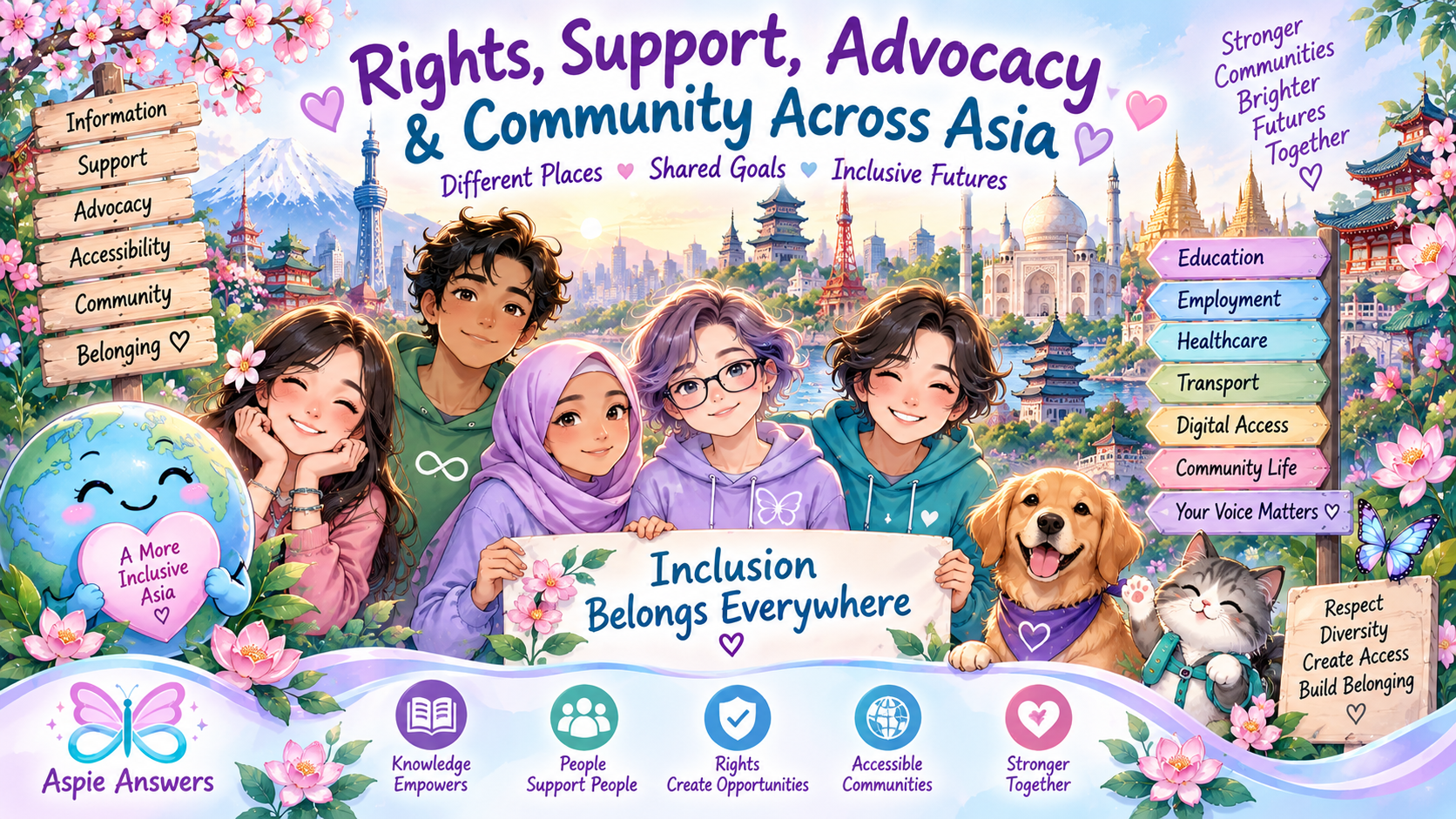
🤝 Rights, Support, Advocacy & Community
Finding help often starts locally. Government agencies, disabled people's organisations, advocacy groups, human-rights bodies, legal services and community organisations may all have different roles.
Government disability information
Look for current national or local government departments responsible for disability, social development, health, education, employment or human rights.
Disabled people's organisations
Organisations led by disabled people may provide community knowledge, advocacy, peer support, rights information and links to local services.
Advocacy & legal support
Depending on the country, advocacy organisations, legal-aid services or human-rights organisations may help someone understand options and navigate a problem.
📣 Complaints, Advocacy & Finding Help
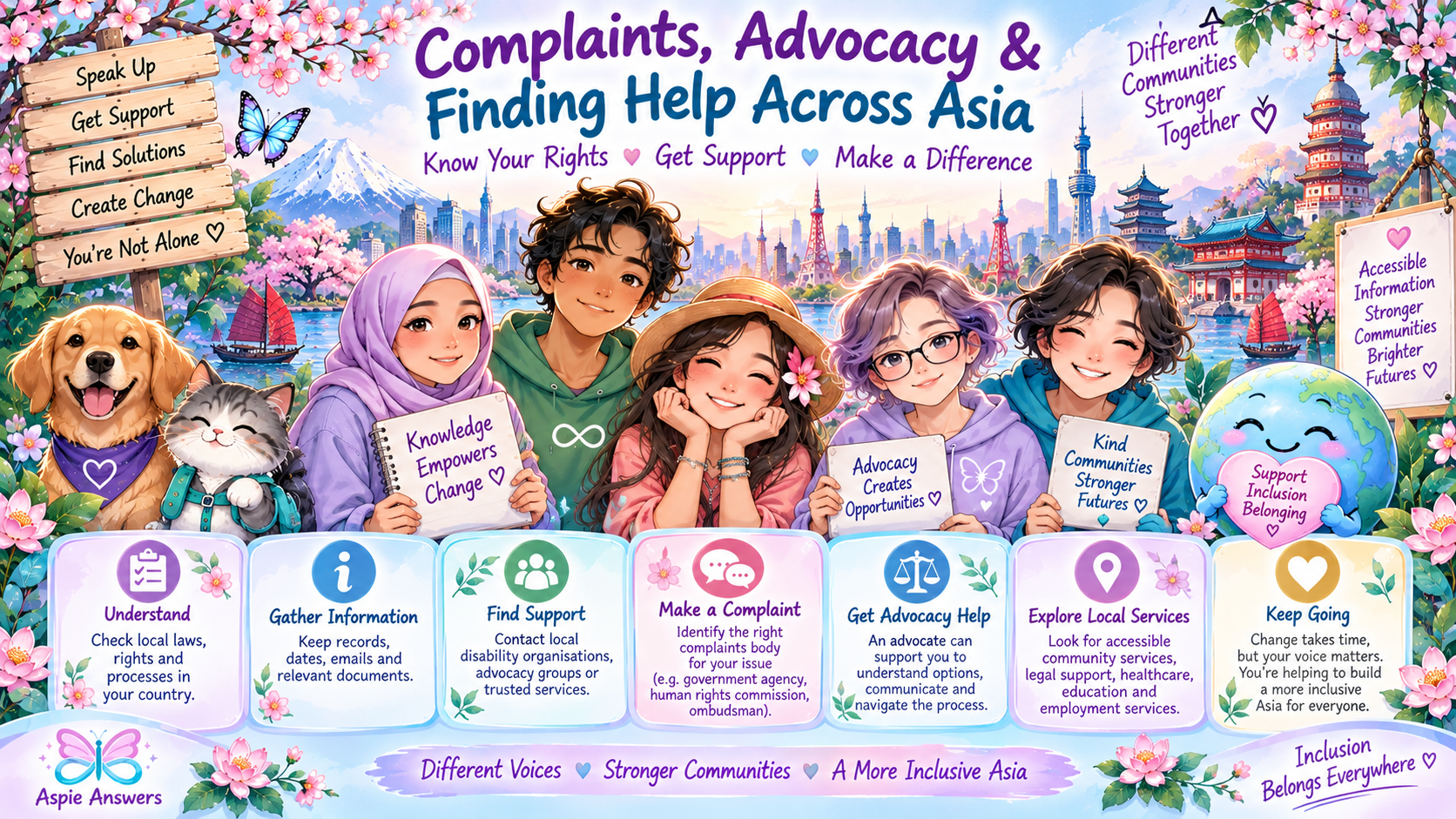
There is no single complaints organisation for Asia. The correct route depends on the country, the issue involved and the organisation responsible.
Check the local system
Find out whether the issue belongs with a service provider, regulator, human-rights institution, ombudsman, court, tribunal, ministry or another complaints organisation.
Keep useful records
Save relevant dates, names, messages, letters, decisions, photographs or other information that helps explain what happened.
Find support
A trusted person, disability organisation, advocate, interpreter or legal service may help explain options or support communication.
Explain what outcome you need
It can help to say what barrier remains and what practical change, response or resolution you are asking for.
Check deadlines
Complaint and legal processes may have time limits. Check current local information rather than assuming the same deadline applies everywhere.
Consider the next pathway
If one organisation cannot help, ask whether it can identify the agency, service or complaints body that is responsible.
Explore Aspie Answers: Discrimination, Complaints & Problems →
✨ Where Do I Start?
A large regional system can feel overwhelming. You only need to identify the next useful step.
Find the location
Which country or territory does the issue relate to?
Identify the issue
Is this access, discrimination, education, work, healthcare, services or another concern?
Check trusted information
Start with current official or established local disability-rights information.
Find support
Look for an advocate, disability organisation, legal service or trusted support person if needed.
Take one next step
Ask a question, request an adjustment, contact a service or begin the relevant process.
🔗 Trusted Regional & International Starting Points
These sources can help with regional context and international disability-rights information. Country-specific questions should still be checked against current national sources.
UN ESCAP — Disability-Inclusive Development
Regional information about disability inclusion, the Asian and Pacific disability decade and related regional work.
Visit UN ESCAP ↗Jakarta Declaration 2023–2032
The current regional declaration guiding the Asian and Pacific Decade of Persons with Disabilities.
Explore the Jakarta Declaration ↗UN Convention on the Rights of Persons with Disabilities
International disability-rights framework covering dignity, equality, accessibility, participation and many areas of everyday life.
Explore the CRPD ↗UN Treaty Collection — CRPD Status
Check whether a particular country is a party to the Convention and view current treaty status.
Check current treaty status ↗💜 A Gentle Information Note
This page provides general educational and navigation information. It is not legal advice and does not determine individual legal rights, eligibility or the outcome of a complaint. Laws, services, government responsibilities and complaint processes vary significantly across Asian countries and can change over time. Use current local and official information for your particular country and circumstances.