
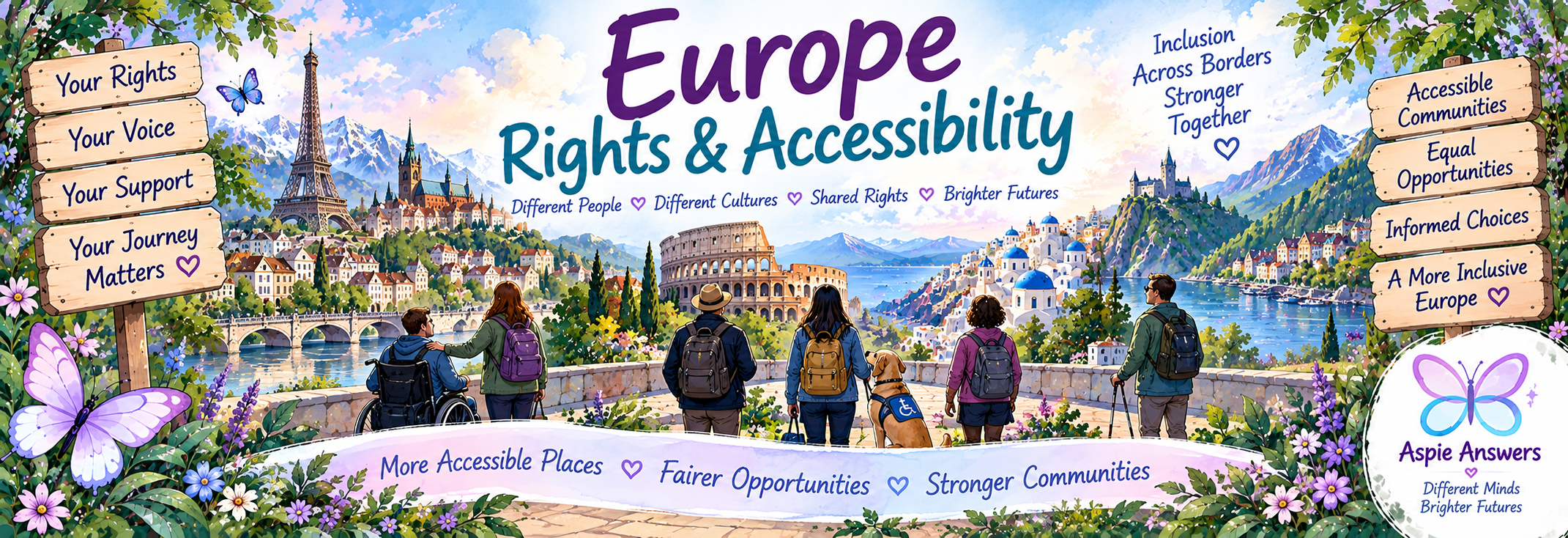
Europe Rights & Accessibility
Disability rights and accessibility across Europe are shaped by several overlapping systems. European Union law may apply in EU Member States, wider European human-rights frameworks connect many more countries, and national laws, services, education systems, healthcare arrangements and complaint processes still matter enormously.
This page provides an accessible starting point for understanding those layers, recognising common accessibility areas and finding the right country or support pathway without expecting one European rule to answer every situation.
🧭 Understanding the European Rights Landscape
European Union
EU legislation and policy affect important areas such as non-discrimination, employment, digital accessibility, accessible products and services, passenger rights and cross-border participation.
EU rules apply within their particular legal scope and are implemented through national systems.
Wider European frameworks
The Council of Europe, European Convention on Human Rights and European Social Charter form part of the wider European human-rights landscape and are distinct from the European Union.
Membership and legal mechanisms are not identical to EU membership.
Country & local systems
National disability law, equality law, healthcare, education, benefits, accessibility enforcement, advocacy and complaints processes differ from country to country.
For many everyday problems, the national or local pathway is the practical place to begin.
⚖️ Key Rights Frameworks
🌐 UN Convention on the Rights of Persons with Disabilities
The UNCRPD provides an international human-rights framework covering areas including equality, accessibility, independent living, education, health, work, participation and access to information.
The European Union is a party to the Convention, and EU disability strategy is designed around its principles.
European Commission — UNCRPD ↗🇪🇺 EU Charter of Fundamental Rights
The Charter includes protection against discrimination on grounds including disability and recognises the importance of measures supporting independence, participation and social and occupational inclusion.
The Charter applies within the scope of EU law rather than replacing each country's own constitutional and legal protections.
EU Charter — Article 26 ↗🧩 EU Disability Strategy to 2030
The Strategy for the Rights of Persons with Disabilities 2021–2030 guides EU action across accessibility, participation, equality, employment, independent living, services and other areas.
In May 2026, the European Commission adopted an enhanced strategy focused more strongly on implementation and practical impact.
Enhanced EU Disability Strategy ↗🏛️ European Social Charter
The Council of Europe's European Social Charter covers social and economic rights. Article 15 of the revised Charter concerns the rights of persons with disabilities to independence, social integration and participation in community life.
Council of Europe — Social Charter ↗♿ Accessibility Across Everyday Life
Accessibility is broader than entering a building. Barriers can affect communication, learning, work, healthcare, transport, technology, community participation and the ability to live with greater choice and independence.
🎓 Education & learning
Inclusive education can involve accessible learning environments, appropriate support, communication access, participation and reducing disability-related barriers.
Education systems and specific legal entitlements remain strongly shaped by national law and policy.
💼 Employment
EU employment equality rules prohibit disability discrimination within their scope and include a duty to provide reasonable accommodation for disabled people in employment.
EU employment guidance ↗🏥 Healthcare & wellbeing
Healthcare rights, disability support, consent, communication access and service organisation differ between countries. EU rules also provide specific pathways for some cross-border healthcare.
EU cross-border healthcare ↗🏡 Independent & community living
Disability rights connect with choice, autonomy, community participation, housing, support services and avoiding unnecessary segregation or institutionalisation.
💬 Communication & information
Access may involve sign languages, AAC, captioning, interpretation, Easy Read, plain language, alternative formats, written communication or additional processing time.
🚆 Travel & participation
Passenger assistance, accessible booking and information, stations, vehicles and recognition of disability-related access needs can all affect travel and participation across borders.
Explore Neurodivergent Accessibility →
💻 Digital, Product & Service Accessibility
European Accessibility Act
The European Accessibility Act establishes common accessibility requirements for selected products and services across the EU.
Covered areas include examples such as computers, smartphones, certain self-service terminals, banking services, e-books, e-commerce, electronic communications and aspects of passenger transport services.
European Accessibility Act ↗Web Accessibility Directive
The EU Web Accessibility Directive requires public-sector websites and mobile applications within its scope to meet accessibility requirements and provide accessibility statements and feedback mechanisms.
EU Web Accessibility guidance ↗Explore Aspie Answers Digital Accessibility →
🪪 Moving Around Europe & Disability Recognition
European Disability Card
The developing EU-wide European Disability Card is intended to make recognition of disability status easier when accessing certain special conditions or preferential treatment during short stays in other EU countries.
National eligibility systems still determine disability status and national cards continue to matter.
European Parking Card
The updated European Parking Card is designed to improve recognition of disability parking rights when travelling within the EU.
Practical rules, implementation timing and national arrangements should always be checked before travel.
📣 Advocacy, Complaints & Finding Help
The correct complaints or advocacy route depends on what happened, where it happened and which law or service system applies.
Identify the barrier or problem
Write down what happened, where it happened, who was involved and what access, support or outcome you were seeking.
Check the organisation's own process
A school, university, employer, healthcare provider, transport operator, public authority or service may have an accessibility, complaints or review process.
Find the national body responsible
Depending on the issue, this may be an equality body, ombudsman, disability agency, regulator, inspectorate, court, advocacy service or another specialist organisation.
Check whether EU law is involved
If the issue concerns an area governed by EU law, EU information and problem-solving routes may help identify which national or European mechanism is relevant.
Get specialist help where needed
Legal, advocacy or specialist advice may be important where deadlines, formal proceedings, employment, education, healthcare, discrimination or significant legal rights are involved.
National equality bodies
EU countries designate national equality bodies. Depending on the country's system and the issue involved, they may provide information or assistance relating to discrimination.
EU guidance — reporting rights breaches ↗EU rights help
The European Commission provides guidance for individuals on where EU-level help may be appropriate and when a national authority is the better route.
Defending your EU rights ↗Explore Discrimination, Complaints & Problems →
🗺️ Country Guidance Matters
🇪🇺 EU Member States
EU countries share some common EU-level protections and accessibility requirements, but implementation, services, eligibility, complaint processes and additional national rights vary.
🇳🇴 🇮🇸 🇱🇮 EEA connections
Iceland, Liechtenstein and Norway participate in the European Economic Area. Some EU internal-market legislation extends through the EEA framework, but the exact legal position should be checked for the particular issue.
🌍 Other European countries
Countries outside the EU and EEA may still participate in Council of Europe and UN human-rights frameworks while having their own national disability, equality, education, healthcare and support systems.
🇬🇧 United Kingdom
The UK has its own disability-rights, equality, education, employment, healthcare and accessibility systems and therefore has its own deeper Aspie Answers pathway.
Continue to UK Rights & Accessibility →🔎 Current Official Starting Points
EU Disability Strategy
Current EU disability-rights strategy and implementation priorities.
European Commission ↗European Accessibility Act
EU accessibility requirements for selected products and services.
European Commission ↗Web Accessibility
Web Accessibility Directive, implementation and current guidance.
Shaping Europe's Digital Future ↗Inclusive Education
European cooperation and policy information on inclusive education.
European Education Area ↗Reasonable Accommodation at Work
Practical EU guidance about employment adjustments and accessibility.
Your Europe ↗European Social Charter
Wider European social-rights framework through the Council of Europe.
Council of Europe ↗Official-source links checked for this page in September 2026. Individual country information can change independently.
🦋 Continue Exploring Aspie Answers
Understanding Accessibility
Start with the foundations of access, barriers and meaningful participation.
Explore page →Reasonable Adjustments & Accommodations
Explore practical ways environments, communication and processes may be changed.
Explore adjustments →Rights & Self-Advocacy
Understand needs, choices, communication and ways to seek support.
Explore self-advocacy →Discrimination, Complaints & Problems
Prepare, document concerns and explore appropriate next steps.
Explore complaints support →Digital Accessibility
Explore accessible websites, apps, documents, communication and digital participation.
Explore digital accessibility →Accessibility & Rights Library
Browse deeper accessibility, rights, advocacy and regional pathways.
Open the library →💜 A Gentle Information Notice
Aspie Answers provides general educational and navigation information. This page is not legal advice and does not determine an individual's legal rights, eligibility, entitlement, complaint outcome or access to a particular service.
Disability rights and accessibility requirements across Europe can depend on the country, type of organisation, setting, applicable law and individual circumstances. European Union law does not apply in the same way to every European country or every situation.
When a specific right, legal deadline, employment matter, education decision, healthcare issue, benefit, formal complaint or significant personal decision is involved, check current official information for the relevant country and consider appropriate professional, legal or advocacy support.
🌍 Different systems. Shared dignity. More accessible pathways.
You do not have to learn every law or institution before asking for support. Start with where you are, identify the barrier in front of you, find the most relevant official or advocacy pathway and take the next manageable step.