

UK Rights & Accessibility
A supportive starting point for understanding disability rights, reasonable adjustments, accessible services, education, employment, healthcare and advocacy across England, Scotland, Wales and Northern Ireland.
Start Here: One UK, Different Systems
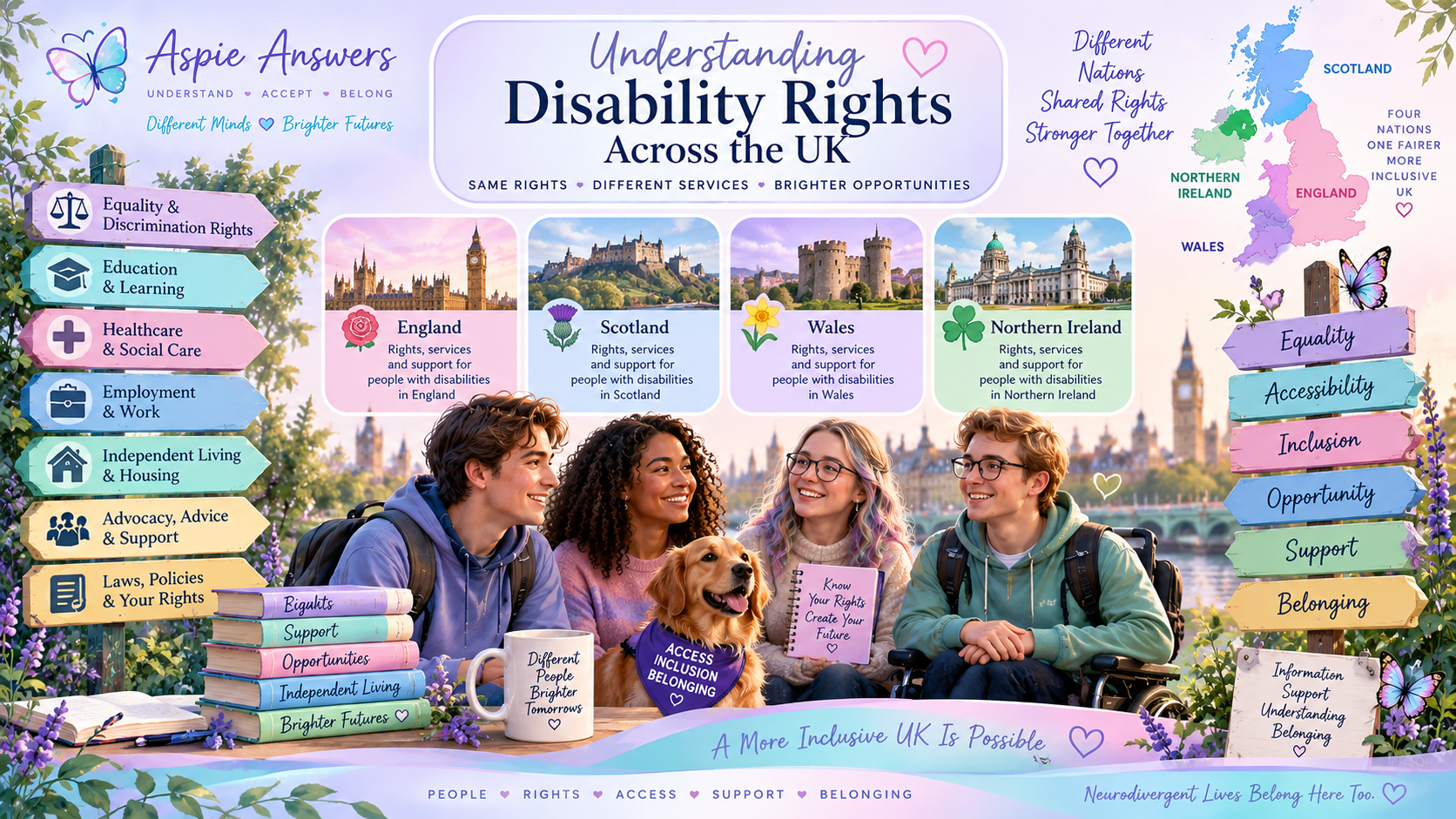
Disability rights in the United Kingdom share some important foundations, but the practical systems are not identical across all four nations.
England, Scotland and Wales are covered by the Equality Act 2010. Northern Ireland has a separate disability-discrimination and equality framework.
Education, healthcare, social care, community support and some disability services are also devolved. This means the organisation, process or terminology you need may depend on whether you live in England, Scotland, Wales or Northern Ireland.
Why this matters
A resource that is correct for England may not describe the system used in Wales, Scotland or Northern Ireland. When seeking support, check both the type of right involved and the UK nation responsible for that service.
Understanding the Four-Nation Landscape
England
The Equality Act 2010 is central to disability discrimination and reasonable-adjustment rights. Education commonly uses the SEND and Education, Health and Care Plan framework. NHS England also has an Accessible Information Standard for relevant health and adult social-care services.
Scotland
The Equality Act 2010 applies, while many public services are devolved to Scotland. Education uses the Additional Support for Learning framework, and Scottish disability policy increasingly emphasises participation, independent living and removing barriers.
Wales
The Equality Act 2010 applies alongside devolved Welsh services. Wales uses the Additional Learning Needs system for learners aged 0–25 and has a Disabled People’s Rights Plan covering areas such as health, education, employment, housing, travel and digital inclusion.
Northern Ireland
The Equality Act 2010 does not apply to Northern Ireland. Disability discrimination is covered through Northern Ireland’s own equality legislation and supported by the Equality Commission for Northern Ireland.
Core Disability Rights & Accessibility
Equal Treatment
Disability discrimination law can protect people from being treated unfairly because of disability in areas such as work, education, services and everyday participation.
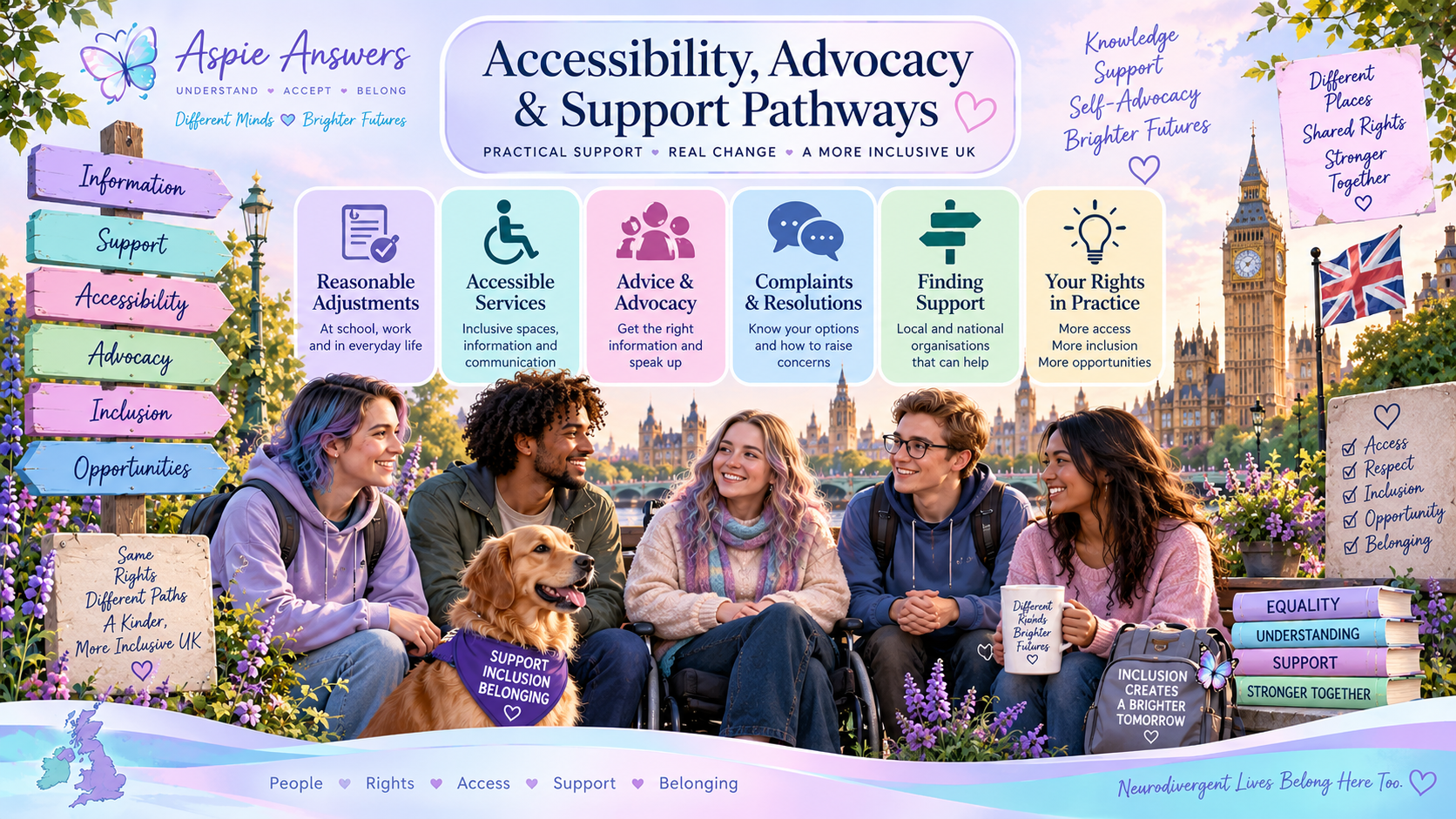
Reasonable Adjustments
Adjustments can include changing procedures, working arrangements, communication methods, physical environments or providing equipment and support to reduce disability-related disadvantage.
Accessible Communication
Accessibility may involve alternative formats, clearer information, communication support, accessible contact methods or additional time to process and respond.
Accessible Services
Public services and service providers should consider barriers that prevent disabled people from accessing services on an equal basis.
Participation & Independence
Disability rights extend beyond physical access. Choice, dignity, autonomy, independent living and meaningful participation are important parts of accessible communities.
Complaints & Enforcement
If access needs or rights are not being met, options may include raising the issue with the organisation, using a complaints process, seeking advocacy or advice, and where appropriate considering a tribunal, ombudsman or legal route.
Education & Learning Support
England — SEND
England uses the Special Educational Needs and Disabilities framework. Some children and young people may receive support through an Education, Health and Care Plan where the relevant criteria are met.
Scotland — Additional Support for Learning
Scottish education law uses the concept of additional support needs. Education authorities have duties to identify, provide for and review the additional support needs of pupils for whom they are responsible.
Wales — Additional Learning Needs
Wales uses a unified Additional Learning Needs framework for children and young people aged 0–25. Support needs may be recorded through an Individual Development Plan.
Northern Ireland — SEN
Northern Ireland has its own special educational needs framework, legislation, education structures and routes for seeking support.
Neurodivergent learners
Autism, ADHD, dyslexia and other neurodivergent experiences can create barriers to learning even when those barriers are not immediately visible. Useful support may involve sensory adjustments, clearer instructions, processing time, communication changes, predictable routines, assistive technology or changes to the learning environment.
Employment & Workplace Access
Workplace Adjustments
Reasonable adjustments at work can include changing how a task is completed, adjusting working arrangements, modifying the workplace, providing equipment, or putting additional support in place.
Recruitment & Interviews
Accessibility can begin before employment. Applicants may need changes to interview formats, communication methods, assessment processes, location or timing.
Access to Work
In England, Scotland and Wales, eligible disabled or neurodivergent people may be able to receive practical workplace support through Access to Work. Northern Ireland uses a different system.
When an Adjustment Is Refused
A refusal does not automatically mean unlawful discrimination, because what is “reasonable” depends on the circumstances. Employers should nevertheless consider needs properly, discuss possible solutions and explore reasonable alternatives.
Healthcare, Communication & Wellbeing
Communication Needs
People may need information in another format, a different method of contact, help communicating during appointments, additional processing time or clearer explanations.
Reasonable Adjustments in Care
Adjustments might include quieter waiting arrangements, longer appointments, sensory considerations, communication support, accessible information or changes to standard procedures.
Different Health Systems
NHS and health structures are devolved. The organisation or complaints route you need may therefore differ between England, Scotland, Wales and Northern Ireland.
Digital & Communication Accessibility
Accessibility includes digital spaces as well as buildings. UK public-sector website and mobile-app accessibility requirements require covered bodies to make digital services accessible and publish accessibility information.
Current UK government guidance uses WCAG 2.2 Level AA as the accessibility standard for covered public-sector websites and mobile applications.
Readable Content
Clear structure, meaningful headings, plain language and predictable navigation help many people access information.
Assistive Technology
Digital services should work with tools such as screen readers, keyboard navigation, magnification and other assistive technologies.
Cognitive Accessibility
Reduced clutter, understandable instructions, sufficient time, consistent layouts and avoiding unnecessary sensory overload can be especially important for neurodivergent users.
Independent Living & Community Access
Choice & Control
Independent living is not simply about living alone. It includes having meaningful choice and control over daily life, support, participation and decisions that affect you.
Accessible Communities
Transport, housing, public spaces, communication, leisure, healthcare and community services can all affect whether a person is able to participate fully.
Social Care & Support
Social-care legislation and assessment systems differ across the four nations. Local councils, health and social-care bodies and nation-specific services may all have roles.
Invisible Access Needs
Accessibility should not depend on whether a disability is obvious. Sensory, cognitive, communication, executive-function and energy needs can all affect participation.
When Something Is Not Accessible
You do not have to know every law before raising an accessibility problem. A simple step-by-step pathway can help.
What is making access, participation or communication difficult?
Explain the adjustment or accessible alternative that may help.
Save useful emails, dates, decisions and copies of requests.
Ask for the organisation’s formal complaint or review process.
Specialist services can help explain further options.
Official UK Information & Guidance
Rights, policies and services can change. These official sources are useful places to check current information.
Information about disability rights and the Equality Act 2010 in England, Scotland and Wales.
Visit GOV.UK disability rights guidance
Northern Ireland guidance about disability discrimination, rights, reasonable adjustments and routes for advice.
Visit Equality Commission NI
Practical information about workplace adjustments and disability discrimination in employment.
Visit ACAS
Current eligibility and application information for the Access to Work programme in England, Scotland and Wales.
Visit Access to Work
Scottish disability policy, equality, independent living and devolved-service information.
Visit Scottish Government
Wales’ rights-focused disability plan covering participation and accessibility across Welsh life.
Visit GOV.WALES
Guidance about accessible health and adult social-care information and communication needs in England.
Visit NHS England
Guidance about accessibility requirements for covered public-sector websites and mobile applications.
Visit digital accessibility guidance