
Canada Rights & Accessibility
Explore disability rights, accessibility, accommodations, inclusion and support across Canada — including the important differences between federal, provincial and territorial systems.
🍁 Start Here
Canada does not have one single disability-rights pathway
One of the most useful first questions is: Is the organisation or issue federally regulated, or does it fall under a province or territory?
Federal disability and accessibility law covers important parts of Canadian life. Many everyday areas — including schools, healthcare, housing, local services and many workplaces — are primarily governed through provincial or territorial systems.
You do not need to understand the whole legal system before asking for help. Begin with your location, the organisation involved and the barrier you are experiencing.
⚖️ Understanding Disability Rights Across Canada
Canada combines national protections with provincial and territorial human-rights, accessibility, education, healthcare and service systems.
Federal jurisdiction
Federal law covers the Government of Canada and federally regulated sectors such as banking, telecommunications and parts of Canada's transportation network.
Provincial & territorial jurisdiction
Provinces and territories have their own human-rights systems and oversee many areas of daily life, including education, healthcare and local services.
Finding the right pathway
The correct rights or complaint route often depends on your location and the type of organisation involved.
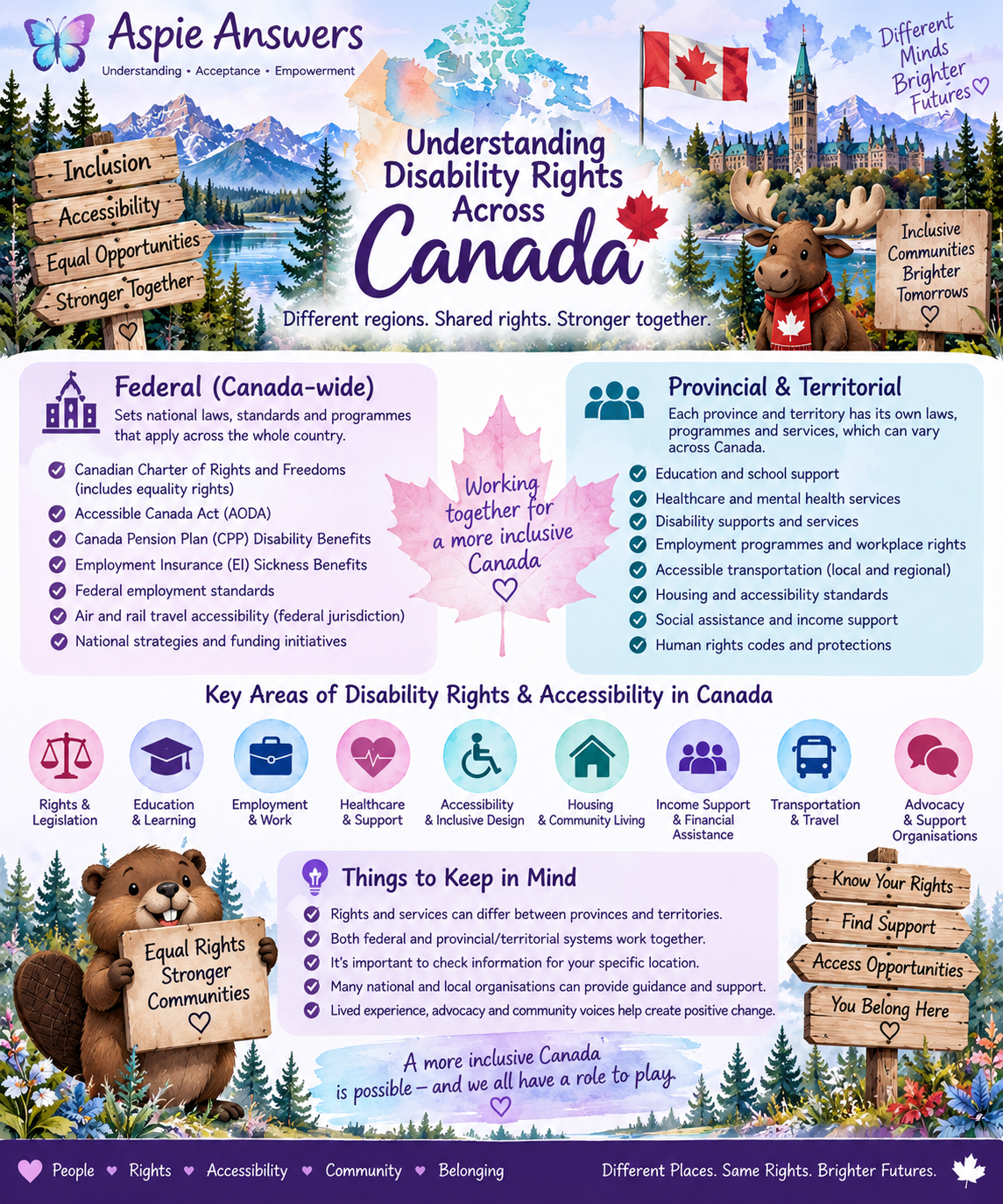
Understanding the different layers of disability rights and accessibility across Canada.
🇨🇦 Federal Rights & Accessibility
Canadian Charter
Section 15 protects equality before and under the law and includes mental and physical disability.
Canadian Human Rights Act
Federal human-rights law protects against disability discrimination within federal jurisdiction.
Accessible Canada Act
The ACA focuses on identifying, removing and preventing accessibility barriers within federally regulated organisations and sectors.
🗺️ Provinces & Territories Matter
Canada has 10 provinces and 3 territories. Each jurisdiction can have its own human-rights legislation, accessibility requirements, complaint systems, education structures, disability programmes and healthcare arrangements.
Human rights
Provincial and territorial human-rights bodies commonly handle discrimination involving locally regulated services, businesses and employers.
Accessibility rules
Some jurisdictions have dedicated accessibility legislation, while others use combinations of human-rights duties, standards, policies and programmes.
Check your location
Always check current information for the province or territory connected with the organisation or service involved.
♿ Accessibility Across Everyday Life
Accessibility includes much more than physical entry. Barriers can affect communication, information, sensory environments, technology, learning, work, travel and community participation.
Buildings & spaces
Entrances, paths, toilets, counters, seating, signage and layouts can all affect access.
Digital accessibility
Websites, apps, forms, videos and documents should be usable by people with varied access needs.
Neurodivergent accessibility
Predictability, sensory adjustments, written information, flexibility and processing time may reduce barriers.
Communication
Accessible formats, captions, interpreters, AAC, plain language and written alternatives may help.
Transportation
Responsibility can differ between local transport and federally regulated transportation services.
Community life
Housing, shops, appointments, recreation and community services are also part of meaningful accessibility.
🎓 Education & Learning Access
Canada does not have one national school system. Provinces and territories operate their own education systems, meaning terminology, supports, accommodation processes and complaint routes may differ depending on location.
School support
Learning plans, assistive technology, classroom changes and accessible materials may form part of support.
Participation
Extra time, breaks, sensory support or alternative assessment arrangements may assist some learners.
Post-secondary education
Colleges and universities may provide disability or accessibility services, although procedures vary.
💼 Employment & Workplace Accessibility
Workplace rights depend partly on whether the employer is federally regulated or falls under provincial or territorial jurisdiction.
Recruitment
Accessible recruitment may include interview adjustments, alternative communication or modified assessment methods.
At work
Accommodation may involve schedules, equipment, communication, sensory conditions, breaks or workplace processes.
Know the jurisdiction
Different labour and human-rights pathways may apply depending on the employer.
🏥 Healthcare & Accessible Services
Provinces and territories are primarily responsible for organising and delivering healthcare services, although responsibilities are shared across Canadian governments.
Communication access
Written information, interpreters, AAC, captions, plain language or additional processing time may improve access.
Sensory access
Quiet waiting options, clearer information and reduced sensory load may help some disabled and neurodivergent people.
Raising concerns
Complaint pathways may involve healthcare organisations, professional regulators or human-rights bodies.
💰 Disability Benefits & Financial Support
Federal programmes may sit alongside provincial or territorial disability, income, housing or support programmes.
Canada Disability Benefit
The federal Canada Disability Benefit provides income-tested support for eligible working-age people with disabilities.
Disability Tax Credit
The Disability Tax Credit is a federal non-refundable tax credit and can also connect eligible people with some other programmes.
🤝 Accessibility, Advocacy & Support Pathways
Advocacy organisations, disability groups, human-rights agencies, community services and trusted support people may help you understand options and decide what to do next.
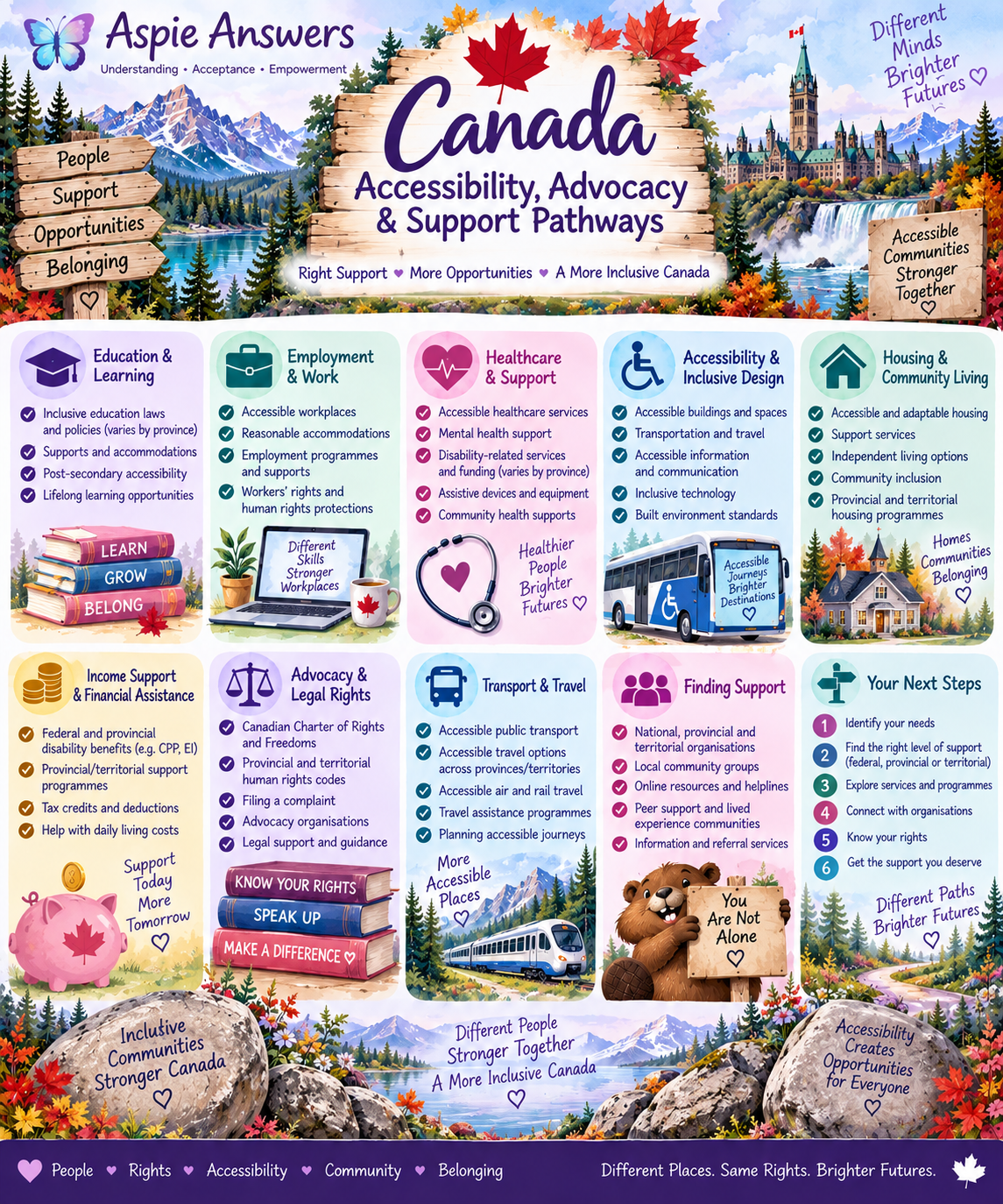
Practical accessibility, advocacy and support pathways across Canada.
Find trustworthy information
Start with the government or organisation responsible for the type of issue involved.
Ask for support
Advocates, disability organisations or trusted people may help with questions or communication.
Keep records
Save relevant dates, emails, letters, requests and responses where possible.
📣 Discrimination, Complaints & Problems
The Canadian Human Rights Commission handles discrimination complaints within federal jurisdiction. Provincial or territorial human-rights bodies may instead be responsible for other organisations.
Identify who
Which organisation is involved?
Find jurisdiction
Federal or provincial/territorial?
Name the issue
What barrier or discrimination occurred?
Check process
Find current rules and deadlines.
Get support
Ask for advocacy if useful.
🦋 Continue Exploring Aspie Answers
Understanding Accessibility
Explore accessibility and barriers in everyday life.
Neurodivergent Accessibility
Explore sensory, communication and cognitive accessibility.
Regional & Country Pathways
Return to the worldwide rights and accessibility doorway.
🔗 Official Canadian Starting Points
Accessible Canada Act
Government of Canada federal accessibility information.
Visit Canada.ca ↗Canadian Human Rights Commission
Federal discrimination and jurisdiction guidance.
Find the Right Pathway ↗Charter — Section 15
Official information about equality rights.
Read Guidance ↗Accessibility Standards Canada
Federal accessibility standards and guidance.
Explore Standards ↗Healthcare System
Government information about Canada's healthcare structure.
Health Canada ↗Canada Disability Benefit
Current federal benefit information.
Benefit Information ↗🍁 Different places. Shared rights. Stronger together.
Start with where you are, identify the barrier in front of you, find the responsible pathway and take one manageable next step.