
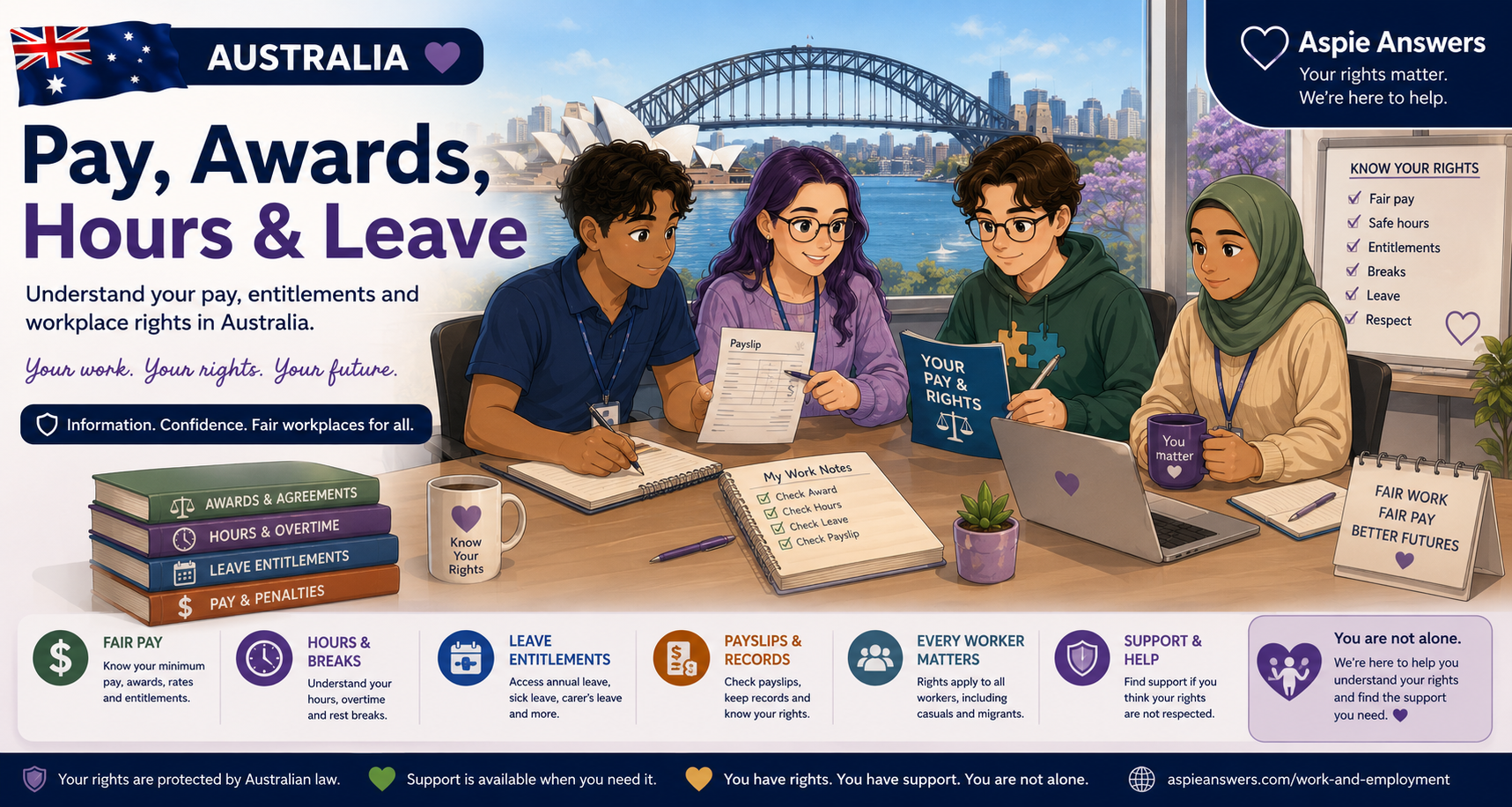
Work & Employment • Workplace Rights & Employment Guidance • Australia
Australia — Pay, Awards, Hours & Leave
Understand the building blocks of Australian pay and employment conditions, including minimum pay, awards and agreements, hours, overtime, breaks, payslips, leave and where to check the rules that apply to you.
🌱 Gentle Legal, Financial & Workplace Guidance
This page provides general educational and navigation information. It is not individual legal, financial, tax, payroll, employment or industrial-relations advice.
Your exact pay and entitlements can depend on your age, job, duties, classification, industry, employment type, award or registered agreement, hours worked and other circumstances. Rates and rules can change, so use current official information when checking an entitlement.
🔎 Search Pay & Entitlements Guidance
🧭 Which Pay Rules Apply to Me?
1. Employment Type
Are you full-time, part-time or casual? Different entitlements can apply.
2. Award or Agreement
Check whether a modern award, enterprise agreement or another registered agreement covers your work.
3. Classification
Award pay can depend on the classification that matches your duties, skills, responsibilities and experience.
4. Hours Worked
Keep track of ordinary hours, overtime, weekends, nights, public holidays, breaks and required work outside rostered hours.
5. Minimum Standards
The National Employment Standards provide minimum employment entitlements for employees covered by the national workplace relations system.
6. Check Current Rates
Use current Fair Work tools rather than relying on an old screenshot, saved rate or social-media post.
💵 Minimum Pay
Employees must be paid at least the minimum rate that applies to them. This may come from an award, registered agreement or the national minimum wage for eligible award- and agreement-free employees.
Use the Pay and Conditions Tool
Fair Work's Pay and Conditions Tool can help calculate minimum pay rates, penalties and allowances under awards.
Fair Work PACT ↗Check the Whole Pay Period
Compare the hours and circumstances you actually worked with the rate, penalties, overtime, allowances and deductions shown on your payslip.
⚖️ Awards, Enterprise Agreements & the NES
Modern Awards
Awards set minimum pay and conditions for many industries and occupations. They can include classifications, ordinary hours, breaks, overtime, penalties and allowances.
Find an Award ↗Enterprise Agreements
Registered agreements can set workplace conditions for covered employees. Check the agreement that applies rather than assuming the award alone gives the final answer.
Find an Agreement ↗National Employment Standards
The NES provide minimum entitlements. Awards, agreements and employment contracts cannot lawfully provide less than applicable NES minimums.
Explore the NES ↗📋 Classifications & Job Duties
Your job title alone may not tell you the correct award classification. Classifications can take account of the work you actually perform, your level of responsibility, skills, qualifications, supervision and other award-specific criteria.
Make the job concrete.
If classifications feel confusing, write down your regular duties, responsibilities, equipment or systems used, whether you supervise others, and any qualifications required. Then compare that information with current official award guidance.
🕒 Hours, Overtime, Rosters & Breaks
Ordinary Hours
Ordinary hours help determine pay, leave accrual and when overtime may apply. Awards and agreements can contain detailed rules.
Overtime
Work outside ordinary hours or other specified circumstances may attract overtime depending on the applicable instrument.
Breaks
Meal and rest-break entitlements can be set by awards or agreements. Check the rules applying to your work.
Rosters
Awards and agreements may contain rules about rosters, changes, notice and working patterns.
Required Work Time
Employees need to be paid for time they are required to work, including required meetings, training and opening or closing tasks.
Right to Disconnect
Australian workplace law includes a right to disconnect. Whether refusing out-of-hours contact is unreasonable depends on the circumstances.
Right to Disconnect ↗🌙 Penalty Rates, Overtime & Allowances
Depending on the award or agreement, additional payments can apply for work at particular times or in particular circumstances.
Penalty Rates
Higher rates may apply for evenings, weekends, public holidays or other specified times.
Overtime Rates
Overtime rules vary between awards and agreements. Check when overtime begins and what rate applies.
Allowances
Allowances may apply for particular duties, skills, expenses, tools, travel, clothing or working conditions.
🧾 Payslips, Time Records & Deductions
Payslips
Employers must give employees a payslip within one working day of payday. Payslips contain required information about the pay period and payment.
Payslip Rules ↗Keep Your Own Records
Keep copies of payslips and consider maintaining your own record of shifts, start and finish times, breaks, leave and unusual changes.
Deductions
There are rules about when money can be deducted from an employee's pay. If a deduction looks unfamiliar, check the legal basis and your records.
Deductions ↗🌿 Leave Entitlements
Leave entitlements depend on the type of leave, employment status and applicable workplace rules. The NES includes several minimum leave entitlements.
Annual Leave
Full-time and part-time employees generally accrue four weeks of paid annual leave per year under the NES, with additional entitlements for some shiftworkers.
Annual Leave ↗Sick & Carer's Leave
Eligible employees can access paid personal/carer's leave, while casuals and other employees may have unpaid carer's leave rights in qualifying circumstances.
Sick & Carer's Leave ↗Compassionate Leave
Compassionate leave may be available in specified circumstances involving an immediate family or household member, pregnancy loss or other qualifying events.
Compassionate Leave ↗Parental Leave
Eligible employees can have unpaid parental leave entitlements under the NES, separate from government parental-leave payments.
Parental Leave ↗Family & Domestic Violence Leave
Employees, including casual employees, can have paid family and domestic violence leave entitlements under the NES.
FDV Leave ↗Long Service Leave
Long service leave can depend on state or territory legislation, awards or other arrangements, so jurisdiction matters.
Long Service Leave ↗🎉 Public Holidays
Public holidays can differ by state, territory and region. Employees have workplace rights relating to public holidays, including rules about requests to work, reasonable refusals and payment.
👥 Casual Employment
Casual employees have different arrangements from full-time and part-time employees. Casual loading, minimum engagement, penalty rates, leave entitlements and pathways relating to ongoing employment can depend on the Fair Work Act and applicable award or agreement.
Fair Work — Casual Employees ↗🔍 If Your Pay Looks Wrong
Check Before Comparing
- Your employment type
- Award or agreement
- Classification
- Hours actually worked
- Overtime and penalty periods
- Allowances
- Deductions
- Payslips and bank payments
Then Seek Help
If the numbers still do not make sense, raise the issue with the employer where appropriate and keep a written record. Fair Work provides information and pathways for workplace problems and unpaid wages.
My Pay Doesn't Seem Right ↗Do not rely on memory alone.
A simple timeline of shifts, pay periods and payslips can make a confusing pay problem much easier to explain.
🧠 Neurodivergent-Friendly Pay & Leave Organisation
One Pay Folder
Keep contracts, award information, payslips and important workplace letters together in one physical or digital location.
Use a Simple Shift Log
Record date, start time, finish time, breaks and anything unusual such as overtime, a public holiday or changed duties.
Make Leave Visible
Use a calendar or tracker for requested leave, approved leave, evidence supplied and important follow-up dates.
Write Questions Down
Prepare specific questions before contacting payroll, a manager or an official service so you do not have to remember everything in the moment.
Ask for Written Follow-Up
If verbal information is difficult to process, ask whether key information or agreed actions can be confirmed in writing.
Check One Thing at a Time
Start with the award or agreement, then classification, then hours and rate. Breaking the problem into steps can reduce overload.
🧮 Superannuation & Tax — Connected, but Different
Superannuation and tax affect working life but are not the same as award pay and Fair Work entitlements. The Australian Taxation Office is the official starting point for current super and tax information.
ATO — Superannuation ↗ ATO — Income & Records ↗📥 Resources & Downloads
Pay & Payslip Checker
Work through hours, rate, penalties, allowances, deductions and the payslip in a calm order.
More resources are coming soon.My Award & Classification Worksheet
Record your role, duties, award, classification and official sources checked.
More resources are coming soon.Hours & Shift Log
Track start and finish times, breaks, overtime, weekends and public holidays.
More resources are coming soon.Leave Entitlements Tracker
Organise leave requests, approvals, balances and important dates.
More resources are coming soon.Underpayment Evidence Checklist
Gather payslips, rosters, time records, contracts and relevant communications.
More resources are coming soon.Pay Question Preparation Sheet
Prepare clear questions before contacting payroll, Fair Work or another support service.
More resources are coming soon.📚 Related Collections
💵 Pay & Payslips
Pay checking, payslip reading, shift records and underpayment organisation tools.
More resources are coming soon.🕒 Hours, Rosters & Working Time
Shift logs, break trackers, overtime planning and working-time resources.
More resources are coming soon.🌿 Leave & Time Away From Work
Leave planning, request preparation and entitlement-tracking resources.
More resources are coming soon.🔗 Related Aspie Answers Guidance
Australia — Workplace Rights & Employment Guidance
Australia ParentWorkplace Issues & Problems
Workplace Issues & ProblemsFlexible Working & Changes to Work Arrangements
Flexible WorkingGetting Help With a Workplace Problem
Getting HelpLeaving Employment
Leaving EmploymentMore Australian Workplace Guidance
Additional Australia-specific workplace rights pages and practical resources are being added across the Work & Employment Hub.
More guidance is coming soon.Know the Rule • Check the Record • Ask for Help
Australian pay and leave rules can look complicated when several systems overlap. Work through the basics one step at a time, keep your own records and use current official information when checking exact rates or entitlements.
Aspie Answers gentle guidance: General educational and navigation information only. Pay rates, awards, agreements, leave rules and individual entitlements can change and depend on personal circumstances.
↑ Return to the Beginning