
Aspie Answers · Clear Language · Awareness · Inclusion
Awareness Glossary & Definitions
Use this full A–Z glossary to explore words and phrases that appear across awareness campaigns, neurodiversity, mental health, disability, accessibility, health, inclusion, advocacy and support. Definitions are designed as clear starting points rather than rules about how anyone must describe themselves.
Gentle notice
Some definitions touch distress, self-harm, suicide, eating disorders, discrimination, bullying, harassment or trauma. You can hide sensitive terms at any time, explore at your own pace, and return when it feels right for you. If a term connects with something urgent or difficult, you can move straight to support instead of continuing to browse.
Language changes — and preferences differ
Some people prefer identity-first language, others prefer person-first language, and terminology can vary between countries, communities and generations. This glossary supports understanding rather than prescribing one “correct” label for everyone.
Clinical, legal and technical terms need context
Some words have specific diagnostic, legal, policy or service meanings that vary by jurisdiction or professional setting. These definitions are educational summaries, not personalised medical or legal advice. Where a term affects diagnosis, eligibility, rights or a formal complaint, check the relevant current professional or official guidance.
Find a word or phrase
Jump to a letter
A
AAC (Augmentative and Alternative Communication)
Ways of communicating that supplement or replace speech, such as communication boards, symbol systems, typing or speech-generating devices.
Ableism
Ideas, systems or behaviour that treat disabled people as less capable, less valuable or less entitled to access and participation.
Acceptance
Moving beyond simple awareness toward respect, inclusion and valuing people as they are.
Access need
A practical need, condition, support or change that helps a person access information, environments, services, work, learning or community participation.
Accessibility
Designing environments, information, services and technology so people with different needs can use and participate in them.
Explore Accessibility & Rights →Accessible information
Information presented in ways people can find, understand and use, such as plain language, Easy Read, captions, large print, audio, accessible digital formats or multiple communication options.
Accommodation / Adjustment
A change to a process, environment or expectation that helps reduce a disability-related or access-related barrier.
ADHD
Attention-deficit/hyperactivity disorder: a neurodevelopmental condition that can affect attention, activity, impulse control, motivation, working memory and executive function in varied ways.
Advocacy
Speaking up, taking action or supporting change so needs, rights and perspectives are heard and considered.
Allyship
An ongoing practice of supporting people from marginalised groups, challenging barriers and discrimination, and making space for lived-experience voices rather than speaking over them.
Anxiety
A state of fear, worry or apprehension that can be temporary or part of an anxiety disorder when it becomes persistent or significantly affects daily life.
Assistive technology
Devices, software or equipment that help a person communicate, move, learn, work, access information or complete everyday tasks.
Autism
A lifelong neurodevelopmental difference involving patterns of social communication, sensory processing, interests, routines and ways of experiencing the world that vary greatly from person to person.
Autism acceptance
An approach that emphasises respect, inclusion, access and valuing autistic people rather than focusing only on awareness.
Autonomy
A person’s right and ability to make choices about their own life, including with support when they want or need it.
Awareness campaign
An organised effort to increase public understanding or attention around a condition, cause, community, issue or support need.
Explore the Awareness & Campaigns Library →B
Barrier
Something in an environment, system, attitude, communication process or design that makes access or participation harder or impossible for some people.
Belonging
Feeling accepted, respected and able to participate as a genuine member of a group, community or environment.
Bullying
Repeated behaviour intended to hurt, intimidate, isolate or control another person, including in-person and online forms.
Burnout
A state of deep exhaustion and reduced capacity after prolonged stress or demands; autistic burnout and occupational burnout may have different patterns and causes.
C
Campaign
A planned set of activities or messages designed to raise awareness, encourage action, share education or support a cause.
Captioning
Written text that represents speech and important sounds in audio or video, supporting Deaf, hard-of-hearing and other viewers.
Carer / Caregiver
A person who provides practical, emotional, personal or health-related support to someone who needs assistance.
Chronic illness
A long-term health condition that may be ongoing, episodic or fluctuating and may affect daily life in visible or invisible ways.
Co-design
Designing services, resources, policies or environments together with the people who will use or be affected by them, with meaningful input throughout the process.
Co-occurring condition
A condition that occurs at the same time as another condition or diagnosis, such as anxiety alongside ADHD or autism. The relationship between them can vary.
Co-production
A collaborative approach in which professionals, organisations and people with lived experience share power and responsibility in creating services, resources or decisions.
Coexisting condition
A condition, disability or diagnosis that is present alongside another condition. One does not necessarily cause the other.
Communication partner
A person who supports another person’s communication by listening, allowing time, respecting communication methods such as AAC, and helping reduce barriers without taking over their voice.
Community inclusion
Creating conditions where people can access, participate in and contribute to community life regardless of disability, identity or support needs.
Crisis
A situation in which distress, danger or loss of safety becomes urgent and may require immediate support or intervention.
D
Disability
A broad term for long-term physical, sensory, cognitive, learning, intellectual, neurological or mental-health-related impairments that can interact with barriers in society.
Disability pride
A positive identity and community perspective that values disabled people, culture and lived experience while challenging shame, stigma and ableism.
Disclosure
Choosing whether, when and how to tell someone about a diagnosis, disability, health condition or support need.
Discrimination
Unfair or unequal treatment connected to a characteristic such as disability, race, sex, gender, age, religion or other protected or marginalised status.
Diversity
The presence of different identities, backgrounds, experiences, abilities, perspectives and ways of thinking within a group or community.
Dyslexia
A specific learning difference that commonly affects accurate or fluent word reading, spelling and decoding, although strengths and experiences vary between people.
Dyspraxia / Developmental Coordination Disorder (DCD)
A developmental condition affecting motor coordination and the learning or performance of movement-based tasks. The term “dyspraxia” is used differently across countries and settings.
E
Easy Read
An accessible information format using simple language, short sentences, supportive images and clear layout.
Eating disorder
A serious mental-health condition involving eating, food, body image or related behaviours and thoughts; different disorders can present in different ways.
Emotional regulation
Processes used to notice, understand and respond to emotions, including ways of adjusting intensity, expression or behaviour.
Empathy
The ability or effort to understand, recognise or respond to another person’s feelings, experiences or perspective.
Equality
Providing the same rights, opportunities or treatment to people, although identical treatment does not always remove unequal barriers.
Equity
Recognising that people may need different resources, supports or adjustments to have a fair opportunity to participate.
Executive function
Mental processes involved in planning, starting tasks, organising, shifting attention, remembering steps, managing time and regulating actions.
F
Fatigue
Physical, mental or sensory exhaustion that can affect energy, concentration, movement and daily functioning.
Fluctuating condition
A condition in which symptoms, capacity or support needs change over time, sometimes from day to day or within the same day.
G
Gender identity
A person’s internal sense of gender, which may or may not match the sex assigned to them at birth.
Global awareness day
A recognised day used internationally to highlight a topic, condition, issue, community or cause.
H
Harassment
Unwanted behaviour that intimidates, humiliates, threatens or creates a hostile environment for another person.
Hyperfocus
A period of very intense attention on a task or interest that can make it difficult to notice time, other tasks or surrounding needs.
Hypersensitivity
Heightened sensitivity to sensory input such as sound, light, touch, smell, taste or movement.
I
Identity-first language
Language that places an identity word before the person, such as “autistic person” or “disabled person”; some communities and individuals prefer this style.
Inclusion
Actively removing barriers and creating conditions where people can participate, contribute and belong.
Explore Inclusion, Belonging & Participation →Inclusive design
A design approach that considers a wide range of people, bodies, minds and access needs from the beginning rather than adding accessibility only after barriers appear.
Inclusive practice
Everyday ways of organising communication, environments, expectations and support so people with different needs and identities can participate and belong.
Informed consent
Voluntary agreement made after a person receives relevant information in a form they can understand and has a real opportunity to ask questions, consider choices and say yes or no.
Intellectual disability
A developmental disability involving significant limitations in intellectual functioning and adaptive functioning, such as conceptual, social or practical everyday skills. Terminology varies internationally.
Interoception
The sense that helps a person notice internal body signals such as hunger, thirst, temperature, pain, heartbeat or the need to use the bathroom.
Intersectionality
A way of understanding how multiple identities and social factors can overlap and shape a person’s experiences of advantage, disadvantage or discrimination.
Invisible disability
A disability that is not always obvious from appearance and may still significantly affect access, energy or daily life.
J
Justice
Fairness in rights, opportunities, treatment and systems, including addressing barriers that create unequal outcomes.
K
Kindness
Considerate and respectful behaviour that can support inclusion, while not replacing rights, access or meaningful structural change.
L
Learning difference
A broad non-clinical term describing differences in how someone learns, processes or uses information.
Learning disability
A term with different meanings internationally; in some countries it refers to intellectual disability, while elsewhere it may refer to specific learning difficulties. Context matters.
LGBTQIA+
An umbrella acronym for lesbian, gay, bisexual, transgender, queer/questioning, intersex, asexual/aromantic and other diverse sexual orientations and gender identities.
Lived experience
Knowledge and perspective gained through personally experiencing a condition, identity, service, barrier or life situation.
Low-stim
Designed to reduce sensory load, visual clutter, movement, noise or other stimulation that may feel overwhelming.
M
Masking
Consciously or unconsciously hiding, suppressing or changing traits or behaviours to fit social expectations or avoid negative responses.
Medical model of disability
A model that locates disability mainly within an individual’s impairment, condition or diagnosis and often focuses on treatment, cure or individual adaptation.
Meltdown
An intense, involuntary response to overwhelm or overload that can involve loss of usual coping, communication or behavioural control. It is not the same as a deliberate tantrum.
Mental health
A broad term for emotional, psychological and social wellbeing, including how people think, feel, cope, relate and function.
Explore Mental Health Support →Mental illness
A health condition that affects thoughts, emotions, behaviour or functioning and may meet recognised diagnostic criteria.
Microaggression
A subtle comment, action or assumption that can communicate bias or devalue someone from a marginalised group.
Mobility aid
Equipment that supports movement or mobility, such as wheelchairs, walkers, canes, crutches or mobility scooters.
N
Neuroaffirming
An approach that respects neurodivergent ways of thinking, communicating and regulating, while supporting real needs without treating neurotypical behaviour as the only acceptable goal.
Neurodivergence
A broad concept describing brains or nervous systems that function in ways that differ from what is considered typical or dominant.
Neurodivergent
An adjective commonly used for a person whose brain or nervous system differs from dominant or typical patterns.
Neurodiversity
The natural variation in human brains and nervous systems across the population.
Explore the Neurodivergence Hub →Non-speaking
A term for someone who does not use speech, or uses very limited speech, and may communicate through AAC, typing, gestures or other methods.
O
Overload
A state in which sensory, emotional, cognitive or environmental demands exceed a person’s current capacity to process or respond comfortably.
Overwhelm
Feeling that demands, information, emotions or tasks have become too much to manage at that moment.
P
Participation
Being able to take part in decisions, activities, education, work, services or community life in a meaningful way.
Peer support
Support provided by people who share relevant lived experience, identity or similar challenges.
Person-first language
Language that places the person before a diagnosis or disability, such as “person with a disability”; preferences vary by person and community.
Pink Shirt Day
An anti-bullying awareness campaign associated with kindness, inclusion and standing against bullying.
Plain language
Clear, direct communication designed so the intended audience can understand information more easily.
Processing difference
A difference in how a person takes in, interprets, organises or responds to information.
Proprioception
The sense that helps the brain understand body position, movement and the amount of force used by muscles and joints.
Protective factor
Something that may reduce the likelihood, severity or impact of harm or distress, such as supportive relationships, access to care, coping skills or safe environments.
Psychosocial disability
A term used in some countries and systems for disability that arises through the interaction between mental-health-related impairments and social, environmental or systemic barriers.
Q
Quality of life
A broad idea describing wellbeing and satisfaction across areas such as health, relationships, autonomy, safety, participation and everyday living.
Queer
A reclaimed umbrella term some people use for diverse sexual orientations or gender identities; not everyone is comfortable with it, so personal preference matters.
R
Reasonable accommodation
A change or support intended to remove or reduce a disability-related barrier. In some countries this is the more common legal term for what others call a reasonable adjustment.
Reasonable adjustment
A change to remove or reduce a barrier so a disabled person can access work, education, services or other activities more fairly; legal definitions vary by jurisdiction.
Recovery
A personal process of rebuilding wellbeing, safety, functioning or meaning after illness, crisis, burnout or other difficulty; it does not always mean symptoms disappear completely.
Representation
The presence and portrayal of people from different identities, communities and experiences in media, leadership, education, decision-making and public life.
Respectful language
Language that aims to recognise dignity, identity and preference while avoiding unnecessary stigma or demeaning assumptions.
Rights
Entitlements and protections people have under laws, policies, human-rights frameworks or service standards.
Risk factor
A characteristic, circumstance or exposure associated with a higher likelihood of an outcome such as illness, distress or harm. A risk factor does not automatically mean the outcome will occur.
S
Safeguarding
Actions and systems intended to protect people from abuse, neglect, exploitation and avoidable harm while respecting their rights, dignity, choices and autonomy.
Self-advocacy
Speaking up for your own needs, preferences, rights and choices, with or without support from others.
Self-determination
The ability and right to direct one’s own life, make meaningful choices and pursue personally important goals with appropriate support when needed.
Self-harm
Intentional injury to oneself. It can occur for different reasons and is a sign that someone may need compassionate, appropriate support.
Sensory overload
Distress or reduced functioning when sensory input becomes more intense or numerous than a person can comfortably process.
Sensory processing
How the nervous system receives, organises and responds to sensory information from the body and environment.
Sensory seeking
Actively looking for or enjoying extra sensory input such as movement, pressure, sound, texture or visual stimulation because it feels regulating, interesting or satisfying.
Shutdown
A reduced-response state that can occur during overload or exhaustion and may involve less speech, movement, eye contact, decision-making or interaction. Experiences vary widely.
Social model of disability
A model that understands disability as arising largely from the interaction between impairments or differences and barriers in society, environments, systems and attitudes.
Stigma
Negative stereotypes, judgement or social attitudes that can lead to shame, exclusion or discrimination.
Stimming
Repetitive movements, sounds, words or actions that may support regulation, expression, focus or sensory needs, such as rocking, hand movements, humming or repeating phrases.
Strengths-based approach
An approach that recognises abilities, interests, resources and possibilities while still acknowledging real support needs and barriers.
Suicide prevention
Efforts to reduce suicide risk through awareness, safer support, early intervention, crisis care, connection and broader protective measures.
Support person
A trusted person who helps someone communicate, understand information, make decisions, attend appointments or access services.
Supported decision-making
An approach in which a person receives the support they need to understand options, communicate preferences and make their own decisions rather than having decisions automatically made for them.
T
Tourette syndrome
A neurodevelopmental condition characterised by multiple motor tics and at least one vocal tic over time.
Trauma
The lasting emotional, psychological or physiological effects that can follow experiences that were overwhelming, threatening or deeply distressing. Responses differ from person to person.
Trauma-informed
An approach that recognises the possible effects of trauma and aims to promote safety, choice, collaboration and avoid unnecessary re-traumatisation.
Trigger
Something that prompts a strong emotional, sensory, memory-based or stress response; the word is used in different ways and context matters.
U
Unconscious bias
Automatic assumptions or attitudes that can influence judgement or behaviour without deliberate intent.
Universal design
Designing environments, products, information or services to be usable by as many people as possible from the outset.
V
Visible disability
A disability that may be apparent to others through physical characteristics, equipment or observable access needs.
Volunteering
Giving time or skills to support a cause, group or community without standard paid employment; accessible volunteering can be an important form of participation.
W
Wellbeing
A broad sense of physical, emotional, social and everyday wellness rather than simply the absence of illness.
Wheelchair user
A person who uses a wheelchair for mobility, either all the time or in some situations; many wheelchair users can also stand or walk to varying degrees.
Workplace inclusion
Practices that help people participate fairly at work through accessible recruitment, communication, adjustments, culture and support.
Explore Work & Employment →X
Xenophobia
Fear, hostility or prejudice toward people perceived as foreign or from another country or culture.
Y
Youth mental health
The emotional and psychological wellbeing of children, teenagers and young adults, including age-appropriate prevention, support and access to care.
Z
Zero discrimination
A principle and campaign idea focused on reducing unfair treatment and promoting dignity, equality and inclusion.
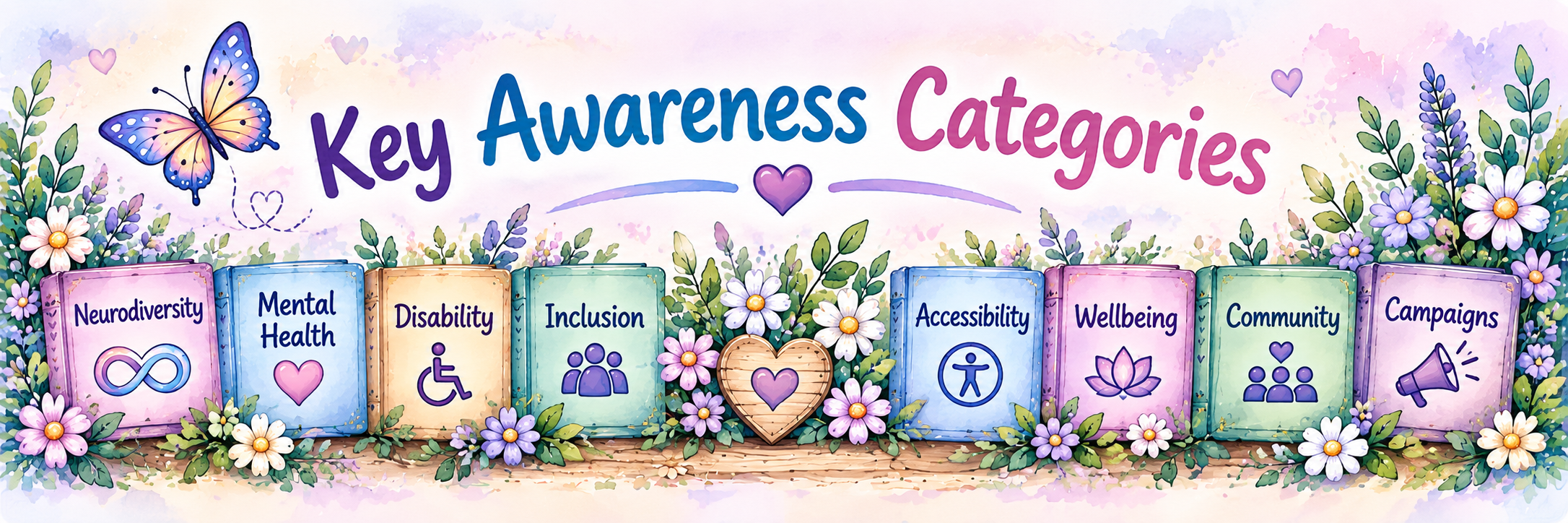
How this glossary is organised
Neurodiversity & Neurodivergence
Autism, ADHD, neurodivergence, masking, sensory processing, executive function and related language.
Mental Health & Wellbeing
Anxiety, crisis, recovery, regulation, distress, trauma-related language and wellbeing.
Disability, Access & Communication
Accessibility, AAC, hidden disability, Easy Read, universal design, mobility and communication access.
Community, Identity & Inclusion
Belonging, diversity, intersectionality, LGBTQIA+ language, participation and representation.
Rights, Advocacy & Equity
Adjustments, discrimination, equality, equity, rights, advocacy and self-advocacy.
Awareness & Campaigns
Campaign language, awareness days, anti-bullying work and public education.
Helpful ways to use definitions
A definition can help you understand a term without telling you everything about a person. Context, lived experience and individual preference still matter.
Ask rather than assume
When referring to a specific person, their own language preference is usually the best guide.
Country context matters
Terms such as learning disability, accommodation and reasonable adjustment can mean different things across countries and systems.
Clinical meaning can be narrower
A word used casually may have a more specific meaning in diagnostic criteria, healthcare or research.
Community language evolves
Words can be reclaimed, replaced or used differently over time. Older material may therefore use terminology that is less common today.
Support needs are individual
Two people using the same label can have very different strengths, barriers, preferences and support needs.
Awareness is a starting point
Understanding words should lead toward better access, respect, acceptance, support and participation.


Related Aspie Answers pathways


Further learning & support
Living language · Reviewed September 2026
Terminology changes over time
Definitions are reviewed, not frozen
Community language, professional terminology and public understanding can change. Aspie Answers may revise wording when better, clearer or more respectful language becomes established.
Older resources may use older wording
Historical campaigns, archived resources and older publications can reflect the language of their time. That does not always mean the same wording is preferred today.
Country and service context matters
Legal, clinical and educational meanings can differ across New Zealand and other countries, so formal eligibility or rights questions should be checked against the relevant current system.
Lived experience remains essential
A glossary can explain a term, but it cannot replace listening to people about how they describe themselves, what support they need or what inclusion looks like in their lives.
Can’t find the term you need?
This Awareness glossary is intentionally broad, but it is not the only terminology resource on Aspie Answers. Try the wider Glossaries & Definitions Index for specialist glossaries, or use the Whole-Site Topics A–Z when you want a subject page rather than a short definition.
Words can open doors to understanding
A glossary cannot capture every lived experience, but it can make unfamiliar language less intimidating and help people move from awareness toward understanding, accessibility, acceptance and belonging.