Bullying
Workplace bullying can involve repeated unreasonable behaviour that creates harm or a health and safety risk in some jurisdictions. Exact legal tests differ, and some countries use different definitions.

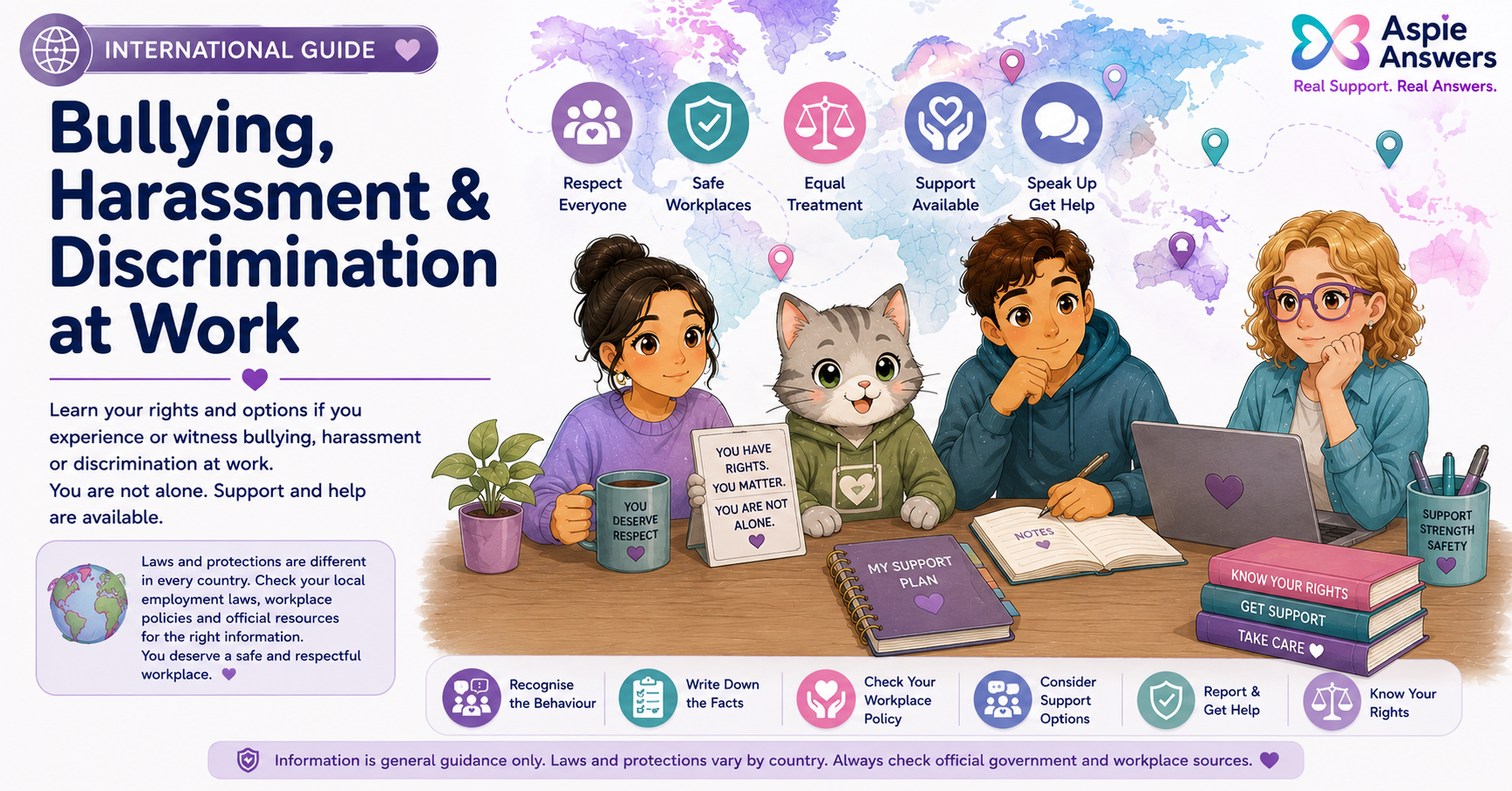
Work & Employment • Workplace Rights & Employment Guidance
Understand concerning workplace behaviour, organise what has happened, explore support and reporting options, and find the official country-specific guidance that applies where you work.
Bullying, harassment and discrimination are related but distinct issues, and their legal definitions differ between countries. Aspie Answers provides general educational and practical planning information, not individual legal, employment, health and safety, medical or professional advice.
You do not need to decide the perfect legal label before asking for support. Start with the facts: what happened, when, who was involved, how it affected you, what evidence or witnesses may exist and what support or outcome you need.
Official complaint routes, protected characteristics, employer duties, remedies and deadlines can differ substantially. Check current official guidance for the country where you work before relying on a legal rule or deadline.
Search Aspie Answers for bullying, harassment, discrimination, workplace problems, adjustments, disclosure, employment rights and related support.
The words are sometimes used interchangeably in everyday conversation, but workplace and legal systems may treat them differently.
Workplace bullying can involve repeated unreasonable behaviour that creates harm or a health and safety risk in some jurisdictions. Exact legal tests differ, and some countries use different definitions.
Harassment can involve unwanted conduct that is offensive, humiliating, intimidating or prohibited under applicable law. Some forms relate to protected characteristics or are sexual in nature.
Discrimination can concern disadvantageous or unequal treatment connected to characteristics or grounds protected by applicable law. The protected grounds and employment actions covered vary.
Describe what happened, when it happened, who was involved, how it affected you and what support or change you need.
Repeated insults, humiliating comments, aggressive communication, inappropriate jokes, threats or unwanted remarks can be concerning.
Repeated exclusion from information, meetings or work-related activities can be relevant depending on the circumstances.
Unreasonable demands, deliberately impossible expectations, unfair treatment or misuse of authority can form part of a workplace concern.
Problems can occur through email, messaging, video calls, social media and other digital channels as well as face to face.
Concerning behaviour may involve managers or colleagues and, depending on local rules, contractors, customers, clients, visitors or others connected with work.
Different treatment connected to disability, age, race, sex, religion or another protected ground may raise discrimination concerns under applicable law.
Performance discussions, feedback, workplace directions, disciplinary processes, organisational changes or disagreements are not automatically bullying or discrimination. Some jurisdictions specifically distinguish reasonable management action carried out reasonably from workplace bullying.
Neurodivergent and disabled workers may experience misunderstandings around communication, sensory needs, executive functioning, social expectations, working styles or adjustments. Individual needs and experiences differ.
Direct communication, processing time, eye contact, tone, body language or different social styles should not automatically be interpreted as poor attitude or lack of commitment.
A workplace concern may overlap with a disability-related adjustment or accommodation request. Rights and processes are country-specific.
If you are repeatedly singled out, excluded or disadvantaged, record the facts rather than feeling you must immediately decide which legal category applies.
A clear factual record can make it easier to explain a concern, identify patterns and remember important details.
You do not necessarily have to handle a workplace concern alone or confront another person directly.
Depending on the organisation, support may come from a manager, another manager, HR, a health and safety representative, employee representative or another designated contact.
Some processes allow a support person, representative, advocate, union representative or another person to assist. Check your workplace and country rules.
An employment regulator, labour authority, equality or human-rights body, health and safety regulator, union, advocate or legal service may be appropriate depending on the issue and jurisdiction.
Workplaces may have informal and formal options. The appropriate pathway depends on the seriousness of the behaviour, what you want to happen, workplace policy and local law.
Look for bullying, harassment, discrimination, grievance, complaint, conduct, health and safety or respectful-workplace policies.
You might want behaviour to stop, communication to change, a safety issue addressed, an adjustment considered, a complaint investigated or another outcome.
Where appropriate, options can include seeking support, raising the issue informally, speaking with a manager or making a formal complaint.
A formal complaint may lead to an investigation. Processes differ, but careful handling, procedural fairness and clear communication can be important.
Bring your timeline, relevant documents and key points you want to explain.
Ask what the process involves, who will receive information, expected timeframes and whether a support person or representative is allowed.
Record meetings, information requested, decisions communicated and next steps or review options.
Some jurisdictions protect workers from retaliation, victimisation or other adverse treatment connected with raising a workplace right, complaint or discrimination concern. Terminology and scope vary.
Keep dates, details and relevant communications, and check official country-specific guidance promptly because some workplace claims and complaint pathways have strict time limits.
Workplace conflict, bullying, harassment or discrimination can be exhausting and stressful. Practical support can matter alongside any formal process.
Break the process into smaller steps: record facts, identify one support contact, prepare questions and deal with the next immediate task.
A trusted person, representative, union, workplace support service or appropriate professional may help you organise information and understand options.
Emotional or practical support can help you through the experience, while official employment or legal sources can clarify rights, deadlines and complaint routes.
Use this international page to understand the issue, then use country-specific official guidance for legal definitions, protected grounds, complaint options, regulators and deadlines.
Employment New Zealand provides separate guidance on bullying, harassment and discrimination, workplace responses, complaints and resolution options.
Employment New Zealand ↗Australian pathways can involve the Fair Work Ombudsman, Fair Work Commission, work health and safety bodies and anti-discrimination or human-rights bodies depending on the concern.
Fair Work Ombudsman ↗Regional doorway for Pacific countries and territories. Employment, safety, discrimination and complaint rules must be checked country by country.
Regional pathway developingUK workplace bullying, harassment and discrimination can involve workplace procedures, equality law and other employment protections. Acas provides practical guidance.
Acas — Bullying at Work ↗European equality frameworks interact with national employment and workplace rules. Country-specific law and complaint systems remain essential.
Regional pathway developingHarassment or discrimination connected with protected characteristics can involve federal law and the EEOC, while other workplace conduct may involve different federal, state, local or employer processes.
EEOC — Harassment ↗Protections and complaint routes can depend on federal, provincial or territorial jurisdiction and applicable human-rights and occupational health and safety rules.
Aspie Answers country sibling developingAdditional country and regional pathways beyond the dedicated United States and Canada routes.
Regional pathway developingCountry-specific employment, equality, safety and workplace complaint pathways across Latin America and the Caribbean.
Regional pathway developingCountry-specific workplace behaviour, discrimination, employment and safety pathways across Asia.
Regional pathway developingCountry-specific employment, equality, workplace-safety and complaint pathways across African jurisdictions.
Regional pathway developingIf your location is not listed, use your government's official employment, labour, equality, human-rights or workplace-safety authority.
More pathways comingPractical tools are being developed to help organise workplace concerns and prepare for conversations, reporting and support.
Record dates, events, people involved and follow-up actions.
More resources are coming soon.A structured way to record repeated or concerning behaviour.
More resources are coming soon.Organise facts about treatment you believe may involve discrimination.
More resources are coming soon.Keep track of relevant messages, documents, dates and witnesses.
More resources are coming soon.Clarify what happened, what you want to communicate and what support you need.
More resources are coming soon.Prepare key facts and questions before using a formal workplace process.
More resources are coming soon.Record what was discussed, decisions made and follow-up actions.
More resources are coming soon.Plan what you want your support person to understand and help with.
More resources are coming soon.Identify contacts, practical supports, boundaries and next steps.
More resources are coming soon.Rights guidance, workplace-problem records, complaint preparation, evidence tools and support pathways.
More resources are coming soon.Adjustments, disclosure, communication, sensory access, self-advocacy and sustainable working.
More resources are coming soon.Incident logs, meeting notes, evidence checklists, conversation planners and follow-up tools.
More resources are coming soon.You do not have to solve everything at once. Start with the facts, keep useful records, find appropriate support and check the official rights and pathways for the country where you work.
Aspie Answers gentle guidance: This page provides general educational information, not individual legal, employment, health and safety, medical or professional advice. Definitions, protections, reporting processes and deadlines differ between jurisdictions and can change.
↑ Return to the Beginning