
Work & Employment • Workplace Rights & Employment Guidance
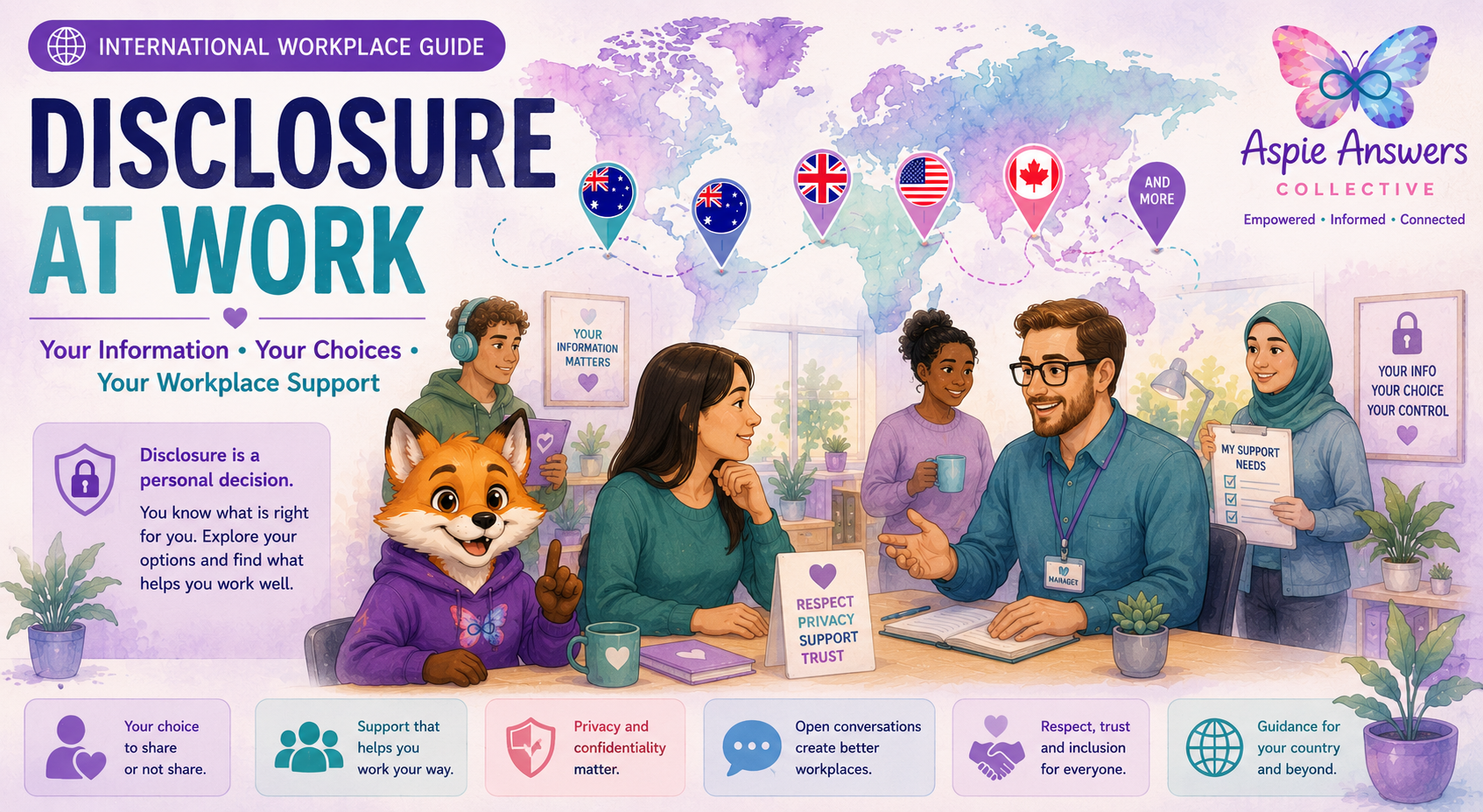
Disclosure at Work
Think through what you may want to share, why you may want to share it, who may need to know, and how disclosure can connect with privacy, workplace support and adjustments.
🌱 Gentle Information, Legal, Privacy & Wellbeing Guidance
Disclosure is personal. There is no single disclosure decision that is right for everybody.
Aspie Answers provides general educational information and practical planning support, not individual legal, employment, medical or professional advice. Whether information must be shared, what an employer may ask, how information is handled, and what protections apply can depend on your country, job, safety requirements and circumstances.
You can take time to identify what you want a workplace conversation to achieve, what information is relevant to that purpose and which current official rules apply where you work.
🔎 Find Disclosure & Workplace Support
Search Aspie Answers for disclosure, privacy, workplace adjustments, neurodivergence, disability, employment rights and related support.
What Does Disclosure at Work Mean?
Disclosure at work can mean sharing information about a disability, neurodivergence, health condition, access need or another personal circumstance relevant to employment. It can happen during recruitment, after starting a job, when circumstances change, or when someone wants to discuss workplace support.
💬 Sharing Information
You might choose to explain a diagnosis, condition, access need or the way something affects you at work.
🛠️ Asking for Support
You may want to explain a workplace barrier and discuss an adjustment or another practical form of support.
🔐 Setting Boundaries
You can think carefully about what information is relevant, who needs it and what you want to remain private, subject to the rules that apply where you work.
Do I Have to Disclose?
There is no safe one-rule answer for every worker worldwide. Disclosure duties and protections can depend on the country, the role, whether information is relevant to safely or effectively carrying out essential work, and why information is being requested.
Why Might Someone Choose to Disclose?
🧩 Workplace Adjustments
You may want a change that reduces a barrier or helps you participate more fully at work.
🗣️ Clearer Understanding
Sharing relevant information may help a manager understand what supports your communication, organisation or working style.
📝 Recruitment Support
You may want to request an accessible application, interview or assessment process.
🦺 Safety or Job Requirements
Some circumstances can make particular information relevant to safely or effectively carrying out a role.
🌱 Circumstances Have Changed
A support need may become relevant later even if you did not need or want to discuss it when you started the job.
💜 Personal Choice
Some people simply feel more comfortable being open about an important part of themselves.
Why Might Someone Choose Not to Disclose?
People can have many reasons for wanting to keep personal information private. These decisions should not be reduced to a lack of confidence or willingness to communicate.
🔐 Privacy
The information may feel personal and the person may not believe it is relevant to their work.
⚖️ Concerns About Stigma
Someone may worry about being treated differently, misunderstood, harassed or discriminated against.
🧰 No Support Needed
A person may currently be able to do their job without needing workplace changes or support.
Diagnosis, Personal Information & Support Needs
What does the workplace actually need to know?
Before sharing a large amount of personal information, identify the purpose of the conversation and the workplace barrier or support need you want to address.
Questions to Consider
- What am I trying to change or make easier?
- What information is relevant to that goal?
- Who is the appropriate person to speak with?
- Why is the information being requested?
- How will it be stored, used or shared?
Focus on What Helps
Depending on your circumstances and local rules, a useful conversation may focus on the barrier, its effect on work and the support that could help rather than treating disclosure as a requirement to explain every part of your personal or medical history.
Disclosure & Workplace Adjustments
You may be considering disclosure because something at work is creating a barrier and you would like support or an adjustment. Disclosure and adjustment processes can overlap, but they are not identical.
Start with the barrier.
What is making work difficult? What effect is it having? What change might help? Then check what information may be relevant to the adjustment process where you work.
Explore Workplace Adjustments →Privacy & Confidentiality
Disclosure often involves sensitive personal information. Privacy and confidentiality rules vary internationally, so it is worth understanding how your workplace handles information before or during the conversation.
👤 Who Needs to Know?
Ask who will receive the information and why they need it for the stated purpose.
📁 How Will It Be Used?
Ask how the information will be recorded, stored, used and shared under the rules that apply to your workplace.
✍️ What Has Been Agreed?
Where appropriate, keep a written record of what information may be shared, with whom, and any support arrangements that were agreed.
A Gentle Disclosure Decision Pathway
Why Am I Considering Disclosure?
Identify what has brought you to this decision and whether there is a specific workplace issue or goal.
What Do I Want to Achieve?
Think about whether you want an adjustment, clearer understanding, recruitment support, a communication change or something else.
What Information Seems Relevant?
Separate information that supports your goal from information you do not currently need or want to share.
Who Should I Speak With?
This might be a manager, HR, recruitment contact, occupational-health service, union representative or another appropriate person.
What About Privacy?
Think about what you want recorded, who may need access and what questions you want answered about confidentiality.
What Is My Next Step?
You might prepare a written request, ask for a private conversation, seek advice first, or decide that disclosure is not currently the right step for you.
You do not have to explain everything at once.
Take time to think about what you want the conversation to achieve and check the rules that apply where you work.
Preparing for a Disclosure Conversation
Before the Conversation
- Write down the main point you want to communicate
- Identify any barrier or support need
- Prepare questions about privacy and process
- Decide what information you are comfortable discussing
- Check whether you want a support person where permitted
Possible Conversation Starter
“There is some information about how I work that I would like to discuss because I think a change or support could help me do my job well. Before I share more, could you explain how this information will be handled and who may have access to it?”
After Disclosure
📝 Confirm
Where appropriate, confirm key points, agreed actions and responsibilities in writing.
📅 Review
If support or an adjustment is agreed, consider when it will be reviewed and how concerns can be raised if it is not working.
🧭 Seek Guidance
If you are concerned about how your information or request has been handled, use your country pathway to find relevant official guidance and support.
Neurodivergent-Aware Disclosure
Autistic people, people with ADHD, dyslexia, dyspraxia and other neurodivergent people can have very different views about identity, diagnosis, disability, privacy and workplace support. There is no single neurodivergent disclosure script that fits everyone.
🧠 Identity & Language
Use language that feels right for you. You may want to discuss a diagnosis, neurodivergence, disability, access needs, specific barriers or simply what helps you work well.
💬 Processing & Communication
If spontaneous conversations are difficult, preparing notes, requesting written follow-up or asking for time to consider questions may help.
🌿 Individual Needs
Do not assume another person's disclosure decision, support needs or workplace experience will be the same as yours.
🌏 Choose Your Country or Regional Pathway
This international parent page provides the decision framework. Dedicated country siblings can explain local disclosure, privacy, disability, workplace-support and employment rules.
🇳🇿 New Zealand
Use New Zealand employment, privacy, human-rights and workplace-safety guidance when deciding what information is relevant and how workplace support may be arranged.
Existing NZ guide to connect here🇦🇺 Australia
Australian guidance says disability information is generally private and disclosure is a personal decision in most circumstances, with particular considerations where work requirements, safety or adjustments are involved.
Aspie Answers country sibling developing🌊 Oceania & Pacific Islands
Regional doorway for Pacific countries and territories. Disclosure, privacy and disability-employment rules must be checked country by country.
Regional pathway developing🇬🇧 United Kingdom
UK disability-employment guidance includes protections against discrimination, reasonable-adjustment duties and rules around disability-related information and confidentiality.
Aspie Answers country sibling developing🇪🇺 Europe & EU
European frameworks can interact with national employment, equality and data-protection law, but disclosure rules must be checked in the relevant country.
Regional pathway developing🇺🇸 United States
Disability-related questions, medical information and accommodation processes can involve federal and state rules depending on the employment stage and circumstances.
Aspie Answers country sibling developing🇨🇦 Canada
Disclosure, accommodation and human-rights obligations can depend on whether employment is federally, provincially or territorially regulated.
Aspie Answers country sibling developing🌎 North America
Additional country and regional pathways beyond the dedicated USA and Canada routes.
Regional pathway developing🌎 Latin America & Caribbean
Country-specific employment, privacy, disability and equality pathways across Latin America and the Caribbean.
Regional pathway developing🌏 Asia
Country-specific disclosure, privacy, disability and employment pathways across Asia.
Regional pathway developing🌍 Africa
Country-specific disclosure, privacy, equality and workplace-support pathways across African jurisdictions.
Regional pathway developing🌍 Other Countries & Territories
If your location is not yet listed, use your government's official employment, privacy, equality, disability or labour authority.
More pathways coming📥 Resources & Downloads
Practical tools are being developed to support thoughtful disclosure decisions without pushing visitors toward either disclosure or non-disclosure.
My Disclosure Decision Planner
Think through why you are considering disclosure and what you want the conversation to achieve.
More resources are coming soon.Should I Disclose? Reflection Worksheet
Explore reasons, concerns, questions and priorities without pushing you toward one answer.
More resources are coming soon.Preparing for a Disclosure Conversation
Organise what you want to say, questions you want to ask and support you may need.
More resources are coming soon.What I Want My Employer to Know
Separate relevant workplace information from details you may not need or want to share.
More resources are coming soon.Privacy & Information Sharing Checklist
Prepare questions about who will see your information, why it is needed and how it will be handled.
More resources are coming soon.Disclosure Meeting Notes
Record key points, agreed actions, questions and follow-up steps.
More resources are coming soon.My Workplace Support Needs Profile
A practical summary of barriers, communication preferences and support that helps you work well.
More resources are coming soon.Disclosure & Adjustments Conversation Planner
Prepare for a conversation where disclosure and workplace adjustments may overlap.
More resources are coming soon.📚 Related Work & Employment Collections
🔐 Disclosure, Privacy & Self-Advocacy Collection
Decision tools, privacy questions, communication planners and self-advocacy support.
More resources are coming soon.🌈 Neurodivergent Workplace Success Collection
Disclosure, adjustments, communication, sensory needs, executive function and sustainable working.
More resources are coming soon.🛡 Workplace Rights Collection
Employment rights, agreements, pay, leave, adjustments, workplace problems and official-help pathways.
More resources are coming soon.Your Information • Your Choices • Your Workplace Support
A thoughtful disclosure decision starts with understanding why the information may matter, what you want from the conversation, what you are comfortable sharing and which rules apply where you work.
Aspie Answers gentle guidance: This page provides general educational information, not individual legal, employment, medical or professional advice. Disclosure, privacy, disability, employment and workplace-safety rules vary between jurisdictions and can change.
↑ Return to the Beginning