
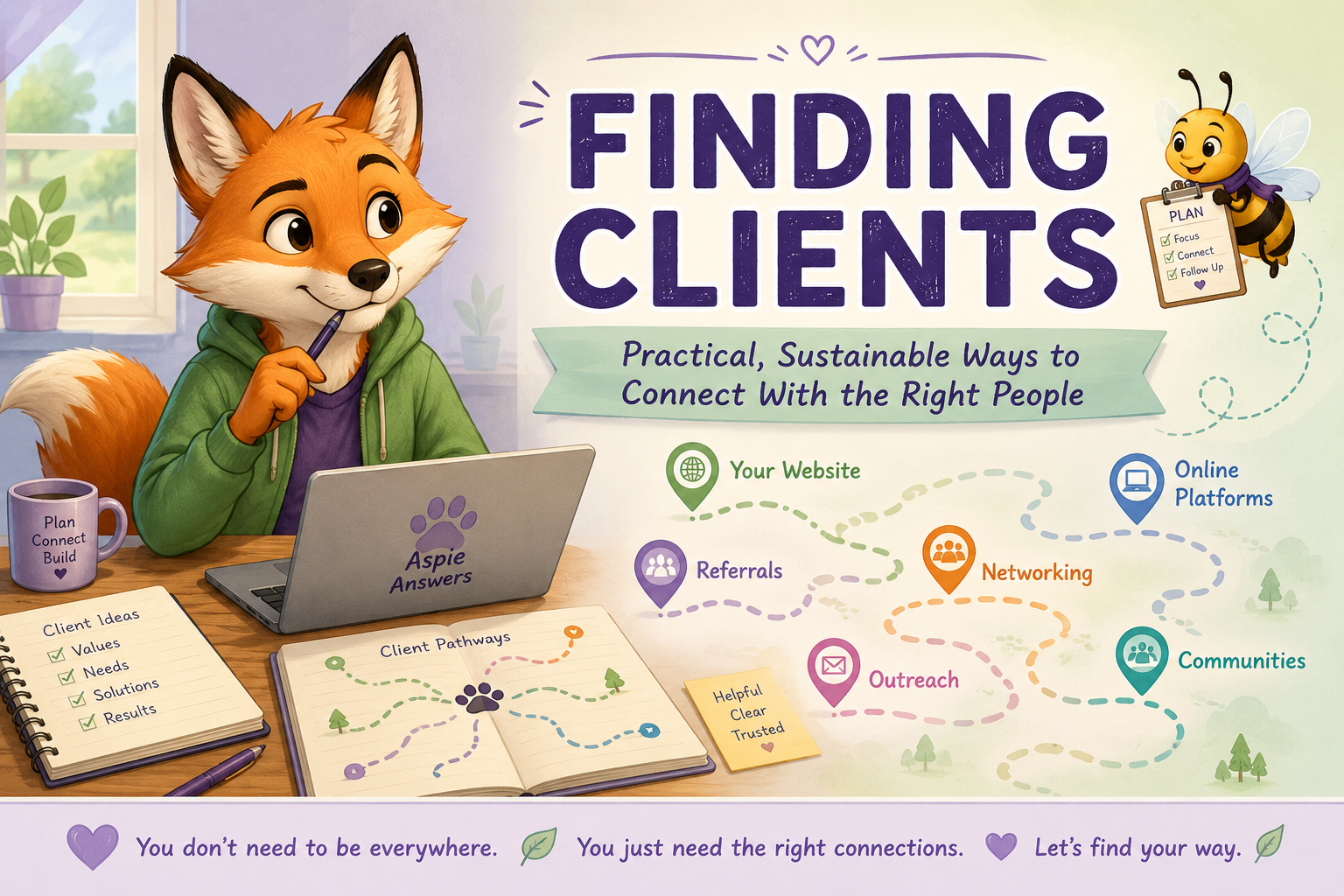
Finding Clients for Freelance & Self-Employment
Finding clients does not have to mean constantly selling yourself, cold-messaging strangers or trying to be visible everywhere. There are many ways people can discover your work — through your website, recommendations, communities, professional relationships, freelance platforms, social media and direct outreach. This guide will help you explore those different pathways and build a client-finding approach that fits your business, your strengths and the amount of energy you realistically have available.
Find Your Path
There is no single correct way to find clients. Explore different routes and identify the ones that make sense for your work and the people you want to reach.
Build Genuine Connections
Finding clients can be about helping the right people understand what you do, building trust and making it easy for them to take the next step.
Keep It Sustainable
You do not need to chase every opportunity. A smaller number of good-fit clients can be more valuable than constantly trying to reach everyone.
🦊 Finn Fox Says: You Don't Need Every Path
One route may lead through referrals. Another may begin with your website, a community connection or someone discovering a useful piece of your work. Finding clients is partly about experimenting with different pathways and noticing which ones lead to the people who are the best fit for what you offer. We can work through those pathways one step at a time.
What Finding Clients Actually Involves
Finding clients is the process of helping suitable people discover your work, understand what you offer and decide whether working with you may be a good fit. It can involve marketing, referrals, conversations, networking, websites, freelance platforms, community connections and direct outreach. The aim is not to convince everyone to become a client. It is to make it easier for the right people to find you — and for you to recognise which opportunities are worth pursuing.
Being Discoverable
Potential clients need some way to encounter your business through search, referrals, communities, platforms or other channels.
Explaining What You Do
People need enough clear information to understand your service, skills and the kind of problem you may be able to help with.
Building Trust
Examples, helpful content, testimonials, referrals and respectful communication can all help reduce uncertainty.
Recognising Good Fit
Not every enquiry needs to become a client. Skills, scope, budget, communication and capacity all matter.
Creating a Next Step
Make it easy for interested people to enquire, request information, book, contact you or take another appropriate action.
Following Up
Some suitable clients may need time, reminders or additional information before they are ready to make a decision.
Think of Client Finding as a Pathway
A client relationship often develops through several small steps rather than one immediate sale.
You Are Choosing Clients Too
Client finding is not only about whether another person chooses you. You also get to consider whether the project fits your skills, values, working style, boundaries, capacity and business goals. A smaller number of suitable clients can be much healthier than saying yes to every enquiry simply because work is available.
🦊 Finn Fox Says: Look for Paths, Not One Perfect Route
One client may arrive through a recommendation. Another may find an article on your website. Someone else may meet you in a community or see your work on a freelance platform. Instead of relying on one method, explore a few sensible pathways and notice which ones consistently lead toward good-fit opportunities.
Knowing What Kind of Client You Want
Finding clients becomes easier when you have some idea of which people, organisations or projects are most likely to work well with what you offer. You do not need to invent one perfect “ideal client”. Instead, think about the characteristics that make a working relationship clearer, more respectful and more sustainable for both sides.
Relevant Needs
A good-fit client has a need, goal or problem that genuinely connects with the service or skill you provide.
Clear Communication
They can explain what they need, respond to important questions and communicate in a way that makes the project workable.
Respectful Expectations
They understand that scope, time, boundaries and professional expertise all matter.
Suitable Budget
The client's available budget should be reasonably compatible with the work, time and resources required.
Realistic Timing
Deadlines and response expectations should fit the amount of work involved and your available capacity.
Workable Energy Cost
Consider not only the hours involved, but also the communication, meetings, uncertainty and emotional load a project may create.
Build a Good-Fit Client Snapshot
You can use these prompts to notice what makes a client relationship easier to sustain.
Different Services May Need Different Client Types
The best client for one offer may not be the best client for another. A quick one-off service may suit people who need speed and clear scope, while longer-term support may require stronger communication, trust and ongoing collaboration. Think about fit for the specific work being offered rather than trying to create one universal client profile.
🦊 Finn Fox Says: A Good Opportunity Should Work in Both Directions
It is easy to focus on whether a potential client will choose you. Remember to ask whether you would choose the project too. A client can be interested in your work and still not be the right fit for your skills, capacity or boundaries. That is useful information — not a failed opportunity.
Understanding Where Your Clients May Be
You do not need to search everywhere for potential clients. A more focused approach is to think about where the people most likely to need your service already spend time, look for help or ask for recommendations. That may be online, offline, inside professional networks, through search, in local communities or on specialist platforms.
Search & Websites
Potential clients may find you while searching for information, services, examples or answers connected to their needs.
Social Platforms
Some audiences discover businesses through social media, creator communities, professional platforms or shared content.
Referrals
Past clients, colleagues, friends, community members and professional contacts may introduce people who already have some trust in your work.
Freelance & Service Platforms
Specialist marketplaces can connect service providers with people already searching for particular skills.
Communities & Groups
Local groups, professional communities, support organisations and interest-based networks may contain relevant connections.
Direct Outreach
Sometimes you can identify a person or organisation that may genuinely benefit from your work and introduce yourself directly.
Match the Client Type to the Pathway
Different kinds of clients may naturally appear in different places.
Ask Where People Look Before They Need You
A useful question is not only “Where can I advertise?” Ask where someone would naturally go when they first notice the problem you help with. They may search Google, ask a friend, join a community group, browse a specialist directory or look through a professional platform. That can tell you more about where your time is worth spending.
🦊 Finn Fox Says: Follow the Clues
Notice where your best enquiries already come from. If several suitable clients found you through referrals, search or one particular community, that is useful evidence. You do not have to guess forever. Let real client pathways help you decide where to focus next.
Starting With Your Existing Network
Your first clients do not always need to come from strangers. People who already know you, your work, your skills or your reputation may be able to become clients themselves, recommend you to someone else or simply help the right people understand what you now offer. This does not mean pressuring friends or family to buy from you. It means making your work visible enough that trusted connections can recognise when your services may be relevant.
Friends & Family
People close to you may know someone who needs your service, even if they are not the right client themselves.
Former Colleagues
Past coworkers, managers or professional contacts may already understand your skills and the kind of work you can do.
Study & Training Connections
Classmates, tutors, mentors and training networks may lead to relevant opportunities or introductions.
Community Connections
Local groups, support networks, clubs and community organisations may know people who need your skills.
Professional Contacts
People working in related fields may be able to refer clients whose needs overlap with but do not compete with their own services.
Previous Clients or Customers
Where appropriate, people who had a good experience may return, recommend you or introduce you to others.
How to Let Your Network Know What You Do
You do not need a dramatic announcement. Keep the information clear and easy to pass on.
A Useful Introduction Can Be Simple
You might say something like: “I've started offering [service] for [type of person or organisation]. If you ever come across someone who needs help with [problem], my website explains what I do.” That gives people useful information without placing pressure on them to become a customer or find work for you.
🦊 Finn Fox Says: Your Network Is a Starting Point, Not an Obligation
Some people have large professional networks. Others have only a few trusted connections — and that is okay. Use the relationships you already have where it feels appropriate, then build additional client pathways gradually through your website, communities, referrals and other methods.
Referrals & Word of Mouth
Referrals can be one of the strongest ways to find suitable clients because the new person often arrives with some trust already established. A referral may come from a previous client, colleague, friend, professional contact, community member or another business that understands what you do. You do not have to aggressively ask everyone for recommendations. A good referral system makes your work easy to understand, remember and pass on when a relevant opportunity naturally appears.
Create a Good Experience
People are more likely to recommend work when they felt respected, informed and satisfied with the overall experience.
Be Easy to Describe
A clear service description makes it easier for someone to explain your work to another person.
Make Sharing Simple
Give people a useful webpage, portfolio link or contact option they can easily pass along.
Build Reciprocal Relationships
Professional contacts may naturally refer work in both directions when each person understands the other's strengths.
Stay Remembered
Occasional useful updates can help past clients and contacts remember what you do without repeatedly asking them for work.
Encourage Relevant Referrals
Explain the kinds of clients or projects that suit you so people are more likely to send appropriate opportunities.
How to Make Referrals Easier
People may be willing to recommend you but still need enough information to know when a referral makes sense.
You Can Ask for a Referral Without Making It Awkward
After a successful project, you might say something simple such as: “If you know anyone who may need similar help, you're welcome to send them my website or contact details.” That gives the person permission to refer without creating an expectation that they must promote your business.
🦊 Finn Fox Says: Make the Path Easy to Pass On
A good referral should not depend on someone remembering a long explanation. Give people one clear description and one easy place to send a potential client. The simpler the pathway is, the easier it becomes for someone to think, “This sounds like the person who could help.”
Using Your Website to Attract Enquiries
Your website can do more than explain that your business exists. It can help potential clients discover you, understand whether your services fit their needs, build confidence in your work and know exactly what to do next. A useful client-focused website does not need to be complicated. It needs to answer the important questions clearly and remove unnecessary barriers between “I might need this” and “I know how to enquire.”
Say Who You Help
Visitors should be able to understand which people, businesses or organisations your service is designed to support.
Explain What You Offer
Describe your services in plain language, including what is provided and the kind of problem or goal it may help with.
Build Confidence
Relevant examples, experience, useful information, testimonials and clear processes can help visitors feel more confident about contacting you.
Help People Find You
Useful pages and clear page titles can help search engines and visitors understand what your website contains.
Make Navigation Clear
Potential clients should not have to search through many unrelated pages before finding your services, pricing information or contact options.
Provide a Clear Next Step
Tell visitors how to enquire, request a quote, book, contact you or learn more when they are interested.
What Does a Potential Client Need to Know?
Imagine someone has arrived on your website for the first time. Can they quickly find answers to these questions?
A Simple Website-to-Enquiry Path
♿ Accessibility Helps Potential Clients Reach You
Accessibility is part of the client journey. A person may be interested in your service but still leave if the website itself creates unnecessary barriers.
- Use descriptive headings and a logical page structure.
- Keep text readable with sufficient colour contrast.
- Add meaningful alternative text to informative images.
- Use descriptive link and button wording.
- Make forms clear, labelled and keyboard-friendly.
- Avoid relying on colour alone to communicate meaning.
- Provide captions or transcripts where relevant for media.
- Keep animation subtle and respect reduced-motion preferences.
- Use plain language where possible and explain specialist terms.
- Offer more than one contact method when practical.
Your Website Can Work Even When You Are Offline
Unlike live networking or constant social-media activity, a useful website can continue explaining your work while you are resting, working with another client or doing something completely unrelated to marketing. That makes it particularly valuable for people who want a client-finding system that does not depend entirely on being socially available every day.
🦊 Finn Fox Says: Walk Through the Path Yourself
Pretend you know nothing about your business and visit your website as a new client. Can you work out what is offered? Can you find the right service? Do you know what happens next? Every unnecessary obstacle you remove makes the path a little easier to follow.
Social Media & Online Communities
Social media and online communities can help potential clients discover your work, see how you think and become familiar with what you offer. The most useful approach is usually not to join every platform or promote yourself constantly. It is to choose a few spaces where relevant people already gather and contribute in a way that is useful, respectful and sustainable.
Choose Relevant Platforms
Focus on the places where your likely clients genuinely spend time rather than maintaining accounts everywhere.
Join Real Conversations
Helpful replies, useful explanations and thoughtful participation can build recognition without turning every interaction into a sales pitch.
Share Useful Work
Articles, tips, examples, case studies or resources can help people understand your knowledge before they need to contact you.
Build Relationships
Communities can lead to referrals, collaborations and opportunities that develop gradually rather than through one direct promotion.
Make Your Offer Visible
Your profile, website link or service information should make it easy for interested people to understand what you do.
Protect Your Energy
Set boundaries around notifications, engagement and platform time so finding clients does not become constant online availability.
How to Participate Without Feeling Like You Are Constantly Selling
Think about contributing value first and making the path to your business clear when it is relevant.
You Do Not Need a Huge Audience
A small community containing the right people can be far more valuable than a large audience with little connection to what you offer. Ten relevant people who understand your work may create more useful opportunities than thousands of passive followers. Quality of connection matters.
🦊 Finn Fox Says: Join the Right Conversation, Not Every Conversation
You do not need to respond to every post, join every group or keep every social platform open. Choose a few places where your knowledge genuinely fits, contribute when useful and make sure interested people have a clear path back to your website or service information.
Freelance Platforms & Marketplaces
Freelance platforms and online marketplaces can connect you with people who are already searching for specific skills or services. They can be useful for building experience, finding early projects or reaching clients outside your usual network. At the same time, different platforms can involve fees, competition, rating systems, platform rules and pressure to respond quickly. The goal is to use them as one possible client pathway — not assume they must become your entire business.
Built-In Discovery
Potential clients may already be searching the platform for the kind of skill or service you provide.
Wider Reach
Online platforms may allow you to work with clients outside your local area or existing network.
Reviews & Reputation
Completed projects and positive feedback may gradually make it easier for future clients to trust your profile.
Fees & Pricing Pressure
Platform fees and competition can reduce what you actually keep, so compare the final income with the real workload.
Rules & Processes
Each platform may have its own communication, payment, dispute and service rules that you need to understand.
Capacity Still Matters
Easy access to many listings does not mean you need to apply for every project or accept unsuitable work.
Before Joining or Using a Freelance Platform
Take a little time to understand what using the platform will actually involve.
Do Not Race to the Lowest Price
Some marketplaces can create strong pressure to compete mainly on price. Before lowering your rates, look at what the project actually requires, how much time it will take, what fees apply and whether the remaining income is sustainable. A project that looks like easy income can become poor-value work once unpaid communication, revisions and platform costs are included.
🦊 Finn Fox Says: Treat the Platform as One Path, Not the Whole Map
A freelance marketplace may be useful for one stage of your business and less important later. You can build other routes at the same time — your website, referrals, professional contacts, communities and direct enquiries. The more healthy pathways you develop, the less pressure there is for one platform to provide every client.
Direct Outreach Without Feeling Pushy
Direct outreach means contacting a person or organisation because you have a genuine reason to believe your service may be relevant to them. Done well, it is not about sending hundreds of identical sales messages. It is about identifying a potentially useful connection, explaining why you are getting in touch, giving the person enough information to decide whether there is a fit, and respecting their choice if they are not interested.
Choose Carefully
Contact people or organisations where there is a genuine connection between their needs and what you offer.
Do a Little Research
Understand who you are contacting and avoid sending a generic message that could apply to absolutely anyone.
Explain the Reason
Tell them why you thought your service might be relevant rather than simply asking them to buy something.
Keep It Low Pressure
Give the person room to decide. A respectful introduction does not require an immediate response.
Give One Clear Next Step
Offer a website, service page, enquiry option or simple invitation to continue the conversation.
Respect a No
Not every potential client will be interested. A polite response or no response is a normal part of business outreach.
A Simple Outreach Message Structure
You can adapt this five-part structure rather than trying to write a perfect sales message from scratch.
Example: A Gentle Professional Introduction
Imagine you provide a service that may be useful to a particular type of organisation.
[Your Name]
🌱 Helpful Outreach Usually Looks Like This
- Relevant to the person or organisation.
- Clear about why you are contacting them.
- Brief enough to understand easily.
- Respectful and professional.
- Honest about what you offer.
- Easy to ignore or decline without pressure.
- Focused on a genuine potential fit.
⚠️ Things to Avoid
- Sending the same message to huge numbers of unrelated people.
- Making exaggerated promises.
- Using pressure or artificial urgency.
- Repeatedly contacting someone who has declined.
- Ignoring platform, privacy or anti-spam rules.
- Making the message entirely about what you want.
- Assuming that silence means permission to keep messaging.
A Small Number of Relevant Messages Can Be Enough
You do not need to send dozens of messages every day. For many small businesses, a few carefully considered introductions can be more useful than a large volume of generic outreach. The quality of the connection matters more than simply counting how many messages were sent.
🦊 Finn Fox Says: Open a Door — Don't Push Someone Through It
Think of direct outreach as opening a door and saying, “This may be useful to you.” The other person gets to decide whether they want to walk through it. Your job is to make the opportunity clear, respectful and easy to understand — not to force a decision.
Networking in a Way That Fits You
Networking does not have to mean walking into a crowded room, handing out business cards or talking to dozens of strangers. At its simplest, networking means developing useful professional relationships. That can happen through a conversation, an online community, a local event, a professional group, a shared interest, a referral or simply staying connected with people whose work overlaps with yours. The best networking approach is one that you can actually sustain.
Start Small
One useful conversation can be more valuable than trying to meet an entire room of people at once.
Ask Genuine Questions
Showing interest in another person's work can create a more natural connection than immediately talking about your own services.
Look for Shared Interests
Common industries, projects, communities, challenges or values can provide a natural reason to continue a conversation.
Think Mutual Benefit
Good professional relationships are not only about what someone can do for you. Consider what you may be able to offer in return.
Follow Up Simply
After a useful conversation, a short message thanking someone and keeping the connection open can be enough.
Let Relationships Develop
Not every networking conversation needs to become a client, referral or collaboration immediately.
Networking Can Take Many Forms
Choose approaches that match your communication style, energy and business needs.
A Simple Networking Conversation
You do not need a rehearsed sales speech. A natural conversation might follow this pattern:
🌿 Make Networking Neurodivergent-Friendly
You can adapt networking instead of forcing yourself to copy someone else's communication style.
- Choose quieter or smaller events where possible.
- Prepare a short introduction before attending.
- Set a realistic goal, such as speaking with one person.
- Use written communication when it works better for you.
- Take breaks before your energy is completely depleted.
- Use notes or reminders to help remember follow-ups.
- Decide in advance when you will leave an event.
- Allow yourself recovery time after socially demanding activities.
Networking Is Not a Performance
You do not need to be the loudest person in the room, have the most impressive introduction or collect the most contacts. Being reliable, curious, helpful and genuine can be far more useful for building long-term professional relationships. Quiet networking is still networking.
🦊 Finn Fox Says: Find Your Comfortable Route
There is more than one way to build a professional network. If large events drain you, try one-to-one conversations. If phone calls are difficult, begin with written communication. If online spaces feel overwhelming, choose one smaller community. The goal is not to become someone else. The goal is to find a networking method that helps the right relationships grow.
Creating a Simple Client Pipeline
Once you begin finding potential clients, it can become difficult to remember who contacted you, who you replied to, who is still considering your service and who has actually become a client. A simple client pipeline gives you somewhere to keep track of those stages. It does not need to be complicated software. A spreadsheet, notebook, planner or simple digital board can work perfectly well. The important thing is that you can see what needs your attention without having to hold everything in your head.
Potential
Someone may need your service or has been identified as a possible opportunity.
Enquiry
They have contacted you or expressed genuine interest.
Conversation
You are discussing their needs, project, scope or possible next steps.
Decision
You and the client are deciding whether the work is a suitable fit.
Client
The work has been agreed and the appropriate business process can begin.
What Could You Track?
Only record information that genuinely helps you manage the relationship.
A Simple Four-Column Version
🌱 Potential
People or organisations who may be suitable but have not yet made an enquiry.
📨 Contacted / Enquiry
People you have contacted or who have contacted you and may need a response.
💬 In Discussion
Potential clients where you are actively discussing needs, scope or pricing.
🤝 Confirmed
Agreed work that has moved into your normal client-management process.
🌿 Keep the Pipeline Neurodivergent-Friendly
The purpose of a pipeline is to reduce mental load — not create another system you have to constantly maintain.
- Use one main place to record potential clients.
- Keep the number of stages small.
- Use consistent labels.
- Add a next action whenever one is genuinely needed.
- Use calendar reminders for important follow-ups rather than relying on memory.
- Review the pipeline at a predictable time.
- Archive or close opportunities that are no longer active.
- Do not treat every potential client as an urgent task.
A Pipeline Is a Visibility Tool — Not a To-Do List
Seeing ten potential clients in a tracker does not mean you have ten tasks to complete today. Some people may simply be waiting. Others may not need another message yet. Some opportunities may never progress. Use the pipeline to understand what is happening and identify genuine next actions — not to create pressure to contact everyone constantly.
🐝 Busy Bee Says: Get It Out of Your Head
If you are trying to remember every enquiry, follow-up and potential project in your head, your brain is doing work that a simple system can do instead. Write it down. Then you can use your attention for the work that actually needs you.
Following Up Without Chasing
Following up is a normal part of finding clients. Someone may have been interested but become busy. They may need time to discuss the project, compare options or get approval from someone else. A thoughtful follow-up keeps the conversation open without turning it into pressure. The key is to know when a follow-up is useful, what you actually need to say, and when it is time to step back.
Give Reasonable Time
Allow enough time for the person to respond based on the type of conversation and any timeframe you discussed.
Add Something Useful
A follow-up can answer a question, clarify something or provide information rather than simply saying “Just checking in.”
Keep It Brief
The person should be able to understand the reason for your message quickly.
Respect Their Capacity
People may have other responsibilities, deadlines or communication needs that you cannot see.
Leave an Easy Exit
Let people know it is okay if the service is not right for them at this time.
Know When to Stop
Repeated messages without engagement can become counterproductive. Sometimes the right next step is simply to close the opportunity.
When Might a Follow-Up Make Sense?
There is no single perfect timeframe for every situation. Consider what was actually discussed.
📨 After Sending a Quote
A gentle follow-up might look like:
[Your Name]
📅 After a Conversation
If you discussed possible work but did not make a decision:
[Your Name]
🌱 A Healthy Follow-Up
- Has a genuine reason.
- Is reasonably timed.
- Is clear and concise.
- Respects the person's choice.
- Provides useful information where appropriate.
- Allows the conversation to end naturally.
⚠️ Avoid Turning Follow-Up Into Pressure
- Repeatedly messaging after no response.
- Creating artificial urgency.
- Using guilt or emotional pressure.
- Suggesting someone owes you a response.
- Ignoring a clear “no”.
- Continuing through multiple channels after someone has not engaged.
No Response Is Still Information
Silence does not always mean “no” — but it also does not mean you should keep messaging indefinitely. The person may be busy, have changed their plans, have chosen another option or simply not need the service. Give appropriate space, follow any agreed timeframe and then decide whether the opportunity should remain open or be closed.
🦊 Finn Fox Says: Follow the Trail — Don't Chase the Fox
A good client system should tell you when a follow-up makes sense. You do not need to spend your day wondering who might reply. Record the next action, set a sensible reminder when needed, then return your attention to the work in front of you.
Turning Enquiries Into Good Client Conversations
When someone makes an enquiry, the goal is not simply to convince them to buy. A good client conversation helps both sides understand what is needed, whether you can provide it, what the expectations are and whether the relationship is a good fit. Taking time to understand the person before jumping straight into a price or solution can prevent misunderstandings later.
Listen First
Give the potential client space to explain what they need before immediately offering a solution.
Understand the Problem
Ask enough questions to understand the actual need rather than making assumptions from a short enquiry.
Clarify the Goal
Find out what the client hopes will happen as a result of the work.
Clarify the Scope
Make sure both sides understand what is included, what is not included and what the project involves.
Discuss Practicalities
Talk about pricing, timing, communication and other important expectations before agreeing to the work.
Check the Fit
Remember that you are also deciding whether the client, project and working arrangement are suitable for you.
Useful Questions to Ask
You do not need to ask every question every time. Choose the ones that help you understand this particular enquiry.
💬 Example: A Helpful Response to an Enquiry
Instead of immediately saying “Yes, I can do that,” you could first make sure you understand what the person needs.
• what outcome you're hoping for, and
• whether you have a particular timeframe in mind? Once I understand those details, I can let you know what I can offer and what the next step could look like. Kind regards,
[Your Name]
🌱 A Good Client Conversation
- Allows both people to ask questions.
- Uses clear and understandable language.
- Clarifies expectations early.
- Does not promise something you cannot deliver.
- Allows time to consider important decisions.
- Respects different communication needs.
⚠️ Things to Watch For
- Pressure to agree before you understand the work.
- Unclear or constantly changing expectations.
- Requests that fall outside the agreed service.
- Unrealistic deadlines or promises.
- Disrespectful communication.
- Pressure to ignore your normal business boundaries.
The Right Client Is About More Than Getting Paid
Finding a client is not automatically a success if the project leaves you overwhelmed, underpaid, confused or constantly dealing with expectations that were never agreed. A good client relationship should make sense for both sides. It is okay to ask questions, set boundaries, request clarification or decide that a particular project is not the right fit.
🦊 Finn Fox Says: Understand the Problem Before Solving the Puzzle
You do not have to solve everything in the first message. Listen for the clues. Once you understand what the person actually needs, you can work out whether your service is the right solution — or whether you should point them somewhere else. Sometimes the best business decision is knowing when you are not the right fit.
Knowing When to Say Yes, No, or Not Yet
When you are trying to build a business, it can be tempting to say yes to every possible opportunity. But a client can be a poor fit for many reasons. The work may fall outside your skills, the timeframe may be unrealistic, the price may not make sense, or the working arrangement may conflict with your boundaries and capacity. Learning to assess opportunities helps you build a business that is sustainable rather than simply busy.
Yes
The work fits your skills, capacity, boundaries, pricing and goals, and you are comfortable agreeing to it.
Not Yet
The opportunity may be suitable, but you need more information, time, preparation, resources or a clearer agreement before deciding.
No
The project is unsuitable, unsafe, outside your scope, unrealistic or otherwise not something you can reasonably take on.
Questions to Ask Before Saying Yes
You can use these questions as a quick decision check.
🌱 Signs an Opportunity May Be a Good Fit
- The work matches your skills or agreed service.
- The client communicates respectfully.
- The expectations are reasonably clear.
- The timeframe is realistic.
- The payment arrangements are understood.
- You can maintain your boundaries.
- You have enough capacity to do the work well.
⚠️ Signs to Pause and Look More Closely
- The client keeps changing the scope without discussion.
- The deadline is unrealistic.
- You are being asked to work outside your skills or agreement.
- Payment expectations are unclear.
- You feel pressured to ignore your normal boundaries.
- The person is disrespectful or threatening.
- The project would significantly exceed your available capacity.
🟡 “Not Yet” Is a Valid Business Decision
You do not always have to give an immediate yes or no. Sometimes you can say: “Thank you for getting in touch. I'd like a little time to review the details and make sure I can give you an accurate answer.” Taking time to think can prevent you from agreeing to something you later regret.
Saying No Can Protect the Quality of Your Work
Taking on too much work can affect your ability to deliver well for everyone. A respectful “no” can protect your existing clients, your reputation, your income and your own wellbeing. You can also refer someone elsewhere when you know another person or service may be a better fit.
🦊 Finn Fox Says: Not Every Path Is Your Path
When you are looking for clients, every opportunity can look exciting at first. Pause. Look at the clues. Ask whether the project fits your skills, capacity, boundaries and goals. Sometimes the cleverest solution is not taking the job — it is leaving room for the right one.
Referrals & Word-of-Mouth
A referral happens when someone who knows your work recommends you to another person or organisation. Referrals can be a powerful way to find suitable clients because the new person may already have some confidence in you before the first conversation. You do not need to constantly ask everyone for referrals. Instead, you can make it easy for people who genuinely value your work to understand who you help, what you offer and how to pass your details on.
Do Good Work
Reliable, respectful and useful work gives people a genuine reason to recommend you.
Make Your Work Easy to Explain
A clear description of what you do makes it easier for someone else to tell another person about your service.
Give People Somewhere to Send Them
Your website, service page or enquiry form can provide a simple destination for someone who has been referred.
Stay Connected
Keeping healthy professional relationships alive can create opportunities for future referrals without constant promotion.
Thank People
If someone sends a suitable person your way, a simple thank-you can acknowledge their trust.
Never Make It Obligatory
A referral should be an optional recommendation, not something people feel pressured or responsible for providing.
Where Referrals Can Come From
Think broadly about people who genuinely understand your work.
💬 A Simple Way to Ask for a Referral
If someone has genuinely been happy with your work, you can make the request simple and low-pressure.
[Your Name]
🌱 Healthy Referral Practices
- Make it easy to understand what you offer.
- Ask appropriately and without pressure.
- Respect confidentiality.
- Thank people for appropriate referrals.
- Follow up professionally with the person who was referred.
- Be clear about what happens next.
- Keep the relationship valuable even when no referral occurs.
⚠️ Things to Avoid
- Pressuring clients to recommend you.
- Sharing someone's contact information without appropriate permission.
- Making unrealistic promises about referred clients.
- Expecting referrals simply because someone has used your service.
- Using personal relationships to create uncomfortable pressure.
- Assuming every person is a suitable referral.
- Offering incentives without understanding relevant rules or obligations.
A Referral Is a Recommendation — Not a Guarantee
Someone can recommend your work with the best intentions, but the new person still needs to decide whether your service is right for them. Treat every referral as a new relationship. Thank the person who made the introduction, listen carefully to the new enquiry and assess the fit just as you would with any other potential client.
🦊 Finn Fox Says: Let Good Connections Travel
You don't have to chase every possible client. Sometimes your work can travel through the people who already understand what you do. Make your service clear. Do good work. Look after your relationships. Then, when the right conversation happens, people will know who to send your way.
Building Partnerships & Collaborations
A partnership can connect your work with someone else's skills, audience, community or professional network. You do not need to create a large formal partnership to benefit from collaboration. Sometimes it is simply two people recognising that their work fits together and finding a useful way to support each other. The strongest collaborations are usually based on clear expectations, mutual benefit and respect.
Look for Complementary Skills
Consider people whose services work alongside yours rather than directly competing with what you provide.
Create Mutual Value
A good collaboration should offer something useful to everyone involved, rather than benefiting only one person.
Reach Different Communities
A collaborator may work with people or organisations who are relevant to your service but outside your existing network.
Share Ideas
Collaboration can lead to new resources, workshops, projects or services that neither person would have created alone.
Cross-Promotion
Where appropriate, two businesses may introduce each other's work to audiences that genuinely benefit from knowing about it.
Start Small
A small shared project can help both people understand whether a longer-term working relationship makes sense.
Possible Collaboration Partners
Think about businesses, professionals and organisations whose work naturally connects with yours.
💬 Example: Opening a Collaboration Conversation
A first message does not need to contain a complete business proposal.
[Your Name]
🌱 Healthy Collaboration
- Both people understand what they are agreeing to.
- Responsibilities are clearly discussed.
- Credit and ownership are handled appropriately.
- Payment or revenue arrangements are clear when relevant.
- Communication expectations are agreed.
- Either person can raise concerns.
- The relationship remains respectful.
⚠️ Watch for Unclear Arrangements
- “We'll work it out later” when important details are involved.
- One person doing most of the work without recognition.
- Unclear ownership of created materials.
- Unclear payment or revenue expectations.
- Pressure to commit immediately.
- Promises that depend on unrealistic outcomes.
- Expectations that were never actually agreed.
A Collaboration Does Not Have to Become a Permanent Partnership
You can collaborate on one workshop, one resource, one project, one event or one referral pathway and then decide what happens next. Starting small can help you learn how you communicate, organise work and solve problems together before making a larger commitment. Put important arrangements in writing when appropriate.
🦊 Finn Fox Says: Two Puzzles Can Fit Together
You do not need another business that looks exactly like yours. Sometimes the most useful connection is someone who brings a different piece of the puzzle. Look for the places where your skills complement each other — then see what you might build together.
Building Your Reputation Over Time
Finding clients is not only about getting people to notice you today. Over time, your reputation can become one of your most useful client-finding tools. When people know what you do, understand the quality of your work and trust that you are reliable, they may be more comfortable contacting you, recommending you or returning when they need help again. Reputation is built gradually through the experiences people have with your business.
Be Clear About Your Work
People are more likely to remember and recommend you when they understand what you actually provide.
Be Reliable
Doing what you said you would do and communicating when something changes helps build trust.
Communicate Well
Clear, respectful communication can become part of the reason people remember your business positively.
Keep Improving
Listen to useful feedback and look for ways to improve your processes and services over time.
Share Your Knowledge
Helpful information, resources and insights can demonstrate what you know without requiring constant advertising.
Treat People Well
Professional kindness and respect can make a lasting impression, even when someone does not become a client.
Small Things That Build a Strong Reputation
Your reputation is often shaped by ordinary business habits.
💬 Testimonials & Reviews
When clients genuinely want to provide feedback, testimonials and reviews can help potential clients understand what it is like to work with you. If you use them, make sure the person has given appropriate permission and that you represent their words honestly.
- Ask at an appropriate time.
- Make participation voluntary.
- Do not invent or exaggerate reviews.
- Do not change someone's words in a misleading way.
- Protect personal or identifying information where appropriate.
- Check the rules of the platform where the review will appear.
🌱 Reputation-Building Habits
- Be consistent.
- Be honest.
- Keep promises realistic.
- Communicate clearly.
- Own mistakes and fix them where possible.
- Respect clients and collaborators.
- Keep learning.
⚠️ Reputation Risks to Watch
- Making promises you cannot keep.
- Ignoring problems until they become bigger.
- Misrepresenting your experience.
- Using fake reviews or testimonials.
- Sharing private client information.
- Accepting more work than you can realistically deliver.
- Allowing poor boundaries to damage your service.
Your Reputation Does Not Have to Be Perfect
Every business makes mistakes. A strong reputation does not mean never getting anything wrong. It means building a pattern of honesty, reliability, communication and willingness to put things right when something goes wrong. One imperfect experience does not automatically define your entire business.
🦊 Finn Fox Says: Let Your Trail Tell the Story
You do not have to tell everyone how good you are. Let the trail of your work speak too. Helpful resources. Finished projects. Respectful conversations. Satisfied clients. Useful collaborations. Over time, those little pieces can help people understand what kind of person and business they are dealing with.
Keeping Clients & Encouraging Repeat Work
Finding a new client takes time and energy. When someone has already had a positive experience with your work, they may choose to return when they need something similar again. Repeat work should never be assumed or demanded. Instead, focus on creating a professional experience that makes it easy for a satisfied client to understand how you can help them in the future.
Do What You Agreed
Deliver the agreed work as clearly and reliably as possible, and communicate early when something needs to change.
Keep Communication Clear
Good communication helps clients understand what is happening without having to continually chase you for updates.
Create a Good Experience
Professionalism, respect and predictability can be just as memorable as the actual service.
Understand Their Future Needs
Where appropriate, notice whether your service naturally connects to something the client may need later.
Make Future Work Easy
Keep useful records and make it clear how a previous client can contact you again if they need your service.
Stay Helpful Without Pressure
A useful resource or occasional relevant update can maintain a relationship without turning every contact into a sales message.
Small Habits That Encourage Good Client Relationships
You do not need a complicated customer-retention system.
📅 Example: A Future Service
A client has finished one project with you. During the project, you notice that
your service also includes something they may need later.
Rather than repeatedly selling it, you can simply mention it at the appropriate
time:
“If you ever need help with [service] in the future, that's something I also
offer. There's no need to decide now — I just wanted you to know it's available.”
💬 Example: Closing a Project
A simple closing message could be:
“Thank you for working with me on this project. I've now completed the agreed
work and included the final files/details. If you need my services again in the
future, you're very welcome to get in touch.”
🌱 Healthy Client Retention
- Provide reliable service.
- Communicate clearly.
- Make future contact easy.
- Offer relevant services when appropriate.
- Keep useful records.
- Respect the client's decisions.
- Maintain professional boundaries.
⚠️ Avoid Pressure-Based Retention
- Repeatedly messaging clients to buy again.
- Making people feel guilty for not returning.
- Assuming previous clients owe you future work.
- Using urgency when there is no genuine urgency.
- Keeping unnecessary personal information.
- Ignoring a request to stop promotional communication.
- Allowing repeat work to exceed your capacity.
💬 Staying Connected After a Project
Not every client needs ongoing contact. For some businesses, the best approach is simply to finish the project well and make yourself easy to find if the client needs you again. For others, an occasional useful update, newsletter, resource or relevant message may make sense. The right approach depends on your business, your relationship with the client and any applicable communication or privacy requirements.
The goal is not to stay in someone's inbox forever. The goal is to leave the relationship in a place where future contact is comfortable and professional.
🟡 Repeat Work Is an Opportunity, Not an Obligation
A previous client may return — or they may not. Their circumstances may change. Their needs may disappear. They may move to another provider. They may simply not need your service again. A healthy business plan allows for this. Keep building your reputation, relationships and client-finding pathways rather than depending entirely on repeat work from one small group of people.
🦊 Finn Fox Says: Leave the Door Open
You don't have to stand at the door asking someone to come back. Do good work. Finish well. Make it easy to find you again. Then leave the door open for the next opportunity — whether it comes from a returning client, a referral or a completely new connection.
Creating a Simple Client-Finding Routine
Finding clients can feel overwhelming when it becomes something you think you need to do constantly. You do not have to spend every day networking, posting, emailing and searching for opportunities. A simple routine can help you make steady progress while still leaving time for your actual work, rest and everyday life. The best routine is one you can realistically maintain.
Tiny Routine
Choose one small action, such as replying to an enquiry, updating one profile or contacting one relevant person.
Weekly Routine
Set aside a short, predictable block each week for client-finding activities.
Growth Routine
When your business has more capacity, you can add structured networking, content, partnerships or outreach.
Review Routine
Look at what is actually bringing useful enquiries rather than assuming every marketing activity is equally valuable.
Relationship Routine
Keep in touch with relevant contacts and past clients in ways that feel natural and professional.
Recovery Routine
Build in rest after demanding networking, meetings or communication-heavy activities.
A Simple Weekly Client-Finding Plan
You can change this example to suit your own energy, workload and business.
🌿 What If I Have Very Little Energy?
Client-finding does not have to stop completely just because you are having a low-capacity day. Your low-energy version can be much smaller.
- Reply to one important enquiry.
- Update one line on your website.
- Save one useful contact.
- Send one short follow-up.
- Schedule something for another day.
- Review your client tracker without taking action.
- Do nothing client-related and focus on recovery when that is what you need.
🌱 A Sustainable Routine
- Fits around your actual work.
- Has clear limits.
- Uses predictable steps.
- Allows flexibility.
- Includes recovery time.
- Can be reduced when capacity changes.
- Gets reviewed rather than followed blindly.
⚠️ Signs the Routine Is Too Much
- You spend more time finding clients than doing your work.
- You feel you must be visible every day.
- You are constantly checking messages.
- You are saying yes to unsuitable opportunities.
- Marketing is taking over your rest time.
- You are copying strategies that do not suit you.
- You feel guilty whenever you are not promoting yourself.
Your Routine Should Support Your Business — Not Become Your Business
The purpose of a client-finding routine is to create a steady pathway toward future work. It is not to keep you permanently busy. Once your business grows, you may need to change the balance between finding clients, serving clients, administration, finances, planning and rest. A routine should evolve with your business.
🦊 Finn Fox Says: One Step Still Moves You Forward
You do not have to find ten clients today. One useful conversation. One thoughtful follow-up. One helpful resource. One connection. One small improvement. Those little steps can build a much bigger trail over time.
Reviewing What Is Working
Finding clients is an experiment as well as a business activity. You may try networking, social media, referrals, your website, community connections, direct outreach or other approaches. Some will work better for you than others. Regularly reviewing what is happening can help you spend more of your time on the approaches that are useful, while changing or reducing the ones that are not giving you enough value.
Look at the Evidence
Notice where enquiries, conversations, referrals and actual clients are coming from rather than relying only on assumptions.
Notice Patterns
You may discover that certain types of people, platforms, communities or activities consistently produce better opportunities.
Consider Your Time
A method that produces one good client with little effort may be more useful than something that takes many hours for very little result.
Listen to Feedback
Questions and comments from potential clients can reveal whether your message is clear and whether people understand your offer.
Keep Learning
A method that does not work today may become more useful after you change your message, audience, timing or approach.
Make Small Changes
You do not have to completely rebuild your business every time something is less successful than expected.
Questions to Ask During a Client-Finding Review
A monthly review can be enough for many small businesses. You can review more or less often depending on your situation.
✅ Keep
Continue methods that are producing suitable opportunities and fit comfortably within your business.
🔄 Change
Adjust the message, audience, timing, platform or process when something has potential but is not working as well as it could.
⏸️ Pause
It is okay to stop an activity temporarily when it is taking too much time or energy for the value it provides.
📋 What You Could Track
You do not need complicated analytics. A simple spreadsheet, notebook or client tracker can record:
- Date
- Client-finding method
- Where the contact came from
- Type of enquiry
- Whether the opportunity was a good fit
- Follow-up required
- Outcome
- Time or effort involved
- What you learned
🟡 Do Not Measure Your Business Against Someone Else's Numbers
Another business may have a completely different audience, budget, network, location, experience level, service or capacity. Their numbers do not tell you whether your business is succeeding. Your review should help you understand your own patterns and make better decisions for your own circumstances.
🦊 Finn Fox Says: Follow the Clues
You don't need to guess your way forward forever. Look at the clues. What brought people to you? What made them stay? What created a useful conversation? What felt manageable? What was not worth the effort? Every review gives you a little more information about the path that works for your business.
Creating My Client-Finding Plan
You have now explored many different ways of finding clients and looked at what may or may not work for your business. The next step is to choose what you actually want to do. Your client-finding plan does not need to contain every possible marketing strategy. It should contain a small number of realistic actions that fit your business, your goals, your available time and your capacity.
My Goal
What kind of clients, projects or opportunities am I hoping to find?
My Audience
Who am I trying to reach, and where are they most likely to find information about my service?
My Main Method
Which one or two client-finding methods will I focus on first?
My Available Time
How much time can I realistically spend finding clients without neglecting existing work?
My Capacity
How much new work can I actually take on if several opportunities arrive at once?
My Review Point
When will I stop and check whether the plan is working or needs adjusting?
Build My Plan Step by Step
Write down your answers somewhere you can return to them.
🟢 Do Now
Choose one or two actions that are realistic and directly connected to your current client-finding goal.
🟣 Do Next
Keep a small list of useful actions that can be added once your first steps are established.
🟡 Bank for Later
Interesting ideas do not have to become today's workload. Save them for a future review.
💡 Example of a Small, Realistic Goal
Instead of: “I need to find lots of new clients.” try making the action more specific:
🌿 My Low-Capacity Version
Your plan should have a smaller version for weeks when your available energy changes.
- One client-finding action instead of several.
- One follow-up instead of a full outreach session.
- Review existing enquiries rather than seeking new ones.
- Prepare something now to use later.
- Ask a trusted collaborator for appropriate support.
- Pause client-finding when existing work or recovery needs to come first.
🔎 Remember to Review, Not Just Repeat
A plan is not a rule that you must follow forever. After your chosen review period, look at what happened. What produced useful conversations? What produced suitable clients? What took too much time? What felt manageable? What needs changing? Then update the plan.
🦊 Finn Fox Says: Pick the Path You Can Actually Walk
You do not need the biggest client-finding plan. You need a plan you can actually use. Choose a direction. Take one step. Notice what happens. Then decide where the next step should go. A smaller plan that you can maintain is often more useful than a huge plan that leaves you overwhelmed before you begin.
Finding Clients — Final Checklist & Next Steps
You have reached the end of the Finding Clients section. Finding clients is not one single activity. It is a collection of relationships, systems, conversations, opportunities and decisions that can gradually help people discover your business. You do not need to use every strategy you have learned here. The goal is to understand your options, choose the approaches that fit you, and build a client-finding process that you can realistically maintain.
✅ My Finding Clients Checklist
You do not have to tick everything today. Use this as a final review and return to the areas that still need attention.
🌱 What I Know Now
- Finding clients takes time and experimentation.
- Not every opportunity is the right opportunity.
- Relationships can matter as much as advertising.
- Referrals and partnerships can create useful pathways.
- A good reputation grows through consistent experiences.
- Repeat work should be encouraged through good service, not pressure.
- Reviewing results helps me make better decisions.
💜 What I Can Remember
- I do not have to use every marketing strategy.
- I can choose approaches that suit my communication style and capacity.
- I can say no when something is unsuitable.
- I can change my plan when circumstances change.
- Slow progress is still progress.
- My business does not have to look like someone else's.
- I can keep learning as I go.
Where Do I Go From Here?
Now that you have explored Finding Clients, the next step is to look at the other parts of building and running your self-employment journey. Depending on your situation, that may include managing clients, delivering your service, organising your business, finances, pricing, customer service, marketing, workload, growth and knowing when to ask for support. You do not have to build everything at once. Choose the next piece that is most useful for where you are right now.
🟡 One Final Reminder
Finding clients is not about convincing everyone to buy from you. It is about helping the right people understand what you offer, making it possible for them to find you, building trust and deciding whether working together makes sense. That is a much more sustainable foundation for a business.
🦊 Finn Fox Says: You Have More Than One Path
There is rarely only one way to find the right client. You might meet someone through a conversation. Someone might recommend you. A person might discover your website. A community might introduce your work. A previous client might return. A partnership might open another door.
Keep exploring. Keep learning. Keep solving the little problems along the way. And remember — you don't have to walk every path at once. Choose the one that makes sense for you.