
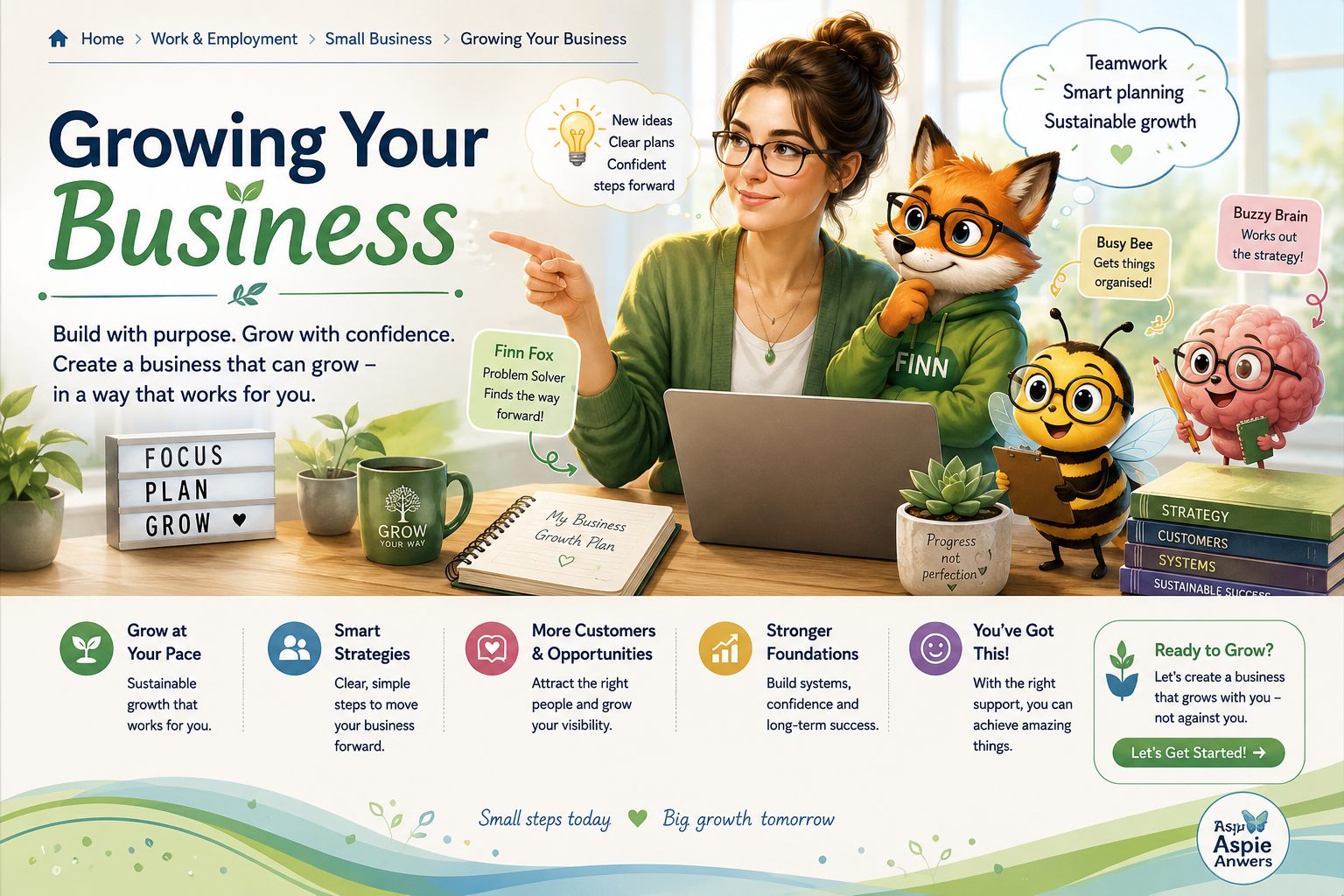
Grow Your Business in a Way That Works for You
Growing a business does not have to mean doing everything at once. Your business can grow gradually, thoughtfully and in a way that works with your strengths, energy, goals and circumstances.
Whether you are just starting to think about growth or you already have ideas about where you want your business to go, this page can help you explore your options and decide what makes sense for you.
There is no single right way to grow a small business. The goal is to build something sustainable that you can manage, enjoy and continue developing over time.
Growth Can Be Small Steps
A new customer, a better system, a new resource, a useful partnership or one new service can all be meaningful progress.
What Does Growth Mean to Me?
Growing a business does not have to mean becoming bigger, busier or more complicated. Growth can mean something different to every business owner.
Your Version of Success Matters
Before deciding how to grow, it can help to think about what you actually want your business to become.
For one person, growth might mean reaching more customers. For another, it might mean earning a more reliable income, creating more resources, reducing financial pressure, working fewer hours, or having more freedom.
More Customers
Reaching more people who genuinely need your products, services or support.
More Opportunities
Developing new services, products, partnerships or ways of working.
More Sustainable Income
Building income in a way that supports your longer-term goals rather than simply chasing more work.
More Freedom
Creating a business that gives you greater control over your time, working style or priorities.
What Would Successful Growth Look Like for Me?
There is no right or wrong answer. Think about what would make your business feel more successful or sustainable for you.
It can mean better, simpler, more sustainable or more meaningful — whatever matters most to you.
Am I Ready to Grow?
Growth can be exciting, but it is worth checking whether your business has enough time, capacity and support for the next step.
Growth Doesn't Have to Happen Immediately
You do not have to grow simply because other businesses are growing. Taking time to understand your current position can help you choose a direction that is more realistic and sustainable.
Sometimes the right next step is to grow. Sometimes it is to strengthen what you already have first.
Time & Capacity
Do I have enough time and energy to take on additional work without becoming overwhelmed?
Something I need to consider:Money & Costs
Do I understand the likely costs of growing and whether the opportunity makes financial sense for my business?
Something I need to consider:Systems & Organisation
Are my current systems organised enough to cope with additional customers, work or responsibilities?
Something I need to consider:Support
Do I know who or what could support me if the business becomes busier or more complex?
Something I need to consider:Where Am I Right Now?
I May Be Ready
I have a clear reason for growing and feel able to explore my next step.
My next step could be:I Need to Prepare First
There are areas I would like to strengthen before taking on more.
Something I could strengthen:I'm Not Sure Yet
I need more time, information or support before I decide what growth should look like.
Something I need to find out:Understanding your capacity is not holding your business back. It can help you choose growth that you can actually maintain.
Choosing the Right Growth Path
There are many ways a small business can develop. You do not have to follow someone else's idea of what growth should look like.
Start With What Makes Sense for You
Think about your goals, your customers, your capacity and the resources available to you. The best growth path is one that supports your wider purpose rather than creating unnecessary pressure.
Develop What I Already Offer
Improve an existing product or service, create a new version, or offer additional options for existing customers.
This might suit me if:Reach More Customers
Increase awareness of your business and connect with people who may benefit from what you offer.
This might suit me if:Build Partnerships
Work alongside other businesses, organisations or professionals where collaboration could create useful opportunities.
This might suit me if:Improve How I Work
Strengthen systems, technology, organisation or processes so the business can operate more effectively.
This might suit me if:Explore New Markets
Consider reaching a different audience, location or customer group when that opportunity genuinely fits.
This might suit me if:Strengthen Before Expanding
Improve the foundations of your business first rather than taking on additional work immediately.
This might suit me if:Which Direction Feels Most Useful?
You can choose one, several, or decide that you need more time before choosing.
If an opportunity would create more pressure than benefit, it is okay to pause, say no, or choose a smaller version of the idea.
Growing Your Products, Services or Offers
Growth can sometimes come from improving what you already offer rather than creating something completely new.
Look for Useful Opportunities
Before adding a new product or service, think about what your customers already need, what you enjoy providing and what your business can realistically support.
Sometimes a small improvement can create more value than launching something completely different.
Improve an Existing Offer
Make an existing product or service easier to use, more useful, more accessible or more valuable.
Add Something Related
Create an additional product, service, package or option that naturally connects with what you already provide.
Create Packages
Bring related products or services together into a clearer package or collection.
Offer Different Formats
Consider different ways people might access what you provide, such as digital, printable, physical or personalised options.
Ask Myself These Questions
Explore One Idea
Choose one possible product, service or improvement and explore it before committing to it.
Ideas can be explored, tested, adapted or put aside. Choosing carefully can help protect your time, money and energy.
Reaching More Customers
Growing your business can involve helping more of the right people discover what you offer.
Focus on the People You Want to Help
Reaching more people does not necessarily mean trying to reach everyone. It can be more useful to understand who your business is designed to help and where those people are most likely to find you.
A clear message, a welcoming presence and consistent communication can help the right people recognise that your business may be useful to them.
Your Website
Make it easy for visitors to understand what you offer, who you help and what they can do next.
One thing I could improve:Social Media
Share useful, relevant content and give people a reason to discover and remember your business.
One platform I could focus on:Recommendations
Happy customers, colleagues and professional connections may help introduce your business to people who need it.
Someone I could reconnect with:Community & Networks
Local groups, professional communities, events and relevant organisations can create useful connections.
A community I could explore:Helpful Communication
Clear emails, newsletters or updates can help people stay connected with what your business provides.
A message I could improve:Being Discoverable
Use clear words, useful information and consistent business details so people can find and understand you.
Something people should find more easily:What Happens When Someone Finds Me?
A person may discover your business in one place and then need several simple steps before deciding whether to connect, buy or ask for help.
They find my business.
They understand what I offer.
They feel comfortable exploring further.
They know what they can do next.
One Way I Can Reach the Right People
Choose one realistic action rather than trying to change everything at once.
Choose communication channels that suit your audience, your resources and your own capacity. A smaller, consistent presence can be more sustainable than trying to do everything.
Building Your Business Network & Partnerships
You do not have to build your business completely on your own. The right connections can create opportunities, support and shared learning.
The Right Connections Can Make a Difference
Networking does not have to mean attending large events, constantly talking to strangers or collecting hundreds of contacts.
For a neurodivergent business owner, networking can be adapted to a communication style and environment that feels comfortable and manageable.
Professional Connections
Connect with people working in related industries or professional areas who may share knowledge, referrals or useful opportunities.
A connection I could develop:Local & Community Networks
Local business groups, community organisations and events can provide relationships, visibility and practical support.
A local network I could explore:Collaborative Partnerships
Another business or organisation may have complementary skills, products or audiences that could create a useful collaboration.
A possible partnership:Peer Support
Other business owners can understand challenges that people outside business may not always see.
Someone I could learn from:Mentors & Advisors
A mentor, coach or trusted professional can sometimes help you look at decisions from a different perspective.
A question I could ask:Online Communities
Online groups and professional communities can provide connection when travelling or face-to-face networking is difficult.
An online community to explore:Networking Does Not Have to Look One Particular Way
You can choose the communication methods and environments that allow you to participate comfortably.
Use email, messages or online groups when they are easier than face-to-face conversations.
Write down what you want to say or ask before a meeting, event or conversation.
You do not have to attend every event or maintain every connection.
One useful relationship can be more valuable than trying to meet lots of people at once.
Is This Connection Right for Me?
A partnership should ideally be useful, respectful and clear about what each person expects.
One Connection I Could Explore
Keep this small and realistic. You can always build from one conversation.
Look for connections where communication, expectations, boundaries and benefits are respectful for everyone involved.
Managing Growth Without Becoming Overwhelmed
A growing business can bring exciting opportunities, but it can also increase decisions, tasks and responsibilities. Planning for that change can help you stay in control.
More Business Should Not Mean Losing Yourself
It can be tempting to say yes to every opportunity when your business starts gaining attention. But taking on everything at once can make it harder to maintain quality, energy and enjoyment.
Sustainable growth means paying attention to what your business needs and what you need.
Too Many Tasks
As work increases, it can become difficult to remember everything and decide what needs attention first.
Something I could simplify:Too Many Interruptions
More customers and communication can make it harder to protect focused work time.
A boundary I could create:Decision Overload
More opportunities can mean more choices. Simple systems can reduce the number of decisions you need to make.
A decision I could make once:Energy & Recovery
Your capacity can change from day to day. Building rest, recovery and flexibility into your business matters.
Something that helps me recharge:Ways to Make Growth More Manageable
Small systems can protect your attention and reduce the amount of work you have to hold in your head.
Look at how much work you can realistically manage before accepting more.
Decide what matters most rather than treating every task as urgent.
Where appropriate, reduce repetitive work through templates, systems or suitable technology.
Consider professional, practical or personal support when responsibilities become too much.
Decide what you will and will not take on before pressure builds.
Test changes in smaller steps before committing to a much larger expansion.
What Do I Need to Protect?
Think about the parts of your life and business that need protecting as your workload changes.
One Boundary I Want to Protect
A clear boundary can help you decide when an opportunity is right for you and when it is not.
A sustainable business is not measured only by how large it becomes. It can also be measured by whether it supports the life, goals and values of the person building it.
Measuring Progress & Knowing What Is Working
Growth is easier to manage when you pause regularly to look at what is changing, what is helping and what may need to be adjusted.
Progress Is More Than a Number
Income, sales and customer numbers can be useful, but they are not the only ways to understand whether your business is moving in a positive direction.
You can also look at your workload, customer feedback, confidence, systems, opportunities and whether the business is still supporting the life you want.
Financial Progress
Look at income, costs, sales and other financial information that helps you understand how the business is performing.
Something I want to track:Customer Progress
Notice changes in customers, enquiries, repeat business, feedback or the people you are reaching.
Something I want to notice:Business Systems
Check whether your systems are saving time, reducing confusion and helping the business run more smoothly.
Something I could improve:Personal Capacity
Notice your energy, workload, stress and ability to continue doing the work sustainably.
Something I need to protect:Feedback & Learning
Customer comments, questions and your own observations can help reveal what needs improving or developing.
Something I have learned:Progress Towards My Goals
Step back and ask whether the business is moving towards the goals and purpose you originally identified.
A goal I am moving towards:Keep, Change, Pause or Explore?
Not every idea needs to continue. Reviewing your progress gives you permission to adjust your direction.
Keep
Something that is working well and worth continuing.
Change
Something useful that could work better with an adjustment.
Pause
Something that may need to wait until the timing or capacity is better.
Explore
A new possibility that deserves more thought or testing.
A Simple Business Growth Check-In
You can return to these questions regularly without turning your review into another overwhelming task.
Give yourself credit for improvements that may not show up immediately in sales or numbers. Better systems, stronger relationships, greater confidence and a more sustainable workload can all be meaningful progress.
Understanding Your Customers & Market
Growing a business is easier when you understand who you are helping, what they need and what makes your offer useful to them.
Growth Starts With Understanding People
You do not need to understand every person in your market. Start by learning about the people your business is actually trying to help.
Listening carefully can help you improve your products, services, communication and the overall experience you provide.
Who Am I Helping?
Think about the people who are most likely to benefit from what you provide.
The people I most want to help:What Do They Need?
Consider the problems, goals, questions or difficulties your customers are trying to solve.
Something my customers need:What Are They Looking For?
Notice the words, questions and concerns people use when searching for help or solutions.
Something people often ask about:What Makes My Offer Useful?
Think about the difference your product or service can make for the people you want to reach.
The value I want to provide:Where Can I Learn What People Need?
Useful information can come from many places. You do not need an expensive research system to start learning.
Notice repeated questions and common concerns.
Look for useful comments, suggestions and patterns.
Notice which offers, pages or services receive interest.
Explore what similar businesses offer and how they communicate.
What Makes My Business Different?
Your difference does not have to be dramatic. It may be your approach, knowledge, accessibility, personality, quality, experience or the people you serve.
Before I Try to Grow
Start by listening, noticing patterns and staying curious. Understanding grows over time — just like your business.
Understanding Income, Costs & Profit
Understanding what comes into your business, what goes out and what remains can help you make more informed decisions about growth and sustainability.
Knowing Your Numbers Can Give You More Clarity
Money can sometimes feel complicated or uncomfortable, especially when you are focused on creating something meaningful and helping other people.
You do not need to understand every financial term at once. Start by understanding the basic flow of money through your business.
Income
Income is the money your business receives from selling products, services or other business activities.
Where my business income comes from:Costs
Costs are the expenses involved in creating, delivering and operating your business.
Costs I need to remember:Profit
Profit is what remains after eligible business expenses are taken into account. It can help you understand whether your business model is sustainable.
What I want to understand:Where Does the Money Go?
Looking at the journey of money through your business can help you spot areas that need attention.
Sales, services, products or other business income.
Expenses required to operate and deliver your offer.
The amount left after relevant expenses.
What Might My Business Need to Pay For?
Costs vary between businesses. Use these categories as prompts rather than assuming every one applies.
Software, websites, devices, hosting and digital tools.
Supplies, packaging, products or materials.
Promotion, advertising, design and related services.
Transport, postage, delivery or other relevant costs.
Accounting, legal, business or specialist services.
Other expenses involved in keeping the business going.
What Do I Need to Keep Track Of?
You can use this as a simple starting point for understanding your business finances.
Business structures, tax, expenses and financial obligations can vary depending on your circumstances. When you are unsure, an appropriately qualified professional or relevant government service can help you understand what applies to you.
You do not need to become a financial expert overnight. Start with the basics, keep learning and use good information to help you make decisions that support your business and its future.
Pricing, Value & Knowing What to Charge
Your price needs to work for your customers while also recognising the time, skills, resources and costs involved in providing what you offer.
Your Work Has Value
Pricing can feel uncomfortable, especially when you care deeply about helping people. But charging for your work does not make the work less caring or meaningful.
A sustainable price can help your business cover its costs, recognise your contribution and continue providing something valuable to the people you serve.
Your Time
Consider the time involved in preparing, creating, delivering, communicating and completing the work.
Time I need to allow for:Your Costs
Think about materials, software, equipment, subscriptions, platform fees, travel and other business expenses.
Costs I need to remember:Your Skills & Experience
Your knowledge, experience, creativity and specialist skills are part of the value you provide.
Skills I bring:Customer Value
Think about the problem you solve, the benefit you provide and why someone may choose your product or service.
The value I provide:What Is Included?
Make it clear what the customer receives so that your price and offer are easier to understand.
My offer includes:Sustainable Pricing
A price should not only attract customers. It should also help make it possible for the business to continue.
Something my price needs to support:Questions Worth Asking
These questions can help you look at your pricing from more than one angle.
Understanding One Product or Service
Use this simple exercise to think through one offer at a time.
Business pricing can involve financial, tax or legal considerations. When you need advice specific to your circumstances, consider speaking with an appropriately qualified professional.
You are allowed to recognise the value of your work, learn as you go and adjust your approach as your business develops.
Customer Experience, Feedback & Retention
Building relationships with customers is about more than making a sale. A positive experience can help people feel respected, understood and confident in choosing your business again.
Every Customer Interaction Is Part of the Experience
Customer experience can include how easy it is to find information, ask questions, make a purchase, receive a service and get help when something does not go as expected.
You do not need a perfect business. Listening, responding respectfully and being willing to improve can make a real difference.
First Impressions
Think about what a new customer sees, reads or experiences when they first discover your business.
One first impression I could improve:Clear Communication
Clear information can reduce confusion and help customers understand what you offer, what it costs and what happens next.
Something I could explain more clearly:Making Things Easier
Look for unnecessary steps, confusing instructions or barriers that could make the customer journey harder.
One thing I could make easier:Accessible & Inclusive Service
Consider whether your communication, information and service options work for people with different needs.
One accessibility improvement:Returning Customers
A good experience can encourage customers to return when they need your products or services again.
Something that could encourage return customers:Continuous Improvement
You can use customer experiences and feedback to identify small improvements over time.
Something I would like to improve:Feedback Can Help Me Understand What Customers Need
Feedback does not have to mean waiting for a formal review. Questions, comments, repeat requests and everyday conversations can all reveal useful information.
A Calm Way to Respond
Not every piece of feedback will feel comfortable. You can pause, understand what happened and decide what action is appropriate.
Give yourself time to process what you have heard.
Work out what the customer is actually telling you.
Choose whether something needs to change or be explained.
Take the useful lesson forward where appropriate.
Where Could I Make the Experience Better?
Choose one part of the customer journey and look for one realistic improvement.
A willingness to listen, communicate clearly and keep learning can help your business become better over time. Every useful improvement is another step forward.
Business Risk, Resilience & Contingency Planning
Unexpected things can happen in any business. A little preparation can make it easier to respond, recover and keep moving forward.
Planning for Problems Does Not Mean Expecting the Worst
Resilience is about knowing what matters most, recognising possible challenges and thinking about what you could do if something changes unexpectedly.
You do not need a complicated emergency plan. Even a few sensible preparations can make a difference.
Technology & Data
Consider what you would do if a device, website, account, platform or important file suddenly became unavailable.
Something I should back up or protect:Money & Cash Flow
Think about unexpected costs, changes in income or periods when money coming into the business may be lower.
Something I should prepare for:People & Suppliers
If another person, contractor, supplier or service is important to your business, consider what happens if they become unavailable.
An important relationship or dependency:Unexpected Disruption
Weather, outages, transport problems, platform changes or other events can interrupt normal business activities.
A disruption I could prepare for:Security & Access
Think about passwords, account access, important records and who needs access to business information.
Something I should secure:My Own Capacity
Your ability to work is also part of business resilience. Consider what happens if you need rest, recovery or additional support.
Support I could arrange:What Would My Business Need First?
You do not have to prepare for every possible situation. Start with the things that would have the biggest impact.
What could interrupt an important part of my business?
Which potential problem would matter most?
What simple action could reduce the impact?
Does my plan still make sense as my business changes?
If Something Goes Wrong, What Could I Do?
Choose one important part of your business and think through a simple alternative.
A Few Things Worth Checking
Depending on your situation, you may need advice about insurance, legal responsibilities, tax, finances, privacy, employment or other business requirements. Appropriate professional or official guidance can help you understand what applies to your business.
You do not need to predict everything that could happen. Start with one useful preparation, build from there and give yourself permission to review your plan as your business grows.
Scaling Your Business Carefully
Growing a business can create exciting opportunities, but growth also brings new responsibilities, decisions and demands on your time and resources.
Bigger Is Not the Only Definition of Growth
Scaling might mean serving more customers, increasing income, improving systems, offering new products or services, or making the existing business work better.
You do not have to grow faster than your capacity allows. Sustainable growth is about finding a pace that works for your business and your circumstances.
More Customers
More customers can create opportunities, but also increase communication, delivery and support demands.
If demand increased, I would need:More Products or Services
New offers can create variety and income, but they also require planning, creation, maintenance and promotion.
An offer I might develop:Better Systems
Systems, templates and appropriate technology can reduce repeated work and make growing demand easier to manage.
A system I could improve:Getting Additional Help
Growth may eventually create a reason to consider contractors, employees, professional services or other forms of support.
Something I might need help with:Increasing Capacity
Before increasing demand, consider whether your time, equipment, systems and resources can handle it.
A capacity I need to understand:Protecting Sustainability
Growth should not automatically mean sacrificing rest, wellbeing, quality or the parts of the business that matter most to you.
Something I want to protect:Is My Business Ready?
Growth can be easier to manage when the foundations are strong enough to support it.
More Opportunity Does Not Always Mean “Say Yes”
A new opportunity can be exciting while still not being the right fit for your business right now.
Will this opportunity move the business in a direction I actually want?
Can I take this on without creating an unrealistic workload?
Have I considered the time, costs and likely return?
Can I do this while protecting the things that matter to me?
If I Choose to Scale, What Needs to Happen First?
Break a larger growth idea into smaller decisions so that you can approach it one step at a time.
A successful business does not have to become enormous. It needs to work for the people it serves and for the person building it. Grow when the time is right, pause when you need to and keep building in a way that feels sustainable.
Reviewing, Improving & Evolving My Business
A business does not have to stay exactly the same. Regularly reviewing what is working can help you make thoughtful changes as your goals, customers and circumstances develop.
Improvement Does Not Mean Everything Is Wrong
Reviewing your business is an opportunity to notice what is going well, understand what could work better and decide what deserves your attention next.
Small improvements can build into meaningful progress. You do not need to change everything at once.
Keep
Identify the things that are working well and deserve to remain part of your business.
Something worth keeping:Improve
Find something that is useful but could be made clearer, easier or more effective.
Something I could improve:Stop
Some activities may no longer be useful, sustainable or aligned with where you want the business to go.
Something I could stop:Try
Consider one new idea, experiment or approach that could help you learn something useful.
Something I could try:What Is My Business Telling Me?
Use these questions to notice patterns rather than judging yourself or your business.
Try One Small Improvement
You can learn a lot without changing your entire business. Choose one manageable experiment.
Choose a Review Rhythm That Works for You
There is no single correct schedule. Choose a rhythm that is realistic for your business.
Notice small changes and immediate issues.
Look at progress, customers, finances and priorities.
Revisit your direction when your circumstances or goals change.
You can learn, adjust, try something different and change direction when needed. Progress is not always a straight line — sometimes the most useful step is simply noticing what you have learned.
My Growing Business Roadmap
Bring together the ideas from this section and turn them into a simple picture of where your business is now, where you would like it to go and what you want to work on next.
I Do Not Need to Know the Whole Journey
A roadmap is not a promise that everything will happen exactly as planned. It is a helpful way to see your direction and decide what deserves your attention.
Your roadmap can change as you learn, grow, discover new opportunities or realise that something needs to happen differently.
My Current Business Snapshot
Start with where you are rather than where you think you should be.
My Business Direction
Think about the kind of business you would like to build, not just the amount of growth you want.
What Deserves My Attention First?
Choose a small number of priorities rather than trying to work on everything at once.
My Support & Resource Map
Growth does not have to be a solo journey. Think about the people, services, tools and resources that could help you.
My Next 90 Days
You can adjust the timeframe to suit your business. The purpose is simply to turn your bigger direction into manageable steps.
What can I realistically begin?
What will become possible once my first step is done?
What can wait until the right time?
Review it when your circumstances, goals, customers or opportunities change. Changing the plan is not failure — sometimes it is simply good business planning.
You do not need to have every answer today. Start with what matters most, use the support available to you, learn as you go and allow your business to grow in a way that feels meaningful and sustainable.
Growth Summary & Reflection
Take a moment to look back at what you have explored, what you have learned and what you would like to carry forward in your business journey.
My Business Can Grow in a Way That Fits Me
Growing a business does not have to mean doing everything bigger, faster or all at once.
The most useful growth may be finding better systems, reaching the right people, building supportive relationships, improving your services or creating a business that works better for your life.
What I Discovered
What Matters Most to Me?
Choose the ideas from this section that feel most useful for your own business.
My Next Small Step
You do not need to plan the whole future today. Choose the next step that feels realistic.
I Am Building Something That Matters to Me
Every system you improve, connection you make, customer you help and lesson you learn contributes to your business journey.
Growth does not have to look the same for everyone. What matters is finding a direction that is meaningful, sustainable and right for you.
Your business can evolve as you do.