
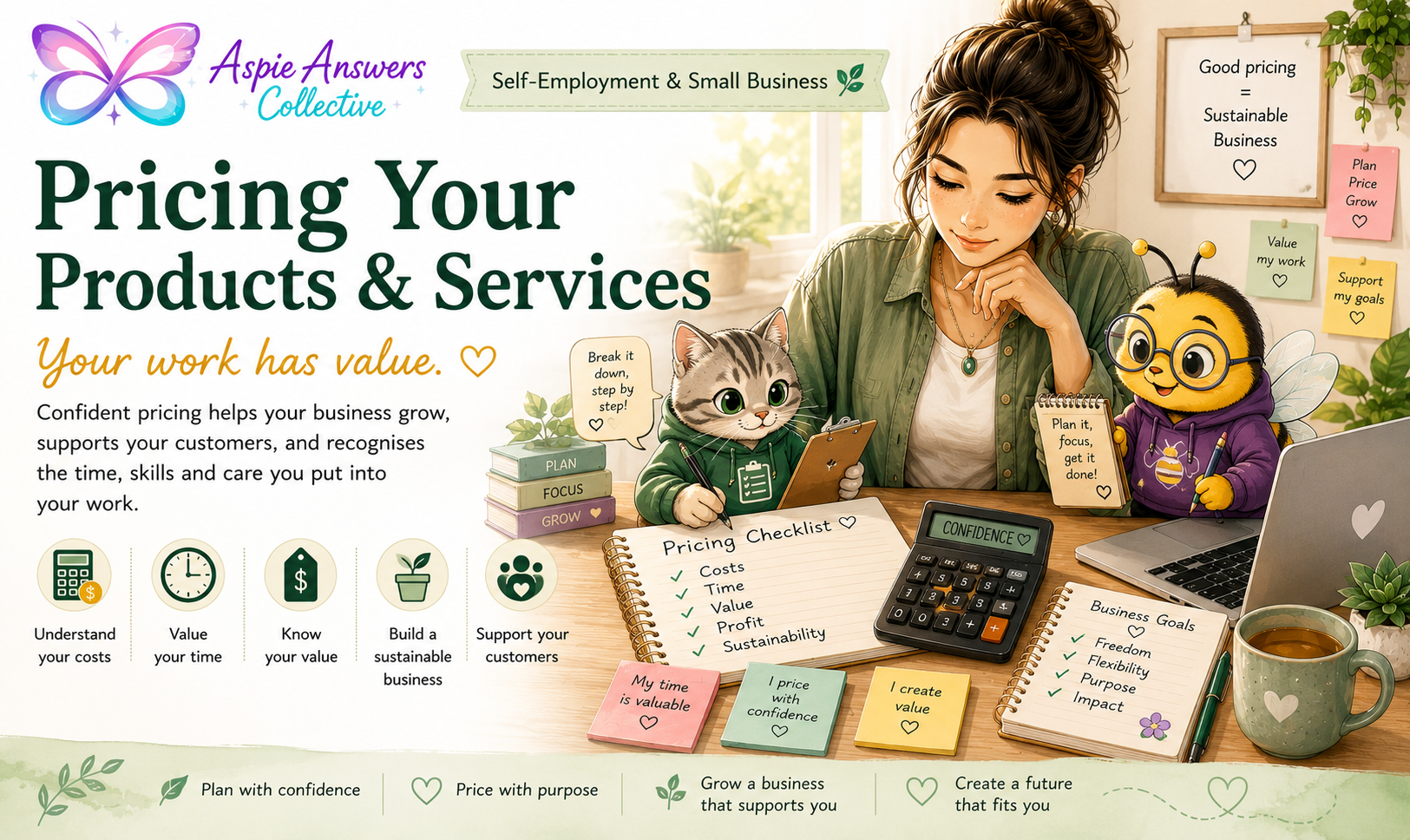
Pricing Your Products & Services
Understand your costs, recognise the value of your time and skills, and create pricing that supports both your customers and your business.
What Does a Good Price Need to Do?
Pricing is more than choosing a number. A useful price needs to recognise what goes into your work while also being realistic for the people you want to serve.
Your Price Has Several Jobs
Your price can help cover your costs, recognise your time and skills, support the way you want your business to operate and make it possible to continue offering your products or services.
You do not need to find the perfect price immediately. The aim is to understand the factors involved and make a thoughtful starting point that you can review as you learn more.
Cover Your Costs
Your price needs to take account of the money you spend on creating, preparing, delivering and running your business.
Recognise Your Time
The time you spend on your work has value. This can include preparation, communication, creating, administration, delivery and follow-up.
Recognise Your Value
Your knowledge, experience, skills, creativity, reliability and the solution you provide can all contribute to the value of your work.
Support a Sustainable Business
A price that leaves your business constantly struggling may not be sustainable. Your pricing needs to support the business and the life you are trying to build.
A Price Does Not Have to Be the Same Forever
Your costs can change. Your experience can grow. Your products or services can change. Your customers' needs can change too.
Reviewing your prices is therefore a normal part of running a business — not a sign that you got everything wrong the first time.
What Do I Want My Pricing to Help Me Achieve?
Finish one or more of these sentences:
I want my pricing to help me...
Something I want my business to be able to afford is...
You Can Break Pricing Down Step by Step
You do not have to solve everything at once. Start with one part — such as your costs or your time — and build from there.
What Does It Actually Cost Me?
Before deciding what to charge, it helps to understand what your business needs to spend. Some costs are obvious, while others are easy to forget because they happen in the background.
Your Cost Is More Than the Materials You Can See
If you sell a physical product, you might think first about the materials used to make it. If you provide a service, you might think about the time spent delivering it.
But your business may also have software, equipment, subscriptions, transaction fees, packaging, advertising, administration and other costs.
Materials & Supplies
Things you need to create, package or deliver your product or service.
- Materials
- Packaging
- Printing
- Consumable supplies
Business Running Costs
Regular costs that help your business operate behind the scenes.
- Software
- Website costs
- Subscriptions
- Equipment
Fees & Charges
Some platforms and payment services take a fee when you sell or receive money.
- Payment processing
- Marketplace fees
- Transaction charges
- Other service fees
Marketing & Promotion
Reaching the people who may want your products or services can also involve costs.
- Advertising
- Promotional materials
- Photography or design
- Marketing tools
What Costs Do I Sometimes Forget?
Small costs can add up. Think about the parts of your business that take money, even when they are not directly connected to the final product or service.
Travel or delivery costs
Phone or internet use
Administrative time and resources
Maintenance or replacement costs
Professional services or advice
Unexpected business expenses
My Business Cost Check
You do not have to know every number immediately. Start by identifying the costs you already know about.
If Numbers Feel Overwhelming
You do not need to calculate everything in your head. Write things down, use a calculator or spreadsheet, ask someone you trust to help, or work through one cost at a time.
Making the information visible can make it easier to understand.
One Cost at a Time
You don't have to organise your whole business in one sitting. Choose one category and work through it step by step.
Make a Simple List
A visible checklist can help you remember costs that are easy to overlook when there is a lot happening at once.
Once I Know My Costs, I Can Look at My Time.
Your time is part of what goes into your work too. The next step is to look at everything you do — including the work that customers may never see.
Your Time, Skills & Knowledge Have Value Too
It can be easy to focus on the physical product or the final service and forget about everything you bring to the process. Your time, knowledge, experience, creativity and problem-solving are all part of the work you provide.
The Work People See Is Only Part of the Work
A customer might see the finished product, completed appointment, delivered service or final document. They may not see the research, preparation, planning, communication, revisions and administration that happened beforehand.
Those parts still took your time and energy.
Your Time
Consider how much time is involved from the beginning of the job to the point where it is finished.
Your Skills
The abilities you have developed through work, study, experience and practice contribute to what you can offer.
Your Creativity
Ideas, design, writing, problem-solving and creative thinking can all be part of what makes your product or service useful.
The Care You Put In
Quality, reliability, communication and thoughtful customer support can also be part of the experience you provide.
How Much Work Goes Into One Product or Service?
Try thinking about one thing you sell. What happens before the customer receives it?
What do I need to organise first?
What needs to happen before I begin?
How long does the actual work take?
How much contact or follow-up is involved?
What happens before the work is finally complete?
My Time & Skills Check
Choose one product or service and think through the work involved. You can estimate at first — you can always refine the numbers later.
What am I offering?
How much time does it take?
What skills am I using?
What work happens behind the scenes?
If You Find It Hard to Recognise Your Own Skills
This is common. Sometimes skills become so familiar that we stop noticing them. You might also compare yourself with someone who has more experience or feel that something only "counts" if it feels difficult.
Try asking someone you trust: "What do you think I am good at when I do this work?"
Break the Work Into Steps
Looking at the whole process one step at a time can make it easier to see how much work is actually involved.
Don't Forget the Hidden Tasks
A simple checklist can help you remember the little tasks that happen before, during and after the main piece of work.
Something I Want to Give Myself More Credit For
Think about the work you do that you sometimes overlook.
I am proud that I can...
Now Let's Bring Costs, Time & Value Together
Understanding these pieces gives you a stronger foundation for thinking about a price that works for both you and your customers.
There Is More Than One Way to Price Your Work
Different businesses use different approaches to pricing. You do not necessarily need to choose only one method, either. The right approach can depend on what you sell, your costs, your customers, your experience and the type of business you are building.
Your Pricing Method Is a Tool — Not a Rule
A pricing method gives you a way to think through your decision. It does not automatically tell you the perfect final price.
You can use the information you gathered in the earlier sections and then consider which approach makes the most sense for your particular product or service.
Cost-Based Pricing
Start by working out what it costs you to provide the product or service and then add an amount that helps make the business sustainable.
Value-Based Pricing
Consider the value, outcome or benefit your customer receives, rather than looking only at what it costs you to produce the work.
Market-Aware Pricing
Look at similar products or services and consider what customers may already expect to pay.
Tiered or Package Pricing
Offer different levels, packages or combinations so customers can choose an option that suits their needs.
Which Approach Might Help Me Think?
Comparing Yourself With Others Can Be Helpful — But It Can Also Mislead You
A business that looks similar from the outside may have completely different costs, experience, workload, operating arrangements or target customers.
Use comparisons as information rather than automatically assuming that another business's price is the price you should charge.
Which Approach Feels Most Useful for Me?
You can choose more than one.
Why does this approach seem useful for my business?
Try One Method First
You don't need to understand every pricing model before you begin. Pick one that makes sense and work through it step by step.
Check Your Decision
Once you have a possible price, use a simple checklist to see whether you have considered your costs, time, value and customer.
I Am Beginning to Understand That Pricing...
One thing I understand better now is:
One pricing approach I want to explore is:
Now Let's Think About the Customer
A sustainable price also needs to make sense in the context of the people you want to serve. Next, we'll look at affordability, accessibility, customer expectations and communicating your price.
Affordability, Accessibility & Customer Expectations
A sustainable price needs to work for your business, but it is also helpful to understand the people you are trying to serve. Customers may have different needs, budgets, expectations and ways of making decisions.
Affordable Does Not Have to Mean Unsustainable
You may want your products or services to be accessible to as many people as possible. That is a valuable goal.
At the same time, your business needs enough income to cover its costs and continue operating. You are allowed to consider both things when making pricing decisions.
Who Am I Serving?
Think about the people your product or service is designed to support and what problem or need you are helping them with.
What Might They Be Able to Afford?
Consider the general price range that may make sense for your audience, without assuming every customer has the same budget.
Can I Make the Offer More Accessible?
Accessibility can involve more than price. Think about how people find information, communicate with you, receive the product or service and understand what they are buying.
Are Expectations Clear?
Customers are more likely to understand a price when they can clearly see what is included, what is not included and what they can expect from you.
Small Changes Can Make Your Pricing Easier to Understand
You do not need to create a complicated system. Clear information can make the customer experience easier for everyone.
Make it easy to find without unnecessary searching.
Reduce uncertainty by describing the offer clearly.
Avoid unnecessary jargon when explaining your prices.
Not every customer will want to make an immediate decision.
Different packages may help people choose what fits them.
Explain payment methods, timing and any important conditions.
You Do Not Need to Apologise for Having a Price
It can feel uncomfortable to tell someone what something costs, particularly when you care about helping people. Clear, respectful communication can make the conversation easier.
"Sorry, I know this is probably too expensive..."
Try:"The price for this service is $____ and includes..."
- What the customer receives
- How much it costs
- What payment options are available
- Any important terms or conditions
My Customer Perspective Check
Imagine that you are seeing your offer for the first time. What would help you understand it?
What am I selling?
Who is it designed to help?
What does the customer receive?
How can I make the information clearer?
You Can Care About Customers Without Forgetting Yourself
Supporting customers does not mean saying yes to everything or charging so little that your business becomes impossible to maintain.
Healthy business boundaries can help you continue providing the support, products or services that matter to you.
Keep the Information Simple
A clear process can make it easier for both you and your customers to understand what happens next.
Check What the Customer Can See
Before publishing a price, use a checklist to make sure the important information is visible and easy to understand.
One Thing I Can Do to Make My Offer More Accessible Is...
Now Let's Protect the Sustainability of Your Business
Understanding your customers matters, but so does protecting your own time, energy and boundaries. The next section looks at underpricing, discounts and the pressure to always say yes.
Avoiding Underpricing & Unsustainable Pricing
Sometimes the hardest part of pricing is not the maths. It is believing that your work is worth charging for and being comfortable saying what something costs.
Being Helpful Should Not Mean Making Your Business Unsustainable
You may genuinely want to help people. You may also worry that someone will think your price is too high or decide not to buy. Those feelings are understandable.
But repeatedly charging less than you need, giving away large amounts of unpaid work or accepting every request can make it difficult to continue.
"I Feel Guilty Charging This Much"
Caring about people does not make your work worthless. A business price can reflect the resources and effort required to provide something properly.
"Someone Else Charges Less"
Another person's price may be based on completely different costs, experience, workload, business structure or circumstances.
"I Should Give a Discount"
Discounts can sometimes be useful, but they should be an intentional business decision rather than something you feel pressured into.
"I Can Just Do This Extra Bit for Free"
Small extras can become a significant amount of unpaid time when they happen repeatedly.
Pause and Check the Numbers
A discount is not automatically bad. The important thing is understanding what it means for your actual income.
Write down the price before the discount.
Make the actual difference visible.
Check whether the offer remains workable.
Decide whether it supports an intentional business goal.
It Is Okay to Say What Is and Is Not Included
Clear boundaries can prevent misunderstandings and reduce the pressure to keep adding unpaid work.
Tell customers what they are paying for.
Explain when extra work may have an additional cost.
Avoid promising more than you can reasonably deliver.
Your time and energy are business resources too.
My Pricing Boundary Check
Complete whichever prompts are useful for your situation.
A price I need to feel comfortable with is...
Something I do not want to give away for free repeatedly is...
A discount I could realistically offer, if appropriate, is...
One business boundary I want to communicate more clearly is...
If Saying "No" Feels Difficult
You do not have to respond immediately. It can be helpful to give yourself time to check your costs, workload and boundaries before agreeing to a request.
A simple response such as "Let me check what I can offer and get back to you" can create useful thinking space.
Protect Your Energy
Your capacity is part of your planning. A price that requires you to constantly overwork may not be sustainable.
Check Before You Agree
Before accepting extra work or offering a discount, check your price, time, costs and existing commitments.
A Pricing Boundary I Want to Remember
I am allowed to...
Bring Everything Together
You have looked at your costs, time, skills, value, customers, accessibility and business boundaries. The final section brings these pieces together into a practical pricing plan you can review and adjust over time.
Bring Everything Together
You have looked at your costs, time, skills, value, customers, accessibility and business boundaries. Now you can bring those pieces together to create a pricing plan that makes sense for you.
Your First Price Does Not Have to Be Perfect
You can begin with the information you have, test your approach, learn from experience and review your pricing later.
Building a pricing system is a process. You are allowed to adjust it as your business grows.
Work Through My Price
Use this as a starting worksheet. You can complete it digitally, print it, or copy the questions into your own planning system.
What Am I Pricing?
Product, service, package or other offer:
What Are My Main Costs?
Include materials, business costs, fees and other relevant expenses.
How Much Time & Skill Does It Require?
Think about the visible work and the behind-the-scenes work.
What Value Am I Providing?
What problem, outcome, experience or benefit are you helping your customer with?
What Do I Need My Price to Achieve?
Consider sustainability, income, capacity and the kind of business you want to build.
My Starting Price
Write down the price you are considering:
My Pricing Checklist
A quick final check can help you feel more confident before putting your price in front of customers.
How Will I Know When My Pricing Needs Reviewing?
Your pricing may need another look when your costs, workload, products, services, customers or business goals change.
Something I rely on has become more expensive.
The amount of time required is different now.
My skills, knowledge or offer have developed.
My goals or the way I operate are different.
One Step at a Time
You do not have to solve every part of your business today. Choose one thing you can work on next.
Check, Review & Adjust
Your checklist is not just for getting started. It can help you review your pricing whenever your business changes.
What Have I Learned About Pricing My Work?
Write down one thing you understand better now and one action you would like to take next.
One thing I learned...
My next step...
Your Pricing Can Grow With Your Business
You do not need to have everything figured out today. Use what you have learned, make a starting decision, keep track of what happens and come back to review your pricing when you need to.
Your work has value. Your time matters. Your business deserves sustainable foundations too.
What Could Pricing Look Like in Real Life?
These examples are here to show the thinking process behind a price. They are not recommended prices or rules for your own business. Your costs, time, skills, customers and circumstances will be different.
A Handmade Product
Imagine someone creates a handmade item and wants to work out whether their current price is sustainable.
What does it cost to make?
- Materials
- Packaging
- Platform or payment fees
- Other relevant business expenses
What work is involved?
- Preparing materials
- Making the item
- Quality checking
- Packaging and customer communication
What is the customer receiving?
- A finished handmade product
- The creator's skill and experience
- Presentation and packaging
- The convenience of buying a finished item
The creator should not look only at the cost of the materials. Their time, skills, business expenses and the value of the finished product are also part of the pricing conversation.
A Freelance or Professional Service
Now imagine someone provides a service based on their knowledge, experience and specialist skills.
What does the customer see?
- The appointment or session
- The completed work
- The final result
What happens behind the scenes?
- Research
- Preparation
- Administration
- Follow-up
What expertise is being provided?
- Knowledge
- Experience
- Problem-solving
- Time saved for the customer
Charging only for the time a customer can physically see may leave out a significant amount of work. The full service needs to be considered.
Different Levels of an Offer
Imagine a business that wants to offer customers a choice between a basic option and more comprehensive options.
Basic
A clearly defined core offer containing the essential service or product.
Standard
A broader offer with additional features, support or value.
Extended
A more comprehensive option for customers who need or want additional support or features.
Packages can give customers choices, but each level still needs to be priced with its own time, costs, workload and value in mind.
When the Customer Is Paying for Expertise
Creative and knowledge-based work can sometimes feel difficult to price because the finished product may look simple.
Something taking less time because you are experienced does not automatically mean that your expertise has no value.
Look at the Whole Problem, Not Just One Number
If a price does not seem to work, don't immediately assume the answer is simply "charge less." Look at the whole picture: costs, time, workload, customer expectations, value and what your business needs.
Apply the Same Thinking to Your Own Offer
Choose one product or service and work through these four questions.
What does it cost?
How much time does it take?
What value does it provide?
Does my price support a sustainable business?
Keep Your Pricing Thinking Simple
When you are unsure, return to the basics: understand your costs, recognise your time and skills, consider the value you provide, think about your customer and check whether the result is sustainable for your business.
Questions You Might Be Asking
Pricing can bring up practical questions as well as worries and uncertainty. You do not have to have all the answers immediately. Start with the question that feels most relevant to you.
What if I have absolutely no idea what to charge?
Start with information rather than trying to guess the perfect number.
- Work out your main costs.
- Estimate how much time the work takes.
- Think about the skills and value involved.
- Research comparable offers for context.
- Choose a starting point you can review later.
What if someone says my price is too expensive?
One person's reaction does not automatically mean your price is wrong.
Before changing your price, consider whether they understood what was included, whether the offer is right for them and whether your pricing still makes sense based on your own numbers.
Should I charge the same as my competitors?
Not necessarily.
Looking at comparable businesses can provide useful context, but another business may have different costs, experience, capacity, customers, overheads or services.
Should I offer discounts?
Discounts can be useful when they have a clear purpose and your business can afford them.
You might use a limited promotion, introductory offer, bundle or another intentional pricing strategy. You do not need to discount simply because you feel pressured to do so.
Can I change my prices later?
Yes. Businesses often review pricing as their costs, experience, offers, workload and goals change.
Keeping track of why you chose a price can make future reviews easier.
What if I am just starting out?
You may have less experience and less historical information to work with, but you can still build a thoughtful starting price.
Use your known costs, estimate your time, research comparable offers and be prepared to review your pricing as you learn more.
What if customers keep asking for "just one more thing"?
First check whether the request is already included in the offer. If it is additional work, you can explain what is included and discuss the additional work separately.
What if I still feel uncomfortable charging for my work?
Give yourself permission to treat pricing as a business skill that becomes easier with practice.
You can write down your price in advance, prepare a short explanation and practise saying it without apologising.
"The price for this is $____ and it includes ______."
Go Back to the Basics
When pricing starts to feel overwhelming, return to five questions:
Feeling Overwhelmed?
Pick just one pricing question to work on. You don't have to solve the whole business at once.
Turn the Problem Into Steps
Write down what you know, identify what is missing and work through one item at a time.
Look for the Problem Behind the Problem
If a price is not working, investigate what is causing the problem before immediately changing the number.
Now Let's Look at Common Pricing Mistakes
Knowing what to do is helpful. Knowing what can go wrong can be just as useful. The next section will give you a practical warning list to use when reviewing your pricing.
Pricing Mistakes to Watch For
Everyone makes mistakes while learning how to price. The important thing is being able to notice what may not be working and make a thoughtful adjustment.
Finding a Problem Does Not Mean You Have Failed
A pricing problem is useful information. It gives you something specific to investigate rather than expecting yourself to get everything right the first time.
Charging Less Than Your Costs Require
A price may look attractive to customers but leave too little income after materials, fees, business expenses and other costs have been considered.
Only Charging for the Time the Customer Sees
Preparation, administration, communication, research, packaging, travel or follow-up may all take time even when the customer does not see that work happening.
Leaving Out the Smaller Costs
Payment fees, software, subscriptions, packaging, equipment, website costs and other smaller expenses can add up over time.
Automatically Matching Someone Else's Price
Another business may have a completely different cost structure, level of experience, capacity, audience or business model.
Discounting Whenever Someone Asks
Repeated discounts can gradually reduce your income and make your normal price difficult to sustain.
Allowing "Small Extras" to Become Regular Unpaid Work
One small request may not seem important, but repeated extras can become a significant amount of time and effort.
Keeping the Same Price Forever
Your costs, skills, experience, workload, products and business goals can all change.
Letting Guilt Decide the Price
Caring about customers is valuable, but guilt alone does not give you enough information to decide whether a price is sustainable.
Not Explaining What the Customer Is Paying For
Even a reasonable price can feel confusing when customers cannot easily understand what is included.
Setting a Price That Requires You to Constantly Overwork
A price may technically cover some costs but still be unsuitable if the amount of work required leaves you exhausted or unable to operate your business sustainably.
Which Pricing Issues Apply to Me?
Tick any areas you would like to investigate further.
Slow Down & Look at the Whole Picture
If something feels wrong, pause before changing your price impulsively. Check the information you already have.
Find One Thing to Fix First
You do not need to correct everything at once. Choose one issue, work through it and then move to the next.
Investigate Before You Change
Look for the reason behind the problem before deciding that the price itself is the only thing that needs changing.
Turn Your Pricing Knowledge Into a Quick Reference
Once you have identified possible problems, the next step is to give yourself simple tools you can return to whenever you need to review or create a price.
My Pricing Quick Reference
You do not need to reread the whole guide every time you create or review a price. Use this page as a simple reminder of the main things to consider.
A Sustainable Price Brings Several Pieces Together
Five Questions to Ask
What does this cost me?
Include the obvious and less obvious business costs.
How much time does it take?
Include preparation, administration and follow-up.
What value am I providing?
Consider the result, expertise, convenience or support.
Who am I serving?
Think about your audience, needs and expectations.
Is this sustainable for me?
Your business needs to work for you too.
Quick Pricing Check
My main costs have been considered.
My time and workload have been considered.
I know what the customer receives.
The price is clearly communicated.
I know what is included.
I know what counts as additional work.
The price is sustainable for my business.
I can explain the price without apologising for it.
Pause Before You Say Yes
A discount should be an intentional decision, not something you automatically offer because you feel uncomfortable saying no.
My Price May Need Another Look When...
Signs I May Need to Revisit My Pricing
I am consistently earning less than I need after costs.
I am doing large amounts of unpaid extra work.
I am constantly exhausted by the amount of work required.
My costs have increased but my price has not changed.
I cannot clearly explain what the customer is paying for.
You Don't Have to Solve Everything at Once
If pricing feels overwhelming, choose one question, one number or one part of your offer and work on that first.
Something I Want to Remember
Turn This Reference Into Practical Tools
The next part of this resource will move from quick reference into practical worksheets and checklists that can be used when creating, reviewing or changing your prices.
Practical Pricing Tools
Sometimes it is easier to work things out when the information is written down in front of you. These tools can help you organise your thoughts, check your numbers and review your pricing.
Choose the Tool That Matches What You Need
You do not have to complete every worksheet. Start with the one that answers the question you are working on right now.
Cost Breakdown Worksheet
List the costs connected with your product or service so you can see what your price needs to account for.
- Materials and supplies
- Business expenses
- Fees
- Other relevant costs
Time & Workload Worksheet
Map out the visible and behind-the-scenes work involved in providing your product or service.
- Preparation
- Main work
- Administration
- Follow-up
Value & Offer Worksheet
Explore what the customer receives and what makes your offer useful, valuable or different.
- Customer need
- Benefits
- Skills and expertise
- What is included
My Pricing Planner
Bring your costs, time, value and business needs together to develop a starting price.
- My offer
- My costs
- My time
- My starting price
Discount Decision Checklist
Pause before offering a discount and check whether it makes sense for your business.
- Normal price
- Discounted price
- Reason for discount
- Impact on income
Pricing Review Checklist
Use this when your business changes or when you want to check whether an existing price still works.
- Costs changed?
- Workload changed?
- Offer changed?
- Business goals changed?
Explaining My Price
Prepare simple wording that helps you communicate your price clearly and confidently.
- What is included
- Price
- Payment information
- Additional work
My Pricing Health Check
Step back and look at your pricing as a whole rather than focusing on one number.
- Costs
- Time
- Value
- Sustainability
Try This Simple Order
Understand what the offer costs.
Understand the work involved.
Understand what you provide.
Bring it together.
Plan One Step at a Time
If the toolkit feels like a lot, choose one worksheet and work through that first.
Check It Off as You Go
Use the checklists to keep track of what you have considered and what still needs attention.
Investigate the Tricky Parts
When something does not add up, use the worksheets to investigate the problem rather than guessing.
More Pricing Resources Can Live in the Resources & Downloads Hub
The page does not need to contain every downloadable file itself. These tools can later connect to the appropriate Resources & Downloads, Collections and topic-based resource areas so visitors can find the right version without the page becoming overcrowded.
Make Pricing Accessible to Different Needs
The next part looks at ways to make pricing information and the decision-making process more accessible and neurodivergent-friendly.
Making Pricing Easier to Understand
Good pricing information should not make people work harder than necessary to understand what they are buying, what it costs and what they can expect.
Clear Pricing Helps More People Make Informed Choices
Accessibility does not mean that every customer needs exactly the same thing. It means thinking about whether your information is understandable, predictable and usable for the people you are trying to serve.
Helpful Pricing Practices
Show the Price Clearly
Avoid making people search through several screens or paragraphs just to discover the basic price.
Explain What Is Included
Tell people what they are actually receiving so they do not have to guess what the price covers.
Explain Additional Costs
Where additional charges may apply, make that information clear before someone commits to buying.
Make the Next Step Obvious
Tell people what happens next, such as how to purchase, book, enquire or request more information.
Reduce Unnecessary Uncertainty
Some people find unexpected costs, vague wording or unclear processes particularly difficult. Clear information can reduce some of that uncertainty.
Say exactly what the price refers to wherever possible.
Make important additional charges or conditions visible before purchase.
Avoid unnecessary jargon when a simpler explanation will work.
Try to keep prices and descriptions consistent across your website, shop and other customer-facing platforms.
Where appropriate, avoid creating unnecessary pressure around purchasing decisions.
Let customers know how they can ask for clarification if they are unsure about something.
"Packages from $50"
The customer may still wonder what package they need, what is included and whether extra charges apply.
"Basic Package — $50"
"Includes A, B and C. Additional work is quoted separately. Contact us if you are unsure which package is right for you."
The point is not that one wording is always correct. The goal is to give customers enough useful information to make an informed choice.
Is My Pricing Information Easy to Understand?
Clarity Can Help Everyone
Clear pricing can reduce repeated questions, prevent avoidable misunderstandings and help customers decide whether an offer is right for them.
Keep It Organised
Consistent pricing information can make your customer journey easier to manage too.
Check the Details
A simple checklist can help you remember the important information before publishing a price.
Spot the Confusing Parts
Look at your pricing from the customer's point of view and ask where someone might get stuck.
Connect the Page to the Wider Resource Library
The next stage is to make sure visitors can find the relevant resources, downloads and related collections without making this page unnecessarily crowded.
Pricing Resources & Practical Downloads
This page introduces the pricing journey. The wider Aspie Answers resource library can provide printable worksheets, checklists, planners, collections and other practical tools to help you keep working on it.
Find the Format That Works Best for You
Some people prefer reading a guide. Others prefer a checklist, worksheet, planner or collection they can return to. The wider resource system allows these different formats to work together.
What You May Find
Step-by-Step Learning
Longer resources that explain a topic in more depth and help readers work through a subject at their own pace.
Think It Through
Practical pages for recording costs, time, ideas, decisions, questions and reflections.
Check Before You Decide
Short practical lists that help you remember important pricing steps without having to read the whole guide again.
Plan Your Next Move
Structured pages that help turn pricing decisions into an organised plan.
Related Resources Together
Groups of resources organised around a common need, topic or stage of a person's journey.
Several Tools in One Place
Larger practical resource packs that bring complementary worksheets, checklists and planning tools together.
Where Should Pricing Resources Belong?
Pricing resources can be connected to the most appropriate topic area rather than being duplicated across every page.
Learning Content Can Have Its Own Home Too
Longer educational guides and teaching material do not need to be mixed together with every downloadable worksheet. Where appropriate, learning resources can connect through the Learning & Education structure while practical files remain available through the Resources & Downloads system.
Some Resources May Later Have Additional Versions
A practical resource can eventually have different editions or formats where appropriate. For example, a free website version may connect to a more comprehensive printable collection, toolkit or paid resource elsewhere.
That does not mean every resource needs to become a product. The priority is usefulness first.
A Simple Way to Choose
Find the Right Tool
You don't need every resource. Choose the one that helps with the next step you are actually trying to complete.
Keep Track
Use checklists to keep your resource journey manageable and organised.
Choose What Solves the Problem
Start with the resource that addresses the problem you are trying to solve right now.
One Resource Can Be Connected From More Than One Place
A pricing worksheet does not necessarily need a duplicate copy in every hub. The website can guide people to the same appropriate resource from relevant pages, while keeping the underlying resource library organised.
This helps prevent the website from becoming cluttered with duplicate pages and makes future maintenance easier.
Connect This Page With Related Business & Work Topics
Pricing is only one part of running a business. The next layer will help visitors discover the other relevant pages in this hub without losing their place in the pricing journey.
Where Can I Go Next?
Pricing is only one part of building and managing a sustainable business. If you are working through your pricing, you may also find these related areas helpful.
Choose the Next Topic That Matches What You Need
You can return to this pricing page whenever you need it. There is no requirement to follow every topic in a particular order.
Planning & Organising Your Business
Work through your goals, priorities, tasks and next steps so your business has a clearer direction.
Managing Your Time at Work
Explore ways to organise your workload, priorities and available time without relying on unrealistic productivity expectations.
Setting Business Goals
Break larger ideas into manageable goals and practical steps that you can work towards.
Marketing & Promoting Your Business
Think about how you communicate your products or services and help potential customers understand what you offer.
Customer Communication
Explore clearer ways to communicate with customers, explain your services and manage expectations.
Building Sustainable Work Practices
Look at routines, boundaries, organisation and practical strategies that can support more sustainable working.
What Are You Working On Right Now?
Pick Your Next Step
You do not need to work on every business area at the same time. Choose the one that matters most right now.
Keep Your Focus
Pick one topic, identify the next action and keep the rest for later.
Find the Right Path
Think about the problem you are trying to solve, then choose the resource that best matches it.
Need Something Different?
Return to the Work & Employment area to explore the wider collection of support, guides, practical resources and related topics.
Take a Moment to Review What You Have Learned
Before finishing this page, pause and think about what stood out to you, what you may want to change and what your next small step could be.
What I Can Take Away From This
Pricing does not have to be something you get perfect immediately. It can be something you learn, review and improve as your business grows.
Know Your Costs
Understand what your product or service costs you to provide, including costs that may be easy to overlook.
Remember Your Time
The work behind an offer matters too. Preparation, administration, communication and follow-up can all take time.
Think About Value
Consider what you are providing, the skills involved and the benefit your customer receives.
Make Pricing Clear
Customers should be able to understand what they are paying for, what is included and what happens next.
Check Sustainability
A price needs to work for your business as well as your customers. Your time, energy and capacity matter.
Review When Things Change
Costs, skills, offers, workload and business goals can change. Your pricing can be reviewed too.
Your Price Is a Business Decision — Not a Measure of Your Worth
Pricing can bring up uncertainty, comparison or self-doubt. Try to separate the number you choose from your personal value. Your price is a decision based on your offer, costs, time, goals, customers and circumstances.
If You Remember Only Five Things
Plan It
Take the information you have gathered and turn it into one manageable next step.
Check It
Use your checklist or worksheet to make sure you have considered the important details.
Review It
If something does not make sense, investigate it before deciding that you have to change everything.
Now Make It Personal
Take a moment to think about what you learned, what you want to review and what small step you would like to take next.
My Pricing Reflection
You do not need to solve everything today. Use these prompts to identify what you understand, what you want to review and what you would like to do next.
Reflection Is About Noticing, Not Judging
Your answers can change as your business changes. The purpose of this reflection is simply to help you notice where you are now.
What Stood Out to Me?
Write down something useful, surprising or important that you want to remember.
Is There Anything I Need to Look At Again?
This could be a cost, a price, your workload, an offer, a discount or anything else that does not feel clear yet.
Is There One Thing I Would Like to Improve?
Choose one thing rather than trying to change everything at once.
What Will I Do Next?
Keep it small enough that you can realistically begin.
My Confidence Check
There is no right answer. Just notice how you feel after working through this page.
One Small Step Still Counts
You do not need to have your entire business figured out before you can make progress. Choose one thing you can understand, check or improve today.
You Have Done the Thinking — Now Take What You Need
Keep your notes, use the practical tools when you need them and come back to this page whenever your business or pricing changes.
You Don't Have to Get Everything Right at Once
Building a business is a learning process. Your pricing can change, your confidence can grow and your understanding can develop over time.
Progress Is Still Progress
You might not have every answer yet. That is okay. You have already taken an important step by stopping to think about how your pricing works.
Keep learning, keep checking your numbers and give yourself permission to review things when your circumstances change.
Start Small
You do not have to review every product or service today. Start with one.
Review Over Time
A price that made sense before may need to change when your costs, workload or goals change.
Be Kind to Yourself
Learning business skills takes time. Asking questions is a strength, not a failure.
“I can learn how pricing works, make informed decisions and adjust my approach as I grow.”A gentle reminder from Aspie Answers
You Don't Have to Figure It Out Alone
What Is One Thing You Can Do Next?
It can be tiny. Checking one cost, reviewing one price, writing down one question or choosing one resource all count.
When You're Ready, Continue Your Journey
You can return to this page whenever you need a refresher, explore another related topic or head back to the wider Work & Employment hub.
Well Done for Taking the Time to Work Through This
Whether you are just beginning to think about your prices or are reviewing an established business, taking time to understand your decisions is valuable.
You Can Come Back Whenever You Need To
Your pricing does not have to be decided forever. As your business, customers, costs, skills, workload and goals change, you can review your approach and make new decisions.
Keep the notes and resources that are useful to you, and return whenever you need another look.
Choose What Makes Sense for You
Review My Pricing
Go back through the information and check one product or service at a time.
Find a Practical Tool
Explore the relevant worksheets, checklists, planners, collections and other resources.
Explore a Related Topic
Continue into another Work & Employment topic that matches what you are working on.
Return to the Hub
Return to the wider Work & Employment area when you are ready to explore something else.
Your Business Does Not Have to Look Like Everyone Else's
Find approaches that are practical, sustainable and understandable for you and the people you serve.
“One Step at a Time.”
You don't have to do everything today. Pick your next useful step, then give yourself permission to pause.
Thank You for Spending This Time With Us
Keep learning. Keep asking questions. Keep building in a way that works for you.
Aspie Answers